Are you interested in applying for our CBTT program, when applications open?
Maybe you are aware of the buzz about teaching husbandry behaviours to animals and want to explore even more…?
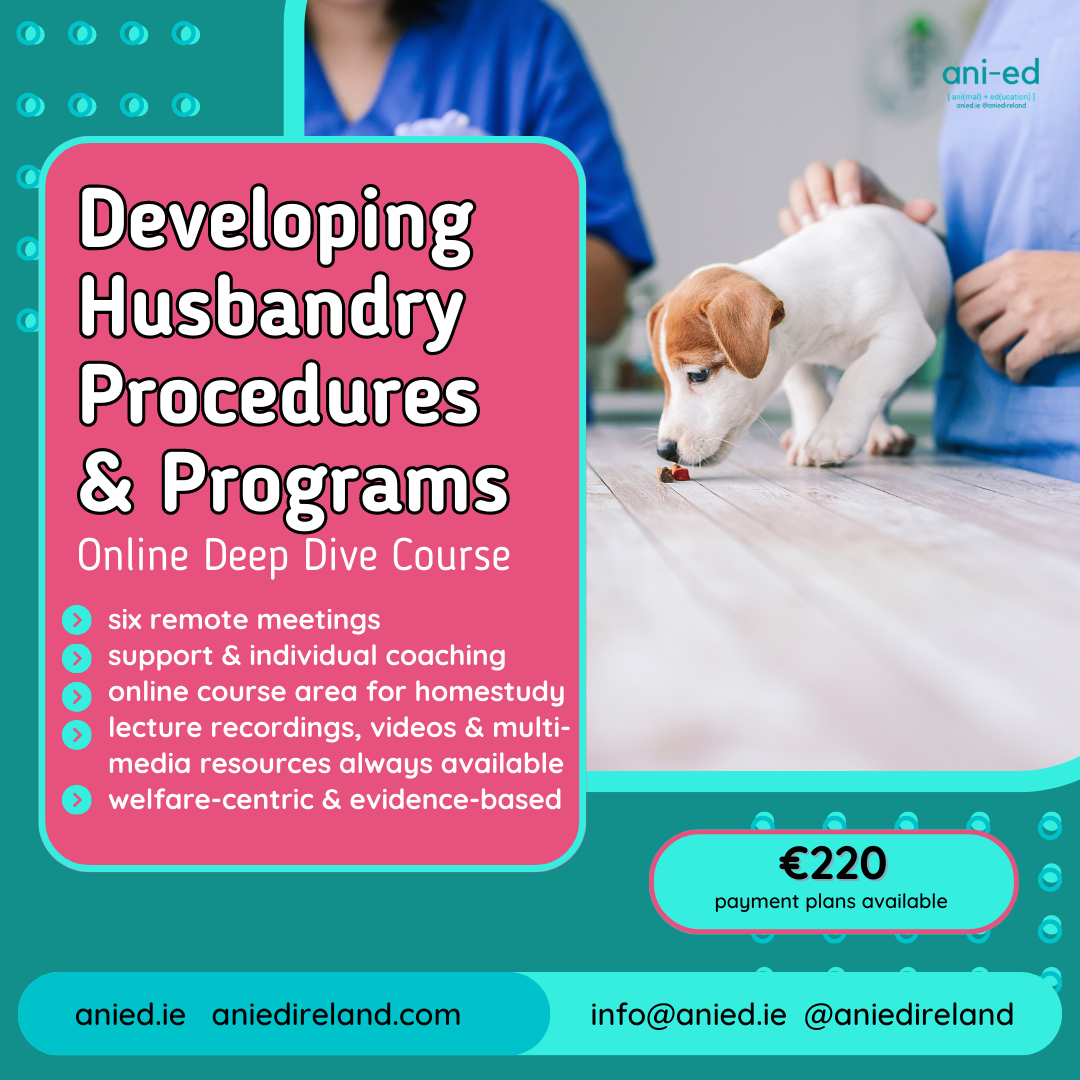
We are bringing this course forward, for one, because it’s an awesome and important course, but also, for those wishing to continue with our CBTT program. This course is the perfect starter to get a taste for working with us and for immersing yourself in evidence based education.
Jump to:
- course overview & ethos
- course outcomes
- what do I get when I take this course?
- when is this course?
- where is this course?
- who is this course for?
- how long is this course?
- how much is this course?
- what will I learn about?
- what do I need to participate?
- APPLY!
Teaching husbandry behaviours to captive animals was very much inspired by Project Pigeon, a US government sponsored program teaching pigeons to guide bombs. This took Skinner’s operant shaping outside the lab and to another species. About a decade later, during the 1950’s some of his colleagues, the Brelands, began working with marine mammals in parks.
The rest, as they say, is history but it took us quite a while to bring these principles from captive wild collections like zoos into the companion animal veterinary context.
The ever broadening popularity of programs such as iCatCare Cat Friendly and Fear Free continues to spread awareness, building on increasing interest in the welfare of our companion animals during husbandry procedures that’s been developing in the industry for last two or three decades.
Understanding this history is important as the evolution of this area has really accelerated. And that means we must scrutinise and carefully critically evaluate the approaches we take to avoid fads and social media hype.
Concepts such as “choice” and “cooerpative care” sound like something we want to add…but what does this really mean for our animal learners? Often times, when we use food and attempt to reduce force (from our point of view), we believe we are applying these concepts under a positive reinforcement umbrella. But, just because we want to provide choices and just because we use food doesn’t mean the animal’s experience is choice filled and cooperative.
How can we know if we are really doing what we intend?
Can our dogs really be ‘cooperative’ or give ‘consent’?
We will investigate this intensively during this course.

This thorough understanding allows us to develop husbandry interventions and programs…but we also must be able to apply this understanding.
And that’s why excellent mechanical teaching skills are emphasised too. If you are teaching cleanly and from a welfare-perspective, fuzzy concepts like “consent”, “choice” and “cooperative” care, are not required.
On this course, you also have free access to our Foundation Mechanical Skills program so that you are sure to have the support to apply your programs so that you learner is supported and learns efficiently. Teaching mechanics are a welfare issue!
What do I get when I take this course?
- 24/7 access to the course online area, from anywhere, for six months (& beyond)
- six remote course group meetings during which we will go through course content and set up you up for ongoing homestudy and teaching practice
- regular individual remote coaching sessions, as needed, and distributed throughout course delivery
- multi-media learning resources for viewing and downloading
- about 20 mini-lectures (in the form of written presentations supported by videos, images, exercises & multi-media resources) covering husbandry program development and related evidence presented in small-ish bites so that you can take time to process and analyse
- free access to our Foundation Mechanical Skills program which is packed full of practical information & demonstrations to help you apply clean & welfare-centric teaching
- comment facility at the online course area for participation, enquiries, interactions
- ongoing online interaction with fellow-students and your tutor as we take this journey of discovery together
Submission of final assessment work is optional but you are encouraged to work through assessment and self-evaluation to support knowledge development and skill building.
Obviously, to get the full benefit, we encourage the fullest possible participation.
After successfully submitting completed final assessment work, you will be awarded an AniEd certificate of achievement.
When is this course?
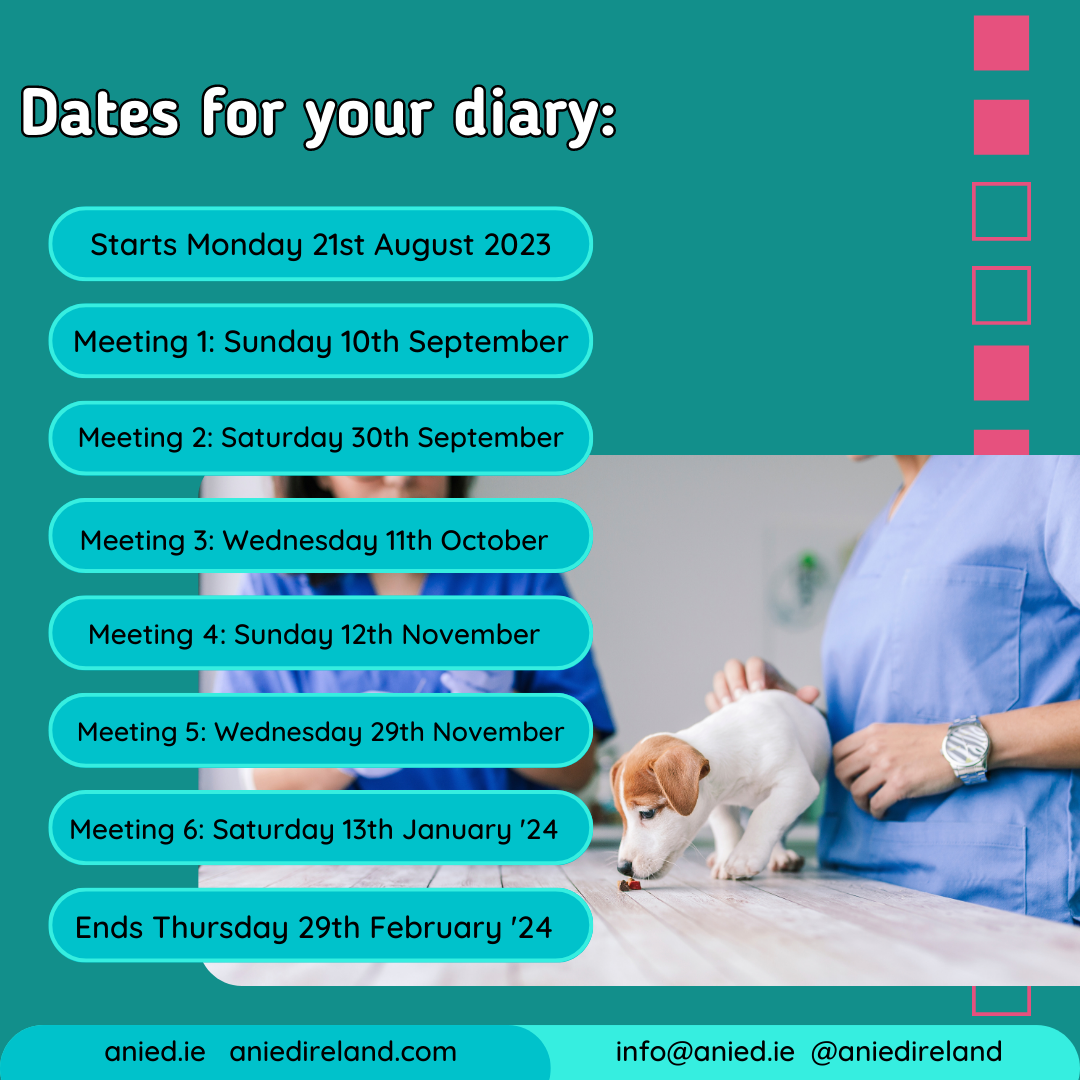
This Deep Dive course opens on Monday 21st August and as soon as you have completed enrolment on or after this date, you will be sent the first of your course content so that you can begin!
Our first remote meeting is on Sunday 10th September and you much have completed enrolment by this date to join this run.
Where?
Anywhere, any time! This course is entirely online so you can participate when and where you like….from your sofa…in your PJs…
You will have access to all the course materials to download to your device so you can work even without an internet connection.
Who?
This course is for all trainers, teachers, behaviour pros, hobbyists and pet guardians with a keen interest in teaching our animal learners in the most welfare centric way, and in examining our applications of positive reinforcement based interventions.
To get maximum benefit, you should have a basic understanding of applying operant teaching, using markers (like clickers) and delivering reinforcement.
It’s particularly suited to dog care pros such as veterinary personnel, training/behaviour pros and groomers.
All are welcome, no matter how you teach or train. This course emphasises a reinforcement based approach to teaching and teaching approaches that maximises the learners’ control. As teachers, we are responsible for setting up our learners for success so application of punishers and aversives is minimised.
How long?
This course consists of six remote meetings which act as cornerstones to guide your ongoing learning across six months.
However, we don’t put pressure on learners about deadlines so this is individual and can be discussed with each learner.
More about Studying with AniEd here.
How much?
This course costs €220.
You can pay the entire fee or discuss an agreed upon payment plan with us. (Simply ask by emailing info@anied.ie)
Course fees must be paid in full before you can access the online area. Please read the terms at application carefully before committing as there are no refunds, full or partial, for any reason, after you have been given access to course materials.
What will I learn about?
There are six parts to this course, each part examined during each remote meeting.
Part 1:
- examining fuzzy concepts
- giving the animal “control”
- principles of husbandry teaching
- history & evidence
Part 2:
- understanding the veterinary experience for all stakeholders
Part 3:
- Level 1 Husbandry Interventions & Programs
- Setting the Scene
Part 4:
- Level 2 Husbandry Interventions & Programs
- Teaching coping/management skills
Part 5:
- Level 3 Husbandry Interventions & Programs
- Husbandry at Home
Part 6:
- Level 4 Husbandry Interventions & Programs
- Teaching husbandry behaviours
Anne Rogers will be your tutor on this course. Here she works with her beloved Decker on some ear husbandry:
More about this procedure here.
What do I need to participate?
- Email address/account, a suitable device and internet access; course materials are presented in MS Word, PDF and links for downloading. You should not have difficulty on most devices and OS.
- Stationary for note-taking (if that’s the way you work).
- You need to be able to use the internet, blogs, social media, and if you wish to participate to the fullest, be able to record and upload short demonstration clips, complete assessment work in Word documents, PDFs and other basic computer skills.
- To complete some assessment work, and get the most out of most of our courses, you will need access to at least one dog or animal learner.
While most discussion is dog-focused, all animal learners may participate. - Means to video yourself and upload your clips for guidance and feedback and to submit assessment work. You will be required to upload video assessment work, according to assessment guidelines, to a video sharing site, such as YouTube.
- Access to MS Teams (we will send you a link, you don’t even need an account, just an email address), and a device that allows you to participate in online video meetings for group meetings and private coaching sessions.
- You will need general training/handling equipment, markers, reinforcers, husbandry tools such as brushes or grooming equipment appropriate to your chosen procedures & programs. It is recommended that you purchase toy or mock veterinary equipment, such as children’s doctor or vet kits that include toy stethoscope and so on.
Having access to a safe table or elevated surface on which to work with your learner, such as a grooming table or sofa, for example, is helpful too.
APPLY!
Are you up for this challenging and rewarding course? Join us today!
Apply here by completing this form and enrolment requirements.
If you would like to discuss this course further, discuss payment plans or discuss entry requirements, please get in touch by emailing info@anied.ie
 AniEd Ireland