
In not a lot of time, the lives of dogs have changed dramatically. As have our lives. Dogs’ and humans’ lives are intertwined so when we become more sedentary and less outdoorsy so too do our dogs.
Because we often choose dogs based on aesthetics (Weiss, et al., 2012), mythic notions of what breeds might be (Ozcan, et al., 2019) (Chyan 2018), or worse, on (social) media appeal (Redlaml, et al., 2013) (Herzog 2006) (Sandoe, et al., 2017), we are often not prepared to meet the behavioural needs to dogs, made for jobs, in our suburban or urban busy but sedentary lifestyles.

Never fear! The pet-product industry has us covered!
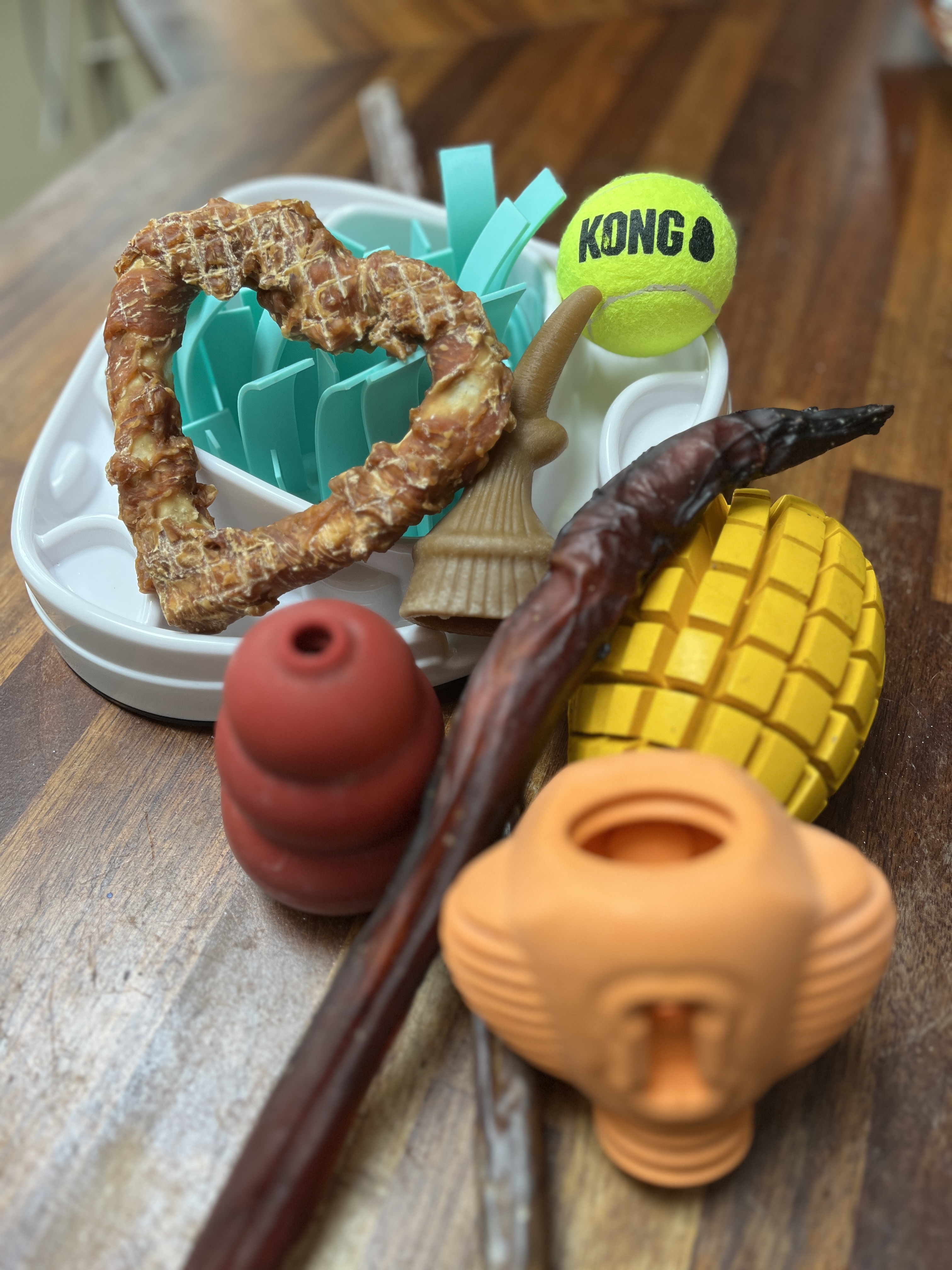
To make up those deficits, so-called “enrichment toys” of every weird and wonderful shape, colour and design have been marketed.
I’m being cynical, of course, but only just. I love food toys, I have so many (I have a serious dog toy buying problem) and I give them to my dog every day.
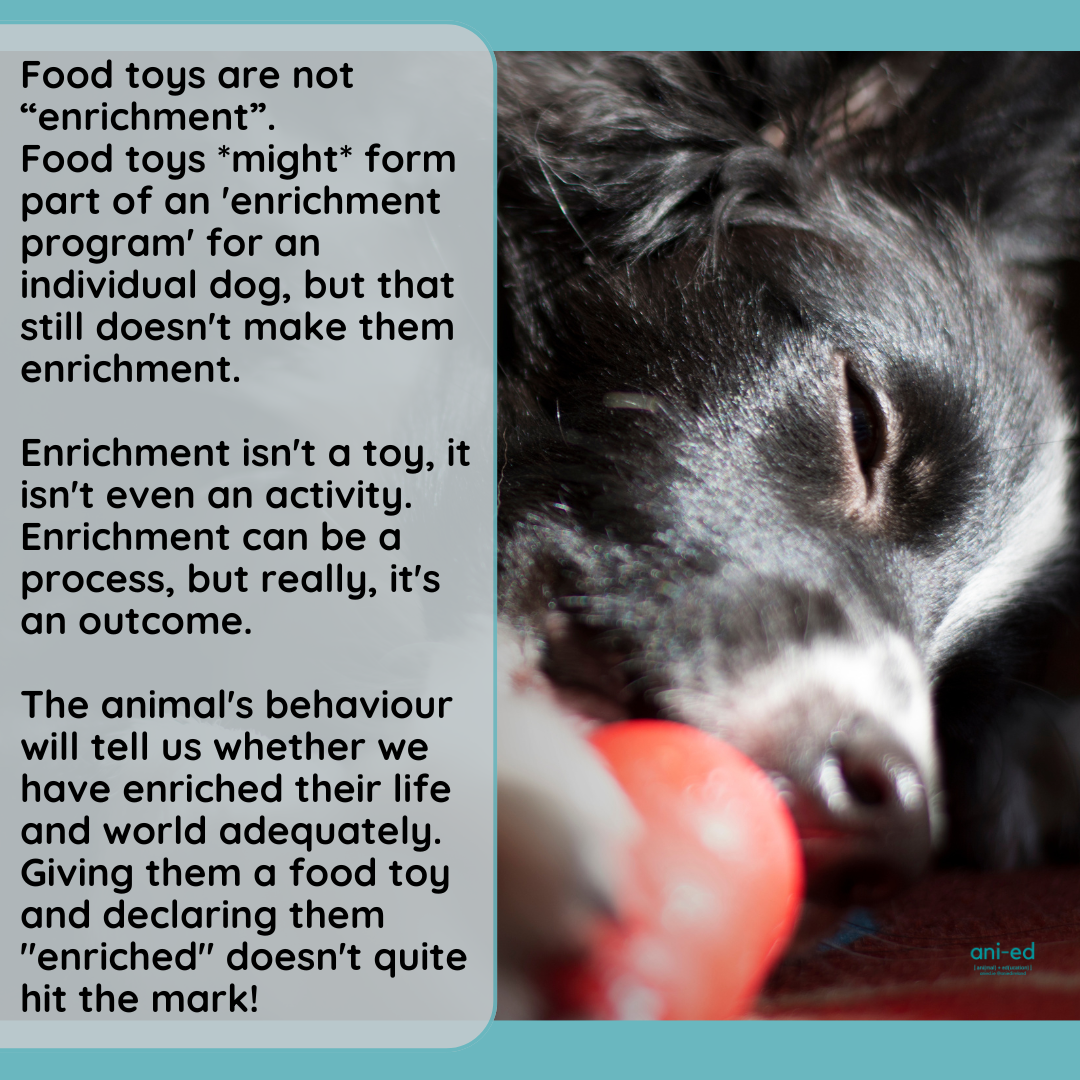
BUT! Food toys are not “enrichment”.
Food toys *might* form part of an ‘enrichment program’ for an individual dog, but that still doesn’t make them enrichment.
(This is another long one, over 2000 words, so take 10-15 minutes to digest it all… The social media images throughout this piece provide the summary.)
Enrichment must be enriching!
Enrichment isn’t a toy, it isn’t even an activity. Enrichment can be a process, but really, it’s an outcome.
While ‘enrichment’ is defined in different ways, it can be considered additions or modifications made to an animal’s environment that lead to measurable improvements in behavioural/physiological welfare (Fernandez 2022).
The important bit here is the measurable improvements bit. The animal’s behaviour will tell us whether we have enriched their life and world adequately.
Giving them a food toy and declaring them “enriched” doesn’t quite hit the mark!
Ask the dogs!
While research on enriching the lives and worlds of captive live animals in zoos and collections is relatively common, research in dogs is far more sparse.
Zoos are really where enrichment originally started, after all.
(See the wonderful works of Hal Markowitz.)
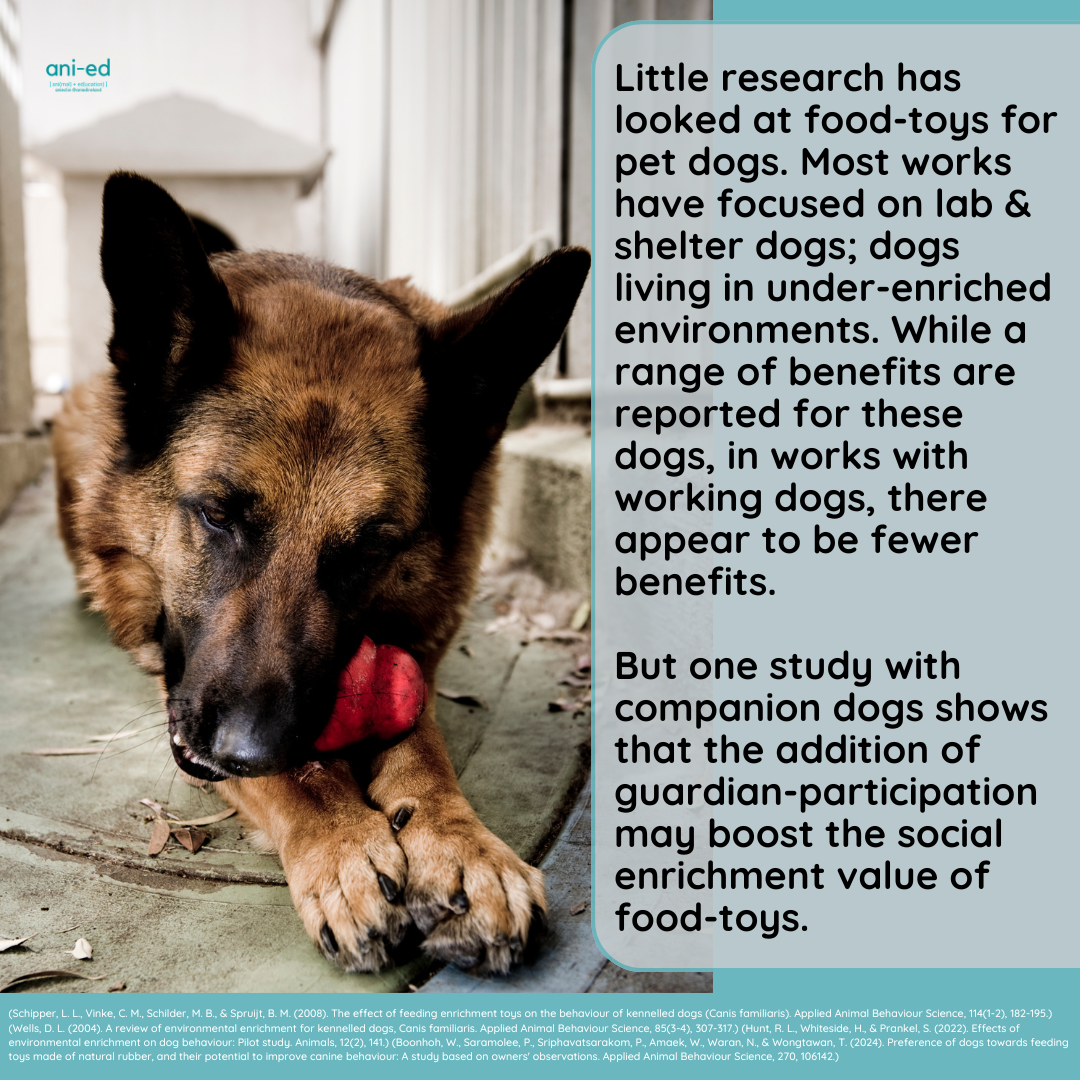
Most works looking at the addition of food toys have focused on lab dogs (Schipper, et al., 2008) and shelter dogs (Herron, et al., 2014) (Sampalo, et al., 2019) (Wells 2004). Dogs who, sadly, are living in pretty under-enriched environments and who might greatly benefit from the addition of the most basic elements to add some novelty to their days.
Many of these works report increased activity, increased rest, and improved kennel presentation (e.g., less barking, sitting or lying, less jumping etc.) (Perry, et al., 2020), with food-toys being the most commonly implemented intervention (Miller & Zawistowski 2012).

Hunt, et al., 2022, conducted a pilot study looking at enrichment for a small population of guide-dogs-in-training in an office environment. This might be somewhat comparable to companion dogs in homes…maybe?
They measured specific behavioural outcomes after the dogs had engaged in different enrichment activities and found that different enrichment activities had different effects on the individuals’ behaviour.
Food toys were found to be the least impactful on the dogs’ behaviour scores. Dogs were observed for 15 minutes before and after each enrichment intervention, with increases in relaxation behaviours and decreases in alert and stress behaviours noted.
However, the food toys were removed once the food was finished to prevent chewing the toy. Might this have limited the benefits of food toys?
The food toys were also the only intervention given in the dogs’ pens rather than in a specific room associated with all sorts of other fun.
There are also some methodological issues largely excused due to this being a pilot.
Gaines, et al., 2008, also found that the addition of food toys didn’t really impact the behaviours of military dogs in training.
Perhaps dogs who are already engaged in pretty exciting activities, who have ready contact with humans or other dogs and lots of exercise, don’t show extra benefits to the addition of food toys.
What about regular companion dogs?
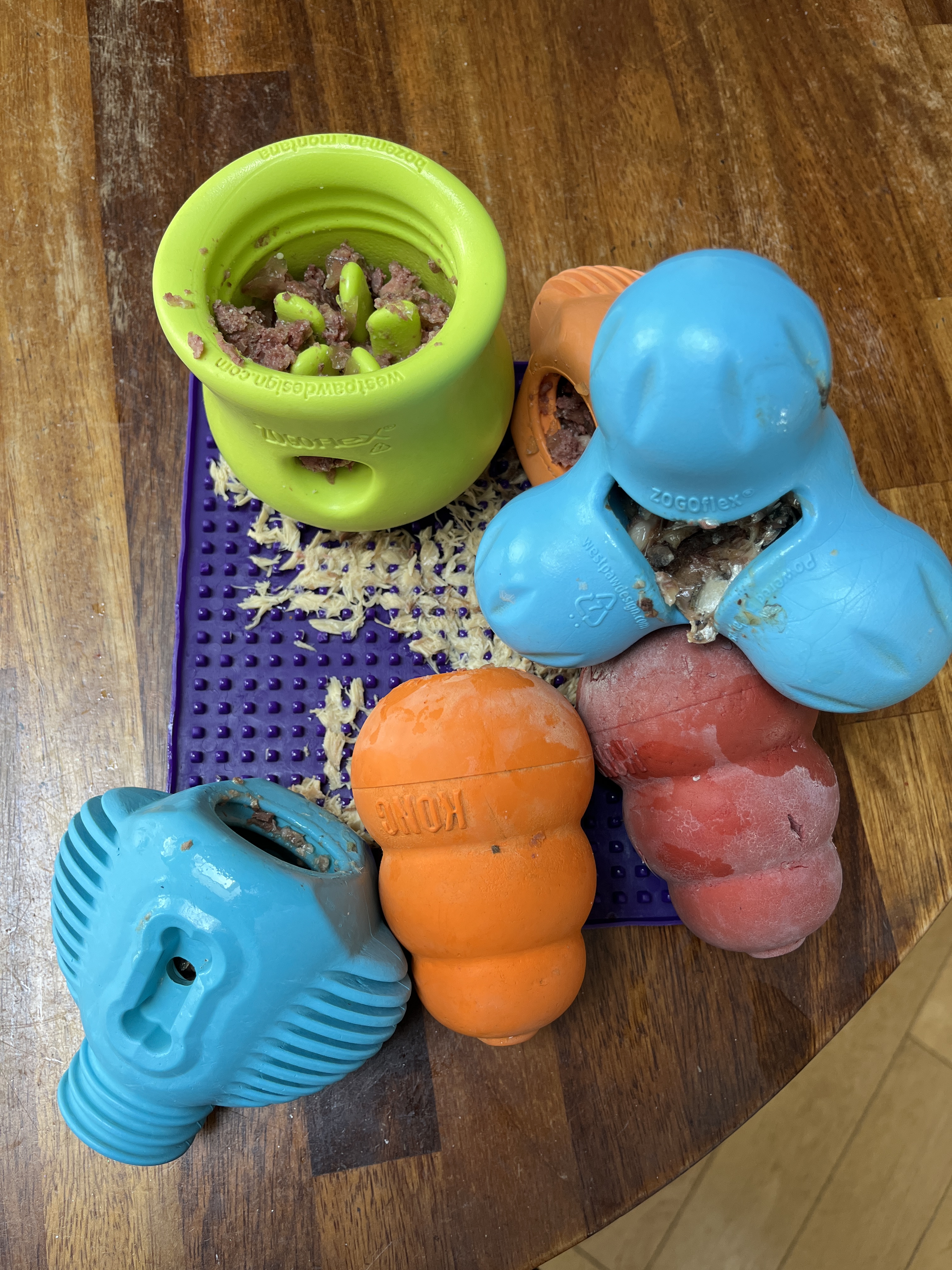
Boonhoh, et al., 2024, developed a couple of food-toys to give to dogs and had participating guardians complete the Thai-version of C-BARQ before providing the toys and after a month’s use of the toys. While they report that there were improvements in the dogs’ behaviour, particularly in excitability-reduction, there are some problems with this study.
About a third of participants didn’t complete the work and this is level of drop-outs is associated with increased risk of bias (and possibly an indication of lack of effectiveness or poor applicability) and there were no control conditions explored. Guardians taking part in research to see how a toy might support behavioural improvements may have a bias toward seeing and recording improvements observed.
When the dogs were given the toys, guardians stayed with them, and that teamwork might enhance benefits associated with toy use providing social enrichment elements.
No one study is perfect, or confirmation of anything, but there are some interesting bits here. There is some analysis of the sorts of the behaviours the dogs engaged in with the toys and this is a great start in exploring the applications of different and combine interventions with companions.
The colour and scent of toys may also impact dogs’ preferences with some suggestions that blue or yellow toys are preferred (not clear between existing works) and vanilla scented over beef scented is a winner too.
Maybe food toys do provide enrichment for companion dogs, but perhaps lots of extra attention and interaction with their humans, during foraging activities, is the key to enriching their world.
What is enriching about enrichment?
Wells 2004, discusses the differences between animate and inanimate enrichment. Animate enrichment involves provision for social contact, while inanimate interventions involve environmental adjustments and additions, including food toys.
Social contact, communications and interactions likely provide the most benefits, enriching the lives and worlds of social animals like dogs. While dogs living in labs or shelters are probably lacking in access to social interactions with people, appropriate pair and group housing has been found to provide increased benefits, enriching the lives and worlds of many of these dogs (Hecker, et al., 2024) (Grigg, et al., 2017).
Animate enrichment provides immediate and ongoing social feedback for the dog. This facilitates dynamic changes, adaptations and adjustments for the animals involved and ticks many enrichment-category boxes all in one go, including cognitive, social and sensory outlets.
Fernandez 2022, argues that enrichment should be considered a contingency, an interaction between the dog’s response and some environmental stimulation. Creating dynamic contingencies might be the key to providing dogs with enriched worlds and lives.
Foraging is more than eating!
Fernandez, 2021, conducted a number of experiments with captive Polar Bears to find the best reinforcement schedule (how and when reinforcers are presented) to reduce pacing behaviour.
They found that providing smaller meals and food scents on response-independent schedules, encouraging more appetitive behaviours relative to consummatory behaviours, reduced pacing.
It’s difficult to provide foraging related outlets to captive animals within ethical and welfare frameworks. Providing live prey for Polar Bears to track and stalk is just not acceptable and not possible.
Reducing the predictable-routine delivery of meals reduces pacing (Wagman et al, 2018). This is important for pet dogs too. Don’t feed your dog according to the clock; predictability and routine are not the same!
What time is dinner?
Have you noticed your dog becoming more agitated as the clock ticks toward dinner time? Just like the Polar Bears, your dog might start to show increased locomotory, social, and even vocalising behaviours in anticipation of dinner time.
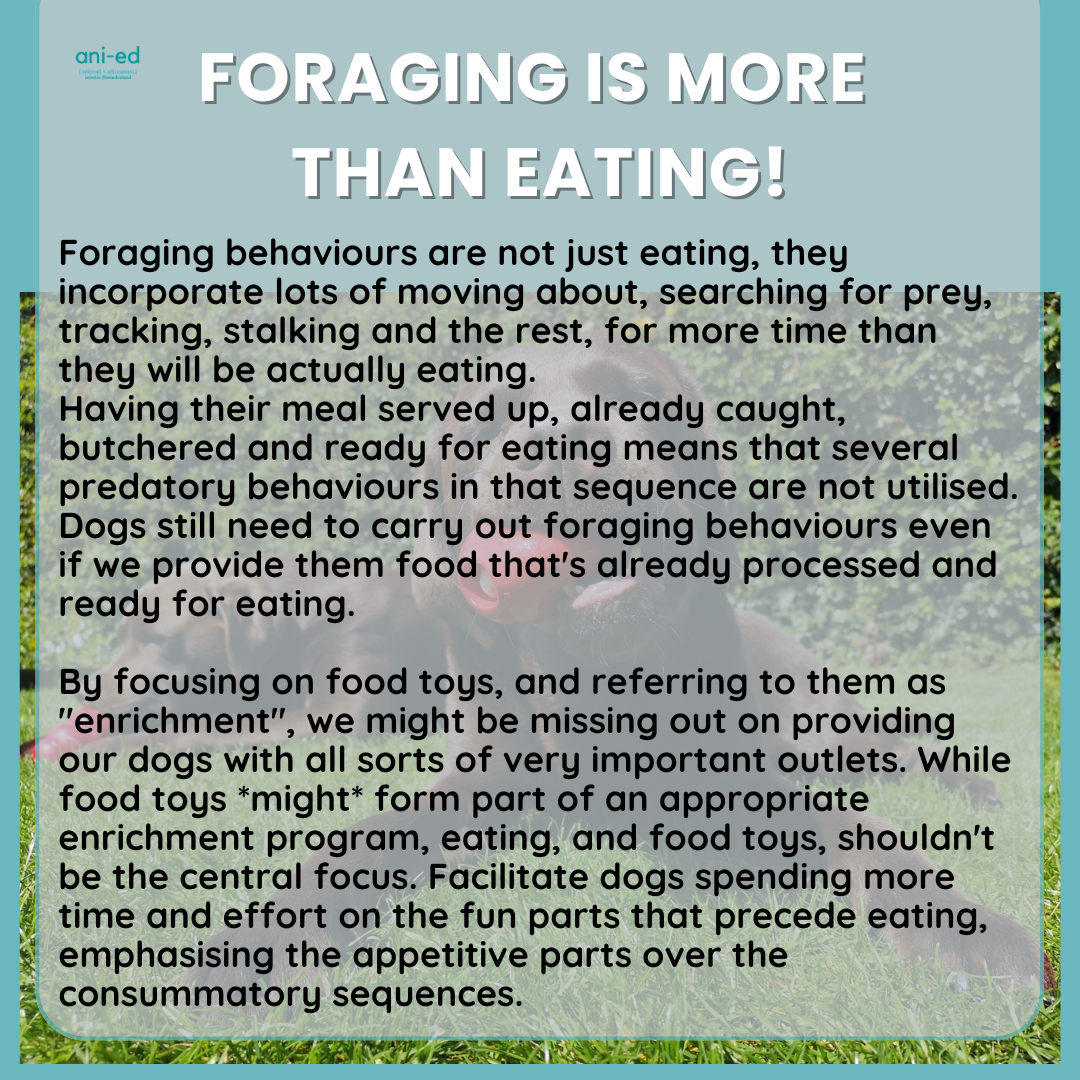
Think of the Polar Bears pacing in anticipation… Foraging behaviours are not just eating, they incorporate lots of moving about, searching for prey, tracking, stalking and the rest, for more time than they will be actually eating.
Having their meal served up, already caught, butchered and ready for eating means that several predatory behaviours in that sequence are not utilised.
And here’s a core concept of ‘enrichment’: animals still need to carry out those behaviours, even if the goals are provided. Polar Bears and dogs still need to carry out foraging behaviours even if we provide them food that’s already processed and ready for eating.
While dogs certainly show a range of foraging behaviours, often illustrated in a ‘predatory sequence’, they have evolved from scavengers and selective breeding has exaggerated and inhibited various foraging behaviours, particularly predatory behaviours. We have often selected against some consummatory behaviours, namely eating the quarry, because dogs were hunting for us!
Now consider the most commonly applied “enrichment” intervention for pet dogs…food toys! By focusing on food toys, and referring to them as “enrichment”, we might be missing out on providing our dogs with all sorts of very important outlets.
While food toys *might* form part of an appropriate enrichment program, they probably don’t need to be central.
Cora-Avila, et al., 2022, concludes that, “animals should experience sufficient amount of “wanting” before they experience “liking”.” Our enrichment programs should provide more opportunities for appetitive behaviours, e.g., searching, stalking, tracking, chasing behaviours, relative to consummatory behaviours, e.g. catching, killing, eating behaviours. Eating shouldn’t be the central focus, with dogs spending more time and effort on the fun parts that precede eating.
Enrichment must make sense…
What behaviours is your dog doing when engaging with food toys? (Indeed, the first question to ask is, is the dog engaging with food toys?!)
How does having outlets for those behaviours help your dog?
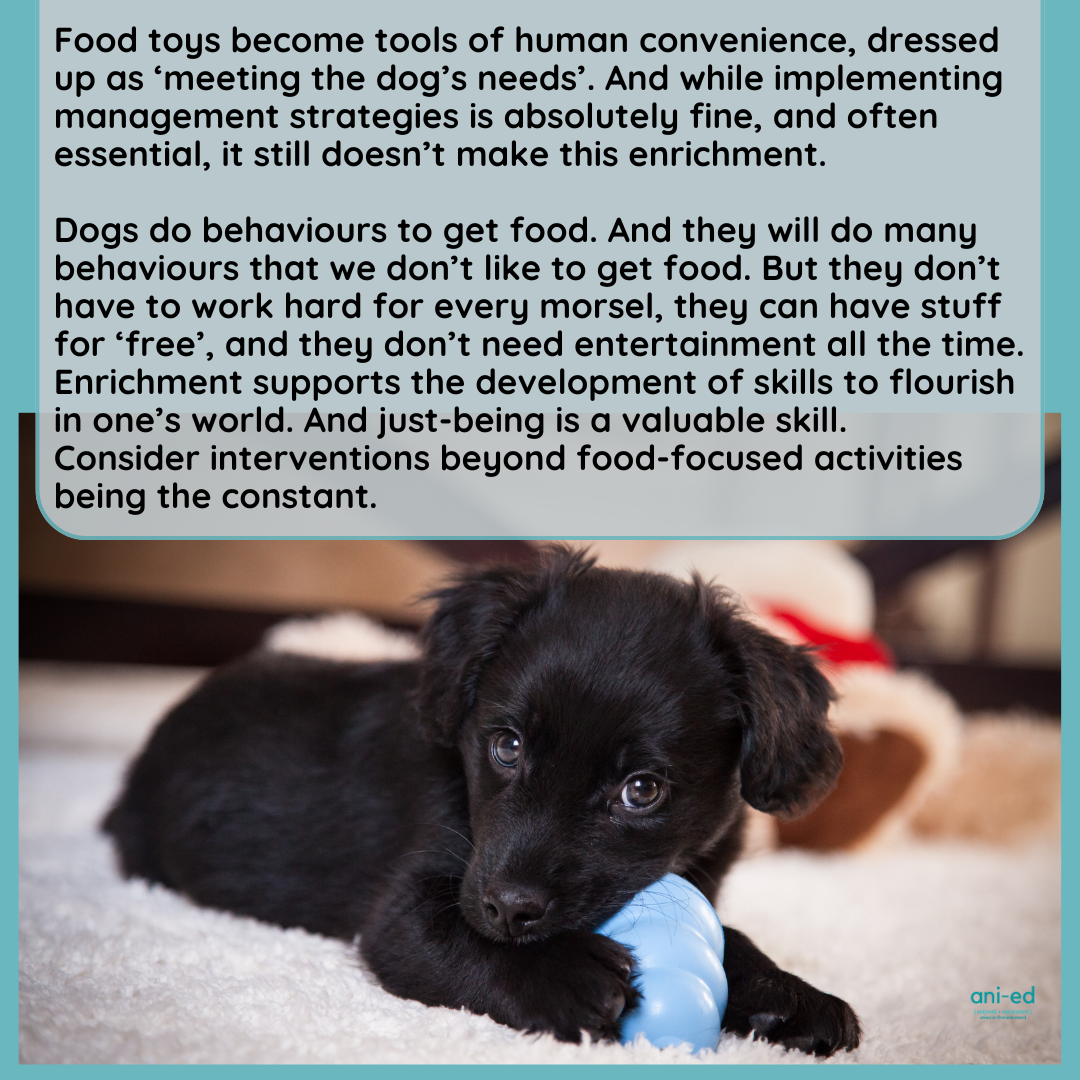
These toys are so often promoted for human convenience, to manage unwanted canine behaviours, and to entertain dogs for lengthy durations. And while that can certainly be useful, it’s not necessarily going to be enriching.
Behaviours function for food
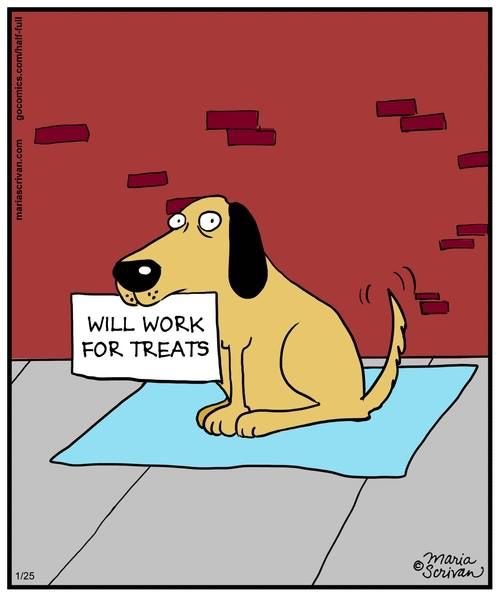
Dogs do behaviours that get them food. No doubt.
There might even be some evidence that some animals, including dogs, may choose to do more behaviours to get food (“work” for food), when food is available for ‘free’. This is referred to as contrafreeloading. (Rothkoff, et al,. 2024)
But most dogs are pretty enthusiastic about doing things to get food. Lots of times, they’re doing things we don’t want them to do…but dogs will enrich their own lives and worlds if we don’t do it for them.
There is so much individual variation when we talk enrichment and behaviour (Grigg, et al., 2017) that there is no prescribed recipe. Plus variation might just be the spice of enrichment too.
Your dog can get food, and anything else they enjoy, for “free”. That’s ok too. You can have fun with food, you can use food toys, you can just chuck their food all over the place to find. Mix it up and provide them with ways to fit plenty of appetitive behaviours in there too.
And make sure your dog is getting food they enjoy. That’s enriching too.

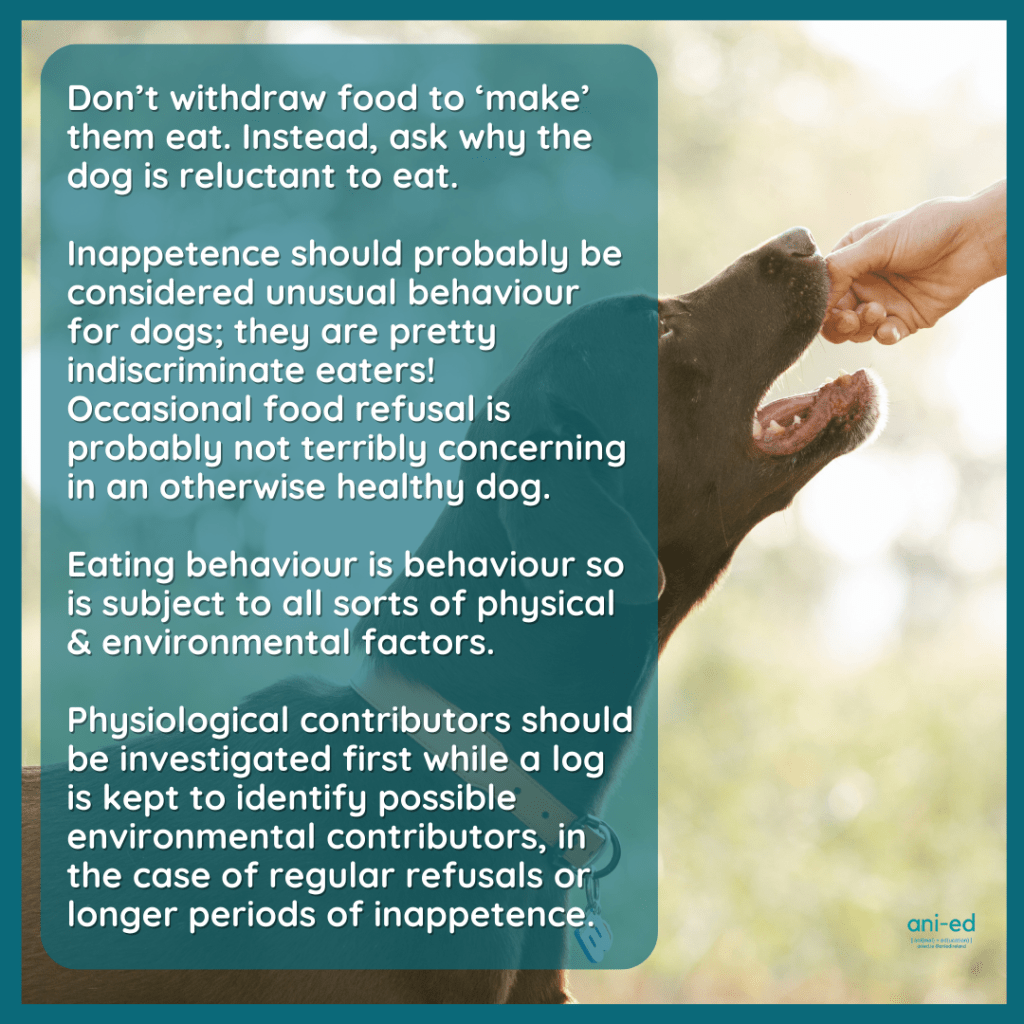


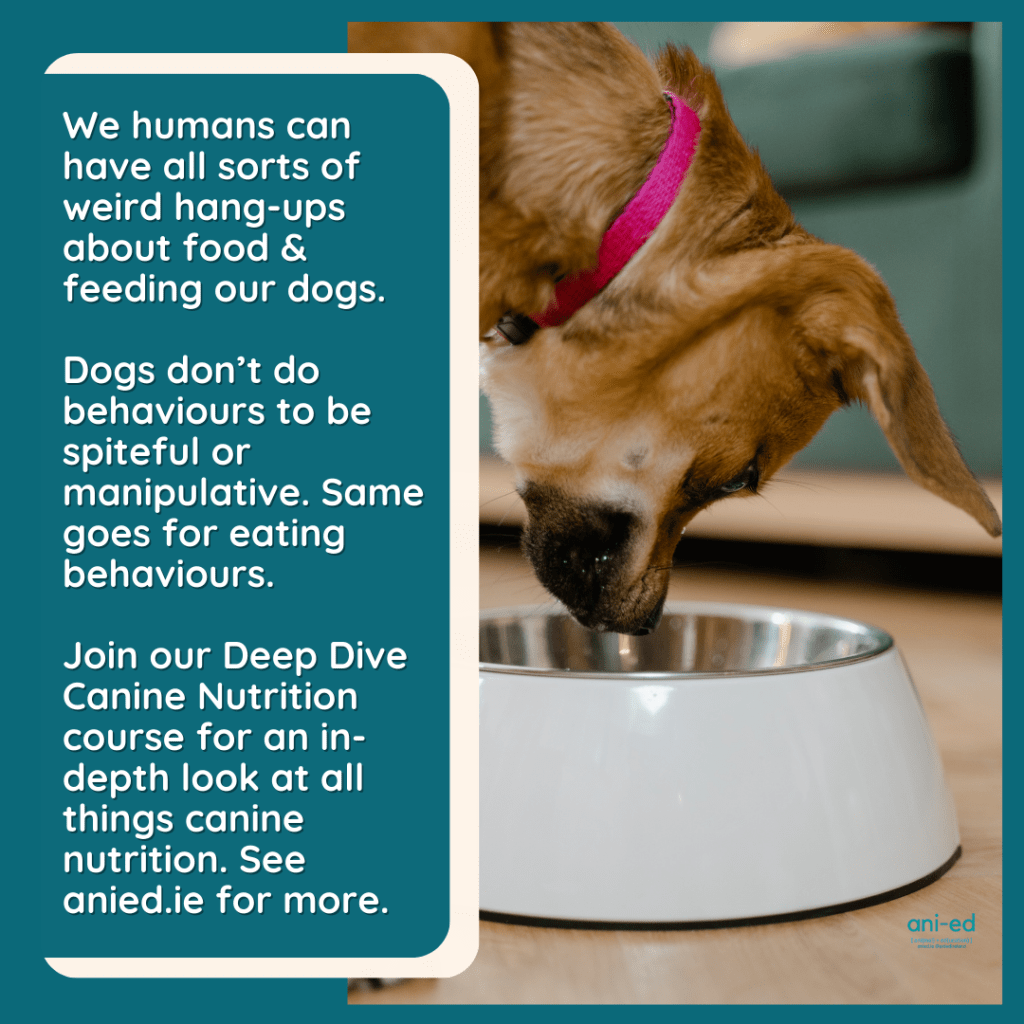
Part of providing an enriched world and life for them means we are doing lots of things that don’t involve food too, and aren’t necessarily food directed behaviours.
Dogs don’t need to be entertained all the time. An enriched life involves lots of ‘rest & digest’, lots of down time and, dare I say it, plenty of boredom.
Boredom is often aversive so animals will behave to resist its effectts (Burn 2017), but is likely to be part of the companion dog’s life. What are the behaviours we can teach dogs to help them to cope with boredom? Just being can be enriching too.
We can certainly facilitate this by providing physical exercise and even using food toys to promote settling, but it comes down to teaching. To setting up those contingencies.
Focus on Flourishing
We enrich our dogs’ lives and worlds by providing them with access to the conditions under which they can carry out reinforcing behaviours.
Dogs live in our world which is designed to enrich the lives of humans. And when dogs do behaviours, in our human worlds, to disrupt that, we get angry, we further restrict their lives, we reprimand and label.
But in our efforts to promote enrichment, we use popular euphemisms. Yes, enrichment is great, it’s required, but the term has lost meaning such is its popularity.
Related concepts like “choice”, and “meeting needs”, are so revered and shared that I’m not sure we have shared meanings any more.

Enrichment must make sense. And it must make sense to the individual:
- must be important and salient to the individual
- alternative behaviours must make sense
- it’s not just novelty & varitey
- it’s not just distraction & entertainment
Providing random choices may not be good enough, declaring their lives enriched because we’ve providing “choices” and food toys is not sufficient.
Choices must be meaningful, and the behaviour options available must be adaptive and accommodate species needs.

Enrichment increases predictability and controlability by teaching dogs the skills they need to live successfully in their/our worlds. By facilitating the development of behaviours that focus on flourishing.
What behaviours would the dog be doing if there were no barriers?
What behaviours would the dog be doing if they weren’t doing unsafe, unwanted, unacceptable?
What’s your dog seeking by doing unwanted behaviours? How do those behaviours function?
Your dog is already telling you how best to enrich their lives and worlds. Their behaviour is information.
Want help understanding how to enrich your dog’s life and world? Start with 100 Days of Enrichment – always free and available, plus there’s a new update coming soon!
Get in touch with AniEd at any time to discuss how best to really enrich your dog’s life and world: info@anied.ie
 AniEd Ireland