Let me just start this piece with a brief disclaimer. At no time here or anywhere else am I making light of or downplaying the trauma, the terror, the pain, the fear relating to dog bites or “attacks”. I work with people who have experienced just that, usually in interactions with their own dogs, every day. I am devastated and upset when I hear of any serious injuries or injuries leading to death caused by dogs.
I don’t wish injury on any person and hope that any person injured by a cow or a dog fully recovers.
Today marks 33 years since BSL (breed specific legislation) was enacted in the UK resulting in the banning of “pit bulls” and other breeds. That quickly led to BSL in Ireland and following this pattern, after the UK government, against expert advice, expanded DDA last year, Minister Humphreys, in her role with DRCD, has announced a similar expansion here too.

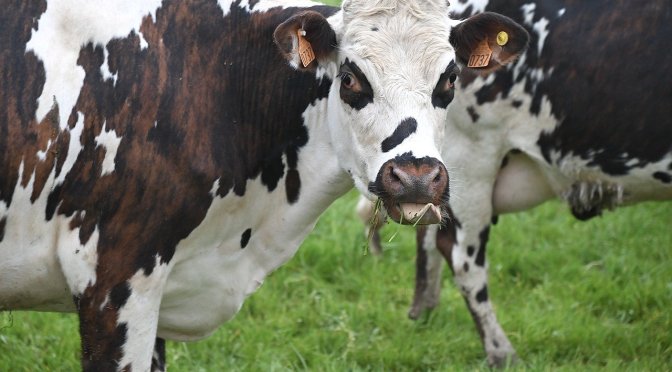
Killer Cows
Agriculture is associated with more occupational deaths than any other job-area. This is despite only a small proportion of the workforce being employed in the sector and despite ongoing education and campaigns, farm related deaths continue to rise.
About a fifth of those deaths relate to cattle. Sadly, during the ten years, 2011-2020, 39 people have been killed in cattle related incidents, with many more injured, often seriously.
More from HSA here.
Certainly anecdotally, docility is a cow-trait, presumably more widespread across populations via selection, with cattle who are harder to handle culled.
Cattle generally have limited contact with people, particularly with untrained or inexperienced people, and are handled in environments equipped with tools and set-ups to manage their behaviour.
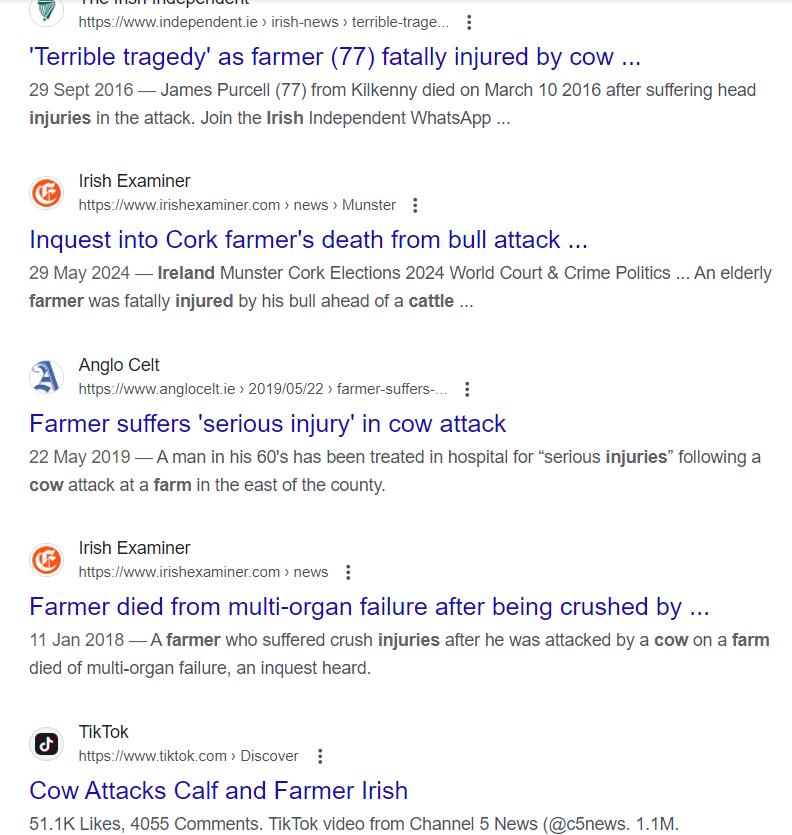
Despite regularly reported cattle related incidents on farms, I could not find one article asking about the breed of cow involved. Not one. I did find a couple who mentioned the type of cattle, dairy breeds, beef breeds etc.
But not one mention of speculation surrounding the breed of cow, her past (was she fighting other cows?, how was she raised?), or questions about what might have happened (what if this were a child?) and zero suggestion that these cows should be banned.
Indeed there is little mention of any sort of blame, shame or declarations that there are “no bad cows, only bad farmers” despite there being hundred of recent articles, across media, reporting on cow related incidents.
Banning Dogs
I am hard-pressed to find even one media article without speculation relating to ‘breed’ of dog, without mentions of presumed “breed-traits”, with out references to “dangerous”, without discussion of banning dogs in some context.
Four people, since records began, have been killed by a dog or dogs in Ireland.
Concerns about measures to reduce animal related injuries and fatalities are absolutely worthy of discussion. But, in understanding those concerns, we need to critically assess the reporting biases created in how these concerns are raised and the implications of these biases.
A decades long campaign to demonise dogs who look like “bull breeds” has resulted in culturally ingrained attitudes toward dogs and their humans. Because BSL has always been about discriminating against the people part of the equation…who would own “these dogs”? People like me.
I was in school when DDA was enacted in the UK and when the “Restricted Breeds” list was enacted here. I was a kid but was ‘in’ dogs even then and I wrote letters and articles, and interviewed people with targeted dogs, in an attempt, along with dog-sports colleagues, to turn the tide. 33 years later BSL is still a tool and continues to show how ineffective it is at preserving safety or welfare.
While thousands of dogs’ welfare is currently suffering and will continue to suffer, not one person on this island will be safer so long as breed-based approaches are relied upon.
Breed based approaches are fundamentally flawed given the difficulties with ‘breed’ ID and the complexity with predicting safety/danger via morphological characteristics.
Improving safety & welfare
The solution is obviously not banning cows or certain types of cows. Instead, multi-layered approaches surrounding improved handling and awareness training, increased investment in resources and programs to improve farm safety, use of appropriate tools to improve safety and publicity that provides advice about environmental adjustments that make it easier to be safe.
This becomes particularly important as farming continues to intensify.
Breed-based approaches, in dogs, have been shown not to improve safety. And that’s likely because dog-safety requires multi-layered approaches at community and society levels.
But breed bans, as blunt political tools, present the illusion of action being taken, of something being done.
Dogs In Society
For these past 33 years, I’ve been continuing to work on improving dog safety and welfare. Depressingly, this isn’t getting better.
I’m so lucky to still be surrounded by awesome dog-peeps and we are continuing to work on this, continuing to develop community focused resources and supports.
Look out for our launching a whole new project next week.

Our focus at this time is BSL and the impending ban on XL Bully dogs in Ireland, from October. But we recognise that to improve dog welfare and human safety, everyone needs help in understanding how behaviour works.
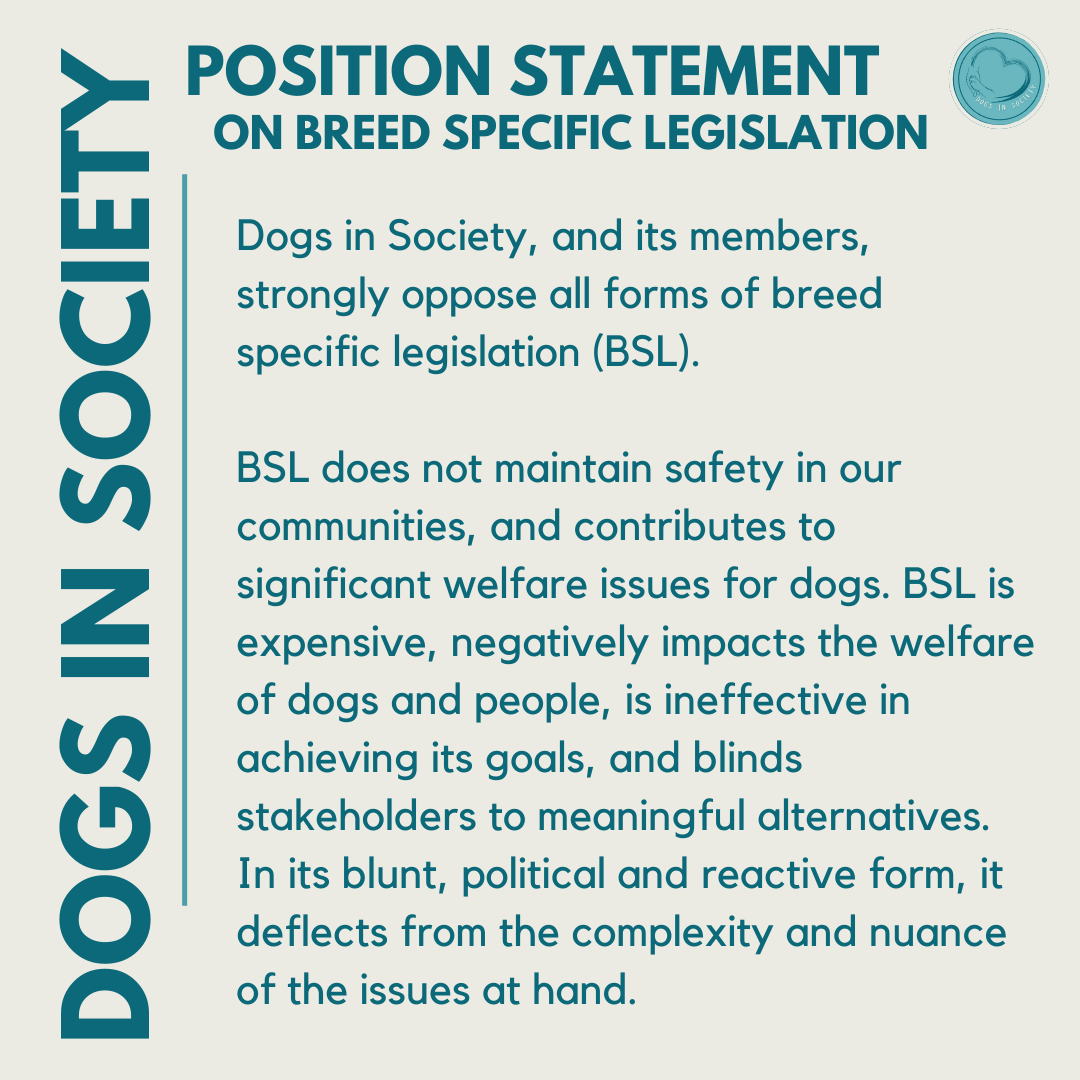
With that level of education in place, BSL will be more widely recognised as the ineffective tool that it is, and dog safety and welfare has a chance to improve.
Dogs In Society is here to support communities in nurturing human-dog relationships to maintain safety, to maintain welfare, via education, supports, resources targeting societal reform. Not useless bans and more poorly enforced legislation.


As ever, thank you so much for your well considered, highly informative take on issues regarding our dog companions. You are always so well researched and giving of your knowledge and expertise.
I always appreciate your thoughtfulness and take on issues. I always learn something or gain a different perspective.
I keep meaning to tell you.. your hard work and real love of dogs is rather wonderful.
Many thanks
Liz and Elsa and Dobs
LikeLiked by 1 person
Thank you so much, Liz, that really means a lot x
LikeLike