
“Meeting needs” is all the rage. There are countless posts, videos, reels, shorts, TikToks, you name it, devoted to showing dogs running and sniffing and exploring and chewing. And countless trainers telling us what dogs need.
This is something I can get behind. But like so many things in our industry, “meeting needs” is the latest in a long long line of fads, championed by social media, that fall apart when scrutinised in any way other than superficially.
And by that I mean, there are some glaring blindspots in this sort of promotion, unsurprisingly. Social media, with it’s rapid consumption via scrolling, often misses out on providing substance and meaning, which of course leads to loss of nuance…the one most consistent feature of every behaviour related topic.
What are behavioural needs?
Behavioural needs are behaviours that are induced by internal (Friend, 1989) and external factors that arise to adapt to the challenges of behavioural restriction (Ninomiya 2014).
This means that we look at what access and exposure that’s lacking for an individual dog, and we make up the difference. Appropriate enrichment should fill those gaps but our efforts won’t be able to compensate for every loss and compromise that dogs living in our human world will experience.
What do dogs need?
Animal welfare science continues to explore quality of life and basic welfare criteria for maintaining the health and welfare of dogs as companion animals. Truth be told, the welfare of companion dogs has been sparsely studied in meaningful ways. It’s largely assumed that, because dogs live with us so entwined within our lives, that they must experience good welfare.
In general, the Five Domains (Mellor et al, 2020) provide a welfare framework defining both positive and negative welfare states in animals. This model has been expanded to include behavioural welfare and human-animal interactions’ effect on welfare standards.
Griffin, et al, 2023, adapted Maslow’s Hierarchy of Needs (for humans) to create a hierarchy of dogs’ needs.

Sniffing is great…but…
Providing dogs with appropriate outlets for species and breed specific needs is important. Nobody is arguing with that.
But meeting dogs needs means that we need to go beyond just one element in our care of our dogs, who live in our complex and not-dog-centric world.
While hierarchies are not necessarily effective as sole frameworks, this one can provide a foundation in understanding how we can structure needs-based interventions.
Dogs need to be safe and to feel safe. And to do that, like it or loathe it, they must be able to live in the human world.
Dogs are not humans and don’t come inbuilt with some of the abilities we have for fitting in. Even we require years and years of guidance, education and support to barely survive in our sometimes cruel world, plus our society has devised layers of punitive actions for those who are not compliant.
Our dogs need to learn how to live comfortably in the human world and that requires skills (behaviours) that we are responsible for teaching them.
They need multi-species social skills, they need handling & proximity skills, they need reinforcement skills, they need settling and confinement skills, and then some, plus they need to be able to perform these behaviours under various conditions.
But skills alone won’t do it. They need humans who are aware of balancing the layers that are required to maintain their behavioural health and welfare.
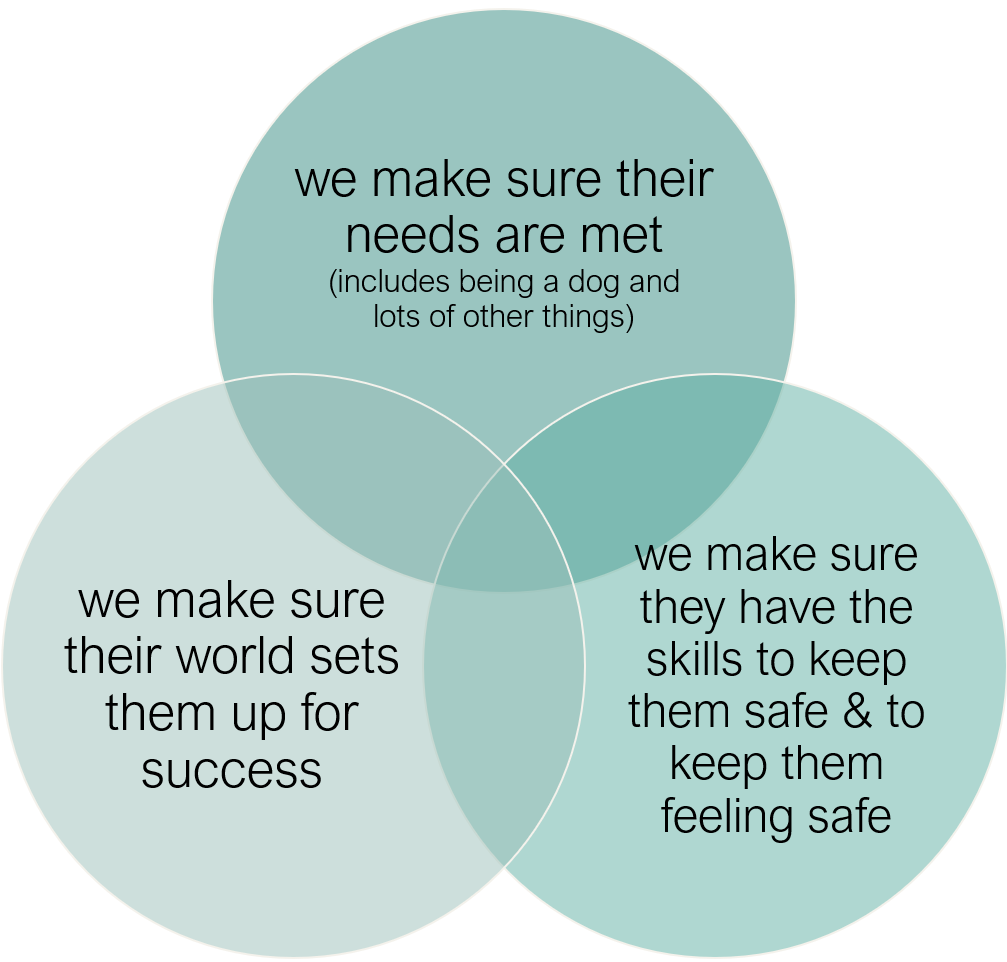
That’s our job, as tour guide to this foreign culture and our alien world.
Skill building requires careful set-ups and management, and good teaching, plus making sure dogs have outlets for all the cool stuff.
When the balance is off, the dog may be left with deficits that require more intense management, anxiolytic medications and a smaller world. This is all fine, particularly when applied with knowledge and awareness, but what happens when the dog must be exposed to the bigger, badder world.
What happens when they have to go to the vet for treatment?
What happens when they have to move to another home with a different layout?
What happens when the kids have to come to stay?
What happens when that big barky dog moves in nextdoor?
What happens when they have to face the things we haven’t given them skills for?
We have back-up plans for the back-up plans. Because our responses to our dogs’ behavioural needs are so often reactive, we are behind the curve on every count. And the dog suffers.
Good teaching is a welfare issue. As humans, we have tendency to make it about obedience and compliance. But good teaching isn’t about that; it’s about setting the dog up to succeed, it’s about keeping them feeling safe because they have the skills to cope with what our world has to throw at them.
And that only works when we truly meet their needs. Beyond sniffing. Through skill-building.
 AniEd Ireland