All posts by AniEd Ireland

In my day…

We all long for our hazy days of youth, when we can look back, through rose-tinted spectacles, at the dogs we spent our days with.

Our expectations of modern day dogs are probably, in part, derived from our skewed memories of childhood encounters with dogs.

Did our parents need to worry about Kong toys? Did our childhood dogs attend training classes and undergo elaborate socialisation programs?

They probably didn’t, or at least we as owners didn’t implement this stuff, nor was it recommended or discussed much

Things have changed and times move on, and modern dogs face challenges their ancestors didn’t. And, as such, modern dog owners face challenges keeping modern dogs in the modern world.

What’s changed?

Modern pet ownership certainly seems more complicated…

  • dog control legislation enacted (in Ireland) in the 1990’s has meant that dogs are largely confined to an owner’s property.
    This limits the dog’s access to the outside world, and to more naturally paced and exposure based socialisation and experience-building for puppies and young dogs.
    Not only is it more difficult for puppies and young dogs to gain vital experience and exposure, dogs confined to their human’s properties have even further diminished choice in their lives; this is detrimental to welfare.

  • dogs live more isolated lives due to increased confinement, increased incidence of living in packed suburban and urban areas, and because their families work outside of the home. Cultural trends in women returning to work and the confinement of dogs, means that dogs may spend many hours each day alone and isolated from appropriate social contact.
    For social animals, this is detrimental to welfare.

  • supply & demand
    Supply – most pet dogs are bred accidentally, or, with an emphasis on phenotypic characteristics – either way, lots of dogs destined for the pet market are produced without adequate attention and preparation.
    Placing dogs in inappropriate homes relative to the dogs’ behavioural needs, its history, environmental requirements and behaviour issues, is a worrying trend, affecting the welfare of both people and pets.
    All dogs require work and commitment from their families, but dogs that bring behaviour baggage are going to require even more work and access to resources to support and help the dog in its new home.
    Demand – attraction and access to a wider range of dog breeds and types, that are not necessarily suited to their owner’s lifestyle, living conditions, or location.
    We cannot deny the role of selection  in the behaviour a dog breed or type will tend toward. If we have selected for certain behavioural characteristics for countless generations, we cannot expect that dog to just suppress that behaviour because he now lives in a city, or housing estate, or because his owner’s work…
    Bringing home a dog that is not appropriate for your lifestyle, time and resources makes it unlikely that that dog’s needs will be met, presenting a range of welfare and safety concerns.

  • as society becomes less and less tolerant of dogs, the expectations thrust upon dogs become higher and higher.
    Dogs are expected to be safe members of the community, friendly to all, cope with all environments, be tolerant and gentle with children, love us unconditionally, literally save lives, and improve our quality of life…
    Our rose-tinted-spectacled view is informed by nostalgia for childhood pets and movie dogs. It’s a long way down from that pedestal – there is no ‘real’ dog on the planet who can live up this.

  • when you know better, you do better.
    We have a well-established and growing science of behaviour – this means our understanding of behaviour, learning and cognition is improving week by week, based on more than just anecdotes.
    Science is self-correcting, so as we gather more information, it allows us to develop better and more effective tools.
    We are learning more and more about dogs, about how they learn, and about how best to help pet owners, now more than ever.

We’re not being needlessly complicated or conservative in our approach when we make recommendations for your dog’s training and care. Dogs have it harder than ever before, and it’s become harder to provide for their needs. We can make it easier by accounting for these modern challenges, and helping pets and their people succeed in the modern world.


Information gathering

So much of training and living with dogs is about doing, doing, doing, action, action, action.

Sometimes it’s important to take time, to be, and allow the dog process the environment.

Give them time:

Clip

The brain errs on the side of caution and tells the body to expect danger, as a default setting. That means we have to do lots of work to give the brain and body time and relief to gather information to facilitate a change in attitude.

The time to reset the brain is during a puppy’s first few months of life, and then to continue this in a structured manner over puppy’s first year. But we need to get that first few months right. Dogs who don’t cope with this well don’t need to have been abused or have had particularly bad experiences in early life. All it takes, is lack of exposure, lack of time to information gather.
We don’t get this behaviour developmental stage back again – we get one go, so we need to get it right.

 Information Gathering for Puppies

This is especially important for puppies, who are just learning about the world. And often explains why puppies and young dogs will suddenly plant themselves in the middle of a walk, unwilling to move on.

20170921_120602512_iOS

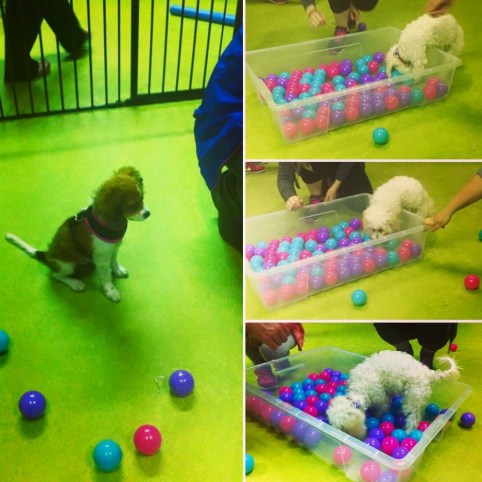
In a Puppy1 class Minnie takes some time to engage with a ballpit puzzle, and Ellie prefers to sit back and watch the goings-on.

Providing puppies (and all dogs) with time to choose how they wish to respond, helps to reduce stress and helps to build confidence.

Information Gathering for Dogs


In this clip Simon, on one of his first trips to AniEd a couple years ago, before he was rehomed, is out for a walk in a busy business park.
Simon, given his rough background, can be a little overwhelmed in some situations. This is our first walk together – that’s why he’s panting plus we had just had some ball fun inside too.
We came across a man mowing a lawn in behind a fence and another man with a forklift working. We moved across the road so that we were about 15-20m away from the action. As soon as he spotted this activity he stopped and I made sure to keep the leash loose. We just waited while he processed the noise and activity.
Notice his rapid head movements as he watches the scene and note his mouth becoming tighter at times as he concentrates on the activity. Listen for his big sigh as he gathers as much information about something that might cause him a little concern.
As soon as he’s ready to move on I mark (YES!) and reward him. That it looks calm and a bit boring (let’s be honest!!) is good – it means that he could relax enough so that he could just watch the goings-on without experiencing too much concern.


Let your dog take it in…

When your dog encounters something that interests them, especially if it causes them to be excited, to be scared or spooked, causes them to lunge, pull, whine or bark, give your dog some time to process that trigger.
If your dog is already reacting like this first move far enough away that your dog is able to give some attention to you and so that they don’t react that way anymore.

But, when you encounter something that you think might be of interest to your dog give you and your dog plenty of space from it.
Keep the leash loose and allow your dog to process any information that he can from what he is seeing, hearing and smelling.

Things won’t seem as scary or interesting to your dog if they have had some time to find out a little more about it.
This is really important for puppies, who are learning about the world, and for dogs who are worried or ‘reactive’ on leash.

It’s not always about “training”

You don’t need to jump in there with treats or cues straight away. Take the time. Don’t encourage, don’t nag, indeed, you don’t need to do a whole lot.

If your dog can’t information gather, you’re too close, you’ve stayed too long, the trigger is too intense. Distance is your friend, and there’s nothing wrong with packing it in and trying again another day.

Things to try, and not to try:

  • keep your distance
  • give your dog time
  • if you notice your dog stiffening, become more tense, or having difficulty moving away – help them. Move away excitedly, call to them, keep it jolly. Try not to put too much pressure on the leash as this tends to escalate things. If needed, move them along with brief, gentle pressure, and then use your jolliness to keep them moving with you.
  • never drag a puppy who has stopped
  • don’t attempt to lure a dog toward something he is unsure of or scared of. Don’t even encourage them to approach – give them time to choose.
  • You don’t need to understand their hesitation – just listen to your dog!
  • after some time information gathering, get ’em outta there, moving in the other direction
  • too much exercise for puppies and growing dogs is damaging – review your exercise regime, and think of outings more for exposure to the world, rather than physical exertion
  • don’t make puppy’s world too big too soon.
    While puppy is on vaccination hold, bring them in your arms to new places on foot and in the car. Remember, they have little choice when in your arms so don’t expose them to new things, people or animals when restrained.
    When they start going for walks, expand their world a few metres each day, starting at the front of your house or garden on the first day, then a couple of houses down the next day and so on. Rather than marching, try playing with toys, doing sniffing searches for them, and letting them range on lead (safely).

If you have difficulty moving a reluctant dog or puppy, give them some time (might take several minutes) and then encourage them to follow you back the way you came. You can move in a big arc to go in your intended direction too.

Clip

Learn to ‘listen’:

Clip

Teach a hand targeting behaviour, to encourage movement in a non-confrontational and low-pressure manner:

CLip

Add movement:

Clip

Clip

Make it fun!

Clip

The Skinny on Using Food in Training

The reluctance and poor tolerance toward the use of food in dog training is not new, or even surprising, but the understanding of its application as a consequence to behaviour, in teaching, is consistently poor.

The fascinating aspect of this reluctance to use food, is that food rewards are generally held to higher standards than other consequences to behaviour, in teaching.
We start talking about fading food, before we even get started, and we presume that it’s going to heroically and miraculously fix all ills, so we abandon it, when it doesn’t…“once he sees <insert distraction here> he won’t even look at the treats”…why would he? What training have you done to proof behaviours in the face of such distractions?

It’s almost as if food were not the problem…!

Food is a contentious training tool, and like any tool there are pros and cons, but, except maybe for shock collars, not much rivals food-use for controversy.

We’ve talked about rewarding behaviour before: Pay the Dog

And discussed the care required with food’s use: Fat Dogs & Food Trainers

The Bottom Line

If you want behaviour, you gotta reinforce it; to reinforce is specific, meaning to strengthen behaviour, increasing its frequency.

The behaviours you want your dog to do, are so often not what the dog would choose (if he could), so we gotta make it worth their while.

Think of the reinforcement account you have built for behaviours that you like (polite greeting behaviour, walking nicely on lead, coming when called from distractions, settling calmly while you are busy and so on)…how consistent are these behaviours?
How healthy your account balance is, will depend on how much reinforcement you have in there…

Think of the consistency of behaviours that you don’t like – jumping up, barking, pulling on lead, not coming back and so on…that’s how healthy those reinforcement accounts are.

Five year old, “food trained” all the time – doesn’t beg, doesn’t steal food, doesn’t need food in everyday life for maintenance of established behaviours, switches between food, play, interaction and sniffing in all training sessions, not overweight, healthy. Maybe food’s not the problem…

I get it. Most average pet owners want a quick fix formula, and that’s ok; you don’t need to be a behaviour-nerd to train your pet dog. But, it does mean that you will need serious help with filling those reinforcement accounts.
With good management, and quick teaching of replacement and desirable behaviours, we can limit the effects of unwanted behaviour relatively fast.

That’s where food comes in. When you come to training class, we’re going to use food and lots of it. That’s one hour per week to ensure your dog’s behaviour in the tricky class environment is better managed, and you and the dog are set up for success.

We are using a high rate of reinforcement (ROR) when teaching behaviour. That’s how behaviour becomes learned, and fast. Food allows for that.

Developing the skill to use food and other consequences of behaviour may not be what you want, and that’s fine. But, using food is probably the quickest, most efficient way to get behaviour you like – with a little care it can be pretty powerful.

You will develop relationship, as a side-effect, and that makes it easier to reduce training prompts.

Put the work in NOW, today, and when you can reliably predict behaviour in relevant contexts, you can reduce the food if you must, switching to other reinforcers to maintain behaviour.

If you are complaining about your dog’s behaviour, there are two places to look (and not one of them is your dog!): the environment (what’s happening around the dog that allows him to carry out behaviour you don’t like), and reinforcement history (the health of those reinforcement accounts) – all down to you. Neither food, or your dog’s to blame!

Change your mindset and catch your dog doing the right thing – look for behaviour you like, rather than waiting for behaviour you don’t like.
Carry a little bag of your dog’s regular food in your pocket or have little pots of it dotted around the house for quick reinforcing. It’s really not that tricky, and it’s better that your dog work for some of that food than get it all for free from a food bowl.

You don’t necessarily need to use food forever, although that’s not the worst thing in the world either. Why do we lament a continuous schedule of reinforcement when food is involved? Especially when we (apparently) happily continue to pull the dog around on the lead, scold them verbally (and otherwise), coerce and intimidate them – this is continuous use of potentially harmful consequences to behaviour, the fallout of which may be greater than use of food.

So, before you moan that you need to use food to train your dog, consider your dog’s behaviour and its consistency as having a reinforcement account and fill it…bring it back into the black. If you are currently moaning about your dog’s behaviour, the desired behaviour’s reinforcement accounts are probably in the red, and only getting redder…

Do good dogs go bad?

This weekend in Galway, Ireland, a woman was killed by a number of dogs, while visiting a relative’s home. Reports are incomplete and few details have been confirmed; there has been much speculation and sensation raised around this incident.
This is the first bite related fatality recorded in Ireland, and has shaken many, including us at AniEd.

When ever dogs are involved in hurting a person, it is terrible; the victim and their family and loved ones are gravely affected, often for the rest of their lives. Although very rare, when deaths occur, I can’t imagine the pain experienced by all who knew and loved the victim, and by those who attended the scene of the incident.

We have tried to produce a non-inflammatory statement but it is a drop in the ocean relative to the highly sensationalised and panic-inducing sound-bites produced by many dog-pros, politicians, and others. Headlines and click-bait do not further our cause in education, and I urge you to please use caution when sharing and commenting.
It is genuine education that will improve safety for both pets and their people.

Our statement can be read here. In it, we refer to valid research looking at the contributing factors associated with fatal dog attacks, with a complex combination of factors found to be contributing to 256 fatal dog attacks in the US over a ten year period.

DOGS WILL BE DOGS

Dogs are predators, have big teeth and powerful jaws and live with humans. When people say that the dog is ‘unpredictable’ or the attack was unprovoked they are attempting to interpret complex behavioural patterns, inaccurately for the most part.

Relative to the amount of contact we have with dogs, and despite the weaponry dogs possess, we get bitten rarely, and when we do get bitten, serious injury is very rare. Fatalities even rarer.

Calling for stricter legislation in relation to dog behaviour is nonsensical and a waste of public funding – this is not a big enough problem at societal level.
Investing in education programs, for pet owners and professionals, to help ensure that risk factors in relation to dog behaviour are minimised, is a better approach likely to yield greater success.

The most influential factor in dog bite incidents is human behaviour (and we are not talking about victim blaming here). Dogs are not unpredictable, they act like dogs each and every time.

WHY DO DOGS BITE?

Behaviour is complicated – generally speaking there are a number of factors influencing behaviour at any one time.

Physiological Causes

Dogs may aggress because they are in pain or uncomfortable, affected by a neurological disorder or other disease process.

Dogs recovering from surgery, on medication, developing senility, going blind or deaf, having a seizure will have an altered view of the world and may be more likely to bite.

If a dog is in poor health, perhaps malnourished, kept in an unsuitable environment or isolated, this will certainly contribute to their discomfort.

Dogs are dogs but the world we keep dogs in has changed and drastically so – we don’t do a great job of helping dogs keep up with these changes.

Genetic Causes

When we have difficulty analysing a behaviour and pinpointing some sort of cause we often fall back on ‘genetics’.

Selecting for a tendency to shyness or being ‘highly strung’ certainly doesn’t help, but all behaviour, and I do mean ALL behaviour, is a mix of genetic and environmental influences.
Just because you carry genes for some characteristic doesn’t mean you express that trait.

Not a whole lot of behaviour in dogs is linked with high heritability, because behaviour across a population is strongly affected by environmental conditions – i.e. how people have intervened in the producing, rearing, caring and safety for the dog.
However, fearfulness and aggressive responding present relatively good heritability. (Goddard & Beilharz, 1982)

Speaking Dog

Dog communication is all about avoiding aggression so if uncomfortable they aim to increase distance. Not so surprisingly, distance increasing signals are used to ask for time, distance, relief from social interaction.

Distance increasing signaling is subtle and needs to be learned – we are not born with a natural, mystical ability to speak dog.

Some of our favourite resources on this topic: iSpeakDog, and these clips: part 1 and 2.

Socialisation

Puppies need to have lots and lots of positive exposure to all sorts of situations within their first few months of life.
Positive exposure must continue for the remainder of the dog’s life especially to counter any bad experiences they may be faced with; this is particularly important during adolescence when crucial development continues.

A puppy’s socialisation experiences must suit the genetics that they come with (so look at type and parents’ behaviour) and to make up for any socialisation-gaps in puppy’s rearing environment.

Bite Inhibition 

Bite inhibition refers to how puppy uses its jaws and pressure, in social situations. It is suggested, although not verified by reliable research, that this will affect the amount of damage the dog will do during a biting incident.

Bite inhibition is acquired during puppyhood, probably in the first weeks of life – puppy learns how to use his pointy little teeth in social situations. Puppies spend their time within their litter, biting and chewing on one another, learning how to give and take.

Puppies will also practice on humans, a common gripe among puppy owners. Any bite inhibition acquired, probably happens in puppy’s first 7 weeks, and there may be genetic factors too.

When a dog bites a human, they don’t always cause damage, and something cause only minor damage – this is a pretty mean feat, given the impressive weaponry dogs have. It is due to the dog inhibiting the force of its bite. We grade bites on a Bite Scale, measuring the damage done to the person, e.g. Dunbar Bite Scale.

Bite Threshold

Bite threshold refers to how quickly and how likely a dog will be pushed toward biting.
What type of warning behaviour does the dog display?
Do they skip from growling straight to biting or do they jump from hard staring to snarling in the blink of an eye?
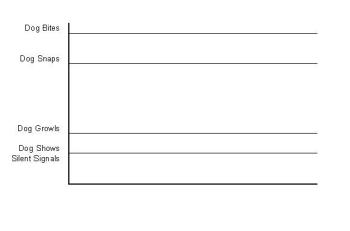

More from Reactive Champion on the bite threshold model.

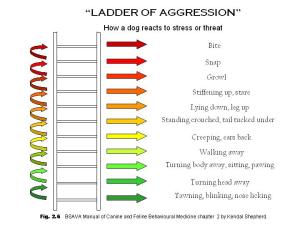
The Ladder of Aggression similarly illustrates canine stress-related behaviour and can be used to help pet owners better understand how canine behaviour may escalate.
More on the Ladder of Aggression here.

Trigger Stacking and Stress 

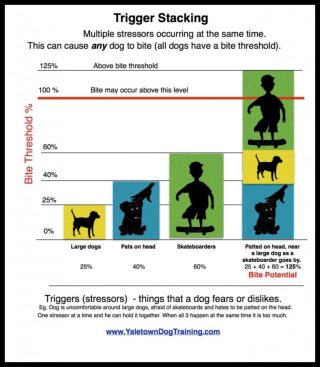
The Bite Threshold model illustrates the effects of cumulative stimuli, that elicit emotionally driven behaviours, such as happiness, excitement, fear and aggression.

Stress is caused when the body must adapt to environmental conditions; the dog may use behaviour to cope with these challenges, to minimise the effects of the stressor.
One stressful event won’t always cause a dog to bite – stress begets stress and often times a dog doesn’t get the opportunity to get over exposure to one stressor before exposure to another.

The manifestation of this is often referred to as trigger stacking; more here. 
Link

Arousal increases, the more stressors the dog is exposed to, and as they become more wound up they are less well able to control themselves. As arousal increases, inhibition decreases – the dog may bite harder, jump up more strongly, may be less responsive to cues or even physical interventions.

Arousal increases in relation to emotional events, and not just negative feelings, but also happiness, excitement.

Training & Experience

A dog’s past experiences with people affect his attitude – have people used harsh training techniques, harsh training equipment, hugged the dog, frightened the dog in the past?

Has the dog been confronted, challenged, intimidated or frightened and then delivered a bite?

Dogs are always been trained; learning about how to cope with their environment, via their environment. Our behaviour, and how we interact with dogs, is a pretty big (HUGE!) part of the environment that will teach that dog which behaviours work, and which don’t.

If a dog is regularly put in situations where they feel they must use distance increasing signaling, they are learning that’s what they need to do to stay safe. Looking at the Ladder of Aggression, if dogs learn that orange and red behaviours gain them relief, that’s what they’ll use; what’s more, they will stop using the green and yellow ones, because those don’t work for them.

When we punish warning behaviours, we are teaching the dog that it’s not safe to warn, but not helping them feel any better about the situation (and the person) so the dog still wants relief. Except, we may have just taken the batteries out of our smoke-alarm…a dog that doesn’t warn, and just bites.

Interactions with people that cause dogs to have a negative experience may contribute, but also may insufficient exposure. A dog who is isolated from the world, who isn’t around people, having positive interactions, in the contexts in which they are expected to live, may also find it difficult to cope.

Indeed, people will usually presume that a dog is showing fearful or aggressive behaviour because they have had negative experiences with people, e.g. abuse or neglect. While that may be true, it is just as likely that the dog is behaving this way because he hasn’t had sufficient positive, appropriate interactions with humans in different situations.

Frustration and Redirection

A dog behind a barrier (real or perceived) who can’t get to or away from something will be frustrated. Frustration has to be released somewhere and without acceptable outlets for this a dog may redirect their frustration on a person.

Guarding Behaviour

A dog may aggress if he feels that his possession of some resource is threatened. This may include a mother dog that bites when she feels her babies are in danger, a dog who threatens when someone approaches his food bowl or yummy bone or the dog who growls if moved off the sofa.

All animals resource guard (you locked your house and car today, right?!) but inappropriate and unacceptable manifestations of this behaviour are  commonly seen in biting incidents.

Handling and Hugging

Lots of people think that it’s OK to hug, grab, lift and restrain dogs – actions they would never carry out on a person they don’t know well but happily cross that line with dogs they have just met.

Indeed, most people bitten are bitten by dogs they do know; dogs don’t really appreciate this type of contact even with familiar people, especially if they haven’t been taught to tolerate or enjoy it.

Predatory Behaviour

Dogs are interested in things that trigger predatory behaviour – throwing a ball, playing chasing, sniffing and sniffing all stimulate this tendency.

Dogs are predators and like other innate behaviours that come inbuilt with dogs, if predatory behaviour doesn’t have an outlet it may be expressed out of your control.

Predatory behaviour may be behind dogs chasing and attacking smaller dogs, other pets and even children. Running, jumping and squealing may trigger this behaviour.

Groups of Dogs

A group of dogs is more likely to do more damage than a solo canine, not just because there are more mouths of teeth.

A group of dogs may take cues from one another, arousal and competitiveness is likely to be higher and as such behaviour will escalate quicker.

Bite History

Has the dog bitten before? Has the dog shown aggression before? If so what happened and how has the situation been managed since?

A dog who has shown aggression before in a specific situation is very likely to do so if in that situation again, where nothing has been done to help the dog to cope.

If the dog has bitten before, how much damage was done to the person? The vast majority of bites inflict little damage, especially relative to the weaponry dogs have – dogs have the tools designed to kill other animals.

The level of management, skill and knowledge required to effectively and appropriately deal with dogs who have or are likely to demonstrate aggressive behaviour is massive; to such an extent that is underestimated.
Without careful environmental change, the dog is likely to bite again. Even with careful management, the dog may bite, as management is only one part of the process (a very important part albeit).

Kids & K9s

Dogs are more likely to bite children – therefore, child behaviour needs to be considered a major contributor. But of course, children can’t be expected to regulate their behaviour too well – a bit like dogs that way!

Adults need to be there – direct supervision and management are the keys. Applied diligently, we could reduce bites to children dramatically.

If you want to learn more about helping parents, pet owners, children and dogs be safer, ask us about webinar: Kids & K9s.

Context

Dog behaviour is contextual; meaning that behaviour occurs due to the presence of specific stimuli. If we want to truly understand the contributors to biting behaviour, we must understand the specific and general context (distant and immediate antecedents).

To truly understand the conditions leading to a bite, we need to know more than just the damage caused by the bite, or the warning behaviour demonstrated – we need to know about context.

What has contributed to this behaviour in the seconds, minutes, hours, days, weeks and even generations before the incident?

PREVENTING DOG BITES

  • regular health checks and speedy treatment of pain and disease
  • good husbandry, good diet, suitable living conditions
  • if dogs are ill, in pain, or uncomfortable give them time and space
  • select a type of dog that suits your lifestyle – can you meet the dog’s needs?
  • select puppies from parents who are sound, social, happy and healthy – check up on the puppy’s parents, littermates and relatives
  • if choosing an older or adult dog, carefully analyse how the dog has been kept and handled; get its back story and carefully consider its behaviour
  • socialise, socialise, socialise and then socialise some more – intensively but carefully
  • make sure that dogs have continued positive experiences with people – you are your dog’s guardian, protect him
  • give dogs space when they have resources
  • teach dogs that close proximity with humans is beneficial rather than a reason to guard
  • NEVER take food bowls or other items off dogs to show them not to guard, to show them ‘who’s boss’ – this will encourage guarding
  • employ safe, dog-friendly training with the help of a dog-friendly dog trainer
  • look for non-confrontational ways of interacting with your dog – don’t worry about dominance!
  • don’t allow anyone to handle your dog in a way that makes him uncomfortable
  • don’t hug your dog and don’t allow anyone else to
  • teach your dog how to cope with frustration and to develop self-control
  • don’t allow your dog to run the fence, bark at the window or strain at the end of the leash – have him live indoors with his family and train him how to enjoy life with people
  • give your dog acceptable outlets for his natural behaviour
  • confine your dog when the kids have friends over, when they are eating, playing, running around, being noisy or active on the floor
  • learn to speak dog and respond appropriately
  • keep groups of dogs under control, happy healthy and make sure that they learn responsiveness to people – children don’t need to be ‘loose’ with groups of dogs
  • if a dog has shown discomfort, aggression or unease around people, especially children, separate immediately and contact a dog-friendly behaviour professional ASAP
  • learn to recognise, avoid and deal with canine stress
  • directly supervise children and dogs at ALL times – there are no exceptions to this rule

But where is ‘breed’ on this list?

Breed considerations are just not as important as these other factors.

Does it play a role? Absolutely!
Aggression is behaviour, influenced by many internal and external factors, so let’s concentrate on behaviour, not breed or not the dangerous-dog-au-jour.

For more on understanding the complexities with understanding behaviour and breed advocacy see: Beyond Breed.

 

Statement

AniEd was saddened and shocked to learn of the tragic death of a woman yesterday, due to a dog attack. This is the first such fatality recorded in Ireland. We extend our sincerest condolences to her family and loved ones, and those who attended the scene.

At this stage, details are not complete or confirmed, and as such we urge caution in commenting and speculating.
There is no benefit in assigning blame to any party, but rather in learning from such incidents, so as to help prevent tragedy happening again.

Dog bites and attacks that result in serious injury are terribly rare, and fatal attacks even more so. Relative to our contact and exposure to dogs, there is a very small risk attached to such interactions, regardless of the dog breed or type.
However, there will always be an emotional response to attacks and serious incidents involving dogs – they are “man’s best friend” after all.

Our remit is canine behaviour, rather than speculation and sensation. Due to the rarity of fatal and serious dog attacks, data is incomplete, especially here in Ireland. The most reliable research on this topic is from the US, looking at 256 fatal dog attacks over a ten-year period (Patronek et al, 2013).

This work identified co-occurrent factors involved in such incidents, including, a vulnerable victim without able-bodied supervision, victim unfamiliar to the dogs, dogs who have been kept isolated from regular human interactions and prior concerning incidents involving the dogs.
Breed or type is not predictive of involvement in serious incidents.

The factors identified in this work are seen in most cases involving serious injury, and are preventable. Such factors may have contributed in this incident in Galway too; an inquest will be scheduled and we will have more information to help us help others prevent such incidents.

Dog behaviour is expressed in response to environmental stimulation: what goes on around the dog determines their responses. Even though dogs inherit characteristics, both phenotypic and behavioural, these genetic effects will be expressed relative to the dog’s environmental conditions. This is generally determined by the humans who produce the dog, who rear the dog, who care for the dog, who are responsible for the dog.

Widespread education is needed to help ensure people can care for their dogs in a manner that promotes safe and welfare-friendly interactions with dogs, so that dog behaviour is adequately managed and the canine-human relationship is enhanced.

We are available for further comment and guidance on this topic in general, and in relation to this incident as confirmed details emerge.