Category Archives: AniEd

“Go Find It!” game

Jump to:

Go Find It! game

I will introduce the Go Find It! game for almost all dogs because it’s so beneficial and versatile.
This game teaches the dog to engage with their human to search the floor or grass, or where ever, for tossed food rewards or other rewards such as a toy.

Clip link

We don’t have to teach dogs how to sniff, they got that down. But we can teach them to search on cue (to a verbal signal, “Go Find It!”) so that we can encourage them to sniff at particular times and in certain situations.

Because dogs don’t actually understand words, and we often think they are understanding our cues when they are usually not, we have to teach signals in a certain way.
This clip shows the mechanics of teaching the Go Find It! cue:

The important bit is to say the verbal cue, “Go Find It!” before even thinking about reaching for the food you will toss. Your dog can’t learn about verbal cues if there is even a hint the food is coming, so we keep them separate with just a beat in-between.

With practice, you can build a whiplash turn in response to this cue to prevent pulling on leash, getting over-excited or distracted, like Bella in this clip:

Practicing in the relevant contexts, such as out on a walk, but with very low levels of distractions, can be more effective than practicing at home alone (but do that too!).

Why “Go Find It!”?

  • a fun searching game that dogs love

Clip link

  • to release your dog to go be a dog

Clip link

  • provide more calming outlets

Clip link

  • a diversion if you’re busy or occupied

Clip link

  • preventing and redirecting from unwanted behaviours

Clip link

  • redirect excitement

Clip link

  • use to reward engagement (e.g. focus on you, walking close to you)

Clip link

  • helping your dog wind down and relax after excitement or exertion

Clip link

  • providing a diversion from something approaching that might bother or distract your dog

Clip link

  • familiarise and gradually build comfort in new environments

Clip

  • comfortably move away from potential stressors

Clip link

  • helping to create pleasant associations and comfort with general and specific situations

Clip

It’s so versatile though that we can adapt this game to help your dog and to provide them with lots and lots of sniffing opportunities.

I teach and work on this game so much I could add many more clips and examples of its application…perhaps a part 2 is in the works…

Shrinkage

In gerontology, older people who live in a bigger world, literally and figuratively, experience a better quality of life.

This concept, neatly referred to as “life-space”, describes the geographical scale of an older person’s life, and the challenges and supports that might represent and present (Cantor 1975). Analysis of life space provides insights into a person’s physical, mental, and cognitive well-being (Bayat et al, 2021).

As our dogs age, their worlds shrink too. AniEd provides a webinar series on exactly this, More for Senior Dogs, Not Less tackling the commonly held belief that aging dogs need less exercise, less interaction, less of life. Instead of shrinking their world, we look at safe and appropriate ways to mitigate that shrinkage, compensating and expanding their life and worlds, while maintaining their comfort and welfare.

This is just a small snippet of “our” beach; it extends a little ways behind me too, to about just under a kilometer of beach along this teeny part of the coastline. It’s one of our favourite places on Earth, where we have spent many thousands of hours across our time together.

The ‘rules’ when hanging out here: “you don’t go out of sight” and “you don’t approach anyone else”. Other than that, he’s free to do what he needs and wants to do. We have been reinforcing behaviours that keep him safe for over a decade so we’ve got it down.

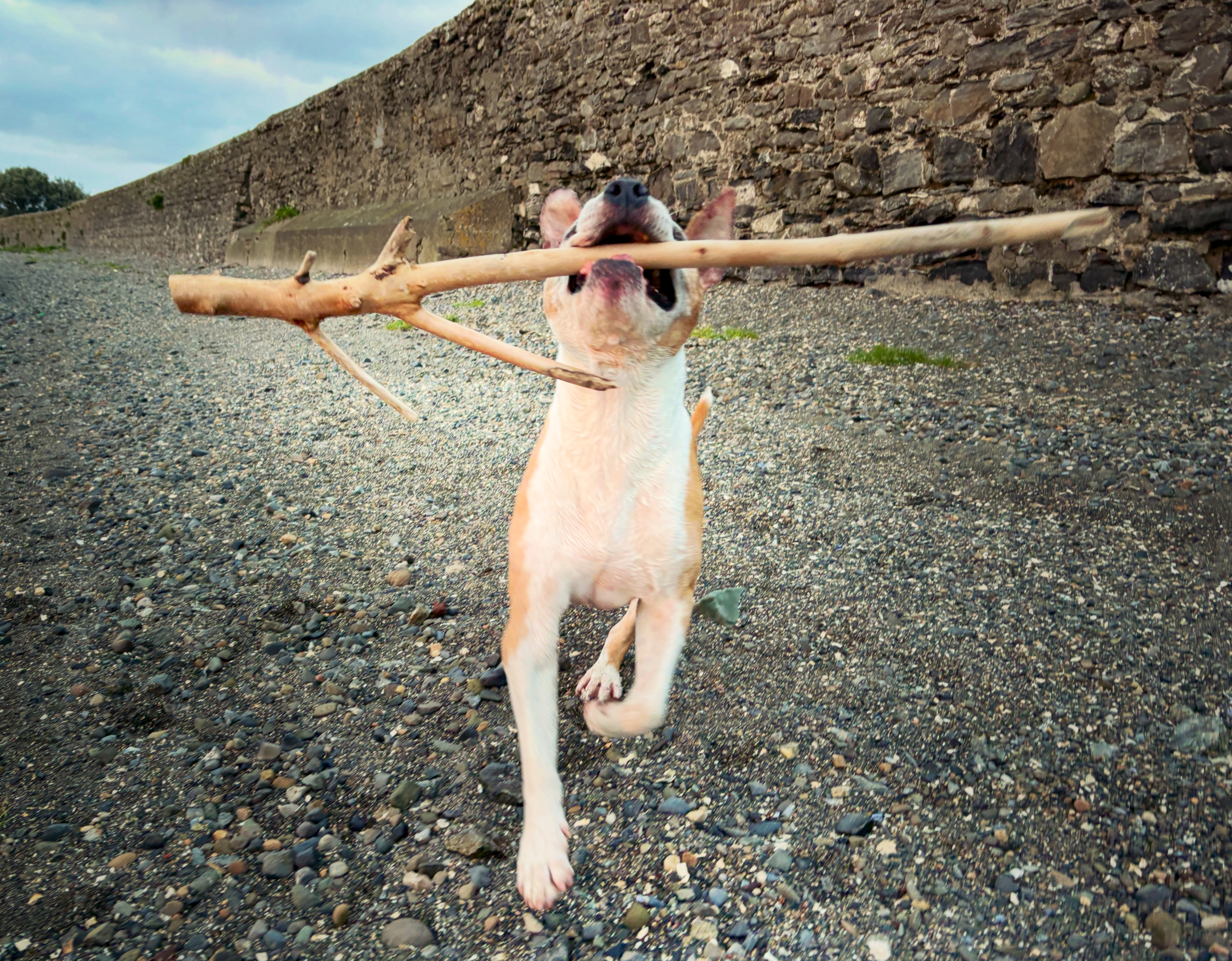
A few months ago, he dissected some washed up wood. Not at all unusual and he has done this hundreds of times before. But before, he had a jaw full of more effective teeth and now, in his old age, he has little dentition left. He swallowed some larger pieces, rather than breaking them up smaller or expelling them from his mouth. This caused some gastritis and an emergency vet visit. He passed the wood and we didn’t have to sedate, anaesthetise, x-ray or do any other scary diagnostics. This time.

Agency

Reading dog-trainer-social-media, you would be forgiven for thinking that “agency” is the latest and greatest. However, this concept has been studied for a while, and most importantly, has been defined and applied to valid works in animal welfare.

Agency is the capacity of animals to engage in voluntary, self-generated, and goal-directed behavior that they are motivated to perform (Wemelsfelder, 1997).

Considering the restrictions and constraints companion dogs experience, true agency, for them living in our human world may be challenging to achieve and challenging for us to provide.

Indeed, an animal’s ability to exercise agency may provide valid assessments of their welfare, their experiences.

Age-related shrinkage

Aging is also associated with brain atrophy, brain shrinkage. Both frontal lobe and hippocampal atrophy is associated with aging in dogs correlating to impaired executive functioning and memory impairments. (Tapp et al, 2004)

Aging dogs experience gradual losses in these abilities affecting their comfort and willingness to explore, learn, participate and engage (Wallis et al, 2016). Many elements necessary for exercising agency.

To survive and thrive, animals must be proactive in their environments, rather than simply reactive. Encouraging their active engagement with their world allows them to develop skills and acquire information for current and future use. Proactively.
This demonstrates the adaptive importance of agency and opportunities to exercise it.

It seems particularly unfair that aging dogs appear to lose competency in olfactory discrimination early on in this process (Salvin et al, 2012). But this may also provide us with insight into the importance of understanding the true focus of agency being on voluntary and self-generated behaviours, those the individual finds most motivating, behaviours that are strongly reinforced.

There are great similarities in the needs of dogs at the bookends of life. Both young and old dogs will require special considerations for their safety and in shaping their world. To mitigate all the shrinkage, aging dogs require extra attention and provisions so that we can maintain a suitably sized world and life, while accommodating their changing abilities.

Giving animals opportunities and options allows them to seek and find the optimal environmental conditions for the individual. (Spinka 2019) This just requires extra special care for aging dogs, careful adaptations, and carer awareness.

Senior dogs need MORE care and considerations for agency as it relates to their welfare. Just how we do this will be individual and challenging, requiring flexibility and ongoing adjustments.

I’m not getting it right all the time; I feel his world contracting, I feel our lives contracting. We have a good foundation in our enriched life and world we’ve built together and for as long as possible, he will continue to get relative freedom at our favourite places or, more precisely, opportunities to exercise agency. It might just look different than it did five years ago or even one year ago. And it will look different in another few weeks or months or however long we have left to experience and experiment.

Behavioural health IS health

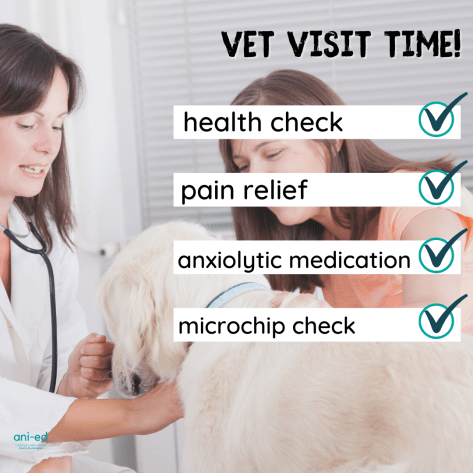
9th December marks the International Day of Veterinary Medicine, recognising the vital contributions that vets, and support staff including RVNs (a valuable profession in and of its own rite), make to animal health & welfare, public health, food safety, policy development and their roles in One Health One Welfare applications.

My favourite cases are those where we get to collaborate and create a care-team for the dog, working alongside allied professionals including the dog’s vet-team. I am so lucky to get to work with some wonderful vets, alongside my clients, creating dream-teams to help pets and their people.

On social media, I regularly, and most recently, see references to “pain trials” and how ‘pet owners’ will need to accept that this isn’t a quick-fix scenario. While I agree that trial analgesia can be lengthy, costly and even overwhelming, it’s up to behaviour professionals to ensure that we are communicating with both our clients and vets, supervising the behavioural aspects appropriately, and collecting and presenting data suitable to both clients and vets to ensure progress can be made.

The buck stops with us.

If the end user/s, clients and vets, are having difficulty with our interventions, rather than targeting external accountability, start within. What can we do better?

A boy who cries pain

It certainly is easier now, more than ever before in my career, to discuss the relationships between physical health, disorder and behaviour. High rates of occurrence of physical contributions are often cited as relating to behaviours of concern, across research, e.g., Mills et al, 2020, and anecdotally from professionals (e.g., in 2024 ~60% of AniEd cases included physical contributors).

While improved recognition is good, there are still gaps in our knowledge, and in the procedures we apply to communicate the relationships between pain and behaviour.

It’s not enough for behaviour professionals to declare that an animal is “in pain”, or lament that the vet just needs to prescribe and get on board. Pain is a multi-dimensional, subjective experience (Wiech et al, 2008). that we can’t rule out on behalf of another individual. It is not easily detectable during visits to the veterinary clinic and diagnostics, like x-rays, can’t provide definitive answers either.

But, fear not! Behaviour is our super-power (in more ways than one!). Behaviour can and should be considered part of clinical signs to inform diagnoses and treatments (Dinwoodie et al, 2021). And we can act as translators between clients & their dogs and the vet-team.

We must be specific and clear. We cannot expect guardians and carers to observe and interpret their dogs’ behaviour – they often do not have the skills for such specific observations, and, it’s incredibly difficult to be objective about your own loved ones.

We must collect information via questionnaire and interview techniques, we must make direct and indirect observations of the dog’s behaviours, and we must support our clients in collecting ongoing data (there will be spreadsheets!). We take this from our clients and translate that into appropriate terms for the dog’s vet-team. No vague statements or euphemisms – actual observable behaviours and evidence-based language that can relate to diagnostic and treatment approaches.

Only the vet can decide on medications, treatment options and diagnostics. But that doesn’t exclude or devalue our contributions, it’s a collaboration!

Behaviour is still in the environment

With our increased awareness and willingness to discuss the bidirectional relationships between physical and behavioural health, it’s everywhere. But as with anything that may be treated as social media fodder, extremes and polarisation are rampant. Pathologising behaviour is widespread as we become convinced by current trends and blinded to the nuances of behaviour.

Of course this infects our insistence about client or veterinary attitudes to our efforts – they are mistaken, their expectations are unreasonable, them, them, them…

Trial analgesia isn’t some panacea. Behaviour is still in the environment. The painful dog’s distance increasing response, e.g., growling and snapping, is still negatively reinforced when the hand reaching for them withdraws. And that response can be maintained beyond our analgesia efforts.

Trial analgesia is just one piece of the puzzle

There are many different types of pain and many types of pain relief. History, data collection and observations may provide some insight into the types of pain potentially contributing to behaviour. Also, it might not.

We can’t just throw things at the wall, hoping something sticks. We form hypotheses using observable behavioural data and our efforts must be falsifiable. Collecting the right data allows us to determine if trial analgesia is appropriate, and, when and what adjustments may be trialed next.

Expectations must be realigned with reality and a roadmap produced for both client and vet-team so we are all on the same journey together. Both need to understand observations that indicate we’re on the right track, and when we’re not…and what that might mean for our plan.
In this collaboration, we are constructing just a fraction of the plan: the clients contributes their bit, the vet-team their bits and the dog must have a say too!

Trial analgesia should be at least 4 weeks, but for clearer data collection, up to 8-12 weeks can be better (Mills et al, 2020). We are not expecting some magical turnaround…remember, behaviour is still in the environment. And we might continue to trial and collect data, or, we might pivot and look at alternative analgesia with continued data collection. We are supervising and supporting along the way (so many shared spreadsheets!).

Given that chronic pain is a chronic stressor, it makes sense that anxiolytic medications may also be indicated (Mills et al, 2020) and may support increased plasticity, helping the brain heal, recover and adapt (Jetsonen, et al, 2025).

Starting both at the same time is sometimes required to improve welfare, but can muddy the waters in our data collection. However, effects can be distinguished at a later time when we have progressed through our intervention plan a little.

Pain relief is not just about pain relief! Pain is multi-systemic affecting behaviour, cognition, inflammation, activity and social interactions. And that means multi-modal pain relief as part of our intervention programs.

Nuance

At AniEd, our professionals and learners do courses and CPD on behaviour health as health, communicating and collaborating with veterinary and allied professionals, and on supervising, guiding and supporting clients in data collection. This is no time for superficial or tenuous recommendations.

I’m not suggesting that awareness of a need for treatment of pain, and other physical contributors to behaviour, should be downplayed. Nope, we have fought hard to build this recognition and we continue to do so.

There must be balance and consideration for how we communicate, supervise and support these investigations as collaborations, as part of team building…building that dream-team.

Hammers & Nails

I don’t often praise social media, particularly in relation to the dog world and dog welfare, but one thing it provides us with is insight into the culture, particularly directed toward dogs, of various dog businesses, pages, organisations and individuals.

That is, these insights, usually videos and posts, provide so much excellent content for learning about canine behaviour, the language we use to discuss behaviour, and often, how not to do those things. But most of all, social media provides us with insight into the understanding, the awareness, the skills & the knowledge of those posting.

Yes, I’m a lurker and a spy. But I claim usage for educational purposes…

Experienced dog professionals, and those who represent themselves in a position of expertise (which on social media doesn’t mean a lot, much of the time), should be a buffer for the quality of the information they produce or share. Maybe someone has shared a clip with them but when they share inappropriate interactions, stressed dogs (without recognising it) or potentially harmful demonstrations, it’s apparent that they may not have a wonderful foundation in understanding canine behaviour.

I have higher expectations of, and hold them to a higher account, these social media content-producers, influencers, experts (or however they rank themselves). Those professionalising dog care, taking fees and charging guardians, those responsible for enforcing dog control legislation, those who care for vulnerable dogs and those advising guardians on “responsible dog ownership” must be unimpeachable in their knowledge and skill regarding canine behaviour, welfare, handling and care.

But our education on canine behaviour is not standardised and without accountability. And that means despite someone’s title, social media hype and postnominals, we might not be able to expect a whole lot.

Often through social media, or, at least facilitated by social media, professionals are drawn to the latest and greatest. I note who is reaching for the fads, noting that foundations in knowledge and skill must be lacking such is their vulnerability to the marketing and the hype.

Maslow’s hammer

The outcome of our interactions with dogs are a result of environmental conditions. This is a fundamental understanding of animal behaviour – behaviour is not in the individual, it’s in the environment. And as humans, we are largely responsible for the environmental conditions to which dogs are exposed.

During this past week, International Day for the Elimination of Violence Against Women was marked. I can’t help relating any of the world’s goings-on to dogs, and our relationships with dogs. Dogs and humans are joined, intertwined, and separation and separate considerations are not possible.

Misogyny and machismo, and their impacts on violence, can be felt throughout dog training, behaviour & care. Our fields of work and study have not escaped violence, aggression, and cruelty inflicted on dogs in the name of “training”, “welfare” and “safety”.

The direct examples, of course, include deliberate abuse and violence suffered by dogs in homes and families affected by domestic violence, and the focus on companion dogs, and other companion animals, as tools for coercive control.

But our industry has been and continues to be shaped by tools and techniques, attitudes and advice, that presents violence, aggression and cruelty as a means, and first line option, for maintaining safety of humans. And that very idea of safety is weaponised against dogs who are victims of their circumstances.

As someone who works with dogs under stress, whose behaviour can pose serious safety risk to humans, and sometimes where there is urgent pressure to clear the way safely, I acknowledge that from time to time, direct action is required.

But, when all you have is a hammer, everything looks like a nail. When the foundation understanding of behaviour is incomplete, partially constructed, or lacking, it’s easier for these direct actions, most often acts of violence and aggression against dogs, to be implemented.

If this, a basis in coercion and suppression, is central to the education of professionals then it all too easily becomes normalised and accepted. Even more.

When I see professionals, on whom I have been spying via their socials, demonstrate lacking in these areas and a focus on education in those areas, I am very concerned that some of our most vulnerable dogs will suffer. And people won’t be any safer.
But machismo will have won again, begetting more violence, perpetuating more aggression, creating more macho-men who blame dogs, label dogs, persecute dogs.

What we do to dogs.

Here we go again…2025 edition

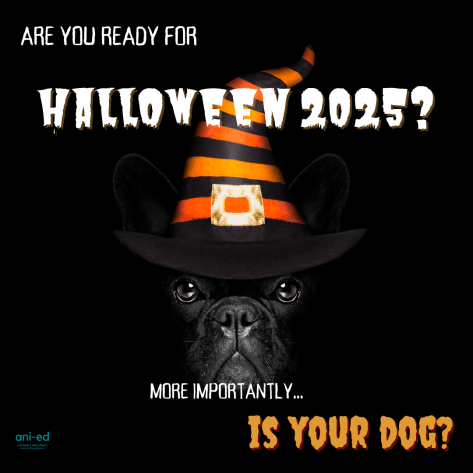
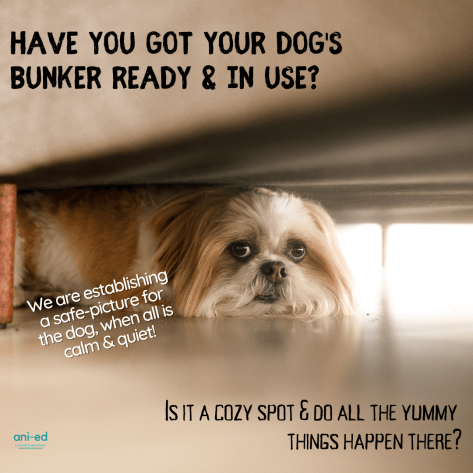
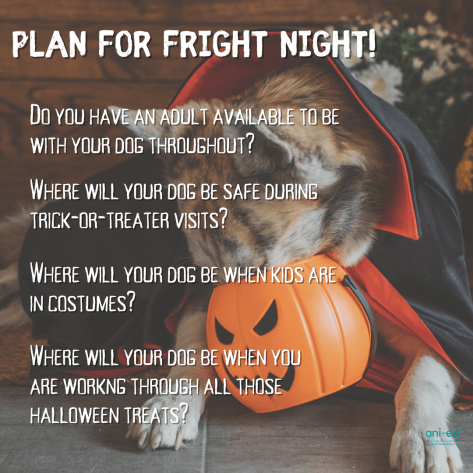
Almost every year I write on this topic and post on social media extensively in the run-up to and well in advance of fright-night. There are so many things we can do to help dogs better cope with fireworks and Halloween activity but fear of same has become normalised.

Every year videos and accounts of terribly distressed dogs are shared, awful stories of the aftermath with missing and dead dogs, and both professionals and guardians promoting inappropriate procedures and poorly supported products.

I can understand some apathy…noise fears are challenging and it requires lots of time and planning to help improve dogs’ comfort. And the nature of pre-Halloween fireworks make it even more difficult for pets and their people.

But dogs don’t have to be frightened of noises like fireworks. There are things we can do to prevent it ever developing, to reduce its impacts and to improve their comfort and coping.

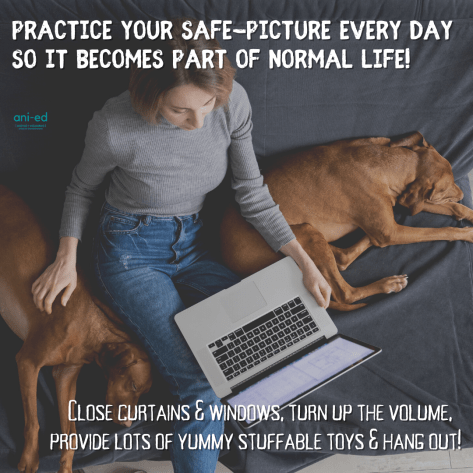
Survive Noise Events

Download this handout here and practice in advance. Practice, practice, practice!

This guidance also forms the basis for the programs we work through, usually starting in February, to help improve comfort and coping for noise events. There’s more to it, for sure, but this is the foundation.

Clip link

Start early

This year, I had reports, from clients all over the country, reporting fireworks and their dogs’ responses as early as late August.

Get all the info…

Prepare for the aftermath…

Fireworks distress doesn’t end when the trick-or-treating is done. While fireworks can continue beyond fright-night, so too do the effects of distress, panic and fear.

Read more, and have a plan in place: Halloween Hangover

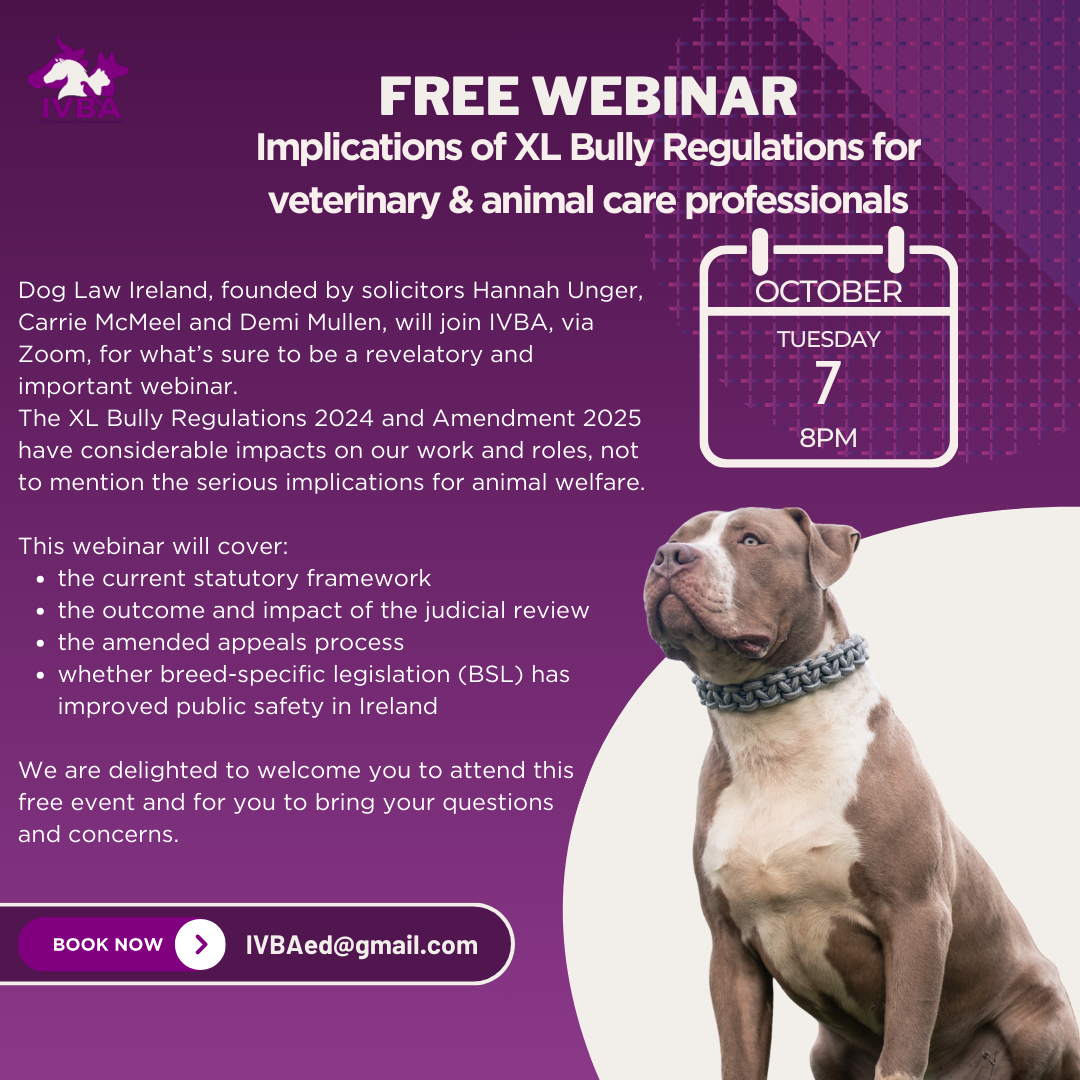
FREE IVBA Webinar

Wearing one of my other hats, I’m honoured to be vice-chair of IVBA and I get to organise our member educational program according to member and industry feedback.

This time, we have a wonderful FREE webinar coming up on Tuesday 7th October at 8pm, with Dog Law Ireland.

Dog Law Ireland, founded by solicitors Hannah Unger, Carrie McMeel and Demi Mullen, will join IVBA, via Zoom, for what’s sure to be a revelatory and important webinar.

The XL Bully Regulations 2024 and Amendment 2025 have considerable impacts on our work and roles, not to mention the serious implications for animal welfare.

This webinar will cover:

– the current statutory framework

– the outcome and impact of the judicial review

– the amended appeals process

– whether breed-specific legislation (BSL) has improved public safety in Ireland

We are delighted to welcome you to attend this free event and for you to bring your questions and concerns. All are welcome and tell your friends!

You must book a spot by emailing IVBAed@gmail.com

Meeting Needs. Needs More.

“Meeting needs” is all the rage. There are countless posts, videos, reels, shorts, TikToks, you name it, devoted to showing dogs running and sniffing and exploring and chewing. And countless trainers telling us what dogs need.

This is something I can get behind. But like so many things in our industry, “meeting needs” is the latest in a long long line of fads, championed by social media, that fall apart when scrutinised in any way other than superficially.

And by that I mean, there are some glaring blindspots in this sort of promotion, unsurprisingly. Social media, with it’s rapid consumption via scrolling, often misses out on providing substance and meaning, which of course leads to loss of nuance…the one most consistent feature of every behaviour related topic.

What are behavioural needs?

Behavioural needs are behaviours that are induced by internal (Friend, 1989) and external factors that arise to adapt to the challenges of behavioural restriction (Ninomiya 2014).

This means that we look at what access and exposure that’s lacking for an individual dog, and we make up the difference. Appropriate enrichment should fill those gaps but our efforts won’t be able to compensate for every loss and compromise that dogs living in our human world will experience.

What do dogs need?

Animal welfare science continues to explore quality of life and basic welfare criteria for maintaining the health and welfare of dogs as companion animals. Truth be told, the welfare of companion dogs has been sparsely studied in meaningful ways. It’s largely assumed that, because dogs live with us so entwined within our lives, that they must experience good welfare.

In general, the Five Domains (Mellor et al, 2020) provide a welfare framework defining both positive and negative welfare states in animals. This model has been expanded to include behavioural welfare and human-animal interactions’ effect on welfare standards.

Griffin, et al, 2023, adapted Maslow’s Hierarchy of Needs (for humans) to create a hierarchy of dogs’ needs.

Sniffing is great…but…

Providing dogs with appropriate outlets for species and breed specific needs is important. Nobody is arguing with that.

But meeting dogs needs means that we need to go beyond just one element in our care of our dogs, who live in our complex and not-dog-centric world.

While hierarchies are not necessarily effective as sole frameworks, this one can provide a foundation in understanding how we can structure needs-based interventions.

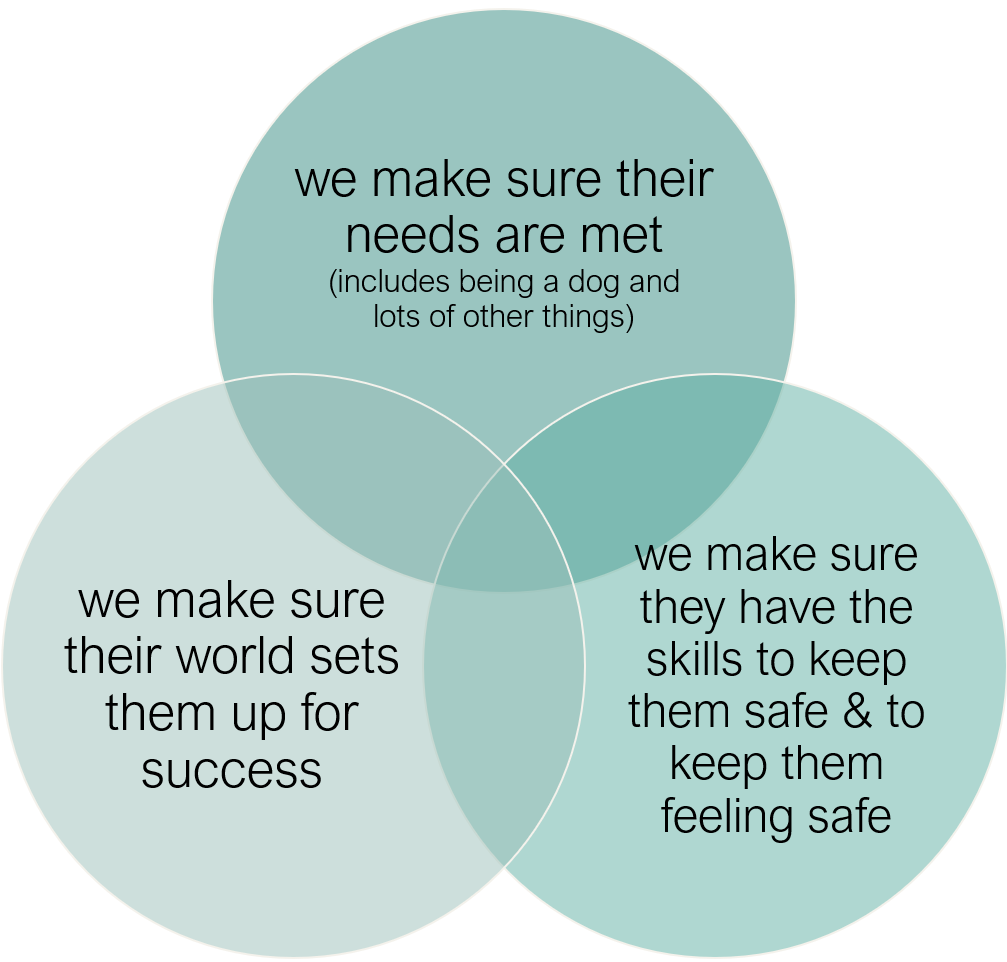
Dogs need to be safe and to feel safe. And to do that, like it or loathe it, they must be able to live in the human world.

Dogs are not humans and don’t come inbuilt with some of the abilities we have for fitting in. Even we require years and years of guidance, education and support to barely survive in our sometimes cruel world, plus our society has devised layers of punitive actions for those who are not compliant.

Our dogs need to learn how to live comfortably in the human world and that requires skills (behaviours) that we are responsible for teaching them.

They need multi-species social skills, they need handling & proximity skills, they need reinforcement skills, they need settling and confinement skills, and then some, plus they need to be able to perform these behaviours under various conditions.

But skills alone won’t do it. They need humans who are aware of balancing the layers that are required to maintain their behavioural health and welfare.

That’s our job, as tour guide to this foreign culture and our alien world.

Skill building requires careful set-ups and management, and good teaching, plus making sure dogs have outlets for all the cool stuff.

When the balance is off, the dog may be left with deficits that require more intense management, anxiolytic medications and a smaller world. This is all fine, particularly when applied with knowledge and awareness, but what happens when the dog must be exposed to the bigger, badder world.
What happens when they have to go to the vet for treatment?
What happens when they have to move to another home with a different layout?
What happens when the kids have to come to stay?
What happens when that big barky dog moves in nextdoor?

What happens when they have to face the things we haven’t given them skills for?

We have back-up plans for the back-up plans. Because our responses to our dogs’ behavioural needs are so often reactive, we are behind the curve on every count. And the dog suffers.

Good teaching is a welfare issue. As humans, we have tendency to make it about obedience and compliance. But good teaching isn’t about that; it’s about setting the dog up to succeed, it’s about keeping them feeling safe because they have the skills to cope with what our world has to throw at them.
And that only works when we truly meet their needs. Beyond sniffing. Through skill-building.

What does your dog wish YOU knew about dog behaviour?

Have a think about this deceptively simple question…

What does your dog wish you knew more of about dog behaviour…about their behaviour and behavioural health?

Perhaps it’s knowledge you’ve developed and your dog’s wishes have come true…or perhaps there’s mysteries about canine behaviour that you’ve yet to unlock?

Whatever it is, we want to hear from you! There are no wrong or right answers and we’ll share what we would love all dog carers to know too soon!

Dogs as spare parts

Visualise the scene with me…

The grown-up holds the ~five foot lead…the dog at its very end…two small humans kick a ball and grown-up pursues…dog is moved along, jerked from left to right…

Indulge me again, if you will…

Picture any weekend market pretty much anywhere and you will see it…dogs on lead, scanning & surveying, tight mouths panting…
Humans moving them by their lead, pressing on their back ends to keep them sitting, restraining them from moving freely amongst so much mouth-watering food, allowing them directly approach others regardless of comfort, exerting enormous social pressure on them…

Surely, our dogs are enjoying just being there. Just being with us. Basking in our presence. Being our spare parts while we enjoy ourselves.

Dogs have fulfilled lots and lots of roles throughout their history alongside humans. As our communities evolve, so too do our relationships with our canine companions. For the most part, dogs are exceptionally adaptive but their abilities to cope with busy human-centric environments and lifestyles is only half the battle.

Dog (Un)friendly

Expansions of human-centric environments to incorporate dogs, while trendy and popular on social media, is big business. Allowing clientele bring their dog is all the rage and I can see the appeal.
As society, in general, becomes less tolerant of dogs and guardians, we want to show ’em that our dogs are special, and loved family members.

But, are we stopping long enough to ask, what our dogs might want and need?

Ignorance is bliss

Being oblivious to the experiences of dogs is something I envy often, particularly when I’m out in public where there are dogs. I would love not be aware of dogs’ discomfort or of them being put in inappropriate situations. I would love not to have the gift of foresight for where this will land in three months, six months, two years time.

Becoming aware of our dogs’ experiences can be both enlightening and heart breaking all at once.

Humans Humans Humans

We tend to take an anthropocentric view of dogs, discussing our relationships with them in terms of how they benefit us. We get dogs for companionship, to get us out walking, to help us connect with our communities, to help us, us us us.

Getting a dog isn’t some convenience, getting a dog isn’t to complete your family, getting a dog is not for practicing parenting or teaching kids life-lessons.

Dogs are not auxiliaries to the brunch or the picnic or the cafe lifestyles. Dogs aren’t tools. They aren’t spare parts.

Our dogs have needs and individual requirements that can only be established by us because we control everything. That’s the human-centric part…the buck stops with us…

What about “working dogs”?

We have spent a long time and much effort developing types of dogs that fulfill pretty specific roles. These dogs come with innate tendencies, built-in and requiring refinement to do their job.

Looking at traditional working dog histories it can be easier to see where notions of “dogs wanting to please us” came from; dogs were tasked with doing behaviours innately reinforcing for them because we had selected for that. And even then, we make it all about us.

Modern jobs for dogs have taken existing types and have continued to attempt to develop their tendencies, often trying to squeeze square pegs into round holes. Rather than choosing traits, we attempt to select against and suppress unwanted characteristics.

The promotion of dogs in every heroic role, particularly via social media, leads to raised and unrealistic expectations for all dogs. Dogs are amazing but their awesomeness is independent of their service to us.

It’s not a quid pro quo, ya know?!

Dogs don’t owe us anything.

Our dogs don’t owe us “good” behaviour just because we took them home and feed them.

Our dogs are not beholden to us and our expectations of them.

Dogs as spare parts

If one wants dogs to fit in in this way, that’s fine; I don’t run anyone else’s life. But expectations will need to change. That’s the bottom line.

And while expectations might change…what about the welfare experience of dogs? That doesn’t change, regardless of our whims, intentions or wants.

Are we really “rescuing” dogs, when we warehouse them, sometimes, for years?

Are we really considering the actual welfare of assistance dogs, therapy dogs, dogs as tools to serve human well-being?

Are we really meeting dogs’ needs with agility, food toys & human-directed detection sports…or whatever the activity du jour?

Is the “pet-life” really a good life? Is it good enough?

To me, the biggest threats to canine welfare are not shock collars or “balanced trainers”, it’s our blindness to dogs’ experiences and our apparent unwillingness to recognise their needs as important and distinct from our own.

This all turned out to be far more ranty than initially intended but there are important thought-experiments to consider. There are actions we can take proactively and we should focus on moving forward with our concerns in mind.