Category Archives: AniEd

Monster is Moving Game

There are lots of ways to help a dog showing fear-related behaviours, but “facing their fear”, “socialising” them, exerting social pressure or coercion and/or attempting to lure them with food are generally not appropriate, safe, kind or effective.

The dog’s behaviour is information telling us what they need. When they display avoidance behaviour, distance and relief meet those needs.

Helping them feel safer is key, not attempting to be friends with them. That might come, but safety first!

Our approaching them, touching them, and even talking to them may not bring them comfort in those moments, when their brain is telling their body to get outta there!

Preventing new people coming in on top of them, giving them space from unfamiliar people, having them on lead, and their own human making sniffing for yummies happen are really important foundations for guest greeting protocols.

Think of establishing a new and predictable guest greeting routine and practice with familiar people first.

It might look something like this:

  • have your guests call or message rather than approaching the door
  • secure your dog in another room or area, ideally where they can’t see your guests, before you answer the door
  • bring your guests in and settle them
  • scatter some amazing yummies on the floor in the area you will hang out with your dog
  • visit with your dog, calm them a little, pop them on lead
  • when you bring them into the room with your guests, move to the furthest spot
  • encourage your dog to snuffle for the goodies
  • continue to toss treats for them

Alternatively, have your guests wait outside and bring your dog out on lead. Circle around behind your guests and have them enter the house and settle. Bring the dog in after and give them space and time for snuffling.

With that in place to establish more predictable guest greeting routines, we can start to teach the dog new skills.

Monster is Moving

This is a communication game and a great way to improve predictability and provide them with ways of controlling what happens to them.

Clip link

At their safe distance (which they determine and we interpret via their responses), we teach the dog to control the situation:

1. Teach the dog to move away and eat tossed treats – food is tossed away from the Monster, into free space

2. Wait for them to learn to look toward the Monster before tossing & moving. Reinforce by tossing away. Two rewards: distance + yummies

3. When offered fluently, add a verbal cue, “Ready!”

Say “Ready!”, wait for them to look toward (eye contact not necessary and lifting their head might be sufficient), toss so they can move away.

4. At BIG distances, and after lots of practice establishing this exercise as part of a predictable guest greeting routine, cue “Ready!”, toss, Monster moves, toss again.

The Monster moves only when the dog can move away.

Practice guest greeting routines and this game with people with whom the dog is comfortable before introducing Monsters! Distance is always your friend, and is the function of fear related behaviours.

You are asking the dog if they are ready at each stage. Listen to the dog and give them what they need!

A Couple of Spots Left!

We have started a new program of webinars, that we hope to develop further, and the best bit is that they are pay-what-you-can!

We want to get evidence based information out there to everyone and reduce barriers in terms of accessibility and financials. This weekend, and next, we are starting this venture.

I have kept the numbers small and am going to take a few more so we have a group, with nobody falling through the cracks.

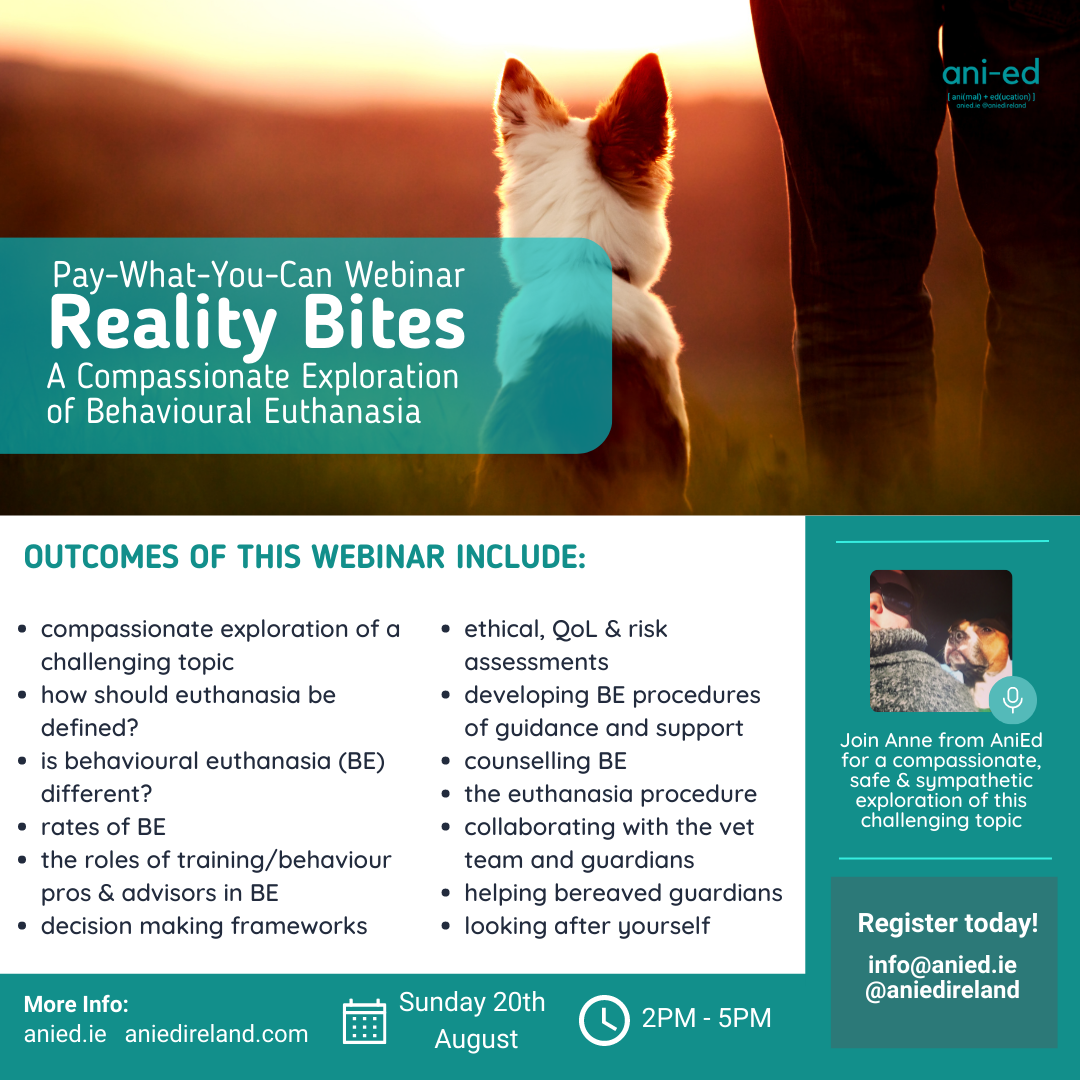
Our first, examining behavioural euthanasia, is this weekend.

And the following, looks at applying fundamental principles in creative ways:

You can find more information and book your spot here.

Please do get in touch if you want to know more!

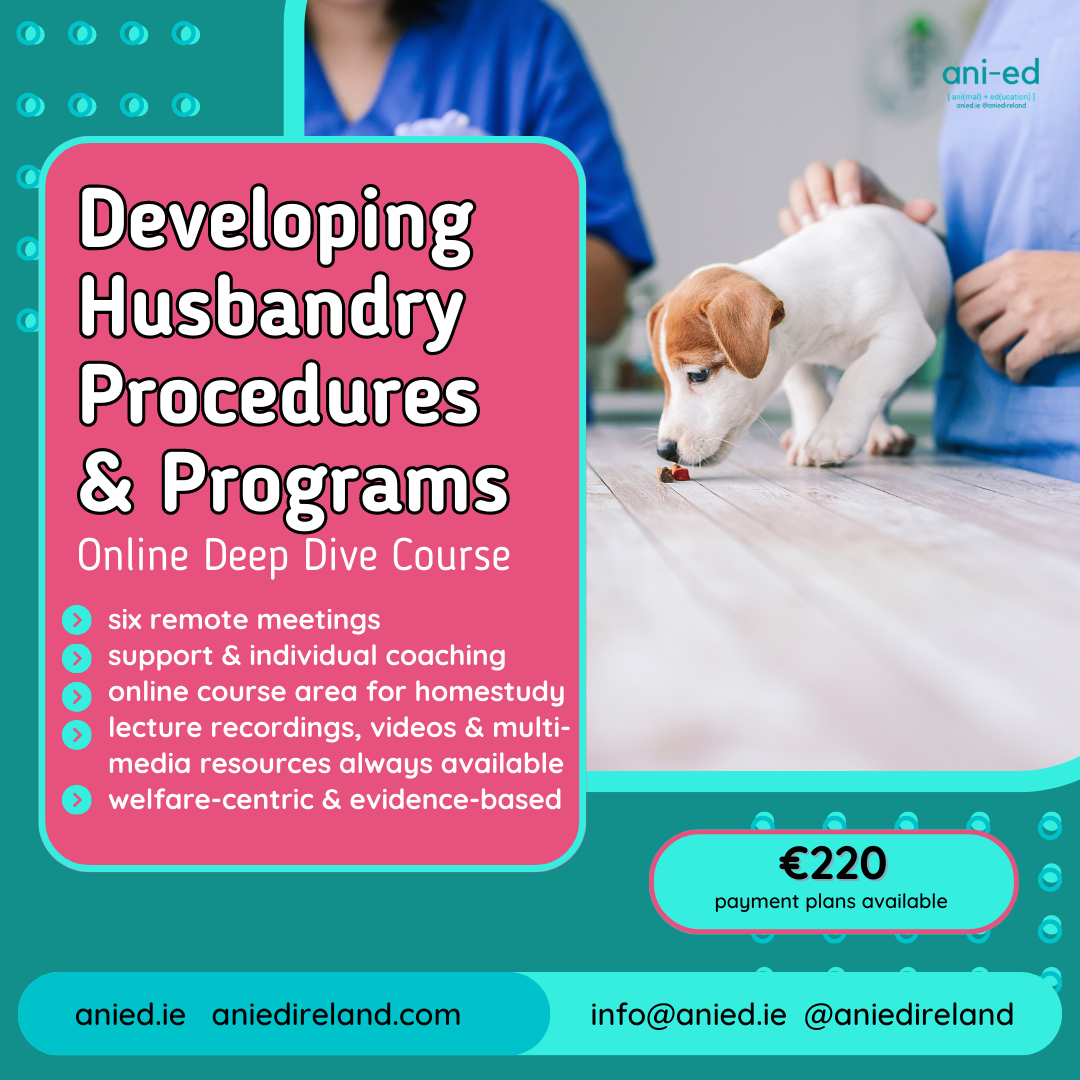
NEW! Deep Dive Husbandry Behaviours Course

Are you interested in applying for our CBTT program, when applications open?

Maybe you are aware of the buzz about teaching husbandry behaviours to animals and want to explore even more…?

We are bringing this course forward, for one, because it’s an awesome and important course, but also, for those wishing to continue with our CBTT program. This course is the perfect starter to get a taste for working with us and for immersing yourself in evidence based education.

Jump to:

Teaching husbandry behaviours to captive animals was very much inspired by Project Pigeon, a US government sponsored program teaching pigeons to guide bombs. This took Skinner’s operant shaping outside the lab and to another species. About a decade later, during the 1950’s some of his colleagues, the Brelands, began working with marine mammals in parks.

(Fernandez & Martin 2021)

The rest, as they say, is history but it took us quite a while to bring these principles from captive wild collections like zoos into the companion animal veterinary context.

The ever broadening popularity of programs such as iCatCare Cat Friendly and Fear Free continues to spread awareness, building on increasing interest in the welfare of our companion animals during husbandry procedures that’s been developing in the industry for last two or three decades.

Understanding this history is important as the evolution of this area has really accelerated. And that means we must scrutinise and carefully critically evaluate the approaches we take to avoid fads and social media hype.

Concepts such as “choice” and “cooerpative care” sound like something we want to add…but what does this really mean for our animal learners? Often times, when we use food and attempt to reduce force (from our point of view), we believe we are applying these concepts under a positive reinforcement umbrella. But, just because we want to provide choices and just because we use food doesn’t mean the animal’s experience is choice filled and cooperative.

How can we know if we are really doing what we intend?
Can our dogs really be ‘cooperative’ or give ‘consent’?

We will investigate this intensively during this course.

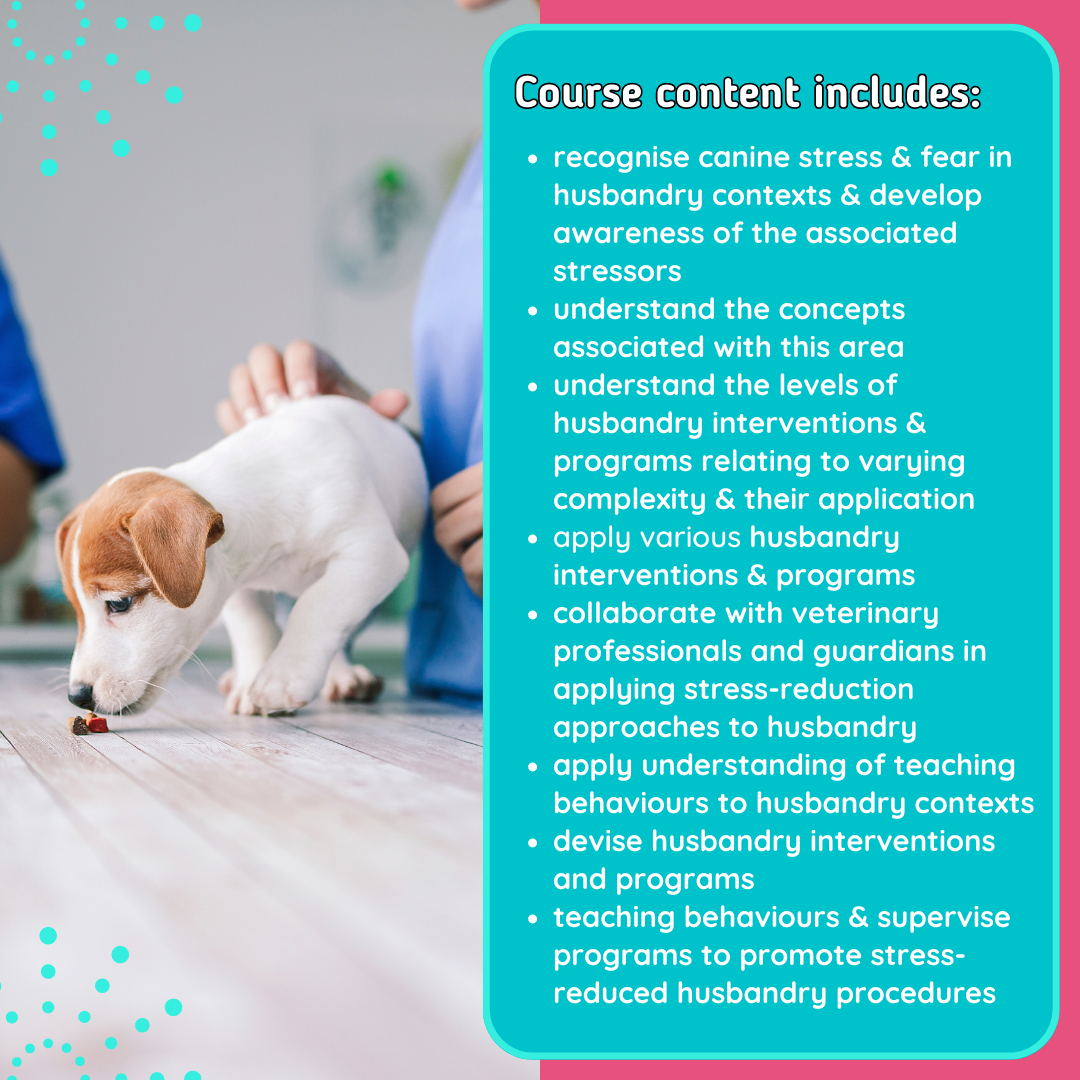
This thorough understanding allows us to develop husbandry interventions and programs…but we also must be able to apply this understanding.

And that’s why excellent mechanical teaching skills are emphasised too. If you are teaching cleanly and from a welfare-perspective, fuzzy concepts like “consent”, “choice” and “cooperative” care, are not required.

On this course, you also have free access to our Foundation Mechanical Skills program so that you are sure to have the support to apply your programs so that you learner is supported and learns efficiently. Teaching mechanics are a welfare issue!

What do I get when I take this course?

  • 24/7 access to the course online area, from anywhere, for six months (& beyond)
  • six remote course group meetings during which we will go through course content and set up you up for ongoing homestudy and teaching practice
  • regular individual remote coaching sessions, as needed, and distributed throughout course delivery
  • multi-media learning resources for viewing and downloading
  • about 20 mini-lectures (in the form of written presentations supported by videos, images, exercises & multi-media resources) covering husbandry program development and related evidence presented in small-ish bites so that you can take time to process and analyse
  • free access to our Foundation Mechanical Skills program which is packed full of practical information & demonstrations to help you apply clean & welfare-centric teaching
  • comment facility at the online course area for participation, enquiries, interactions
  • ongoing online interaction with fellow-students and your tutor as we take this journey of discovery together

Submission of final assessment work is optional but you are encouraged to work through assessment and self-evaluation to support knowledge development and skill building.

Obviously, to get the full benefit, we encourage the fullest possible participation.

After successfully submitting completed final assessment work, you will be awarded an AniEd certificate of achievement.

When is this course?

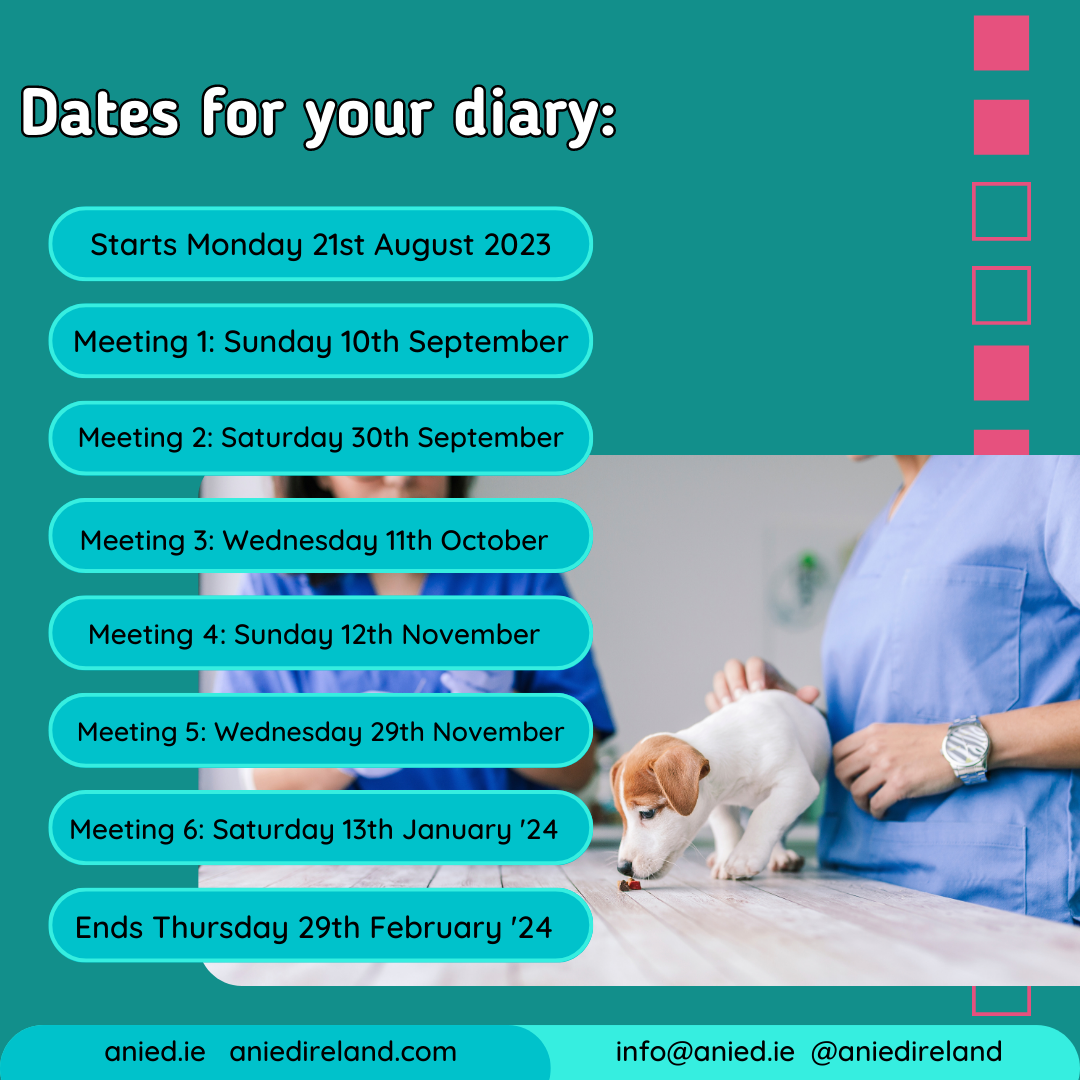
This Deep Dive course opens on Monday 21st August and as soon as you have completed enrolment on or after this date, you will be sent the first of your course content so that you can begin!

Our first remote meeting is on Sunday 10th September and you much have completed enrolment by this date to join this run.

Where?

Anywhere, any time! This course is entirely online so you can participate when and where you like….from your sofa…in your PJs…
You will have access to all the course materials to download to your device so you can work even without an internet connection.

Who?

This course is for all trainers, teachers, behaviour pros, hobbyists and pet guardians with a keen interest in teaching our animal learners in the most welfare centric way, and in examining our applications of positive reinforcement based interventions.

To get maximum benefit, you should have a basic understanding of applying operant teaching, using markers (like clickers) and delivering reinforcement.
It’s particularly suited to dog care pros such as veterinary personnel, training/behaviour pros and groomers.

All are welcome, no matter how you teach or train. This course emphasises a reinforcement based approach to teaching and teaching approaches that maximises the learners’ control. As teachers, we are responsible for setting up our learners for success so application of punishers and aversives is minimised.

How long? 

This course consists of six remote meetings which act as cornerstones to guide your ongoing learning across six months.

However, we don’t put pressure on learners about deadlines so this is individual and can be discussed with each learner. 
More about Studying with AniEd here.

How much?

This course costs €220. 
You can pay the entire fee or discuss an agreed upon payment plan with us. (Simply ask by emailing info@anied.ie)

Course fees must be paid in full before you can access the online area. Please read the terms at application carefully before committing as there are no refunds, full or partial, for any reason, after you have been given access to course materials. 

What will I learn about? 

There are six parts to this course, each part examined during each remote meeting.

Part 1:

  • examining fuzzy concepts
  • giving the animal “control”
  • principles of husbandry teaching
  • history & evidence

Part 2:

  • understanding the veterinary experience for all stakeholders

Part 3:

  • Level 1 Husbandry Interventions & Programs
  • Setting the Scene

Part 4:

  • Level 2 Husbandry Interventions & Programs
  • Teaching coping/management skills

Part 5:

  • Level 3 Husbandry Interventions & Programs
  • Husbandry at Home

Part 6:

  • Level 4 Husbandry Interventions & Programs
  • Teaching husbandry behaviours

Anne Rogers will be your tutor on this course. Here she works with her beloved Decker on some ear husbandry:

Clip link

More about this procedure here.

What do I need to participate?

  • Email address/account, a suitable device and internet access; course materials are presented in MS Word, PDF and links for downloading. You should not have difficulty on most devices and OS.
  • Stationary for note-taking (if that’s the way you work).
  • You need to be able to use the internet, blogs, social media, and if you wish to participate to the fullest, be able to record and upload short demonstration clips, complete assessment work in Word documents, PDFs and other basic computer skills.
  • To complete some assessment work, and get the most out of most of our courses, you will need access to at least one dog or animal learner.
    While most discussion is dog-focused, all animal learners may participate.
  • Means to video yourself and upload your clips for guidance and feedback and to submit assessment work. You will be required to upload video assessment work, according to assessment guidelines, to a video sharing site, such as YouTube. 
  • Access to MS Teams (we will send you a link, you don’t even need an account, just an email address), and a device that allows you to participate in online video meetings for group meetings and private coaching sessions.
  • You will need general training/handling equipment, markers, reinforcers, husbandry tools such as brushes or grooming equipment appropriate to your chosen procedures & programs. It is recommended that you purchase toy or mock veterinary equipment, such as children’s doctor or vet kits that include toy stethoscope and so on.
    Having access to a safe table or elevated surface on which to work with your learner, such as a grooming table or sofa, for example, is helpful too.

APPLY!

Are you up for this challenging and rewarding course? Join us today!

Apply here by completing this form and enrolment requirements.

If you would like to discuss this course further, discuss payment plans or discuss entry requirements, please get in touch by emailing info@anied.ie

Visiting your dog

In developing a program for in-home care visits, I really wanted the opportunity to hang out with cool dogs. Just me + your dog!

I recognise that there are lots of dogs who will benefit most from hanging out at home, while their humans are away, rather than going somewhere else for care. I want to help these special dogs but really I want to hang out with some cool dogs!

What happens during in-home care visits? Recently I provided six visits, over three days for Mo, who is Behaviour Matters team member.

Given our understanding of canine behaviour and managing canine stress, we can structure these visits so that the dog has appropriate outlets for their stress and to facilitate their recovery so that they can relax until their next visit.

Initial Crazies

When a person enters the home, whether familiar or unfamiliar, the dog is expected to experience a surge in arousal, which prepares them for interactions, positive, negative or unknown.

In a new context, with their humans away, spending time alone, and a person entering, we might expect the dog to experience greater swings in these responses.

Rather than attempting to “calm” the dog, I prefer to channel it and provide the dog with outlets to redirect their experiences. These are the initial crazies!

Mo tells me, in no uncertain terms, that he’s not quite got all
the crazies out just yet so football should continue!

Usually providing something for the dog to bite at, chew, or even just carry can help. I might pair that with some chasing or other energy expenditure that allows for focusing on something. That’s what arousal does; it hones focus so that the dog can deal with that specific challenge.

Clip link

As the crazies begin to reduce in intensity, we can switch to some games that encourage a little more thinking through arousal, and rollercoaster in some sniffing breaks.

Clip link

This helps the crazy to taper off a little so that we can clear the way for some sniffing and get ready for further activities that provide more well rounded activities.

The Go Find It! game is one of my favourites for bridging those gaps and rollercoastering.

Clip link

Activities

Once we have some of the initial crazy out, we can structure a visit to allow for both physical and mental exercise and entertainment.

We start with more engrossing and exciting activities and rollercoaster throughout.

Activities will depend on the individual dog, their circumstance and preferences. Their behaviour is information telling us what they need, and what reinforcers their behaviours. These will be the activities they will seek out so I want to make sure there is an abundance of reinforcers available for that dog.

One of my favourites, particularly if the dog isn’t going on adventures with me, are SNIFFARI boxes, bringing the smellside inside!

Clip link

Clip link

Clip link

Just add water for more fun!

Clip link

Mo loves bubble chasing but as a less arousing and exerting version of this game, we played bubble-hunting instead! By firing the bubbles into the longer grass, they remain stuck, allowing for more systematic hunting.

Clip link

Watersports!

Clip link

Outings

Walks and outings just won’t be the same without their humans and I’m definitely going to be taking some extra precautions if bringing the dog out and about. At the very least, I will often add one extra point of connection, just in case their primary equipment should fail for any reason.

Once the dog has been able to come down a little from those initial crazies, and we have worked a little on engagement, we can go adventuring.

Outings are not “obedience exercises”, but we do practice lots of engagement exercises. Engagement means that the dog chooses you, without cueing, nagging, jerking. We know it’s time to work on engagement, when the dog chooses to engage.

Clip link

Clip link

Sniffy walks are the best for dogs in general, but also when their routine is otherwise messy, they provide for excellent exercise, both mentally and physically, and outlets for stress.

Clip link

While we always make time for sniffing & exploration, we also make sure there’s plenty of silliness too!

Clip link

Clip link

Rollercoasters are for outings too! After some time ‘up’, we take a break.

Clip link

Hanging out

Just being is my favourite thing to do with dogs. But it doesn’t necessarily come easily to dogs and certainly not when their background level of stress may be raised due to their humans being absent and the subsequent routine changes.

By directing and redirecting their stress related behaviours, they will be able to calm and settle themselves. With rounds of rollercoasters, a wind down can be applied allowing the dog to be nice and chilled by the time I’m leaving.

Clip link

Clip link

There is no reason for us to expect to be able to touch a dog or that our touching them will be comforting to them.

When the dog seeks out contact, I will very respectfully ask them where and how. By capping touching to no more than a 3-count and only when solicited, the dog learns how to control those interactions boosting comfort and safety.

Clip link

We take time for hanging out and just being on outings too; winding down before we get back home too.

Clip link

Winding down starts at least 30 minutes before departure, but may depend on the dog. Making calmer and exploration based activities available along with peaceful hanging out, facilitates the dog finding it easier to choose calming in preparation for alone time.

Clip link

Rollercoasters

It’s all rollercoasters! Listening to the dog and allowing their behaviour inform our approach means that we can provide acceptable outlets for stress and help them to recover.

More about rollercoasters and winding down here; trust me, you and your dog need this!

Seaside SNIFFARI boxes

On our #100DaysOfEnrichment program Sniffaris are olfactory, and often, multi-sensory, adventures. And although they are often contrived, they can be an excellet way to broaden your dog’s olfactory world, without using food.

I have found them to be so beneficial for so many dogs, in different ways, that they feature on 100Days twice!

See Days 76 and 97!

These sniffaris are a great way of bringing the smellside inside and expanding a dog’s world, without having to expose them to further stressors.

Clip link

Quite simply, I did some beach combing and was able to bring those experiences in to make some sniffari boxes. Once thoroughly investigated, the addition of water creates a rock pool expanding the sensory experience even more.

Collecting smelly things and bringing them back to your dog, once safe, can be an awesome way of helping dogs who are restricted for whatever reason still experience the world through their nose and provide calm exploration.

Check out our #100DaysOfEnrichment program – it’s always free & available!

Sneak Peak!

We have lots of new and shiny things coming your way this summer and autumn.

While we’re not quite ready for bookings just yet, if you want in and at the top of the line, email (info@anied.ie) or message us (@aniedireland) and I will get you on the list straight away.
This may also help you budget for courses you plan to take.

Get ready to mark your calendars!

Developing Husbandry Procedures & Programs

Take a deep deep dive in to the development and implementation of husbandry programs.

While husbandry training has become greatly popular in dog training circles, which is a good thing, an examination of the basic principles is needed.

Can these procedures really be “cooperative”?
Do dogs have “choice” in these interactions?
What more accurate and quantitative models can we apply?

This and so much more should be investigated and our best efforts applied to making sure we can really make husbandry as welfare friendly as possible. And that means understanding the dog’s experience from their point of view.

Full details coming soon!

Pay-What-You-Can webinars

We have a couple of afternoon webinars coming up that allow us to take a deeper dive into some fascinating topics.

We will be starting the challenging topic of behavioural euthanasia, examining our roles in supporting pet guardians facing these unenviable and heart wrenching decisions.

This will be a compassionate exploration where we are all safe to bring our questions about this topic that so often leads to polarised discussion.

Details:

And then we will look at just how applicable, versatile and important the foundation principles of teaching are. I will illustrate each of these principles with examples from real cases, tons of video footage and a look at how we can apply these seemingly simple ideas to even complex cases.

Details:

We are asking for €5 – €30 or whatever you can.

Booking will be available soon and if you want to get ahead of the pack, get in touch!

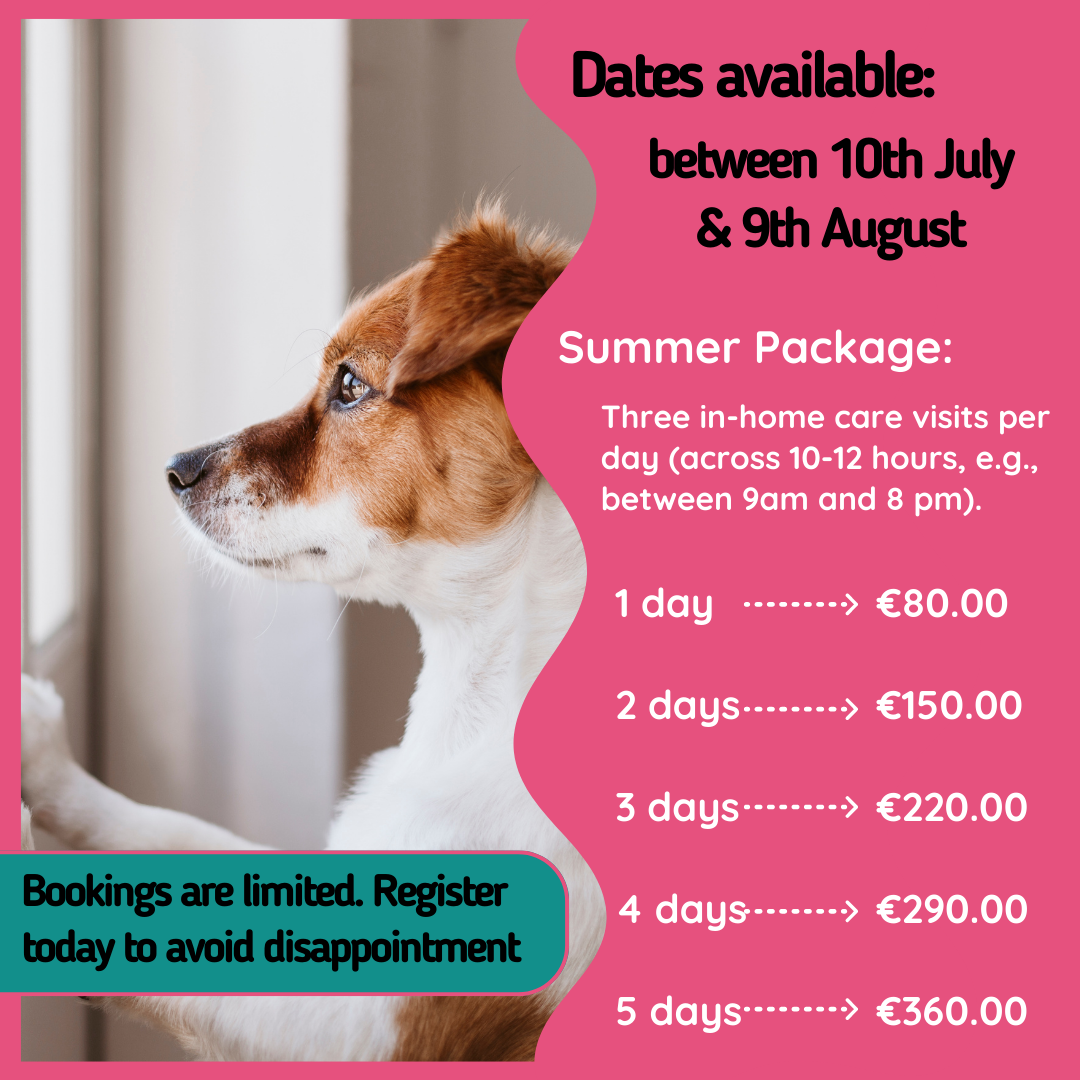
Summer In-Home Care

Summer’s here and we have a new and shiny service we are trialing for just a month.

I am desperate to get back to spending time with dogs. I get to do so little of that now, with so much work remote and with students. I still love all that, but I need my fix only available in hanging out with cool dogs.

This is a private and fully individualised service and of course, I will be caring for your dog as I do my own. I will be able to bring my expertise, which is behaviour, to keeping your dog as comfortable as possible, and enriching their alone time.

Full details here.

What happens during in-home care visits?

To help maintain your dog’s comfort, I will establish a somewhat predictable routine for your dog with me. Your dog will always be handled, and interacted with, compassionately, according to their preferences and at their pace. 

When dogs are alone and a person visits, they can get quite excited. That’s normal and to be expected. By supporting your dog in working through their excitement, I will be able to help them to settle better. We do this with Rollercoasters; combinations of activating and pacifying activities and interactions.

It is expected that your dog’s behaviour may be different while you are away and there’s a different person caring for them. We keep a visit log and will share that with you at handover when you return home. It will take some time for your dog to settle back into your routine after you return home and we will discuss their behaviour at handover. 

Although there will be individual adjustments, and I will always do my best to accommodate your individual dog, the following provides a general overview:

Morning visit:

  • this is usually the longer visit of the day to get your dog set up and ready
  • we will go on a longer outing during this visit, if that’s appropriate to your dog, as it’s generally cooler in the mornings
  • I will make sure that your dog has plenty of opportunities to toilet
  • we will include lots of activities that exercise your dog physically and mentally so that they can relax until our next visit
  • your dog will be fed most of their meal during the morning visit, or in a toy, when I leave, if that’s appropriate

Day-time visit:

  • this is usually the shorter visit of the day to provide your dog with a break and ample opportunities to toilet
  • we may go on short outings, but this may be limited by the heat of the day
  • this visit will be about lots of sniffing games and training games and lots of fun!
  • I will make sure your dog is comfortable and settled for the evening ahead
  • the bulk of their food will be fed during the first two visits of the day so that they are not too full overnight

Night-time visit:

  • for their last visit, we will go for a short outing as appropriate for your dog
  • I will make sure that your dog has plenty of opportunities to toilet
  • we will concentrate on winding down during this visit
  • I will hang out with your dog to help them settle and relax for bedtime 

Check out our free program, 100 Days of Enrichment, for a glimpse of all the fun your dog and I will have!

I am so looking forward to helping dogs feel comfortable while their humans are away, and I can’t wait to get to know new dogs. If you or someone you know might enjoy this service, please do let me know.

What if told you…

Taking stuff from your dog won’t make resource guarding better…and may well make it worse…

Spot the earlier signs associated with resource guarding and maybe even more important, spot the contexts…

“Trading” is not recommended…

Our goal is to prevent resource guarding behaviours becoming a concern…

Humans only add, never take-away!

Get help!

We can help!

Neutrality is no big deal…or is it?

I don’t really follow other trainers online so I’m often out of the loop when it comes to the latest and greatest in trainer-town.

As a result, I was recently called out on the use of the term “neutral” to describe dog-dog interactions, and in its use to describe ‘neutral dog walks’. I had no idea the term neutral could be so contentious…

Trainer Terminology

This illustrates a real challenge in our industry, that is, terminology.

Because professionals enter our industry from diverse backgrounds and we lack standardised & validated terminology, trainers can make up names for approaches to teaching dogs. That means terms may be poorly defined and applied less accurately.

I am clearly guilty of this too!

My neutrality faux pas

Upon being made aware of my possibly unsuitable use of the term, I did a little digging to reveal the errors of my ways.

Apparently “neutrality walks” or some version of that concept, have become quite a popular tool among UK trainers, and possibly elsewhere too. What I found does not represent how we do things at all and certainly doesn’t portray what I would consider neutral social responses from the dogs involved.

I don’t really like to discuss what others might do in the name of training, and instead, prefer to discuss what we do.
But for clarity, these “neutrality walks” often appear to consist of groups of dogs, with their humans, being walked in close proximity to one another, on pretty tight leads, with many showing lowered heads, appearing check out, with tense movement.

That doesn’t seem like neutrality to me!?

Night & Day

In my defense, in using the term, I was describing something very different.

On our Neutral Dog Walks:

  • there are no more than three or four teams
  • dogs are on long lines and are free to move about
  • we use distance and engagement to maintain everyone’s comfort
  • we pay close attention to each individual’s space bubble over time and across contexts
  • we are in enriching and interesting environments so the presence of other dogs and their humans is somewhat diluted
  • each dog’s preferences are considered – some dogs might want to meet or be closer to a compatible individual, but some might not and this is not prioritised
  • they get opportunities away from one another to engage in their interests with their human, without the pressures from other teams

What do we mean by ‘neutral’?

The difficulty with the term neutral is that it may be interpreted as the dog not reacting or responding. Maybe this conjures up images of robot-dogs, which can be very attractive to many pet owners, who, understandably just want a “good” dog, but is so often achieved through pretty heavy social pressure, intimidation and coercion.

Neutral is a label and like all labels, it’s only useful when it’s understood across users, through clear and agreed-upon definitions.

And of course, we are not labelling dogs as “neutral” but more so responses. Problems arise when we start with “the dog is —” as we should be describing behaviours and the conditions under which they happen; what the dog does, rather than what (we think) the dog is.

Neutral responses are “whatever!” or “so what!” responses.
The dog perceives some interesting occurrence such as another dog, a cyclist, maybe even a squirrel, and they have enough time and space to make some choices about their next move.

It doesn’t mean that the dog has no response (if they’re alive, they’re responding!) but that they are able to respond and recover, without too much stress.

Goals

Our outings are goal oriented, but the outcomes for each dog will be individual and evolving.

The humans are developing skills in managing their dog’s exposure by adjusting distance, reinforcing engagement and participating in their dog’s exploration with them.

The dogs are learning to feel safe and are developing skills in these contexts that don’t require swings of excitement and escalations.

We try to have a model dog present too, a dog whose responses are well known, pretty predictable and generally low-key. Decker is very environmentally sound and doesn’t have any interest in interacting with other dogs. The way he navigates his world may be a helpful model for other dogs who might find things exciting or worrying.
And to make sure he is able to do that, everyone understands his preferences, just as we make sure everyone else’s preferences are respected.

Our outings are based in engagement. The dog learns to choose to engage without cueing, leash jerking or tightening or nagging. We adjust their world rather than attempt to mould or coerce them.

The dog’s behaviour is information. If they are having difficulty recovering from stress or their owners feel the need to use a tight lead or other coercion, then we need more distance and an updated plan.

Our ultimate goals are happy, loose dogs, confident humans and lots of team-work.

And now, it looks like we have to come with a new name…ideas welcome!

Summer’s here!

The sun’s out (yay!) and that means that you’ve probably been inundated by posts and images and information about “heat stroke”.

I deliberately schedule our Online Canine First Aid workshops around this time of year so we get to talk about evidence based approaches to detecting, preventing and administering the right first aid for HRI (Heat Related Illnesses). This is emphasised on this workshop because there is so much BS spread about dealing with HRI, some information is inaccurate but some is downright dangerous.

We talk about so much more but while HRI are on everyone’s mind, and timelines, at this time of year, join us for our next Online Canine First Aid workshop. You might just save a life some day!

This fun workshop with in-depth resources costs just €50.00 but if you volunteer with a recognised rescue organisation, you can join in for free!

Doing an online workshop won’t detract from your experience or skill building at all. Check out what our participants say:

Read all about this workshop here and join us!

You can message, email (info@anied.ie) or apply via the website link. If the June/July dates don’t work for you, join us on another workshop. Book today!