If you want to play ball searching games while out and about, choosing a red ball might be the best for hiding from your dog. But if fetch is your game, blue might be better!
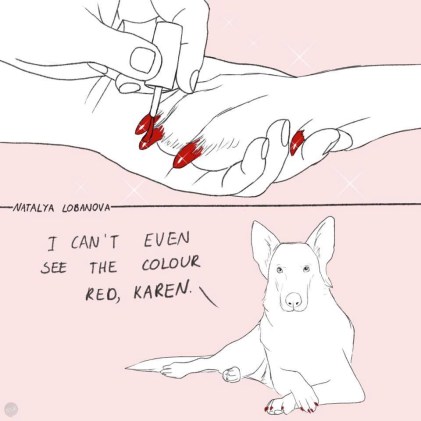
2017 research (Siniscalchi et al 2017) shows that dogs likely have dichromatic vision, similar to that of a person who is red-green colour blind. Indeed, this research devised a test for dogs like that which is used to assess human colour vision.
On top of previous works that have shown that the dog’s eye structure allows for colour vision, given the abundance of cones within retinal structure (Neitz et al, 1989), we can put the myth to bed that dogs see in black and white only.
All of this means that your dog’s toy colour matters!
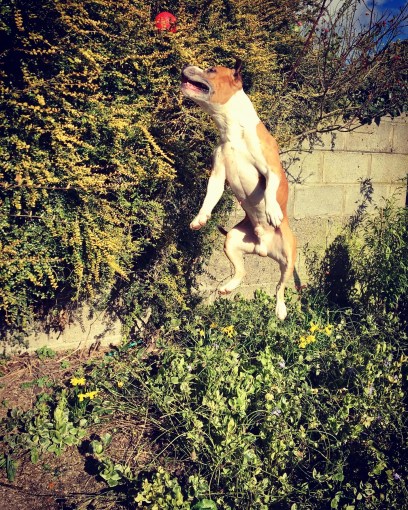
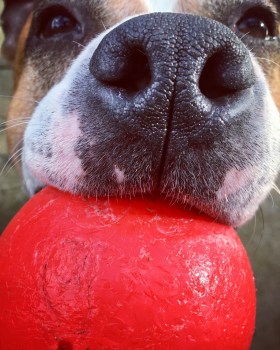
If you want to play fetch out and about, blue is a better toy colour than red. Red, against green grass and vegetation will appear, to your dog, as about the same shade of grey-ish, making it hard to spot.
But, if you want to play toy search games, red might just be the best colour, causing your dog to have to really use their nose, rather than just immediately seeing the toy.
All dogs must go to the vet at some point in their lives. And most people acknowledge that going to the vet is a distressing and scary experience for their dogs. Despite this, it seems that pet owners are largely unaware of the signals dogs use to communicate that discomfort. (Mariti et al, 2015)
Dr Marie Hopfensperger, DVM, DACVB, states that about 10% of puppies show signs of fear at their first visit, but when talking about adult dogs, that figure jumps to 60-80% of dogs showing signs of fear at the vet’s.
That dogs experience fear and distress in veterinary, grooming and husbandry contexts has been largely normalised, unfortunately.
In recent years, a great movement in cooperative care has really taken off in dog training, largely inspired by captive animal training. Husbandry training is a long and ongoing journey, and most pet owners will not be able or willing to participate to the fullest. Indeed, many vets or groomers don’t always have the resources to invest in these programs.
Regardless, there are lots and lots of things that pet owners can do, that require little effort, that can greatly improve their dog’s comfort, reduce stress, increase safety and make it all easier on everyone.
That’s what we will be talking about today; largely, effective management strategies.
Some dogs will require more specialised, in-depth and specific care and we can help you with that, but on a more one-2-one basis.
Prepare a Vet-Kit
Get ready for vet visits by building a Vet-Kit and having it ready in a specific bag:
a bag you can easily have on your shoulder or back so your hands are free (it should be washable and it’s a good idea to use a water proof bag for ease)
your dog’s mat or bed that is a nice place for them to be, associated with lots of rewards
your dog’s gear and muzzle, where relevant
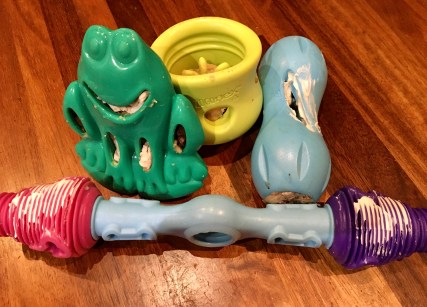
stuffable toys and lappable toys or other dispensers, especially if delivering treats while the dog is muzzled
HIGH value and more-liquid treats that your dog loves
favourite toys
a notepad (or use your phone) with your notes of questions that you want to ask and discuss, prior to your visit, and notes that you can record during and after your visit – it’s tricky to remember everything, especially when you are doing your best to manage your dog’s comfort too
Wash everything when you come home after each visit!
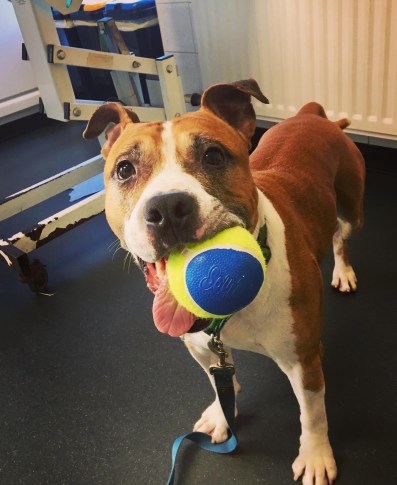
Soft treats and a ball make for happy vet visits for Decker!
Matwork
Bring your dog’s mat or a flat, non-slip bedding. This is helpful if you are waiting, so your dog can rest comfortably, and to have up on the table to increase your dog’s grip and comfort.
Medium or large dogs may be more comfortable being treated on the floor, so you can have them stand on their mat for traction.
Ahead of vet visits, you can make the mat a nice place to be by giving your dog chews and stuffables there and by rewarding the dog when he goes there.
Sit back, bring the mat close to you, and feed your dog’s entire dinner, one piece at a time, on their mat. Even your dog getting ten rewards, on their mat, most days will help them build a happy response to its presence and being there.
Anything you bring to the vet’s, including your dog’s bed or mat, should be washable and cleanable and you should wash it after each visit.
Gear
Obviously bring your dog’s collar, lead and so on. Even if your dog is walked on a harness, have them wear a collar too so that you can gently hook it should that be needed. Make sure to use your dog’s regular gear that’s used for other outings, and not just the vet’s.
Muzzle training and muzzle use is something that I can wholeheartedly recommend. Muzzling helps to keep veterinary staff safe, and feel more comfortable, allowing procedures to be completed efficiently and quickly.
But just like with matwork, we need to build a VERY positive response to the sight of the muzzle, and wearing the muzzle in lots of other places.
You can practice helping your dog become more comfortable sticking their nose into something by simply lining a paper cup or yoghurt pot (depending on your dog’s size) with something irresistible (like cream cheese, yoghurt, butter, pate or whatever floats their boat):
If muzzling is required, muzzle the dog before they become distressed so that might mean before you even enter the vet’s.
Fun stuff
We want to bring things that your dog likes and associates with feeling happy and comfortable. That means the best of the best food rewards and your dog’s favourite toys or games.
Stuffable toys that allow for lapping or lappables like Lickimat or Lickibowl type toys are wonderful additions. (Those links bring you to clips of Decker demonstrating their use; you can buy these products in most petshops and online.)
Use lappable treats so that should sedation be required, these can pass through the stomach faster. Although vets, RVNs and staff may argue that feeding the dog prior to sedation may increase the risk of aspiration, and while that is true, Westlund 2015 argues that the (small) risks are outweighed by the benefits.
These liquid cat treats are yummy, cheap and convenient:
Similar can be purchased online too, e.g. here.
Baby foods with dispensers are great also and tend to be very high value – they come in larger amounts so may be more suitable for bigger dogs.
A small snuffle mat may be a great addition if the dog can have more solid soft treats.
The treats above appear to be super high value are very soft and can be broken up easily!
When choosing treats:
smelly and soft
cut or broken up easily
small enough to be eaten quickly
high meat, fat and/or protein content
easy to deliver and toss
visible on the floor
don’t travel too much on the floor
If your dog loves a particular toy, bring that too. It’s not a good idea to have squeaky toys where other dogs are in close contact, such as in the waiting room, but talk to your vet about using them before, during and after in the consultation room.
Use the same treats and toys in lots of other non-vet contexts too.
Before you start
Exercise your dog well and make sure they have had plenty of opportunities to toilet, before your visit.
Don’t feed your dog a meal before going to the vet’s and do your best to stay calm too. The goal is to make sure that vet visits for your dog is as stress-reduced as possible, so be a good advocate for your dog.
Be prepared to stand up for your dog and discuss their needs with your vet team – you should be in this together!
Discuss your dog’s requirements with their vet team before each stage of your appointment and feel safe and confident with your planning and approach.
If your dog is experiencing distress, it’s ok to ask for a break and even discuss urgency of treatments: does this need to be done right now?
Sometimes, a vet or RVN will ask to take your dog to the back for some treatment. Certainly, many vets, nurses, groomers etc. report that the dog seems easier to handle when not with their owners. This is often erroneously blamed on owners ‘spoiling’ their dogs or some such, but this is unlikely. It’s much more likely that your dog is far less confidence and comfortable without you, so effectively shuts down a little and is easier to handle.
Whether this needs to happen or not, may be individual. I prefer not to allow this happen. But, for some dogs, getting the procedure done quickly is far less stressful than a drawn out process.
As much as I understand that the vet team is under time pressure, especially for routine consultations, giving your dog some time, particularly when you go into the consultation room, will help everyone settle and calm. Greetings can wait!
While you discuss your dog and their needs, allow your dog to sniff the room on a loose lead, giving them space from other people there. Be cool and neutral.
Seek medical help to support your dog and reduce their anxiety. Discuss the use of Sileo or Gabapentin, for example, with your vet prior to visits so that your dog has a little neurochemical help with coping.
Waiting Games
Waiting areas are one of the main areas in which not much improvement has been made in many veterinary practices and hospitals.
They are usually too small, with little room to make space between pets, doors often open right into them so dogs appear at a door on top of waiting pets, they have slick floors and are filled with sights, sounds and smells that dogs have come to associate with fear.
You don’t have to go in
As such, for the most part, I DON’T recommend that you wait, with your pet, in the waiting room.
leave your dog in the car or with someone outside, well away from the entrance or exit
go into reception and let them know that you have arrived and are waiting outside
when you go in, walk your dog briskly and directly into the consultation room
bring your dog straight out afterwards and have them wait outside
return to pay and discuss your dog’s care
Passing other dogs can be stressful for many dogs, but even dogs who might be comfortable in proximity with other dogs, might find passing stressed dogs in a stressful context when stressed themselves all too much.
Discuss this with your vet team before bringing your dog in; perhaps there is another entrance you can use, maybe your vet or RVN can check the waiting room and reception area so you can get the all clear before bringing your pet in or out.
You can ask your vet team and reception team about quieter times for appointments or times when it will be easier to get your dog in and out quickly and quietly.
If you do go in…
Give your dog as much space as you can and set up their mat and keep the treats flowing.
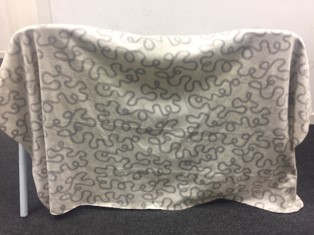
Construct a simple visual barrier by moving a chair or chairs and hanging your jacket or a blanket across the back to provide your dog with some privacy. This also helps other patients, with one less dog to be faced with as they move about.
If possible, leave your dog in the car and come into the waiting room to set up so that your dog can walk in and their familiar mat is immediately available, in their own little private nook.
It’s best not to let others approach or pet your dog. Mostly, people are well meaning but your dog needs time and space to process what’s going on.
Even if your dog seems excited and generally likes interactions with unfamiliar people, all that can be a little much in this context.
Hugging and constant fussing of the dog might not be appreciated from you either; that’s certainly something we think is comforting but may not be for dogs. Work hands-off instead with treats and toys!
Car trips
Make sure that going in the car doesn’t equal a trip to the vet; that’s a quick way to poison you dog’s attitude to car rides and comfort in the car.
With puppies, or dogs who have not had much experience in the car, do your best to get them out for short trips daily. When I say short, I mean one or two minute trips at the start; might just pull out of the drive, go around the block and back home.
This helps to establish the car as no big deal and no reason to get excited.
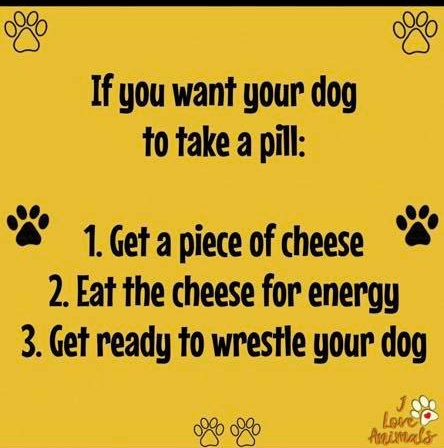
Follow our tips, do your practice, and no wrestling will be required!
Keep it fun and friendly
Going to the vet’s can mean lots of waiting around for your dog; waiting to get there, waiting to go in, waiting while the humans chat.
Along with the fear associated with going to the vet’s, waiting around can lead to increased anxiety in this context.
Have fun and play games!
While you wait and while the humans chat, play simple fun and training games with your dog to keep them moving, take their minds off the vet-stuff, and so that they can have some positivity.
What simple tricks does your dog do – practice them while waiting. Short and sweet behaviours that add a little movement and lots of rewards.
Like hand targets with movement:
Only restrain your dog, with your vet team’s guidance, as much as is necessary. Full pinning and wrestling is rarely required and when it is, sedation may be a better option and a topic for discussion.
Hook your dog’s collar and stay within view so you can comfort and settle them. Talk to your dog calmly.
Make rewarding things happen! Offer a delicious stuffable toy, lappable toy, or other dispenser for muzzled dogs, as soon as the examining or treatment context begins.
As best as possible, allow your dog access these treats throughout. This can help redirect their focus and keep them still, meaning less restraint and less risk for all.
Planning and preparation is on you! We know your dog will need treatments and invasive handling, and we know they find that scary; do them a favour and prepare them.
Happy visits
Discuss opportunities to bring your dog for happy visits, where no treatments happen. Your dog goes to the vet’s, gets some treats and goes home again.
Maybe you practice bread-crumbing onto the scales for a weight check:
The key to success is a little practice at home, in calm scenarios, that are not associated with handling and treatments.
Follow our tips, do your practice, and no wrestling will be required!
Husbandry training
There are lots of excellent resources on husbandry training out there; I particularly like Deb Jones’ book Cooperative Care. and Laura Monaco Tortelli’s work.
Some Facebook groups:
While their full participation is certainly the goal, I recognise that this isn’t possible for all pet owners, or even most. Taking some tips from this post and applying those relevant to your dog’s needs and that of your vet team, will go along way to helping boost their comfort, allow them to feel safe, and reduce everyone’s stress.
And this is just a start, you might already have some great approaches to keeping it cool, so do please share.
Even though dog training and dog care, especially online, are full of ALWAYS’S and NEVERS, you don’t need to stop with fetch games cold turkey.
Our post Fun with Find It!, not just Fetch from last week, gives you lots of ideas so that you can break up repetitive fetch games, add some variety and improve the quality of play time in terms of behavioural health and enrichment for your dog.
All sorts of absolutes are shared online about stopping with fetch games and dumping the ball launcher. Fetch is a most popular game for pet owners and their dogs, and I really don’t want to throw the ball out with the fetch games.
The PDSA Paw Report, 2019, found that almost 40% of dogs only get out of the house for up to 30 minutes at a time, and that 13% of dogs not getting out daily at all.
And a 2019 survey of 1500 pet owners by dog food Forthglade found that less than half of dogs are walked daily.
In the case of some of these dogs, their owners may incorporate some structured enrichment program (beyond food dispensing toys and food puzzles), but for most, this is unlikely.
Given this worrying trend, I certainly do not want to start limiting owners’ efforts when it comes to providing adequate physical and mental outlets for their pets.
It may not surprise you that one of the first things I do with clients is help them improve and refine enrichment for their pets, helping them meet their pets’ needs before we can start with training interventions.
That’s what #100daysofenrichment is all about; encouraging pets and their people to have fun and brain games together with as much guidance and support as possible. And play most certainly forms part of that program.
Fun with Find It! and fetch and other stuff too
Here are some clips from today’s trek around the Phoenix Park. We start with just sniffing and roaming – I want him nice and warm before he does anything strenuous. For the most part, he is trotting and loping around, at will as much as is possible and safe.
Intermittently we might do recalls, Go Find It! games, or just silly stuff just as part of engagement and joy in hanging out together.
When he’s good and loose, we might play fetch; not every time, not in the same places. Sometimes I don’t even bring a ball.
But, we do our best to follow the rule of doing a different move each time to cut down on repetition, and making play time more than just fetch. So, we might have several rounds of this.
Then we might walk on; he gets to carry the ball: he’s the winner! We’ll have intermittent interactions around the ball – “I’m gonna getcha!” and a bit of tug, maybe.
Don’t just think about variation in toy games, but on your walks and outings in general. Engage your dog in lots of different activities and interactions, bring them to areas that allow for sniffing and running, different gradients, different footings, different levels of cover.
Rather than abolishing, we have responsibilities to help refine. And rather than going after pet owners, we have responsibilities to shape behaviour and apply differential reinforcement, rather than aversive approaches.
Add in Find It! games, along with sniffing, and lots of adventure time, rather than taking exercise and entertainment away from dogs. Concentrate on making it more dog.
Going out and about is pretty exciting for dogs; it stimulates all their senses while also providing lots of physical and mental stimulation. Your dog is going to be experiencing high levels of arousal, hopefully at a healthy and manageable level.
Doing all that, experiencing all that, and then bringing your dog home and expecting them to just chill, is pretty unrealistic.
Winding down is a skill. Think of your wind down at the end of your day. Just getting in from traffic and hustle can leave us buzzing and, even though we might be tired, good, restful, peaceful sleep isn’t necessarily immediate or easy to come by.
What works for you? Getting changed, having a shower, cooking a meal, discussing your day and debriefing, watching some TV, relaxing in your favourite spot, being idle, reading a book. Until lights out.
Our dogs are no different. And, indeed, because we have selectively bred many types of dogs to get more wound up quicker, we might have quite a winding-down-challenge on our hands.
This clip shows the last part of our outing; for about two hours Decker had been running about, sniffing, fetching, sniffing, playing flirtpole, practicing engagement and training exerccises. All that activity gets all his systems going.
Not only do we need a warm down for his body but also for his brain.
We end all that excitement with a slower meander through the goalposts. He gets to, at his own pace, check and respond to all the pee-mails, sniffing to his heart’s/nose’s content. You can see some prolonged and persistent sniffing in the clip toward the end of our tour.
This helps to cool him off, gradually lower his heart rate, respiratory rate and blood pressure and helps his brain begin to stand down, slowing in the production and circulation of neurochemicals associated with high arousal, bringing him back to base.
This is a gradual process. We don’t go from 100 back to zero just like that. Sniffing like this, less urgent movement, choice of interaction, brings him down a few notches and starts him on the descent toward baseline again.
Sniffing is the perfect start to warming down the brain and behavioural systems.
From there, add chewing and to bring us all they way down, finish with some lapping.
Crazy to sniffing to chewing to lapping to calm. Crazy back to calm is a multi-step process.
Maybe massages, stretching, or just resting together helps you and your dog – what else?
As with life and play, think in Rollercoasters. Activity and exposure to the world brings ’em up, so we need to help ’em come down again.
That will help your dog relax and really benefit from the activity as well as the well-earned rest afterwards.
After activity or excitement, do your equivalent to touring the goalposts – make sniffing, chewing and lapping happen, bring your dog down, think in Rollercoasters.
Regardless of our opinions or feelings, the welfare needs of the animal do not change.
That realisation, for me, has always been a game changer. And it’s why we are so invested in developing skills in understanding how to measure welfare in animals, particularly companion dogs.
Welfare is a measure of how well the animal is coping with its environment, and that’s generally the set-up we provide and expose them to.
How do we do that? We ask the animal!
Behavioural observations provide one of the least invasive means of measuring how the animal feels about what we do to them, from their point of view.
No matter the conditions in which the dog lives, and no matter our opinions and feelings about that, the welfare needs of that dog remain unchanged.
Last week we talked about dogs’ needs, the things dogs must have to have a good dog-life. How this manifests for an individual dog will depend on a range of factors, that might include:
genetic history: selection history and the behaviour of related individuals can help us predict the extent of this influence
early rearing conditions: for dogs to become family dogs, they must be reared in an enrichment environment, exposed to the human world and learning to just be around humans, especially during their first weeks of life
continued experience and exposure throughout adolescence: the teenage years will see a ton of behavioural development, brain change and body maturation making this period a most important stage in forming a healthy dog
resilience and recovery from stress, self-calming and arousal control abilities: this is what dictates how well a dog will do in the human world and modifying these abilities is tricky as dogs age, and even not possible in some cases
medical history: physical and behavioural health cannot really be separated
training history: even without a structured training program in place, every interaction between the dog and its environment, which includes humans, will have an affect on behaviour
These factors combine, impacting the welfare needs requirements for that dog.
My job is largely helping and supporting dog owners in the provision of their dog’s welfare needs.
Modern life presents many challenges for the companion dog, and its owners and meeting a companion dog’s needs is harder than ever before.
Being a pet dog isn’t all it’s cracked up to be; a pet life isn’t necessarily welfare centric, just by virtue of us loving dogs or welcoming them into our families.
A sedentary ‘sofa’ life may not be the best dog-life for an individual even though that has become somewhat of a standard wish often stated on behalf of dogs.
Our opinions or feelings about what makes a good dog-life don’t change what the dog actually needs.
The dog is telling us; their behaviour provides us with feedback so that we know how well they are coping with the things we expect of them (or not).
Asking the dog is the easy part, we just have to listen to what they are telling us, and then do what we can to give them a good dog-life.
#100daysofenrichment helps you to learn to observe your dog and ask them what they need – it meets dogs needs by helping pet owners with ideas, plans and supports. Join in, dip in, have fun!
Domestication has done wonderful things in producing an animal that likes to live with us and is pretty tolerant of us and our human ways.
Our dogs don’t have much choice in most of what happens to them – they don’t choose to be born, they don’t choose the human they go home with, they don’t choose to live a life of virtual social isolation while their humans work long hours or they are confined to kennel accommodation for chunks of time, they don’t choose to have such limited access to their world especially their olfactory world, they don’t choose a sedentary life; they don’t really get to choose too much of the things we expose them to in our human world.
Because of just how awesome dogs are, they appear pretty tolerant so we often assume they are living a good dog-life and that we are meeting their needs.
But, are we?
What is a good dog-life?
I often say that dogs are here for a good time, not for a long time. We can help them live every day to the fullest and have the best dog-life by prioritising their needs.
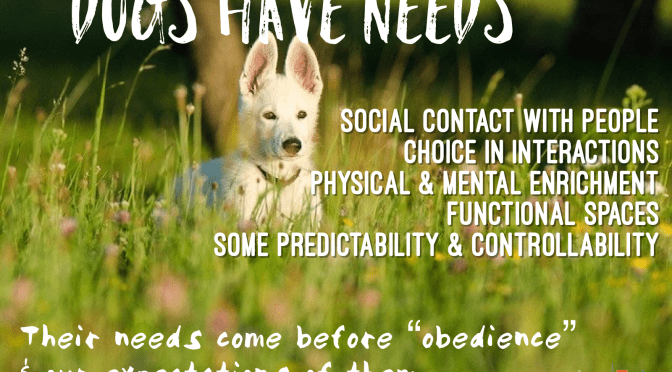
Before we can consider “obedience”, before we can achieve success working on behaviour ‘problems’ and before we can expect them to live up to our human ideals, we first consider the dog’s needs. No point going much further without this.
Dogs must have:
social contact and interaction with humans. We have spent many many thousands upon thousands of years making dogs like us more than other dogs.
The best company for a dog is human company and it’s especially important for young dogs to just be around human life. That’s how they develop appropriate social skills, which is pretty tricky if they are socially isolated for much of the day.
dogs need to be able to interact or not, having the time to choose, and have safe spaces for relief from interactions.
Humans often assume social interaction means contact and human-like contact such as hugs and petting. Dogs like to be close to their nearest and dearest and the ultimate in bonding is to lie in contact with you – no petting or hugging required!
appropriate challenge through mental and physical enrichment is always our central focus – if you get that right, the rest of it falls into place
functional spaces are important to dogs; they, like humans, prefer to have specific areas for feeding, sleeping, resting, hanging out, playing, toileting and so on.
They don’t need a “den”, because they aren’t denning animals but will appreciate their own space and choice to interact.
An enriched environment makes sure that the dog has access to and choice in functional space.
predictability and controllability are the ultimate in stress busters; “I know what’s about to happen to me” AND “I have behavioural solutions to deal with it”
One or the other isn’t enough, for a stress-less life, your dog needs both.
Welfare is assessed from the animal’s point of view. Dogs have needs that we must meet and might have to make specific efforts to meet because these needs might not be a normal part of our human life, with which we expect our dogs to cope. Think dog so you can give your dog the best dog-life.
#100daysofenrichment does just this – it meets dogs needs by helping pet owners with ideas, plans and supports. Join in, dip in, have fun!
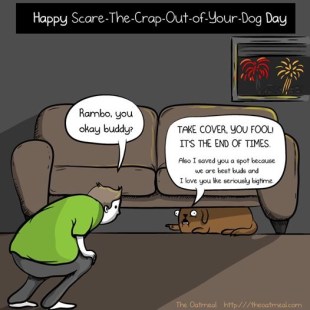
With New Year’s Eve fast approaching, many dogs will again suffer terror and stress at fireworks and displays ringing in 2020. It’s become so normalised that many pet owners feel helpless, thinking there isn’t much they can do.
But, starting now, there are lots of things you can put in place to reduce the effects of fireworks on your pet, like these top ten tips!
Top Ten Tips
Tip 1: Plan & Prepare
Start putting these things in place now!
Think about where you will hang out with your pet, think about where your pet will be, plan for toilet breaks and exercise.
Put together a shopping list or to-do list based on our recommendations here and tips that help your individual dog.
Bring your dog out for exercise early in the day, in daylight, while all is still calm and quiet. Don’t prioritise high-octane exercise that might contribute to your dog remaining wound up for the evening. Instead go for a sniffathon and make your dog’s day about rollercoasters.
Tip 2: Safe & secure
Make sure your dog’s microchip details are up to date and that they are wearing a collar and tag with current details. It’s a good idea to check fences, gates and boundaries too.
When out with your dog, have them wear their normal walking equipment, plus back-ups. An extra lead on a collar, along with their normal lead and harness, for example. A slip lead or martingale collar and lead along with their normal collar or harness, to prevent escape from a slipped collar.
Walk your dog on lead around times associated with fireworks, just in case there is a stray firework let off and your dog flees.
Tip 3: Toilet break safety
Your dog will need to go out to toilet, probably several times so start to plan for that now. You might be lucky and be able to avoid fireworks displays by going out at quiet times, but fireworks are unpredictable as not just official, public displays will be on during the festivities.
Start taking your dog out to the garden, on lead, to toilet. If your dog doesn’t like to toilet on lead, use a long line with no tension. You will need to start practicing now so that it’s not another weird thing on an already scary night for them.
Have your dog drag a lead from a regular flat collar in the house so that you can step on it and restrain them should they attempt to bolt. Only do this while they are supervised though, otherwise they might chew the lead or become tangled.
Tip 4: Where will you set up for the night?
Ideally, you are there with your fearful pet but that might not always be possible. Think about setting up for your pet in a room that is closer to the centre of the building, with a person with whom your pet is comfortable.
It’s best to have one secured door between this space and the comings and goings.
Even though you might still have Christmas decorations and lights up for all to see, close blinds and curtains to minimise noise from outside.
Practice spending time there, with your dog, now too.
Tip 5: Stock up on your pet’s favourites.
Get your dog’s absolutely irresistible favourites and have them ready. I am not talking about any run-of-the-mill treats, I mean the hottest of the hot like meats, cheese, pate, cream cheese, tinned fish. The yummiest!
You might try these Lick-e-Lix treats that I have seen used recently and have tried out:
Get your dog’s favourite toys too; toys that really keep him busy like squeakies and toys for dissection.
Start practicing presenting your dog’s favourite foods in toys or devices that require them to lap, chew and sniff. These are calming and engaging behaviours for dogs so will help to keep them occupied and happy.
Tip 6: Play music and TV louder
Start playing everything louder now to help drown out outside sounds. Playing music with lots of bass and lower frequencies might be more helpful so using good speakers and good quality recordings may be better.
Tip 7: Treat Party for Loud Sounds
Carry chicken, cheese, hotdog or something really yummy in your pockets at all times. Every time, you hear a noise outside, no matter what it is, talk excitedly and toss treats onto the floor – a treat party!
For this to be effective, it doesn’t matter what your dog is doing, even if they are barking and even if they didn’t appear to respond to the sound. Get the family involved too so there will be plenty of treat parties happening between now and New Year’s.
Tip 8: Set up a safe bunker
Maybe your dog has a safe place where they take refuge but if not, set one up now and start to use it.
Throw a blanket or towel over a chair or table, or over their crate to make a blanket fort. Give your dog a yummy stuffable or chew there a couple of times a day to make it a pleasant place for your dog to be.
Tip 9: Talk to your dog’s vet
Have a chat your dog’s vet about calmatives and medication that may help make fireworks more bearable for your dog. There’s lots of further information on medical contributors and help for fireworks fear, with more complete detail on our Dying of Fright piece.
Tip 10: COMFORT YOUR DOG
Contrary to popular belief, you can and should comfort your dog when they are scare. But, do so in a manner that is actually comforting to your individual pet. Not all dogs will be helped by hugs and petting, even though that’s what we think will work.
Ask your dog!
For some dogs, it’s just enough to be in the same room as you. So, be there.
Sit in the room, and calmly invite your dog to join you. If they don’t approach, leave them to decide what they would like to go next.
If they do approach, that doesn’t mean they want to be touched. Sometimes, just leaning against you or resting close to you, is enough.
Pet your dog for a three count, withdraw and see what they want next. Them staying close to you, doesn’t mean they want petting or hugging, necessarily.
Be Prepared!
Although we won’t miraculously “cure” your dog’s firework fear, implementing these tips might just save the day!
For a full covering of fireworks fear and preparing your pet for Halloween and other noisy celebrations, check out Dying of Fright.
There are lots of other safety issues presenting themselves during the festivities. Prepare your pet with our Christmas Bites.
Christmas and this season is all about giving! Here’s some of our favourite dog-products that Santa Paws might bring!
These are tried-and-true and things we use and recommend every day.
The Boring Necessities
To your dog, these are probably pretty run-of-the-mill, but they can be essentials!
In general, when it comes to products in almost all categories, manufacturers will add some gimmick, marketing trick, or notion in an attempt to stand out with their own USP. But, that doesn’t make it better for you and your pet 😉 We like to understand that mechanisms behind the workings and how that applies to your pet’s behaviour, and to your wallet.
Harnesses
While it’s great that there is such a range of harnesses available in every petshop and stockist, that can make choosing one that is safe and comfortable all the more difficult.
Look for harnesses that don’t restrict your pet’s movement, especially the front assembly (straps that cross the shoulder), when fitted properly. Make sure that straps behind the elbow don’t ride up into the arm pit too.
Harnesses, that have become very popular, with large panels that sit on the dog’s shoulders and back, make it more comfortable for the dog to pull, and most worryingly, are very easy for dogs to learn to escape from. I know they’re popular, but we don’t like them, and many dogs find them unpleasant to fit.
We recommend a simple H or Y-front harness that’s properly fitted; like this one from Zooplus. These harnesses tend to be the best tolerated in terms of fitting them. This clip shows you how to fit one using a stuffable toy so that, from the first time, the dog associates having their harness fitted with yummies:
If you feel you need more control in preventing pulling, you attach your lead, or add a second lead, to the ring at the front. Show here in this clip:
My favourite of the modern harnesses is the Blue9 Balance Harness for its versatility and fit, but recognise that they are expensive and difficult to get here.
Collars
Hands up, I have a total collar addiction and my dog has so many collars from all sorts of places that serve all sorts of functions, but really, most just look pretty!
Dogs in Ireland must be microchipped and wear a collar, with their owner’s details, in public.
My absolute favourite ID tags are the plastic tags from Identi-tag – you can fit lots of info on there, they come in teeny sizes and big, they are super hard-wearing (most of Decker’s are almost 8 years old and are as good as new) and very reasonably priced. Love them!
Collars that dogs wear for ID and that they wear most of the time should not be tightening, and just with regular buckles. When dogs are unsupervised, playing in groups, or confined, it’s best to use safety break-away collars or no collars at all.
Take care when using collars with snap buckles if you are attaching a lead and check how secure the buckle on your collar is regularly. Some collars come with safety adjustments, like this in this clip here, with instructions for use and fit:
Martingale or limited slip collars are best for dogs with lots of coat, with narrow heads and with wide necks to prevent slipping. This is one of Decker’s martingales:
Or using a collar, like a Sighthound collar, with a wider side, which also helps to prevent slipping or the collar coming over the dog’s head. This is one of Decker’s:
In general, the wider the collar band, the more comfortable it will be, so choose the widest band you can find.
Lots of collars, to suit your dog and specifications, can be found in stores and online. Measure your dog’s neck with a string at the point you want them to wear their collar, and then measure that.
Go for the simplest lead you can find – generally, you don’t need all the bells and whistles. I like a plain five or six foot nylon or leather lead, with a safe trigger hook. Nothing more, nothing less.
I don’t like poo-bag carriers attached to the lead because they weigh them down and fall/hit the dog. But, choose biodegradable bags and always dispose of them appropriately; do not leave them on the street, hanging on a tree, in a ditch or anywhere livestock or wildlife might access them.
Swaggles do matching leads too!
Long Lines
I am a big fan of long lines but careful, safe use is required. More in this clip:
Long lines are just really long leads and most people do well with a 5m or 10m line – longer than that, becomes harder to manage.
You can get long lines in lots of places including online, e.g. Zooplus and in stores; I particularly like the Maxi Zoo range of long lines.
I much prefer long lines over extendable leads, but recognise that people love their Flexis! Here’s more on how to use them appropriately and safely:
Before we go any further with this one, it’s important to note that LOTS of dogs don’t like to wear coats, clothing and for some, even harnesses.
Clips that are often shared online, showing dogs freezing, having difficulty walking, refusing to walk or struggling to get away when a coat or clothing is being fitted or worn, actually depict a dog experiencing high distress levels.
Unless your dog needs a coat or clothing, it might be better to skip it, unless you can be sure they are comfortable with fitting and wearing.
Clothing that opens so that the dog doesn’t need to put their head through it might be tolerated better; these coats from Petstop open at the front so can be placed on the dog, rather than them having to pass through an opening, are reasonably priced and really good quality.
Confinement
For safety and for training, some form of safe confinement will likely be required at some point in a dog’s life. The best way to prepare them for that, and help with other training exercises, is to confinement train. This means to make being behind a barrier a pleasant experience for a dog and to use confinement, particularly in crates, appropriately.
Wire crates are often most convenient as they can fold away flat and are sturdy. To reduce the noise, wrap the tray in a towel or blanket and then add the dog’s bedding. Savic crates are great, long-lasting and sturdy; you can get them and a more budget friendly line from Jeb Tools.
Plastic travel crates are required for airline travel and can be handy, if you have the space. Zooplus offer a variety but if you are travelling, check the requirements before you purchase.
Soft-sided crates are great because they fold flat, are lightweight and quiet, but a dog who chews or is looking to escape will not be safe with this crate.
Crates are not for every owner or dog so where confinement, management and safety are required, gates and pens are a great addition.
Regardless, when confinement is expected, the dog will need help to learn to settle comfortably behind a barrier so spend some time on that too.
Beds
Before you splash out on a new bed for your dog, do some research and ask your dog about their sleeping and resting preferences. See Day 10 of #100daysofenrichment for more!
There is a lot of variety in beds available for dogs, with lots of choices. I really like the Beddies range in Equipet and we have several, but there are lots and lots of awesome beds to suit every budget and every pet.
Don’t invest in expensive soft bedding if you have a chewer or a young dog but getting some VetBed will tie you over until you can splash out.
For fun and brain games
Now we get to have some fun!
We talk a lot about Kong toys and the Kong range, so of course Kong toys will feature here too! They are available from all sorts of outlets and have toys that offer all sorts of different challenges. The full Kong range can be viewed here.
There are lots of stuffable options out there, and not just Kongs! Try K9 Connectables to offer different challenges and enrichment outlets with these versatile toys.
One of my current favourites is the Toppl; it’s pretty durable and is a straight forward solve for dogs who experience frustration or are new to puzzle feeding.
It can be transformed into a more challenging feeder by combining a small and a large size, but it’s still a great stuffable toy on its own.
My other favourite is the Qwizl – as a straight forward puzzle toy it’s great for kibble or wet foods, can be lined or frozen. I use it with dogs who have a tendency to gulp and swallow the last bits of long chews, like pizzles, so that it’s safer and easier to grip.
There is a wonderful variety of chews, both edible and non-edible, available and we have a whole LONG list here for Day 11 Chewing of #100daysofenrichment.
Stuffables can be some of the most versatile toys so investing in a couple of different types.
When it comes to choosing toys, think what your dog might get out of it; what sort of behaviours will these toys provide outlets for? Toys are enriching for dogs when they allow them to practice natural dog behaviours like chasing, biting, catching, chewing, dissection, tracking; play allows for practicing these behaviours.
Having a range of toys for your dog will allow them to try out different behaviours – your dog can’t be wrong, what behaviours they decide to use in toy or item manipulation is what they find enriching.
Tug toys from Tug-E-Nuff offer a wide range to tempt most dogs, providing lots of opportunities for tracking, chasing, tugging and even dissecting. Decker LOVES an oversized ball to chase and bite like Jolly Balls:
For literally hundreds of ideas and a ton of inspiration for choosing entertainment and fun for your dog, check out #100daysofenrichment and pick from challenges that you think you and your pet will enjoy.
All your dog wants for Christmas is YOU!
Certainly buy your pet gifts and items that make their life more comfortable and enjoyable, but, don’t forget that YOU are the most important part of your dog’s life.
Take time, lots of time, to just be and hang out with your dog, especially over the holidays when the chaos is swirling all around.
If you are taking some time off from work and your normal routine this holiday season, maintain your dog’s comfort by trying to keep some features of normality in their day to day. It’s especially important to keep a little separation and alone time throughout the holidays so that when everything goes back to normal and you leave again, the bottom of their world doesn’t fall out.
Prioritise time to just be with your dog and make sure to go for lots of SNIFFS! rather than walks – making sniffing possible is the biggest gift you can give your dog.
Run through the Sniffing Saturdays from #100daysofenrichment and try to include a little sniffing everyday for your dog.
With so many tempting but out of bounds bits and pieces hanging around during the holidays, it’s easy to understand how challenging this might be for most dogs.
While some dogs can be concerned by new and elaborate decorations cropping up all over, most dogs will be interested in investigating novel items. This usually means that they will approach them, sniff them, taste and chew them – that’s how dogs explore their world!
Make it easy to get it right!
Management is very much the name of the game, particularly if you have a puppy or a dog who is interested and interactive. Make it really easy for them to stay successful thinking carefully about how and where you arrange decorations, presents, party-food and other temptations.
keep things out of reach, remembering that dogs can jump and climb
take care with storing and disposing of foods and presents
use management, like baby gates and leashes, to prevent your dog accessing forbidden items
confine your dog safely when temptations are in play
consider decorating only limited areas elaborately
Check out this gorgeous scene, carefully managing puppy Tucker’s access to that tempting tree!
This fantastic management example is from Linda Adams Brennan of Canine Coach, starring the adorable Tucker!
More on holiday hazards here and more on management during the holidays here.
Uh-Oh! Management Fail!
Sometimes management can fail; the door was left open, the baby gate removed, the dog wasn’t being watched. It’s easy. You are human and your dog is canine – mistakes happen.
Now the dog has got something we would prefer he didn’t have. What now?
First, consider the situation: is the item harmful to your dog, will they damage it? If, the answers are, no, let it go and don’t worry about it. Next time, step up your management to do a better prevention job. If you need to reclaim the item, do so carefully…
STOP! Don’t pursue the dog. Going after them serves to convince them that what they took must be wonderful (because everyone wants it!), which may lead them to ingest it quickly (so nobody else can have it) or guard it (use distance increasing signaling to keep every else away). Some dogs might even take stuff to get that attention and chase, as it works every time!
Instead, move away from your dog. Sounds counterintuitive, but moving away will attract the dog to you. Move away and pretend to engage with something really interesting, with lots of oohs and aaahs for effect. For example, scurry toward the kitchen counters and tap it, move things, wiggle things. Keep oooh-ing and aaah-ing until your dog approaches to check out what you are up to.
Even if you must get the item back more urgently, don’t pursue the dog. Instead move away and create a diversion by, for example, opening the fridge and rustling packaging, getting the dog’s lead and pretending to prepare for a walk, or tossing food rewards away from your dog. We don’t want to rely on this strategy too much, it’s for emergencies only. Otherwise, we might have the dog taking things to get you to play this game!
This is the important part:
Continue with your diversion tactics until your dog moves away from the item. Don’t make this interaction about the item or about getting it back.
When the dog discards the item, continue to redirect them. For example, encourage them to follow you into another room by moving and talking to them excitedly, jollying them along with you. You might even toss a toy or food rewards into another room to help your dog move away. Close the door behind them – they don’t need to be present when you recover the item. Remember, we are not making it about the item!
Step up your management to prevent repeats of this!
There is absolutely no point in attempting to punish scavening behaviour – scolding and reprimanding won’t help you here. Once the dog has taken the item, they have had their fun and the behaviour is reinforced to happen the next time.
Step up management and start teaching them the behaviours you would rather they do when temptation is available.
The Floor is Magic
Food on counters, tables, and on low coffee-tables, during the celebrations can be difficult for dogs to resist.
Scavenging behaviour is normal, natural, necessary dog behaviour; behaviour that we humans go out of our way to suppress.
Making sure to practice settling and working on some canine entertainment in set-ups where food will be available tantalisingly close to your dog will go along way to helping prevent your dog taking food that’s out of bounds.
Plan ahead!
Where will food be most tempting during your gathering? At the dinner table, on the kitchen counters, in the living room low-down?
Introduce the Floor is Magic game in those places and start practicing now.
Work with some pretty yummy food rewards and let your dog see you place one treat on the counter or table. Immediately toss a couple of treats on the floor.
LOOK!, as a reorientation exercise and cue, is a valuable skill to have in your arsenal for all sorts of situations.
LOOK! means that your dog orients toward you, away from a distraction for reward. They never get access to the thing they have been cued away from. You can use any word that you like, such as “Leave It!”.
Check out these puppies learning to leave tissue, a puppy-destruction-favourite:
The key here, as always, is to make sure that you set your dog up for success. We need to use leads and barriers, along with space and distance from the distraction to effectively teach the dog to respond to you when close to temptation.
You can use anything as your distraction such as food, decorations, gifts or the Christmas tree. In the following tutorials, food in a bowl on the floor, is used as the distraction:
Each time your dog looks toward the distraction, cue “LOOK!” (or whatever cue word you like) and wait for your dog to reorient to you. Reward well and repeat.
Very soon, your dog will focus on you because the distraction tells them that focus is the most rewarding thing to do!
Holiday celebrations can have everyone somewhat wound up and it can take a food coma to help with relaxation. For the most part, we will want our pets to chill out too, especially when the family are hanging out or eating, and this is of course made even more difficult given the activity and festivities.
You know what I am going to say….start practicing now!
All is calm
So that they feel comfortable on the day, start practicing chilling out today. This can be easily supported by using some pacifying activities entertainment ideas.
Establish your dog’s safe zone – a comfortable place they can go, spend time, without anyone approaching or interacting. Easy to do by giving your dog a yummy stuffable or an irresistible chew there every day, and leaving the dog to it. (For more see here.)
This helps to reduce your dog’s intensity about all the yummy stuff all the humans have!
Most dogs will benefit from some comfortable confinement during the celebrations, and all dogs will enjoy a break away from the action, even occasionally. (More on preparing for there here.)
To make sure that confinement is a viable option during your party or gathering, and that your dog will be comfortable there, start practicing now! Every day, prepare the most wonderful puzzle, stuffable or chew for your dog – with your dog’s absolute favourites. Give him his treat in confinement and let him out before he becomes upset.
A little bit of alone time, away from the action and social pressure, will benefit most dogs (and people!), while making it easier to maintain safety and reduce unwanted behaviour.
The key to this is practice, every day, so that when you need confinement, your pet will cope better, be more comfortable and you will be at ease.
Dogs learn what response to expect, and therefore, which behaviours will be required in a given context. That picture might include the room they’re in, the people or other animals present, the time of day, what’s just happened, what comes next, the activities that go on there, whether good things, scary things or neutral things happen or can be expected.
During our celebrations, we might expect our dog to be calm and chilled, so we need to set up contexts that allow that to happen. Of course, seasonal festivities are anything but calm so, you’ve guessed it, we need to start practicing now!
Plan ahead
Think where you will like your dog to be calm and chilled out during the celebrations. That’s where we start practicing by setting up a Calm Context there.
practice at times that your dog might normally be calmer
the house is quiet, no comings and goings, nobody expected to come home or call in
all their needs are met – they have toileted, they have eaten, they have been exercised, they have had lots of attention, interaction and company
you can practice with them on lead, if you like, to help reduce their moving around and getting themselves excited again
make less exciting chew toys, chews or toys available to minimise excitement but to give him something to do should he need that
It’s important that you start setting up this calm idea for your dog – no more active or raucous play in that location from now on. Make this place about being chilled out.
And it’s best that your dog has access to this room, only when it’s easy for him to be calm and chilled out.
While I don’t really like to use lots of treats for this particular exercise, that can be helpful to get you started and begin to build value in settling behaviour, for your dog:
Parking is a valuable exercise to practice, for both ends of the lead. This can help your dog learn to chill out in the house and when out and about, meaning you can take your dog lots of places.
Parking is a particularly great for when you are eating or relaxing, and you want to help your dog relax, but also not have to pay them too much attention. This can help to prevent or reduce so-called begging behaviour at the dinner table too.
Park your Pup with their lead on and with a delicious stuffable toy, chew or treat to work on. Hold the toy or chew under one foot, while you are sitting down, and the dog’s lead under your other foot. Give your dog just enough lead that they can comfortably lie down or turn, but not so much that they can jump up or get into mischief.
Start practicing some Parking today! It’s great to practice this exercise as you might use it on the day. For example, Park your Pup while you are eating a meal or relaxing in front of the TV.
Every time you practice calmness and settling in your calm contexts, the easier it will be for your dog to do this, in these contexts, during the celebrations.
Make time for crazy too!
All this settling and being calm is fine, but is tricky for dogs, particularly at exciting times. Always thinking in rollercoasters, regularly interrupt your dog’s settling and calm-time with some fidget and crazy breaks.
Help your dog to become familiar with this routine, by practicing settling and then crazy, settling and then crazy, ending with a little more settling. Not only will this prepare your dog for calmer, more settled behaviour in those Calm Contexts, but also help your dog develop better self-calming skills which will help him calm himself more efficiently after excitement.
But, you gotta start practicing now!
Matwork & Duration
Matwork is a foundation exercise for every aspect of life with dogs and helps to establish important skills for so many situations.
Teach your dog to lie on their mat and build duration so that they can learn to hang out there for longer and longer.
Start with teaching a down behaviour on a mat or bed:
Once we’ve got that underway, start to build duration with 300Peck and specific marker words. This helps to establish predictability for your dog so they know what’s about to happen and what they need to do.
Start with your dog lying on their mat or bed; reward them and then begin to build:
count 1, thumb’s up, deliver a treat to the mat between your dog’s front legs
count 1, 2, thumb’s up, deliver a treat to the mat between your dog’s front legs
count 1, 2, 3, thumb’s up, deliver a treat to the mat between your dog’s front legs
count 1, 2, 3,4, thumb’s up, deliver a treat to the mat between your dog’s front legs
count 1, 2, 3,4, 5, say “GO!” and toss a treat for them to follow after
Establish this pattern to a five count (which is way more than counting 1-5!) and then add further duration gradually, one or two counts at a time.
Your dog is not just learning to lie down for longer periods, but also to tolerate greater delays in rewarding. This can help to improve your dog’s frustration tolerance and prepare them for improved patience.
Practice in the places and set-ups that will work during celebrations, with your dog’s bed or mat at your feet or in a safe spot for them to hang out.
You can practice building distance too and remember to work in some crazy-breaks too. Always work in rollercoasters!























 AniEd Ireland