We all long for our hazy days of youth, when we can look back, through rose-tinted spectacles, at the dogs we spent our days with.
Our expectations of modern day dogs are probably, in part, derived from our skewed memories of childhood encounters with dogs.
Did our parents need to worry about Kong toys? Did our childhood dogs attend training classes and undergo elaborate socialisation programs?
They probably didn’t, or at least we as owners didn’t implement this stuff, nor was it recommended or discussed much
Things have changed and times move on, and modern dogs face challenges their ancestors didn’t. And, as such, modern dog owners face challenges keeping modern dogs in the modern world.
What’s changed?
Modern pet ownership certainly seems more complicated…
dog control legislation enacted (in Ireland) in the 1990’s has meant that dogs are largely confined to an owner’s property.
This limits the dog’s access to the outside world, and to more naturally paced and exposure based socialisation and experience-building for puppies and young dogs.
Not only is it more difficult for puppies and young dogs to gain vital experience and exposure, dogs confined to their human’s properties have even further diminished choice in their lives; this is detrimental to welfare.
dogs live more isolated lives due to increased confinement, increased incidence of living in packed suburban and urban areas, and because their families work outside of the home. Cultural trends in women returning to work and the confinement of dogs, means that dogs may spend many hours each day alone and isolated from appropriate social contact.
For social animals, this is detrimental to welfare.
supply & demand Supply – most pet dogs are bred accidentally, or, with an emphasis on phenotypic characteristics – either way, lots of dogs destined for the pet market are produced without adequate attention and preparation.
Placing dogs in inappropriate homes relative to the dogs’ behavioural needs, its history, environmental requirements and behaviour issues, is a worrying trend, affecting the welfare of both people and pets.
All dogs require work and commitment from their families, but dogs that bring behaviour baggage are going to require even more work and access to resources to support and help the dog in its new home. Demand – attraction and access to a wider range of dog breeds and types, that are not necessarily suited to their owner’s lifestyle, living conditions, or location.
We cannot deny the role of selection in the behaviour a dog breed or type will tend toward. If we have selected for certain behavioural characteristics for countless generations, we cannot expect that dog to just suppress that behaviour because he now lives in a city, or housing estate, or because his owner’s work…
Bringing home a dog that is not appropriate for your lifestyle, time and resources makes it unlikely that that dog’s needs will be met, presenting a range of welfare and safety concerns.
as society becomes less and less tolerant of dogs, the expectations thrust upon dogs become higher and higher.
Dogs are expected to be safe members of the community, friendly to all, cope with all environments, be tolerant and gentle with children, love us unconditionally, literally save lives, and improve our quality of life…
Our rose-tinted-spectacled view is informed by nostalgia for childhood pets and movie dogs. It’s a long way down from that pedestal – there is no ‘real’ dog on the planet who can live up this.
when you know better, you do better.
We have a well-established and growing science of behaviour – this means our understanding of behaviour, learning and cognition is improving week by week, based on more than just anecdotes.
Science is self-correcting, so as we gather more information, it allows us to develop better and more effective tools.
We are learning more and more about dogs, about how they learn, and about how best to help pet owners, now more than ever.
We’re not being needlessly complicated or conservative in our approach when we make recommendations for your dog’s training and care. Dogs have it harder than ever before, and it’s become harder to provide for their needs. We can make it easier by accounting for these modern challenges, and helping pets and their people succeed in the modern world.
The brain errs on the side of caution and tells the body to expect danger, as a default setting. That means we have to do lots of work to give the brain and body time and relief to gather information to facilitate a change in attitude.
The time to reset the brain is during a puppy’s first few months of life, and then to continue this in a structured manner over puppy’s first year. But we need to get that first few months right. Dogs who don’t cope with this well don’t need to have been abused or have had particularly bad experiences in early life. All it takes, is lack of exposure, lack of time to information gather.
We don’t get this behaviour developmental stage back again – we get one go, so we need to get it right.
Information Gathering for Puppies
This is especially important for puppies, who are just learning about the world. And often explains why puppies and young dogs will suddenly plant themselves in the middle of a walk, unwilling to move on.
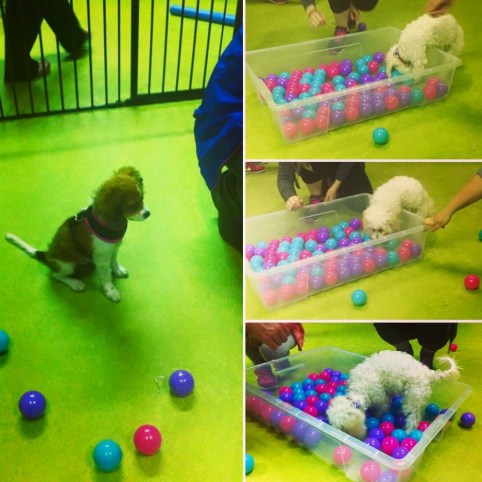
In a Puppy1 class Minnie takes some time to engage with a ballpit puzzle, and Ellie prefers to sit back and watch the goings-on.
Providing puppies (and all dogs) with time to choose how they wish to respond, helps to reduce stress and helps to build confidence.
Information Gathering for Dogs
In this clip Simon, on one of his first trips to AniEd a couple years ago, before he was rehomed, is out for a walk in a busy business park.
Simon, given his rough background, can be a little overwhelmed in some situations. This is our first walk together – that’s why he’s panting plus we had just had some ball fun inside too.
We came across a man mowing a lawn in behind a fence and another man with a forklift working. We moved across the road so that we were about 15-20m away from the action. As soon as he spotted this activity he stopped and I made sure to keep the leash loose. We just waited while he processed the noise and activity.
Notice his rapid head movements as he watches the scene and note his mouth becoming tighter at times as he concentrates on the activity. Listen for his big sigh as he gathers as much information about something that might cause him a little concern.
As soon as he’s ready to move on I mark (YES!) and reward him. That it looks calm and a bit boring (let’s be honest!!) is good – it means that he could relax enough so that he could just watch the goings-on without experiencing too much concern.
Let your dog take it in…
When your dog encounters something that interests them, especially if it causes them to be excited, to be scared or spooked, causes them to lunge, pull, whine or bark, give your dog some time to process that trigger.
If your dog is already reacting like this first move far enough away that your dog is able to give some attention to you and so that they don’t react that way anymore.
But, when you encounter something that you think might be of interest to your dog give you and your dog plenty of space from it.
Keep the leash loose and allow your dog to process any information that he can from what he is seeing, hearing and smelling.
Things won’t seem as scary or interesting to your dog if they have had some time to find out a little more about it.
This is really important for puppies, who are learning about the world, and for dogs who are worried or ‘reactive’ on leash.
It’s not always about “training”
You don’t need to jump in there with treats or cues straight away. Take the time. Don’t encourage, don’t nag, indeed, you don’t need to do a whole lot.
If your dog can’t information gather, you’re too close, you’ve stayed too long, the trigger is too intense. Distance is your friend, and there’s nothing wrong with packing it in and trying again another day.
Things to try, and not to try:
keep your distance
give your dog time
if you notice your dog stiffening, become more tense, or having difficulty moving away – help them. Move away excitedly, call to them, keep it jolly. Try not to put too much pressure on the leash as this tends to escalate things. If needed, move them along with brief, gentle pressure, and then use your jolliness to keep them moving with you.
never drag a puppy who has stopped
don’t attempt to lure a dog toward something he is unsure of or scared of. Don’t even encourage them to approach – give them time to choose.
You don’t need to understand their hesitation – just listen to your dog!
after some time information gathering, get ’em outta there, moving in the other direction
too much exercise for puppies and growing dogs is damaging – review your exercise regime, and think of outings more for exposure to the world, rather than physical exertion
don’t make puppy’s world too big too soon.
While puppy is on vaccination hold, bring them in your arms to new places on foot and in the car. Remember, they have little choice when in your arms so don’t expose them to new things, people or animals when restrained.
When they start going for walks, expand their world a few metres each day, starting at the front of your house or garden on the first day, then a couple of houses down the next day and so on. Rather than marching, try playing with toys, doing sniffing searches for them, and letting them range on lead (safely).
If you have difficulty moving a reluctant dog or puppy, give them some time (might take several minutes) and then encourage them to follow you back the way you came. You can move in a big arc to go in your intended direction too.
Toys that you can stuff are perfect for challenging your dog, giving them long-lasting entertainment and helping them calm after excitement through lapping and chewing.
List the behaviours that your dog does that you don’t like – how can you stop your dog getting into that situation, in the first place? That’s your job, human!
keeping your dog on lead helps to prevent your dog jumping up, running away, chasing things, toileting in the wrong place – you can even use your dog’s lead indoors too!
using a long line can help to prevent your dog learning to not come back and have fun without you
use a baby gate or crate to confine your dog to prevent a whole world of trouble, everything from jumping up and barking out the window to stealing, chasing and chewing!
This is particularly significant in situations where your dog gets too excited, can’t focus, barks, lunges or loses control.
Triggers are things that cause these stressy emotional swings and the first step to helping your dog, is to identify things that cause this behaviour. Maybe it’s the approach of another dog or perhaps it’s when you stop to talk to someone while out on a dog-walk.
Once you have narrowed down the trigger, now avoid them! Walk in quieter areas, remove your dog from a situation quickly, move to give plenty of distance between your dog and the trigger.
3. Look for the good
We spend a lot of time thinking about the behaviours we don’t like, but once you’re preventing those, let’s start thinking about the things you do like your dog to do.
The first rule of behaviour is, that behaviour that is rewarded will be repeated. Remember, dog’s do what works!
If you like a behaviour, pay it! This means rewarding your dog with things he actually likes and wants quickly enough that he can associated that behaviour with access to that reward.
What behaviours do you love?
keeping the lead loose
sitting to greet people
quietly watching out the window
lying calmly
looking at you
toileting appropriately
If you love those behaviours, pay your dog well when he does them.
Your dog’s not being naughty all the time – what would you prefer he do? Make those behaviours more rewarding and he’s more likely to do them instead of the behaviours you don’t like.
Use rewards that your dog really likes, not just things you think he likes or should like.
One of the most common I see, particularly in training class and sessions, is patting, often on the head.
Not all dogs like to be patted, especially on the head, or hugged and often when there are other things going on and possibly better rewards on offer. Your dog might just want the chance to practice the training exercise again to earn another of those rewards.
What your dog wants changes from situation to situation, so your dog might really want attention and tummy scratches when you’re all relaxing in the sitting room, but doesn’t want to know you when he’s out sniffing in the park.
Dogs won’t always want to be petted or fussed or to meet or hang out with people or dogs.
All behaviour has a function, why the dog is doing it, and it’s usually for your dog to get something or escape something. Your dog might offer behaviour because he believes it leads to him getting outside, getting to greet, getting to sniff and so on.
Look at those rewards and use them – they are real-life rewards.
Distractions are just rewards that your dog wants more than what you have to offer – think of those distractions as functional or real-life rewards.
For really excellent training results, reward those behaviours that you like with things that your dog likes – simples!
5. Release the hound!
All the rewards and training and management can mean that your dog doesn’t get to be a dog a whole lot. Teach him a release cue so that you can clearly signal to him when he’s off the clock, and to go be a dog.
This release cue, Go Sniff!, can be used to give your dog a brain break, to allow him to enjoy some sniffing, to divert his attention from triggers and even to reward appropriate behaviour.
Do you already play with your dog (and I do mean with your dog, not just with a toy)? Great!
If not, get started because those who play together, stay together!
Teach your dog to play with you, add variety and add training to play rather than play to training.
I prefer tug-games to fetch, but mixing it up is best. In repetitive fetch games, you just become a mechanical arm, throwing a ball, ramping up over-excitement but not doing a whole lot for teamwork.
Teach your dog the value of patience and politeness. For your dog to be truly zen, we don’t want to have to ask him to be polite, or nag him or tell him off – he just is.
Remember, if you want behaviour, you gotta reward it so watch your dog closely and reward patience and politeness.
Emphasise calm and calming down, rather than crazy. Your dog knows how to do crazy already (that comes as part of the package) so help teach calmness by providing lots of chewing, making sure your dog gets to be a dog, matwork and hanging out quietly.
8. Think about the memories and associations you want your dog to make
You are always training your dog. He is always learning what behaviours work and what behaviours don’t work.
Not only that, he is learning to predict the outcome of particular situations, all the time.
Something good about to happen – stick around.
Something not so good might happen – get away, or scare the scary thing away.
To live with our dogs so that they are happy and healthy, and so that people are safe, we make sure that our dog associates good feelings with proximity and contact with humans.
Every time your dog is exposed to something, look at his behaviour, what associations is he forming?
How is he feeling about this situation?
How will that affect his behaviour in two weeks, two months, two years?
manage your dog’s access and interactions with children – your dog probably doesn’t need to be involved if the kids are active or acting crazy
give your dog lots of distance from distractions
when you see a person, dog, other animal, skateboarder, noisy traffic or other big deal, feed your dog a couple of treats as soon as he looks at them – teach him that good things happen when distractions approach and to look to you because you probably have yummies
help your dog LOVE being handled and manipulated to prepare him for healthcare, veterinary and first aid
It’s easy to get sucked into our busy schedules, and often our dogs get left behind in the blur.
If you want calm focus from your dog, you gotta give it too!
When interacting with your dog, take your eyes off the TV, put away your phone, be there with your dog.
You don’t need to go into the whole mindfulness thing completely, if that’s not your thing, but just be with your dog.
Spend time looking into his eyes, take deep breaths, keep your eyes soft and half-closed and think about what he’s doing, how relaxed his body is, how you are going to spend time together.
Just be.
Use walks and outings as a way to spend time together. Don’t have your phone in your hand, or earphones on your head.
Go to quiet places. Bring a blanket to sit on, and a stuffed Kong for your dog. Half way on your walk, stop and take a break.
Walks don’t need to be military operations keep it calm, low-key and fun.
More on making dog walks more dog here.
Just be. Be with your dog. Do things that he enjoys. Do things that you both enjoy. Just be.
11. Bonus – be the best canine-owning citizen you can be
always scoop the poop, always
follow the rules
No dogs allowed? Don’t bring dogs there.
Dogs only on lead? Keep ’em on lead.
know the law
Make sure your dog is under effectual control at all times (ROI Control of Dogs Act).
Microchip your dog and keep his details up to date.
Don’t let your dog wander, and certainly do not allow your dog to have access to livestock, no matter how friendly you think he is.
never allow your dog approach, run up to or harass any other dog, person or other animal without that individual having first solicited such interaction
No, your dog is not “just playing”, if he’s approaching someone uninvited, he’s being rude.
be polite when approaching other dogs on lead, leash your dog and walk in an arc around them so that they don’t have to interact head-on
get professional help and choose your training & behaviour professional carefully – this industry isn’t regulated so buyer beware!
Take a training class, and more than one – we wouldn’t expect our kids to be prepared for life after completing playschool and it’s not different for dogs after a puppy class.
For you…
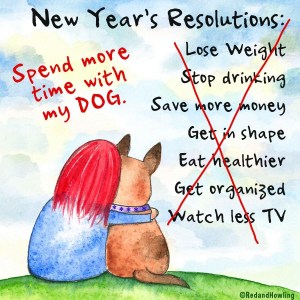
Take a lesson out of the big-book-of-good-teaching: don’t make big, unrealistic and lofty resolutions (if you are into such things) – instead split behaviours, that you would like to acquire, into small achievable steps…
what’s the closest version of that behaviour that you already do?
identify the ultimate goal and recognise that that’s going to take lots of time to achieve
what’s the smallest step you can take toward that?
record your achievements, no matter how small the step
Splitting makes developing behaviours easier and more rewarding, no matter what species you are.
Remember that January is Train Your Dog Month and we have a whole program laid out for you to work on all month: Train Your Dog Month
When we think dog-training, we think being proactive, dishing out cues, making sure to get our timing of rewards just right but there is an easier, quieter, less busy way to achieve great dog-training results.
Your dog is being trained all the time…
Whether you are directly involved or not, your dog is learning about which behaviours get them things they like and which behaviours expose them to things they don’t like.
You may not have a say in what’s being learned!
Your dog is training you…
You are a pretty influential part of your dog’s environment and even when you think that you are proactively training, your dog is learning how to get you to allow him access things he likes, or learning to stop you exposing him to things he doesn’t like.
This is really the key to developing that all important relationship with a dog, to boosting their confidence and being a good guide for them.
To be a good dog trainer you need to be easy to train – making it really easy for your dog to be a good human trainer.
Help ’em out by managing their environment so it’s easiest for them to choose the most desired behaviours and make rewards readily available for behaviours you like.
decide what behaviours you like – what would you prefer your dog to do?
choose behaviours that make it difficult for your dog to do unwanted ones e.g. if your dog is sitting he can’t jump up
watch your dog closely – look for behaviours that your dog offers regularly in every day life
make it really easy – remove temptations that may cause your dog to carry out unwanted behaviour
give your dog tons of space – distance is your friend
use a HIGH rate of reinforcement – that means you keep the rewards flowing
reward where you want your dog to be
use rewards that can compete with other rewards in the environment
where possible use functional rewards – what was your dog trying to achieve with the unwanted behaviour?
Now only allow him access when he offers more appropriate behaviour instead.
Why passive training?
get the behaviours that you like without too much effort – this is lazy dog training
sometimes you will even get other behaviours, like Milo here who offers a reverse behaviour:
We see lots of puppies and we want to see more puppies, and we want to see them earlier.
Waiting for your puppy to be finished his or her vaccinations or waiting until the nipping and the accidents and the chewing are driving you bonkers is too late to start your puppy’s education.
Book a puppy-session NOW and make sure that everyone gets off on the right paw!
What happens during a puppy session?
We talk about all the things that you can start to put in place so that puppy raising is easier and your puppy becomes a great, easy to live with, companion dog.
1. Social Experience
Not only must puppies know how to be dogs, but they must also know how to fit into human society – and that’s tough!
We emphasise:
socialisation is not about your puppy learning to greet, play with and love everyone
socialisation is about your puppy learning that other people, dogs, animals and related goings-on are so normal that they’re not even worth getting worked up about
socialisation is about ensuring puppy has mostly positive experiences in social interactions
socialisation is about puppy learning how to behave appropriately in social situations
We will teach you how to teach your dog to greet politely, to manage their excitement and to teach others how to greet your puppy appropriately so your puppy doesn’t become over-whelmed, and learns that social greetings are positive, enjoyable and safe.
How to use your hand-link-a-Kong to teach all this:
Teach puppy that people approaching makes a treat appear so that puppy learns that approaching humans are safe and so that puppy learns to focus on their own people when someone else is approaching:
Off leash puppy activities must never be a free-for-all!
2. Exposure & Experience
The world is a new, exciting and often scary place for puppies. As their new guide to the human-world, in which they will live, we want to gently and carefully expose them to all the things we want them to be able to cope with later on.
Think of the dog you want in two years time…you are preparing for that NOW!
We emphasise:
bring your puppy everywhere you go – you can carry him, have him in the car
set up a couple of odd things everyday, in a new place in and around the house for puppy to explore
Remember, when you start walking your puppy out and about, increase the size of their world very gradually (from the house to the street on the first day is plenty, and around local streets is lots for the first week) and take your time, stop with puppy and allow them to explore in their on time.
3. Mental Exercise
Puppies are active and inquisitive so let’s channel that energy, so it doesn’t become a people-problem and so that puppy is an active learner and problem solver.
We emphasise:
no food bowls for puppies!
training puppy throughout the day, working for their regular food
All puppies do it, and most people are bothered by it.
Puppy nipping is important for puppies though so we put exercises in place to make sure puppies have an acceptable outlet for this behaviour, but preventing it from becoming to much trouble for people.
There are different schools of thought on this and lots of diverse advice.
We emphasise:
keeping interactions with puppy brief and low-key so puppy doesn’t become over-excited (they will often express that with mouthing and nipping)
making sure puppy has lots of down-time, settling and sleep (over tired puppies are like over tired toddlers…)
diverting puppy behaviour and using treats & toys so that we don’t need to restrain, physically manipulate or position puppy
redirecting teeth onto suitable toys
yelping and withdrawing for 5-10-count if we feel hard teeth
moving away from puppy 20-count timeout if they turn into a landshark
teaching puppies the rules of play with people
making sure puppies have lots of opportunities to play bitey-face games with other appropriate dogs
You already know all the behaviours that puppy is going to do that you are not going to like – squealing when left alone, chewing your belongings, toileting in the wrong places, and that’s just for starters.
So, if you know they’re going to bother you, why are you allowing them to happen?! Prevention is key.
Never allow puppy to practice unwanted behaviour so that they never learn to establish unwanted behaviours.
We emphasise:
night-time training so puppy never develops distress at separation (prevents sleepless nights too!)
This is lazy training, and really effective too! Puppy isn’t doing the wrong things all the time so catch him doing the right behaviour and reward that with food rewards, toys, play, attention or access to things he wants.
We emphasise:
rewarding puppy any time you notice he’s quiet, he has four paws on the floor, he’s keeping the leash loose and he’s showing calm focus
It’s normal, natural, necessary dog behaviour (humans do it too!) so let’s set up our puppies so that they never feel the need to make people go away from them, when they have stuff.
We emphasise:
making sure puppies have their own place where they can eat, chew, play and hangout undisturbed
puppies learn that when they have stuff and people come near, awesome things happen
Puppies and dogs will be handled, sometimes in invasive ways, throughout their lives. Remember, anything we want in our dog in two years time, we need to start working on right now!
Our dogs spend a lot of their day inhibiting their doggiest of dog behaviour; a consequence of living in the human world.
They are told no barking, no digging, no humping, no chewing, don’t eat that, don’t roll there, that’s enough sniffing…
Everyday Decker gets to do things that are ridiculously DOG and to forget about human rules for a little bit.
We found a muddy ditch to be silly in here, who knows what he’ll get up to next!
Decker earns his meal by catching it, chasing it and sniffing it, and although this is certainly lots of fun, he’s also learning lots, such as, to choose his human over all the stuff in the park like dogs, other people, wildlife, smells and goings on, that his human is where the fun is, responsiveness is rewarding even when distracted and excited and boring kibble can be great!
Don’t waste these opportunities by feeding from a bowl – think of every mouthful of food for your dog as an opportunity to reward desirable behaviour. And if you do that, your dog will choose unwanted behaviour less.
Don’t worry if you don’t feed kibble, you can still inject fun/training/exercise/focus into meal times!
(Depending on which components you feed here are some ideas that I have used in such situations)
freezing raw e.g. minces into nuggets in an ice-cube tray and hiding those
using a high quality/grain free kibble
drying dietary components to make jerky – works especially well for offal components
the use of freeze dried treats with a high meat content may be counted toward diet
bone or whole organ components can be used in scent games
stuff Kongs or similar with minces or soften components and bring on walks or use as rewards in training, by offering a couple of licks for example
Fun, focus, exercise and training packed into just one meal!
For more on making ‘boring’ rewards more rewarding here.
This is not an exciting clip. This is just a couple of minutes of Decker on a walk, with minimal cues given so as to allow him dictate the activity as much as possible.
Link
Watch his behaviour. ALL of it is centered around olfaction (sniffing). He spends all his time air sniffing, trailing, tracking and moving to stay on top of smells.
Watch his pattern of movement. Back and forth, over and back, right and left.
This is a busy dog walking area. We are along a path that is bordered by grass where many other dogs have been, and other animals too.
When you want to know what things your dog likes doing, and needs to do, take a look at what he is already doing. This behaviour is important to dogs and is needed for them to remain healthy.
Make sure your dog has outlets for this everyday – even just a few minutes of sniffing without being told to move on and leave it.
Take your dog on a sniff, stand back and let them do what they were made for!
For more on spicing up your dog’s walks see here too!
Part 3 Think Outside
Just-Taking-Your-Dog-for-a-Walk
We’ve been looking at thinking outside the conventional when entertaining your dog here and here already; now we are going to think far outside food-based enrichment to providing sensory, physical, cognitive and social challenges to help keep our dogs happy and healthy.
When you think of entertaining or exercising your dog, you probably have taking your dog for a walk on the list – perhaps that’s the main form of entertainment and exercise your dog gets.
But what if you consider, that just like food-bowls, taking your dog for a walk may be more of a human convenience device than entertaining for your dog.
Human/Dog Divide
Going for a walk for humans and going for a walk for dogs are very different experiences, even when there is one human and one dog, together on the same walk.
It will not be news to you that dogs love to sniff and although we recognise their love of all things smelly, we are often too wrapped up in the human end of the walk to facilitate sniffing for our dogs’ entertainment.
That may be because the preferred human past-time is walking while talking and taking in the sights – we live to take in visual information and that requires walking at not much more than a strolling pace.
Recently, Patricia McConnell shared this interesting paper looking at ways of improving animal welfare by recognising the importance of olfaction in impacting the lives of animals in our care. Scents are invisible and undetected by us, but their importance in our dogs’ lives cannot be underestimated.
Pounding the Pavement
Asking our dogs to walk with us, at our two-legged-sightseeing-pace, on a loose lead is a pretty tall order. Not only do dogs need to move faster so as to take in lots of smells, they also have twice the number of legs that we do so are very efficient at covering distance.
Not only is walking up, down, back and forth on suburban streets difficult for your dog (at human pace), it’s also probably pretty boring for them too.
To top it off we use devices that restrict their movement even further, sometimes painfully.
Sheesh! this walking-malarky is becoming more and more like a military drill…
See ya – Decker’s done with military style walkies
Human/Canine Compromise
What are you getting out of walkies?
healthier lifestyle
physical exercise
fresh air
social interaction
chats with friends
meeting & greeting
see your local world
time with your dog
a quiet dog, afterwards
With all this in mind, what’s your dog truly getting out of walkies…?
This might be his only opportunity to be exposed to something other than the same four walls so we gotta make it worthwhile!
Your dog didn’t choose this more limiting lifestyle, and indeed has probably been made for something much more exciting, so how can we make walkies-time the best-time?
Variety is the spice of walkies
You have one walk, maybe only one hour (or even less), let’s cram as much enrichment into that time as we can to boost the value of every walk, every outing and every activity.
Check out the human list of experiences – it pretty much covers our four categories of enrichment that our dogs need added to their daily lives. We can come up with ways to tick those boxes for our dogs too.
Sensory challenges:
Turn every walk into a sniff – choose locations, routes and times when you and your dog can devote a good chunk of each outing to just sniffing.
Dogs find almost every area smelly, but particular favourites are those where other dogs have contributed, where wildlife or livestock frequents or where there’s plenty of traffic of different species.
Novelty is interesting for many dogs – bring your dog new places that will provide them with different sights, sounds, smells, textures, substrates and conditions.
Take care and make sure that it’s not sensory overload.
Rotate the experience – if you are lucky enough to have access to varied landscapes, try bringing your dog to different places on different walks.
Woodland, grassland, beaches and waterways all provide very different sensory experiences, especially when you factor in seasonal changes too.
Set-up sniffing challenges – you can introduce new and exciting smells for your dog, and what’s more this can be done at home too.Introduce new herb plants that interest dogs (and that are also safe) and by planting them in pots you can rotate them, hide them or arrange them so that they encourage curiosity and investigation.
Some informative resources here, here and here.
Use hunting scents (from different animals, available from hunting and gundog outlets online) and rotate these, set up trails or add to a special toy that you can hide and play with.
Scent work games will always be popular with your pet, no matter what you practice finding like food, toys, other items and specific scents – it’s what your dog was made to do!
Don’t forget to teach your dog to “Go Sniff!” on cue so that you always have a handy reward (that your dog loves) and so that your dog can get all his sniffing jollies:
Dogs are super efficient at burning energy (that’s why they are so easy to overfeed!) so for most dogs, if they are just trotting along beside you on a pretty military-style walk, they are probably not getting a whole lot of physical challenge out of it.
Change your pace – stroll, walk, trot, jog, sprint and then back to trot and up to sprint again and mix & match so that your dog (and you) need to adjust and compensate.
Warm up and warm down – make sure your dog has plenty of time at the beginning and end of activity to walk and trot, to loosen up and stretch before the real physical challenges begin.
Speak to your vet or veterinary physiotherapist about the sorts of conditioning and warm-up exercises that would work best for your dog and activity.
Balancing exercises – introduce balancing on unstable objects to really get your dog’s muscles and body awareness working; but as always talk to your vet or veterinary physiotherapist so that you can match the best exercises for your dog.
Levels, substrates and terrains – rotate and vary the levels your dog must climb, the substrates he must cope with and the terrain he must negotiate as regularly as possible so that your dog gets to exercise different muscles and body awareness skills.
Play – teach your dog to play games with you and with you and toys and bring this on the road. This will help you to introduce varying challenges on each walk, changing pace and directions.
Tug, fetch, jogging with you, flirtpole and chasing with you will bring lots of fun and games to your daily grind.
Remember, always teach the rules of games first and make sure to help your dog warm up and warm down.
It doesn’t always need to involve walking – drive your dog to a safe spot for games or scent work, bring your dog for a swim or a paddle or enroll in a dog-sports class such as agility.
Cognitive challenges:
Puzzles – don’t have to be elaborate or too complicated, just enough to cause your dog to pause and think a little.
Why not bring a frozen Kong on each walk and have some downtime in the middle? This is an excellent tool for training better settling behaviour and a great way for you to catch up on sightseeing or just relaxing and chatting.
Training exercises – when is a better time to practice training exercises than in the very situations you are going to need those cues?
Start by working in really quiet locations using really really high value rewards to build up some reliability and set your dog up for success.
Passive focus – teach your dog valuable focus with lazy dog training techniques.
Just stop and wait for your dog to get distracted by something. Allow him to watch it but don’t move. As soon as he turns away from the distraction immediately reward with high value food rewards. Soon you, and this game, will become more valuable!
If your dog has trouble looking away and back toward you, try moving further away, using super-dooper rewards and working for very short times (30 seconds).
Social challenges:
SNIFFING – it really is that great to and for your dog and it’s probably one of the main ways that dogs interact socially with other dogs in modern life.
Play-dates – we are not big fans of out-of-control-play at dog parks, daycares, group walks or just random meetings and find it much better for you and your dog to meet up with another like-minded duo to hang out with.
Meeting people – gentle introductions to a range of people types can be very pleasant for most dogs. Bring treats and work on polite greetings at the same time!
People-watching – sitting back a bit from the action and just watching the comings and goings can be really beneficial for many dogs, especially those who find being in the thick of it, a bit too much.
Just hang-out – you are the most important entity in your dog’s life. Hang out with him, do fun stuff together, just be with one another. Ultimate joy of living with and loving dogs!
Let your dog be the guide
Help your dog choose – free-choice exercise is probably more beneficial for mental health than addictive adrenaline-junkie-inducing activity.
Take some time out of each walk to allow your dog dictate the flow. I’ll bet his choices will involve sniffing at some point…!
Thinking beyond an everyday walk
Although walkies is traditionally considered the way to exercise dogs, this might not work for everyone and that’s ok too.
Bringing your dog out in the world can be great for lots of reasons but for some dogs alternatives may be even greater.
There are special considerations for puppies and growing dogs when it comes to physical activity. Check out this fantastic piece from Puppy Culture.
Older dogs or dogs recovering from or with injuries or surgery may benefit from much more controlled exercise such as physical therapy, just pottering around the house, hydrotherapy or gentle play.
Intense, regular walking on concrete is probably not terribly beneficial for anyone – another excellent reason for lots of variety in your daily activity.
Dogs who are fearful, reactive or highly distractible may be pushed beyond their coping abilities when brought out and about. Until some work can be put in place with a suitably qualified behaviour professional it may be better to limit exposure to too much, until they have some help with coping better.
Hey! Be more dog. And make sure your dog is too.
Daily dog walks are not the be-all-and-end-all – dogs need daily activity, enrichment, entertainment and exercise, not necessarily in the form of walks.
Try and mix it up and add and rotate different challenges into your daily adventures.
But always remember to strike that balance between mental and physical exercise, with plenty of downtime and calming thrown in for good measure.













 AniEd Ireland