Following accessibility-focused socials accounts provides insights into the benefits of accessibility for all, challenging my privilege in my position as a not-yet disabled person.
I recently watched a documentary about a beautiful, vibrant young lady who was abducted and assaulted by her ex-boyfriend. She, along with her gorgeous family, have been working and working to support her new and changing needs living with acquired brain injury.
The prospect terrifies me. In the blink of an eye, it all could change. And when I run through the possibilities in my head, one of my first considerations is for my dog. How would his life change… and how might he cope?
Preparing for TTA recovery his whole life
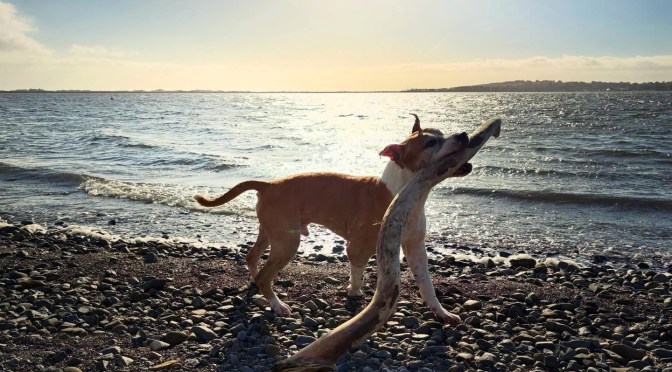
In April 2021 Decker suffered a traumatic rupture to his left ACL. He got his foot caught between rocks at the beach while travelling at his usual torpedo speed. There was no joint disease, it was a traumatic accident; just foot placement of a couple of mm left or right and he would have been fine, as he had been a million times before.
This was during COVID lockdowns, and AniEd closure, and we had been spending at least two hours at the beach swimming and hiking every day at that time.
But that day, everything stopped.
He was on rest immediately, surgery within a couple of days and then months of restrictions, recovery and rehabilitation. Swimming for hours and hiking double figure km everyday was no longer available to satiate his energies and occupy his mind. His access to social interactions was restricted, his sleeping and toileting routines changed, eating changed, play changed, not to mention the traumas associated with injury, surgery, pain, handling, manipulation, medications.
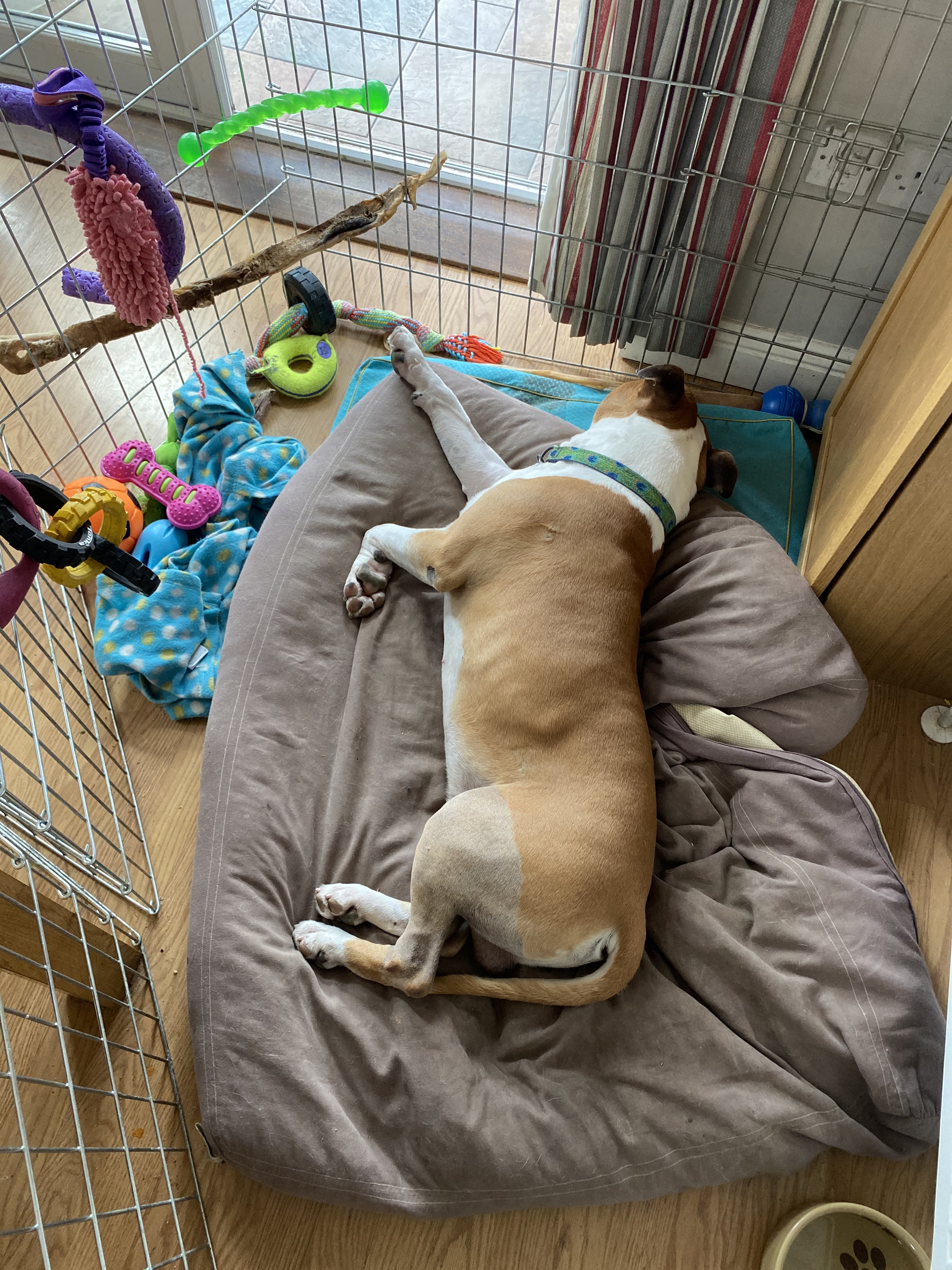
Despite my great upset and a significant knock to my mental health, all because of a busted ligament, Decker thrived. I built an elaborate support plan to maintain his behavioural and physical health and he rocked every single second of it. So much so that he convinced us that this super-active sports dog, was really a lazy dog in a crazy dog’s body.
But really, we had been preparing for this over his entire life.
Getting ready for retirement!
Recently, Dr Helen Zulch presented at our IVBA conference on supporting seniors. She emphasised looking ahead to understand the experiences of our aging dogs (and cats) and how we can prepare them for what’s to come.
Reduced access to stairs, beds and sofas, restricted exercises, changes to activities and social environment effects, vet care and routine changes are ahead of them.
Around November 2024, I noticed some occasional and very subtle changes to Decker’s gait indicating some age-related neuromuscular degeneration. He was showing slight changes to proprioception and very mild loss of strength, particularly to the right pelvic limb. We have followed up with ongoing neurological examinations, with subtle changes found, and we have been monitoring since .
Immediately, though, I ordered a Help ‘Em Up harness from the US. Not because Decker had lost any mobility, these changes were very slight and subtle only, but to prepare him.
In the clip, you can see how complicated a piece of kit this is…there’s lots of straps and fitting and affects on movement and comfort. I wanted him to have time to develop the skills in plenty of time before he needs the harness support.
Think of the skills the dog might need to be able to fit and wear this comfortably…for example:
- be capable of standing still for lengthy initial fitting
- be capable of standing while snuffling or lapping
- be capable of eating while fitting is ongoing
- be happy to move his head through the loop
- be happy to stand still while straps are adjusted and fitted
- be happy with clicking noises (yes he’s deaf but is still sensitive to some types of noises close to him)
- be happy to move with straps moving about his body
- be happy to engage in normal behaviours while wearing the harness (in the clip, you can see him search for tossed treats)
- be happy with pressure on the harness applied to various parts of his body
- be capable of responding to pressure on the harness applied to various part of his body
- …and the rest…
At no time, would I have expected to just stick that harness on to his body and him just to “get used to it“. I ordered it in advance (we still don’t need it!) so we had the time for active teaching, his full participation, and skill building.
Great expectations
We do a terrible thing to our dogs. We just expect them to conform and slot in. And our dogs are exceptionally good at appearing able to conform and just slot in.
So we move on. Once our dogs’ behaviour isn’t causing trouble for us, we assume all is well.
I’m exhausted seeing videos on socials from rescue, assistance dogs, and training profiles showing dogs in situations for which they have not been prepared, for which they do not have the skills. And while that’s bad enough, the dogs’ behaviour or role as portrayed, is extolled as some roaring success.
Our abilities to spot canine behaviours associated with acute and chronic stress are clearly poor. But maybe we’re quite happy that our dogs appear to cope and recognising any different would be quite unsettling. To us.
What’s more, should we tackle the enormity of these realisations, we might need to do something about it. And that means, teaching the skills. Not just expecting them to conform and slot in. Actual shaping of their behaviours to build skills that help them cope, at a minimum. But really, we should be teaching them skills that allow them to flourish.
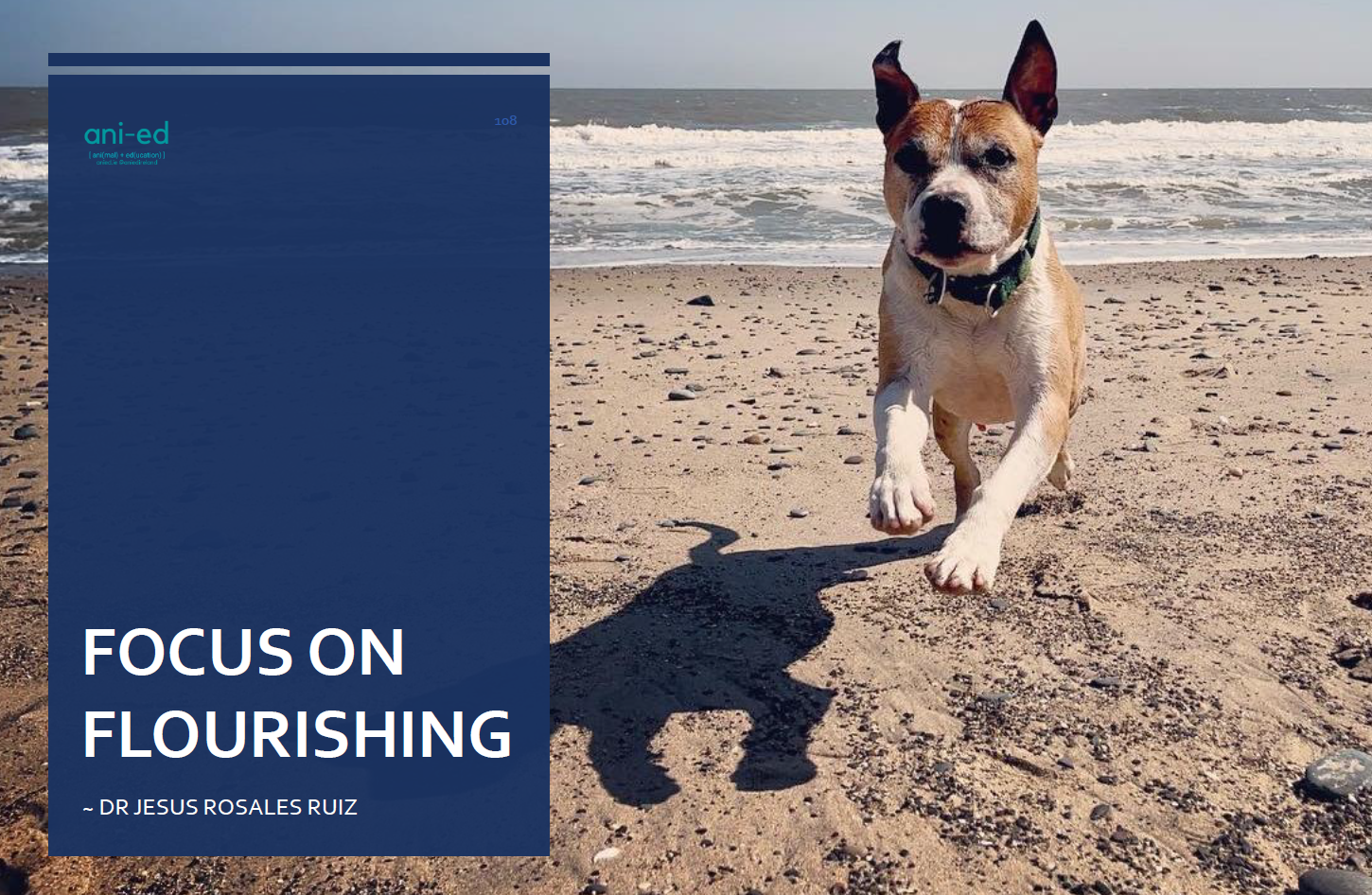
Above: a slide that regularly appears in AniEd course content.
Skill building doesn’t mean “obedience”. Behaviour has evolved to allow animals to control what happens to them. We expect dogs to live in environments not necessarily designed for them to control what happens to them. They must be taught and supported in the development of behaviours that allow them to access chosen reinforcers in appropriate (safe & acceptable) ways.
When dogs show behaviours that we deem as “problematic”, the real “problem” is that the dog does not have the skills (behaviours) to access chosen reinforcers in appropriate ways. Skills deficit is the problem, that is, our expectations and inadequate teaching are the problems.
But we can do something about that…
What rehearsal skills are needed?
When I think about the eventualities that we’re in a living rehearsal for, I want to narrow down skills that will help my dog throughout life, and all of its ups and downs.
For example, my dog is happy to:
- eat in a range of situations
- settle himself
- work on chews and puzzle toys independently
- settle comfortably in confinement
- travel calmly and comfortably in the car
- cope with others entering or moving about
- tolerate handling and manipulation
- walk on lead in a variety of conditions
- get on with life in the face of changes to his routine
- largely ignore others
- explore novel environments comfortably
- move away from things and engage with his human
There are more, of course. But it’s never too later to start.
Have a plan
Should the unthinkable happen and you become incapacitated in some way. What happens your dog? Start planning and rehearsing now.
Have a plan in the immediacy. Where will your dog be? Who can go get them safely? Who will look after them?
What do back-up and emergency carers need to know? What does your dog need? Where do they find their stuff?
Have an agreement in place with those who will care for them. Make it legal if you have to; include it in advance planning.
Have a plan for short, medium and long -terms. What happens your dog?