#100daysofenrichment will be starting, with Day 1, on Monday 6th September.
The entire program is always available for you to access (here), but this will be a guided run via the Facebook group.
You can follow along via this blog, but we would love you to come along and join in on our Facebook group where the most wonderful community of enrichers has built up over the years. Thousands of members later and everyone is friendly and supportive, and we are all in it together!
Sadly, we are waking, on this Bank Holiday Monday, to the heart-breaking news that, overnight, an infant was killed by a dog in Waterford.
Child deaths have bookended lockdown, with a young boy killed by two dogs, in Dublin, last March. The first ever recorded dog bite related fatality, in Ireland, came on the June Bank Holiday in 2017.
A helpless infant dying is devastating and I can’t imagine the pain this baby’s family and loved ones are experiencing. AniEd extends our sincerest condolences to family and friends of this little one.
As is usual in these cases, there is scant verified detail available at this early time, and as is also usual, there is a myriad of speculation and sensation already generating on the back of this baby perishing. We will not engage with this, or in blaming any party involved.
Our remit is canine behaviour, rather than speculation and sensation. Due to the rarity of fatal and serious dog attacks, data is incomplete, especially here in Ireland. The most reliable research on this topic is from the US, looking at 256 fatal dog attacks over a ten-year period (Patronek et al, 2013).
This work identified co-occurrent factors involved in such incidents, including, a vulnerable victim without able-bodied supervision, victim unfamiliar to the dogs, dogs who have been kept isolated from regular human interactions and prior concerning incidents involving the dogs. Breed or type is not predictive of involvement in serious incidents.
Some combination of these risk factors is present in most incidents involving serious injury and are preventable through environmental management and modification.
Dog behaviour is expressed in response to environmental stimulation: what goes on around the dog determines their responses. Even though dogs inherit characteristics, both physical and behavioural, these genetic effects will be expressed relative to the dog’s environmental conditions. This is generally determined by the humans who produce the dog, who rear the dog, who care for the dog, who are responsible for the dog.
Widespread education is needed to help ensure people can care for their dogs in a manner that promotes safe and welfare-friendly interactions with dogs, so that dog behaviour is adequately managed and the canine-human relationship is enhanced.
Try to resist sharing posts, stories, individuals and so on that continue to speculate and sensationalise, and essentially monetise, a sad incident. If given the opportunity, we can learn from these tragedies and help prevent further heartache in the future.
While we are pretty familiar with our dogs sniffing, we can only really spectate from the sidelines, not really comprehending their experience.
There really isn’t too much comparable for us. Perhaps getting really involved in a good page-turner, getting lost in some absorbent music or perhaps studying a painting, moving back and forth to adjust our view, take it all in, marvel in its wonder.
For dogs, the joy and intense sniffing that comes from non-contrived, non-human-led randomly coming across some spot extra-smelly is out of this world.
We were a good ten minutes or so at this sniffy-spot. You can see how intensively he is gathering information and the repertoire of olfaction related behaviours, along with sniffing.
Watch him press his nose right in, track and trail, sniff and taste, dig to stir up even more information.
This really is a Mona Lisa level sniffing spot…whatever’s been there.
Erichment
We are all about appropriate enrichment for dogs. We’ve got the whole 100 Days of Enrichment program free and available for dog owners everywhere.
But, do you ever think why we must put so much effort into such elaborate and contrived enrichment programs just to provide for our dogs’ needs.
Dogs are domesticated animals and surely domestication should better prepare dogs for life with humans. But, it’s more complicated than that…
Sniffing
There are all sorts of contrived ways to provide dogs with sniffing opportunities, from home-made sniffing puzzles, to store-bought toys, to formalised nosework sports and training.
No matter, dogs must sniff and most of their sniffing should be dog-led and non-contrived, surely.
Most pet owners are probably not engaged in providing their dogs with lots of extra and contrived sniffing opportunities. So most dogs probably only have outlets naturally available to them.
While extra opportunities to sniff are appreciated, and may be important for dogs who can’t get out and about, and are fun outlets for both humans and dogs, less contrived and more natural sniffing is vitally important.
It doesn’t need to be elaborate, this clip is just us sitting on a log in some woodland. All that air sniffing is absorbing, as he monitors his world, intensively taking it all in.
Eager to Please?
A myth traditionally and commonly perpetuated about dogs is that they are eager to please us, that they will work for us, that they just want to do things for us. Of course, this really isn’t a thing; dogs, like all animals, have evolved to be pretty selfish, innocently so, but selfish none the less.
There are all sorts of discussions we could have about this because there are certainly dogs that have been developed to be more engaged with humans, but they are doing that for some sort of pay off…to get something or to avoid something.
But, it’s easy to see how this myth and attitude toward dogs has gone from strength to strength.
When dogs were first developed to work alongside humans as landraces or types, later to become breeds, dogs were selected on the basis of their ability to do the job. To do the job that they were made to do. That they did because they were intrinsically motivated to do so.
Although we presume this to be because they are doing it for us, because we seem to make every interpretation anthropocentric and anthropomorphic, these jobs satisfied their needs. Dogs had outlets for their natural behaviours.
Over time we refined their performance through selection, and dogs got to do their job better and more.
Now think of the behaviours we want dogs to do… Loose leash walking is an example of a relatively simple sequence of behaviours but something that requires a high rate of reinforcement or strongly aversive tools to suppress normal dog behaviour (walking faster than us, sniffing, stopping, going where they want to and so on). Whichever is employed, both are generally required over a longer term to establish behaviour we find desirable.
We often talk about upping the ante on the value of extrinsic reinforcers to get behaviour, increase our rate of reinforcement. All to get dogs doing behaviours we want and they clearly may not.
There are ethical questions we need to ask here.
Functional Dogs
I am a big fan of purpose bred and functional dogs. Dogs that will require some refinement to do their job because it’s intrinsically fulfilling for them.
Not only are they coming with the right genetic and epigenetic package, but also being matched to the right environmental conditions.
Most of the dogs I work with have been chosen as companion dogs, and very often, they do not come with the right package to do this job, in what is usually, under very challenging environmental conditions.
Choosing & Placing Dogs
Dogs are not interchangeable and unfortunately, love is not enough to provide for their welfare. Dogs have needs at species level, at breed/type level and at individual level.
How easily will a dog’s intrinsically motivated behavioural needs be met?
How much intervention will be required to provide that dog with skills to live a welfare-rich life in their new world?
While breed and breed history and function is important, a lot of breed history is mythic. We really want to know what are the behavioural tools they possess, in built, that allow them to do the job they were made for.
And it’s not just about breed.
We also want to consider the possible effects of epigenetics, despite it being a very immature area of study. What sort of environmental conditions have this dog’s relatives endured over generations? A dog whose lineage has lived in rural areas, as dogs who got to potter about all day, who didn’t have to cope with the constraints of suburbia, may require a lot of support to maintain their welfare in a regular family living in a semi-d in a housing estate.
And on top of that, what sort of rearing experiences was this puppy expose to? We really only have a few weeks at the beginning of a puppy’s life to equip them with the skills they will need to cope with the world as they age.
These early rearing experiences are just refining the genetic and epigenetic package, already in place.
What function will this dog need to fulfill? Real, straight forward companion dogs are not easy to come by…
I don’t have the answers
I’m just thinking out loud really. I don’t have the answers but I do think we should examine this.
Today is literally a day of contrived sniffing on the current run of #100daysofenrichment, Day 55. And most of that program includes contrived examples of ways to help meets dogs’ needs.
My breed has a history of blood sports, although AmStaff lines are somewhat watered down relative to their ancestors’ bloodsport past. I am not into providing dogs with those sorts of outlets, regardless of function! But, my dog is from a lineage of sporty companions who have lived this life for generations. And I do consider outlets for the behavioural tendencies he comes with, that helped his ancestors do their gruesome jobs, important and make up a lot of what we do.
We can provide dogs with appropriate enrichment and want to do more and more of that, but also need to consider the ethics, ask the difficult questions, pose the whys and listen for the answers.
Valentine’s Day is just about upon us so it’s time to treat the ones who really, and always, love us…our dogs!
Here are some simple but HIGH value treat recipes to really treat your special Valentine!
In today’s cookbook we have:
Pyramid Treats
Charred Liver Treats
Liver Kibble Crush
Liver Pate/Ice Cream
For the treats demonstrated here, I have used chicken livers as the base. I buy them in bulk and divide them out into treat-recipe-portions and then freeze them. They are super tasty, nutritious in small amounts, and are quick to cook.
But, you can use any flavour base that works best for you and your dog. Meats, offals and fish work best, but you might use cheeses or yoghurts, nut butters or even your dog’s regular food.
I will warn you that I am pretty experimental about this ~ my dog is not one bit fussy and would eat pretty much any amount of any food offered ~ but your dog might have more specific requirements so try different combinations and amounts out to see which works best.
Keep a note as you trial and error so you know when you have hit success – I’m sure you will always have willing taste-testers…!
Pyramid Treats
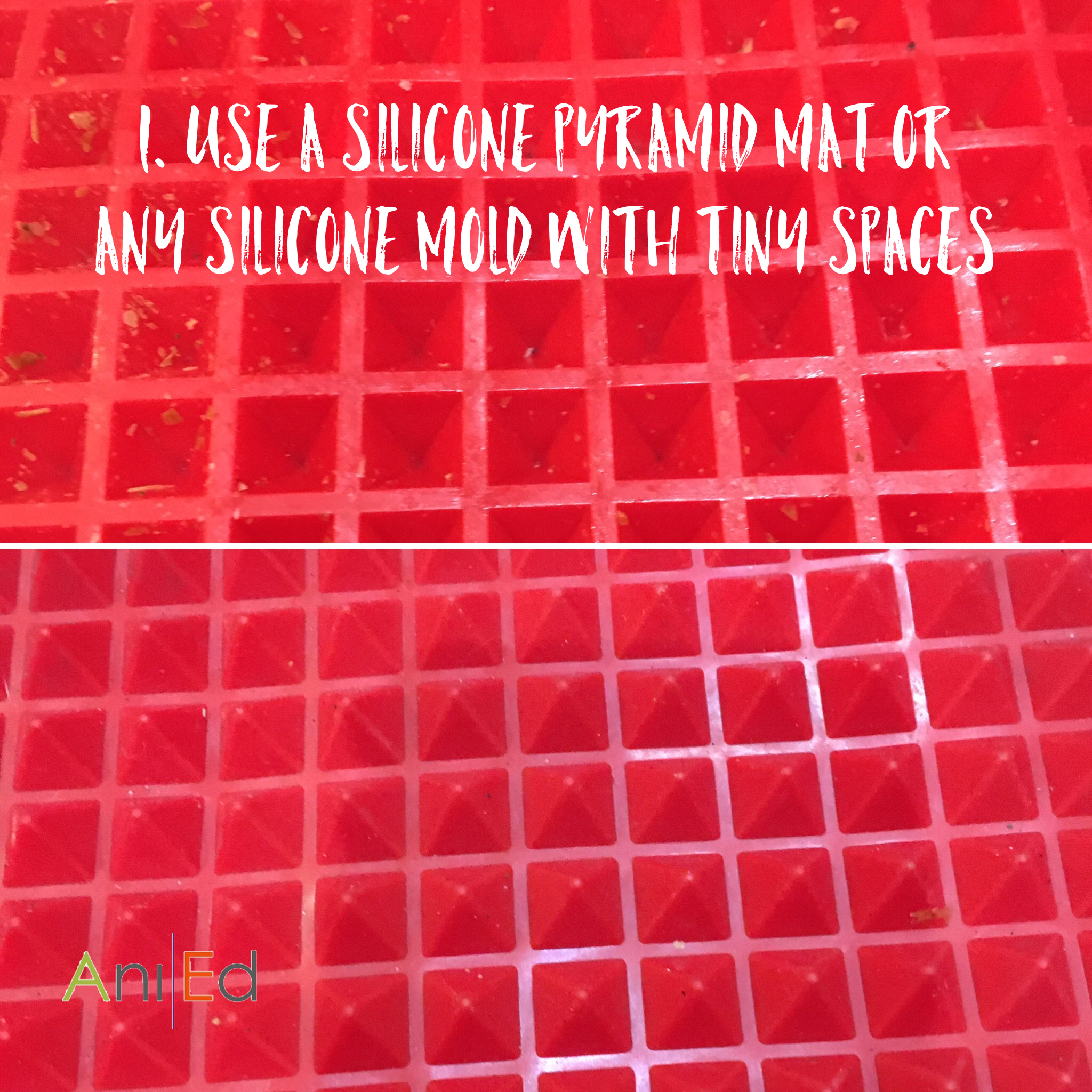
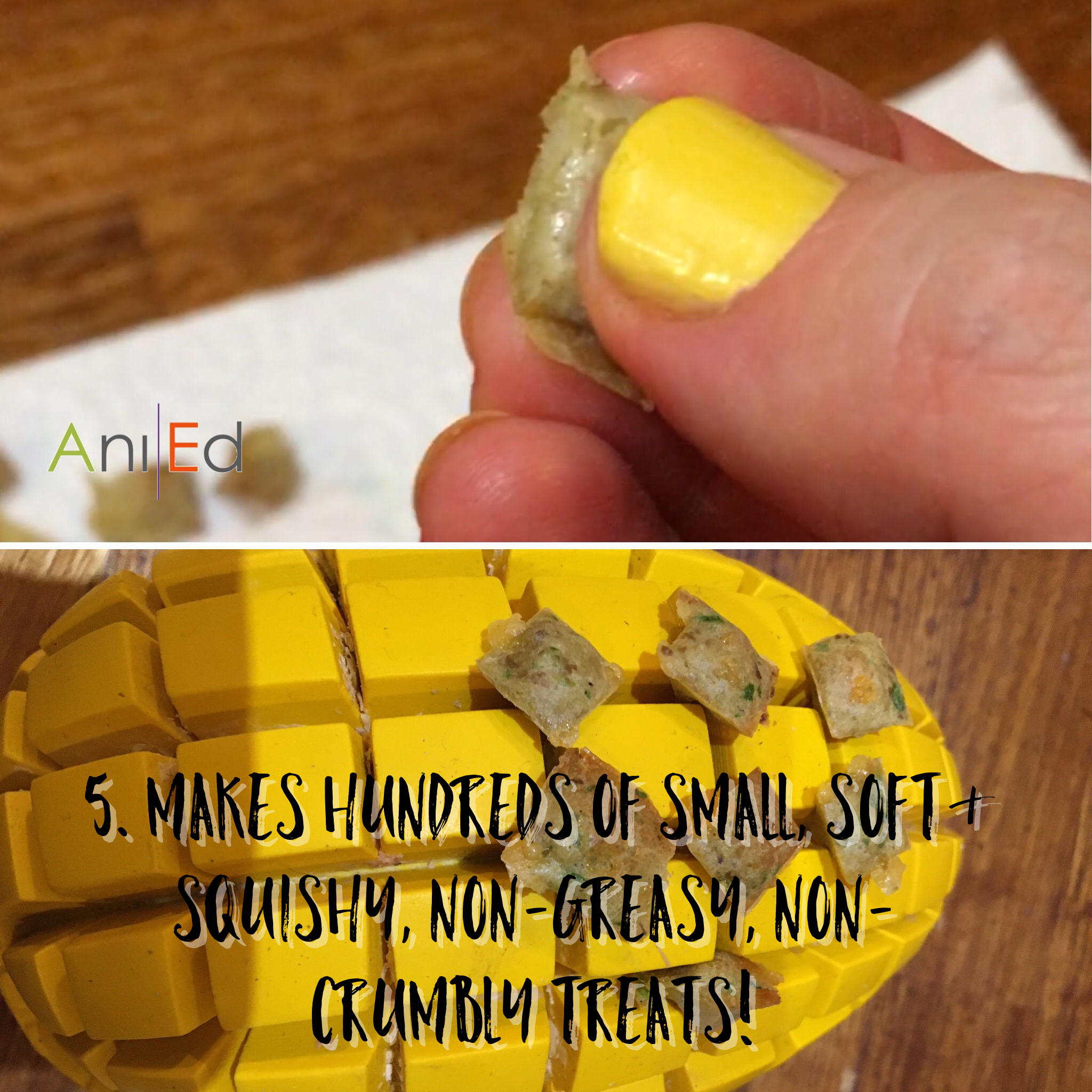
Silicone pyramid mats are used to help cook healthier, by draining the fat, but did you know that they make an awesome mold for soft, squishy, non-greasy, non-crumbly baked dog treats?! You can use any oven-proof mold with small spaces really (and there are lots of different types available apparently); the pyramid mat makes hundreds at a time at a nice size.
The basic recipe:
100g of the protein – the star of the show that brings the yumminess, e.g. liver, fish, minced meat, cheese, yoghurt, peanut butter
100g of grain like flour of different types, oats or kibble ground up
20g/1 tablespoon of fat such as oil of your choice, butter, yoghurt, but butter
2 eggs
Add water to thin to the right consistency, as needed. You want this to be a loose pancake batter type consistency. Blend in a food processor or similar to combine in a smooth mix.
In the pictures I have mixed:
150g chicken livers
150g flour
2 eggs
1tblsp olive oil
handful of spinach
handful of grated cheddar
water to thin and a splash of kefir
That makes about two pyramid pans worth of treats.
Pour on to the mat or mold and spread so each space is filled without bubbles. (Although I’m not sure how much that matters….)
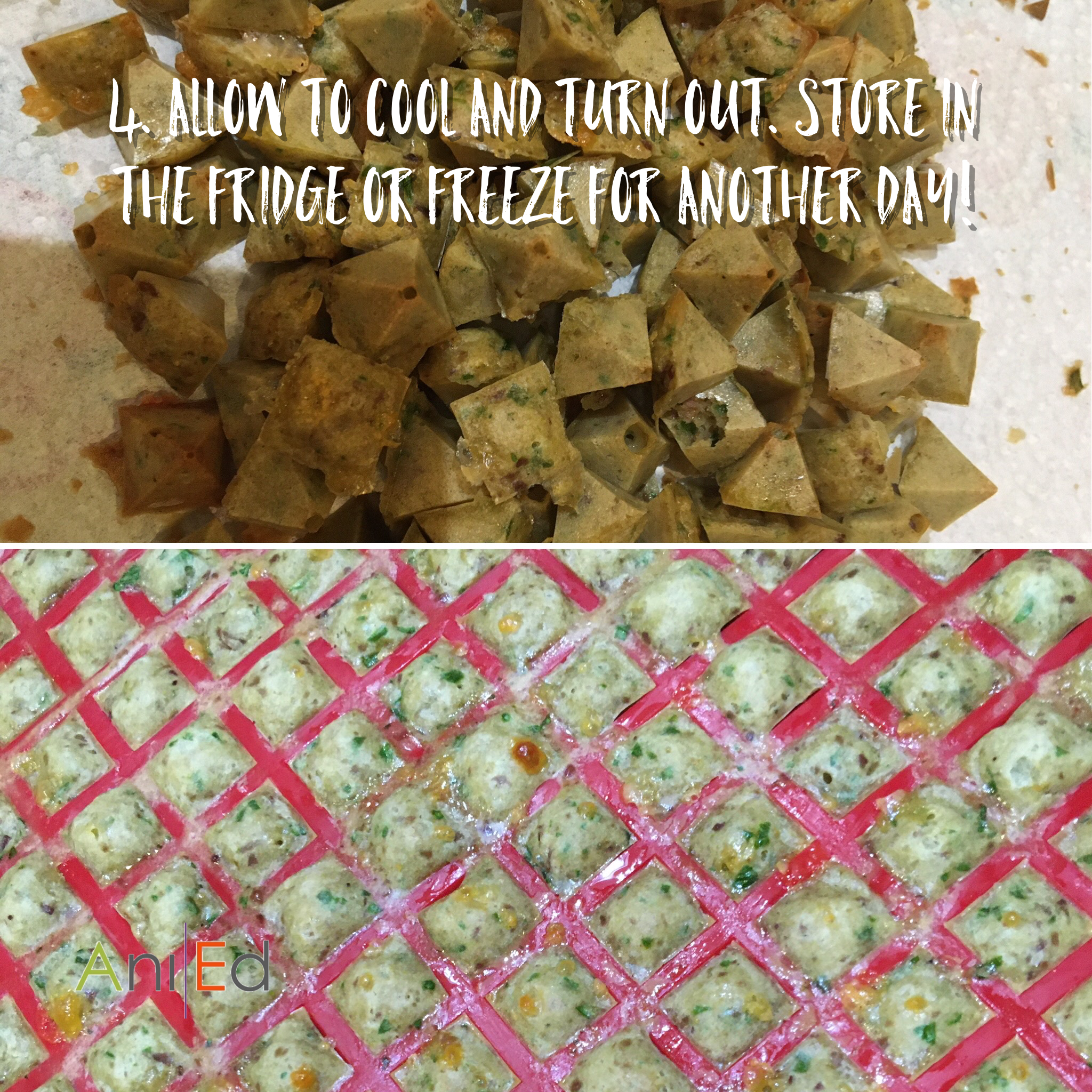
Cook at 175C for about 12 minutes. I find the smaller ones on the edge get a little crispy so watch closely and cook for a couple of minutes less.
The great thing about these treats is that they turn out of the pan really easily and cleanly, making this a very efficient way of preparing food rewards.
Opening the oven door can be a little smelly, depending on the ingredients so be prepared for that!
These treats freeze well.
They are small and squishy to handle, and not greasy or crumbly.
You can design these to your dog’s tastes and requirements, for example, looking at egg or flour replacements, adding the proteins that work best for you and so on. You might need to experiment a little to get it right for your mix and preferences, but that’s all part of the fun too, right?!
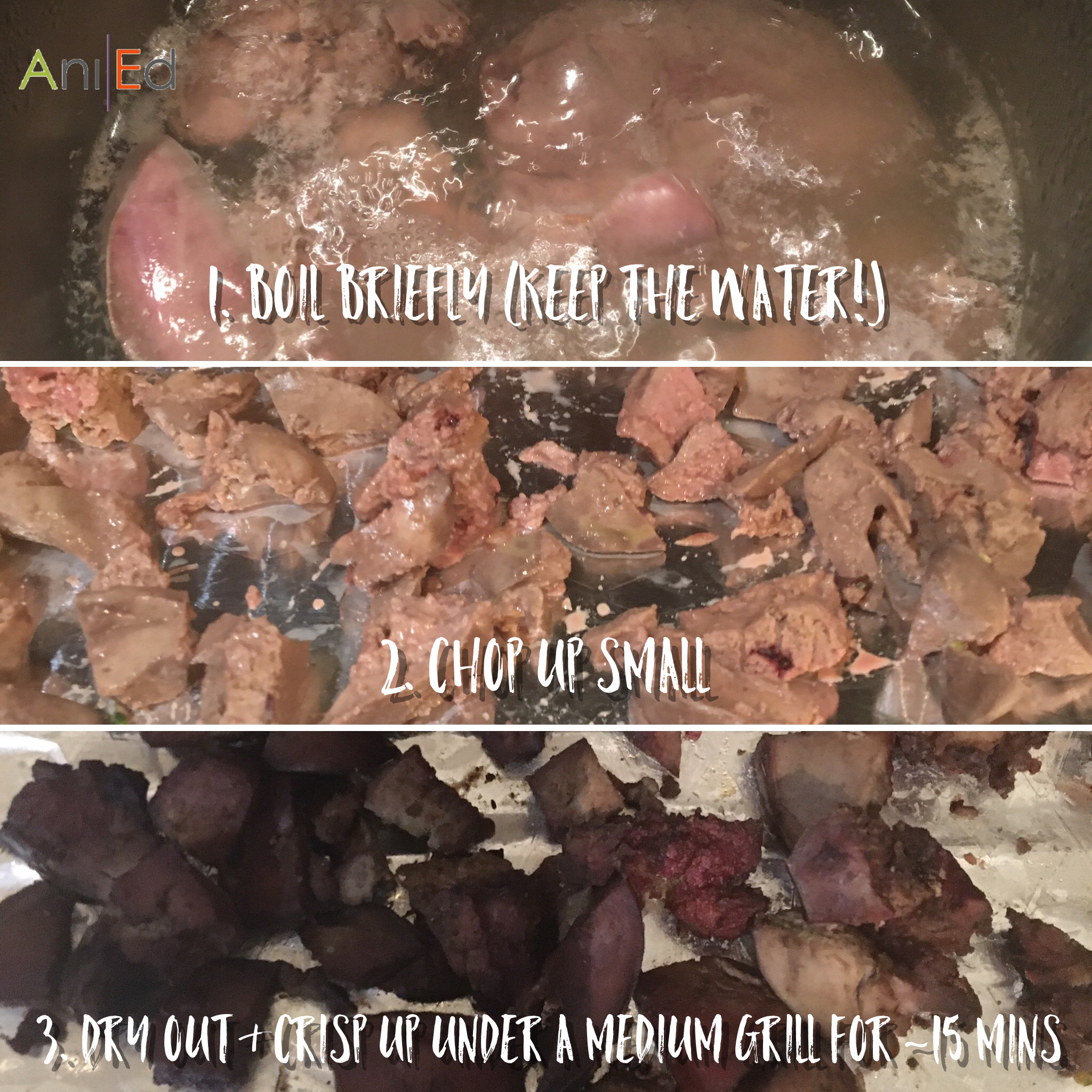
Charred Liver Treats
This is a long standing favourite of mine, particularly preparing for the show ring and obedience competitions back in the day…I have charred a lot of liver and sausage for dogs treats!
Again, you can use any flavour bases you like but offal and meats work best as they don’t just turn to mush. I am using chicken livers here.
Simple as 1…2…3!
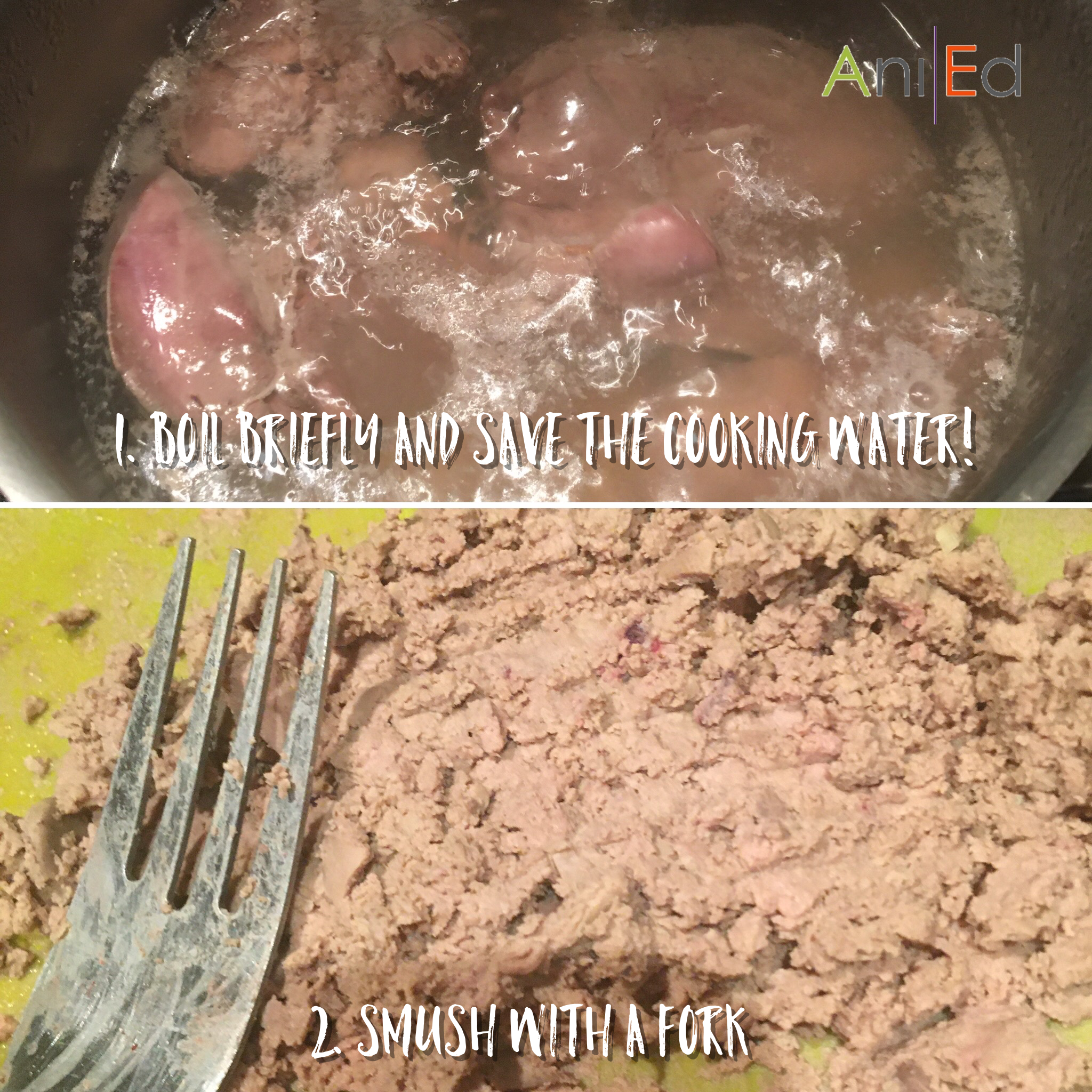
Liver Kibble Crush
This can be a great way to enhance the value of kibble. You can just add small amounts to meals to boost palatability and enthusiasm for regular food.
It’s also a great way of preparing kibble for stuffable toys, which can be frozen too for extra challenge.
Use the water you lightly boiled your liver (or chose option) for your charred treats.
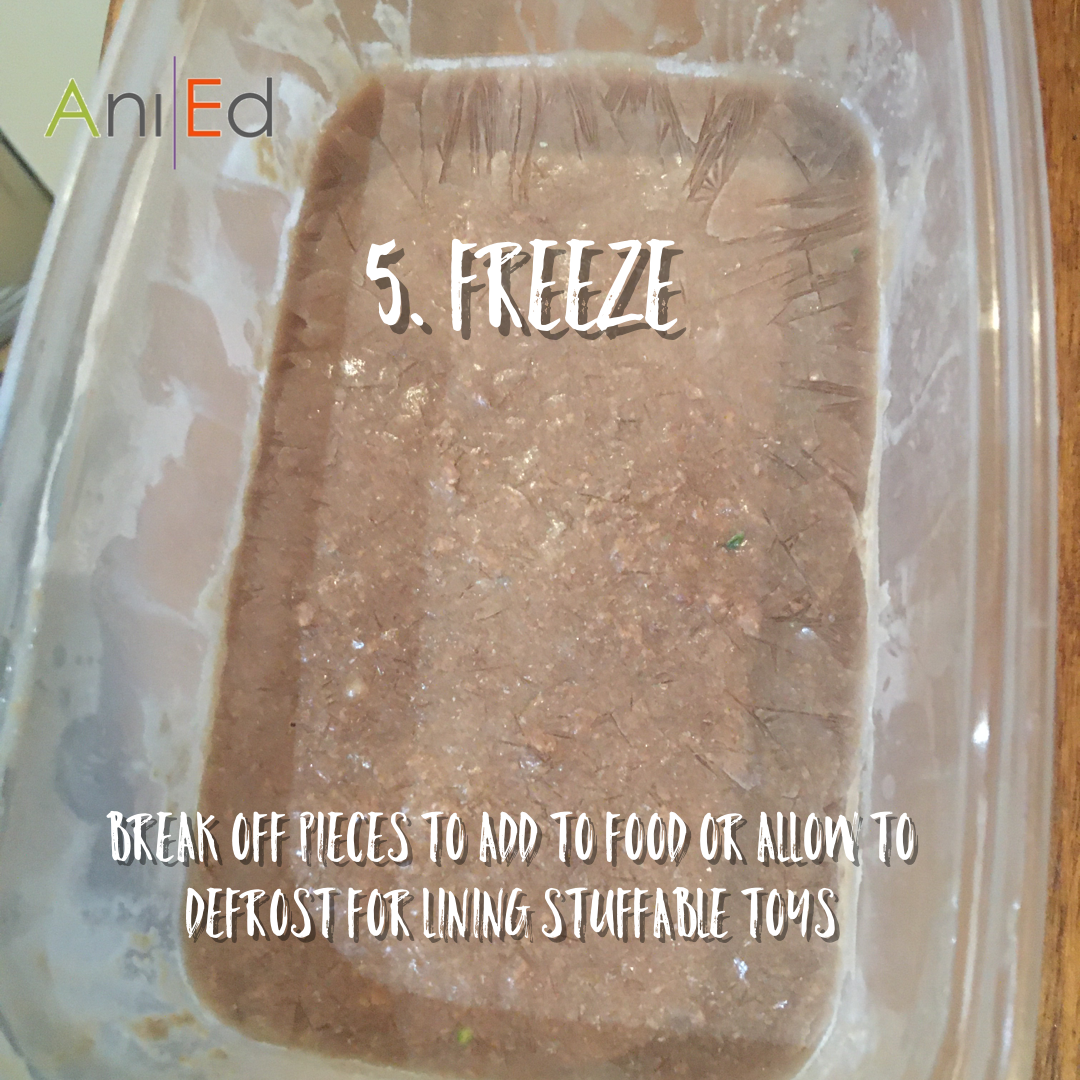
Liver Pate/Ice-cream
Liver really works best for this one but if using other meats or flavour bases, such as fish, you might need to use a blender or similar to get a smooth texture.
Not sure your dog will mind too much texture though, so that might not be a concern!
This is really versatile. I like to break off chips of frozen mix to add to stuffable toys or as a topper. You can defrost it and spread it in toys and refreeze too!
Happy Valentine’s!
Enjoy your treats and share your ideas that work for your dogs.
When talking about stress, most people are referring to the negative effects largely associated with chronic stress. Stress is a normal part of life and nobody can be insulated from it.
Stress responses are experienced at neurobiological, physiological, psychological and behavioural levels. This involves a complex interplay between body and brain systems.
Dogs, like other mammals have similar biological ‘equipment’ for experiencing stress – the parts involved in stress responses are very ancient and likely evolved in more simple creatures. That’s because stress keeps us alive.
If stress keeps us alive, how can it be bad?
Stress acts at a number of different levels, depending on the nature of the stressor. Different stressors elicit different types of stress responses.
Any time the body is faced with challenge, it must produce a response that helps it cope with that challenge. If the individual has the neurobiological, physiological, psychological and behavioural tools…
Food based enrichment is the most popular approach to enrichment for most animals in captivity; it’s probably the easiest and most obvious way to add entertainment to a pet’s life.
Although I’m not a big fan of food bowl feeding, and I do believe that reducing their use generally does good things for pets and their people, we are not going to get religious about this stuff during this program.
You do what works for you and your pet – you are here, adding enrichment to your dog’s life and we are delighted to have you.
Food Based Enrichment
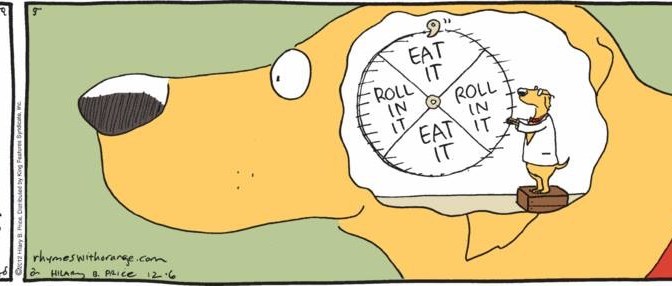
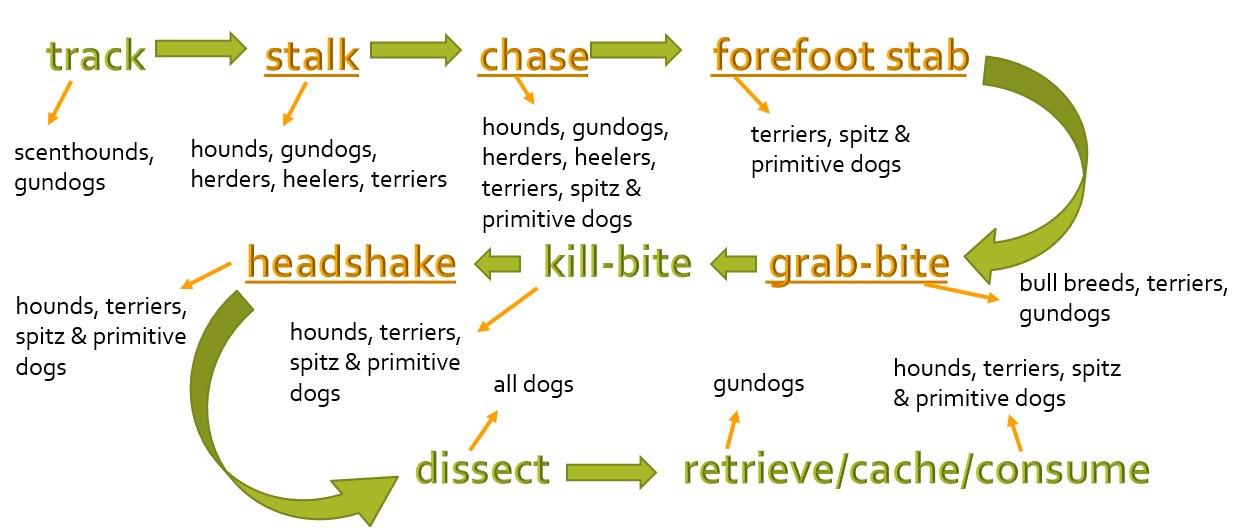
Animals come with installed motor patterns that relate to feeding behaviour. All dogs have inbuilt predatory behaviours that are also found in wild canids including tracking, stalking, chasing, pouncing, biting, dissecting & chewing, caching and consuming.
Various portions of this predatory sequence have been enhanced or inhibited through selective breeding, producing…
The animal’s behaviour is feedback telling us humans how well we have set up their environment for success. Or not.
It lets us know what we can refine, adjust, improve.
I don’t want to draw too strong a line between training and enrichment, as there is lots of cross over, and how much cross over there is will largely depend on how we do either one.
In enrichment, we take that notion even further than often we allow ourselves to in training. (We should be approaching training in the same manner, but that’s for a different day!)
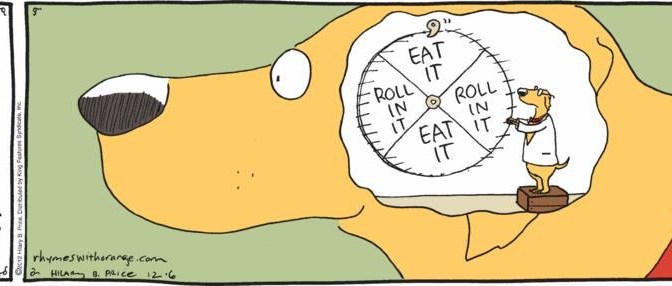
How the animal chooses to engage, or not, with the enrichment activity or device is up to them. Regardless of our intentions or how we think they should approach the challenge – the animal decides. This allows enrichment to be enriching.
With the popularity of discussions of ‘enrichment’ in dog-care, it’s really become very trendy to talk about it and ‘enrichment’ has become a bit of a buzz word.
That has led to some misuse and misapplication of this term, describing activities that are not truly enriching for the individual animal.
And in turn, as is the way within the animal care industries, there has been backlash.
Sigh.
The popularity and awareness of enrichment for dogs is a good thing, but, it’s important that it is implemented correctly to actually help dogs, rather than contribute to harm.
Just giving a dog some puzzle or food dispensing toy doesn’t necessarily equate to enrichment – the only way we can ascertain how enriching enrichment is, is by asking the dog.
Enrichment must be goal oriented (the main goal being, that enrichment must be enriching) and the dog’s behaviour should be observed to ensure…
We gotta talk about health and safety in all our enrichment endeavours. An awareness of what might go wrong will help us keep our pets safe, because, let’s face it, they don’t always look to keep themselves safe!
Dogs will injure themselves in all sorts of ways, especially when it comes to edibles or things they think should be edible…
What follows are general tips but there may be more specific guidelines appropriate to your pet. There will also be more specific safety tips with particular challenges. But, the bottom line is, you need to know your dog and their tendencies.
Always supervise pets with puzzles. Again, knowing your pet is important here – there are some things that can be given to some dogs to keep them busy when alone. Choosing appropriate toys or devices will need to be appropriate to the dog’s size and chewing/play style. Toys or…
The first week of #100daysofenrichment is just around the corner and as it’s the first week, we are going to keep it pretty simple and straightforward.
Keep up with all the resources and challenges relating to #100daysofenrichment here
and join our Facebook group too!
All challenges are presented with multiple options so you won’t lose out if you don’t have some of the items.
Any of these toys, just like the classic red Kong, can be used as stuffables for appropriate pets!
For Week 1 you will need:
a range of foods suitable for stuffing such as your pet’s regular food, spreadable yummies, chews and treats, higher value foods such as meats and fish (for dogs and cats) (more detail here)
toys that can be stuffed which basically means any toys that are somewhat durable (appropriate to your pet) and have two holes (two holes are better for safety).















 Various portions of this predatory sequence have been enhanced or inhibited through selective breeding, producing…

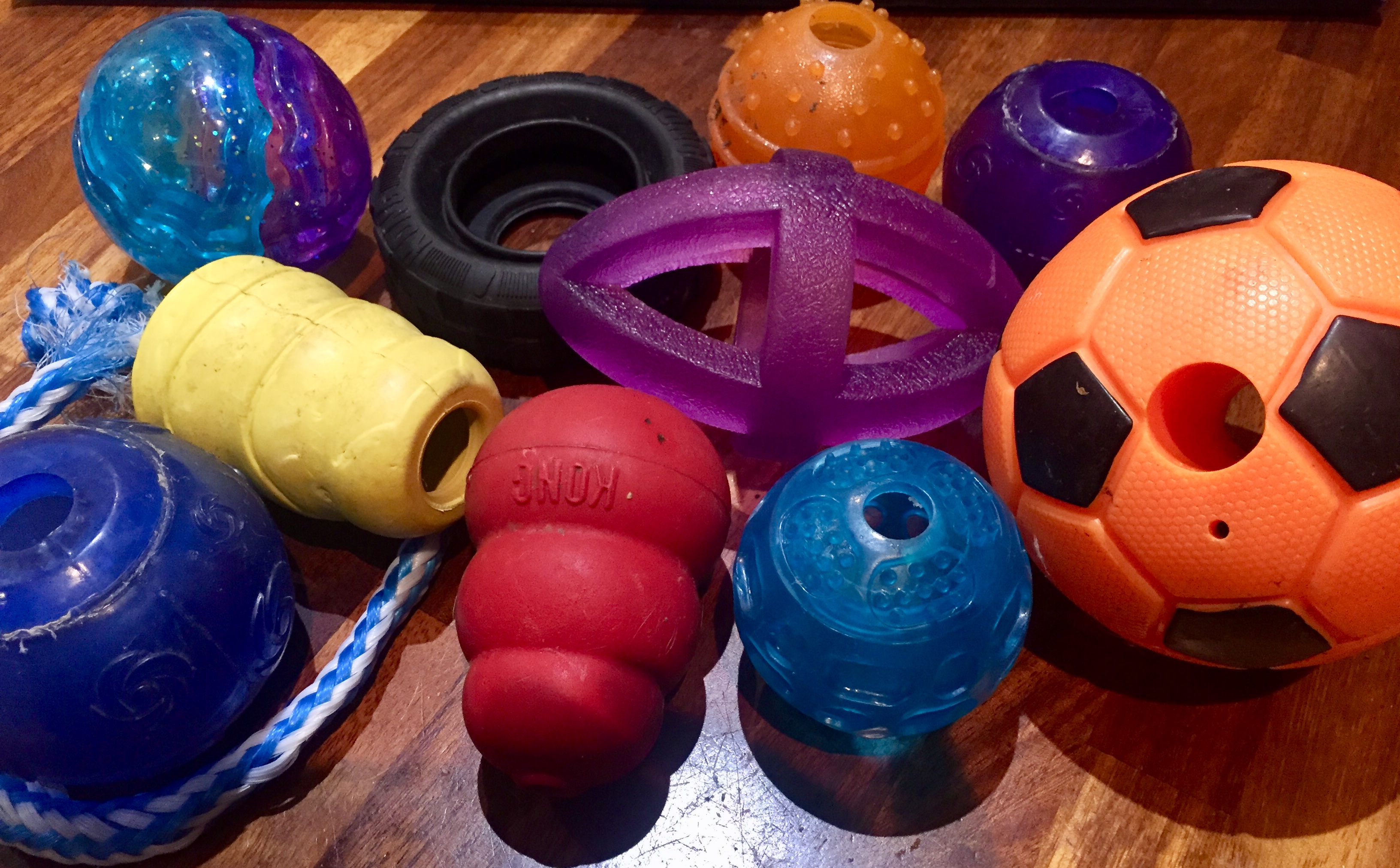 Any of these toys, just like the classic red Kong, can be used as stuffables for appropriate pets!
