We are still running a little behind; here’s what you’ll need for Week 2 here.
Category Archives: AniEd

On Lockdown
How’s everybody doing? It’s a pretty weird time, to say the least!
This upheaval, uncertainty and change is not just causing stress for humans, but for our dogs too.
Suddenly everyone is home a lot, morning routines are very different (or non-existent), there is little respite from family activity, children are around a lot and full of life, and cabin fever is setting in throughout the household.
Even the outside world has changed considerably with few people in places that once were crowded and more people and activity in places that used to be quiet.
This sort of sudden change to things that greatly affect them, and their routine, really does blow canine minds.
And, things don’t seem to be going back to normal any time soon.

Creatures of Habit.
Dogs like routine. Predictability and controllability are the keys to animals feeling comfortable and to reducing stress.
Think about the sorts of behaviours we are seeing in our fellow humans right now, such as panic buying, hoarding essentials and even competing with one another for toilet roll. This is pretty much resource guarding and associated with high-stress. When we lose predictability and controlability, we try to control what we can.

Just like us at this time, when things are in a constant state of flux, with unexpected changes popping up regularly, dogs may become worried, displaying behaviour associated with stress and anxiety.
- maintain some of your regular routine as much as possible such as your dog’s meal times, or chill out time in the evenings
- bring your dog for regular toilet breaks – changes to routine can upset toileting, especially in young dogs
- try to keep your dog’s bed-time routine the same
- establish a safe resting place for your dog, where they will not be disturbed or approached
- make sure your dog gets plenty of opportunity for rest, away from the action so that they can actually rest and switch off for a while
If you notice changes to your dog’s behaviour, even if you think those changes may be attributed to all this chaos, the first port of call is your vet. Contact your dog’s veterinary practice and ask them about procedures for attending for appointments, making enquiries and so on.
(You can read more on preparing your dog for stress-reduced vet visits here: Vet Ready!)
Get in touch with us to discuss your dog’s behaviour; we have lots of remote and in-person options available to you.
Home Alone.
Over the last week or so, more and more people are working from home, staying home to mind children, or sadly, losing their job (hopefully only temporarily). This means that, all of a sudden, lots of dogs’ nearest and dearest are available and accessible a lot of the time.
Maybe dogs are behind all this crazy stuff after all…

While in the short term that’s certainly a good thing and very beneficial to dogs, who are likely basking in your company, this might make going back to normal (whatever that will be) quite difficult.
Suddenly leaving them alone for extended periods in the weeks or months ahead will be another change that dogs might find difficult to handle.
- as much as possible, try to leave your dog alone for even short periods most days, even if you just go out the front and sit in your car for twenty minutes
- establish a leaving-routine that tells them they will be settled with something yummy to work on while you go briefly and return – how long you go is set by your dog’s comfort levels
- set up a safe-place for your dog to settle in when you are there too
If your dog has difficulty with spending time separated from you or alone, get in touch and we can help you remotely or in-person.
Out and about
Since the lockdown, of effectively the entire country, was announced, public parks, beaches and many public spaces have suddenly become one of the few places people can go to for exercise, for a break from the house, to bring children and for entertainment.
And because normal routines have been turned on their heads, it’s busy at different times than usual, and it’s harder to predict when it might be quiet.
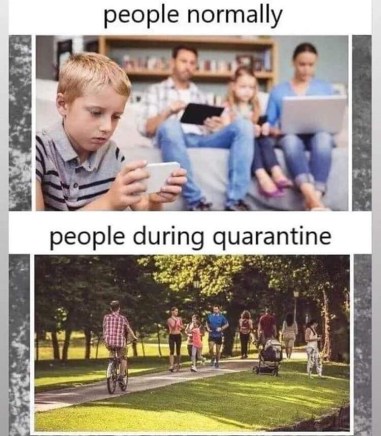
Lots of dogs are more comfortable when they can have some space from passers-by, joggers, kids, other dogs, traffic and other potential triggers. This may be more difficult right now.
Taking your dog for a relatively peaceful sniff is terribly difficult at the moment and that can further affect your dog’s stress levels, both out of the house and indoors.
- do your best to choose quieter times and places for outings
- give your dog as much space as possible from others
- be a responsible dog walker and don’t allow your dog to approach, run up to, jump on others without their consent – that includes other dogs.
With stress heightened at this time, other dogs might not be quite so tolerant of social faux pas.
There is no reason for a dog to approach or engage with others, without solicitation, just as it would be poor etiquette for humans. Your dog is not just being friendly. - lots of joggers and lots of children running around may be difficult for many dogs who may exhibit behaviour associated with over-excitement, discomfort and distance increasing, all of which indicates the dog is experiencing a level of stress they are finding difficult to deal with
- use a long line or extendable lead, appropriately, so that your dog can roam and sniff, but you can still safely control them when needed
- get more value out of outings by introducing lots of sniffing tasks, engagement games and exploration
- always scoop the poop!
What do we do about puppies?
It is vitally important that puppies and young dogs have continuous and appropriate social exposure and environmental experience. During the first months of life, the brain of the young dog is more open to novel experiences and flexible in their ability to develop comfort.
If they don’t have this support, they may not be able to develop coping skills required in later life. It really is that crucial.
Our approach to puppy education, is holistic with us introducing all sorts of exercises to help prepare puppy for life in many ways. But here, we will just discuss providing puppy with appropriate social exposure, particularly in relation to other people, right now.
This is a tricky time as movement is so restricted and it’s important that we stick to the guidelines provided by the HSE and other government agencies.
That means visitors to your house, to help prepare puppy, are going to be very limited, if there will be any at all. It also may mean that you have fewer opportunities to visit others and their dogs, who may also help.
Because main streets in towns and shopping centres may be somewhat quieter, bringing puppies these places works out better as the dog gets a less overwhelming experience due to crowds and hustle.
Indeed, at this time, park land and forest walks may actually be too overwhelming while lots and lots of people flock there instead.
While this is often discussed in relation to puppies in their first four months of life, continued careful social and environmental exposure is important for young dogs in general. Even if a young puppy had wonderful experiential exposure early on, if this is interrupted or discontinued, they may still experience problems associated with poor early exposure when they are adults.
- bring your young dog for a short car trip everyday
- hang out in car parks, with the dog secured safely in the car, and let them sniff the air and watch the comings and goings
- working within the guidelines laid out, bring your young dog to quieter places and play engagement games
- play dress-up at home – wear wellies, hats, sunglasses, long coats; one at a time rather than all at once.
- play doorbell games
- #100daysofenrichment has now become essential participation for young dogs!
It’s not a good idea to let your young dog be pet or handled by others as this may be a source of infection. Instead work on people watching (or dog watching).
“Socialisation” is NOT about your young dog getting to meet, interact or play with every person or dog that appears. This just leads to magnetisation, and problems later on. Instead, make good things available when other people and dogs show up so your dog learns that others are a positve and that YOU make the magic happen, so they are more interested in you than in everything else.
The right time
It’s not all doom and gloom. With the right level of careful management and taking some proactive steps, this will go a long way to making sure your dog is OK through all this.
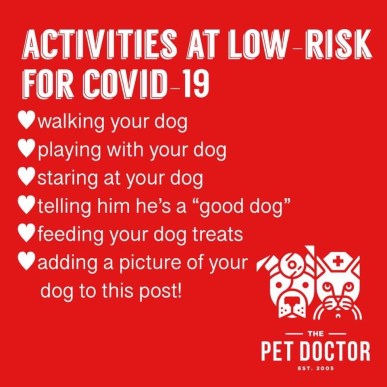
#100daysofenrichment
To help keep spirits up and to take advantage of this time at home with your pets, we have started another run of #100daysofenrichment
You can join at any time and this program will help you to provide tons of entertainment for your dog (and you). This is essentially a 100 day ‘training’ program, with hundreds of challenges all designed to help improve behavioural health. And it’s all free!
Doorbell Games
Because there will be a lull in people coming to the door, this is also a great time to play lots of Doorbell Games with your dog. This helps them learn more appropriate behaviour when the doorbell goes, meaning their response is easier to manage.
You will have better control of the doorbell sound as there are less likely to be random callers at this time.
#100daysofenrichment presents so much of this and more including covering things like greetings, husbandry and grooming, recall, engagement, play, loose leash walking, puzzles, sniffing and much much more.
Kids & K9s
With parents up and down the country attempting to homeschool, while also work from home, keep everyone safe, run the house and provide children with lots of entertainment, this is certainly challenging.
Children being home a lot is not just a change to your dog’s routine, but also means that the dog doesn’t get to rest when the house is quiet and might not have the opportunity to take a break from interactions and activity.
The kids are probably experiencing serious cabin fever at this point, along with lots of the adults too, so they might be a little more rambunctious than usual. And being home most of the time, under one roof, might add a significant amount of stress to a dog’s day to day life.

Stressed dogs and rambunctious kids can be a recipe for disaster.
Now that everyone might be busier at home, dogs may not get quite as much exercise, entertainment or attention as usual, and that can be a further stressor, on top of everything else.
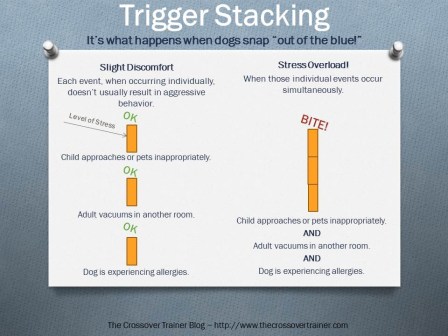
Stress has cumulative effects on behaviour; for example, changes in routine, on top of primary care givers being present all the time, lots of activity, possibly less rest, less space to escape the action, all adds up.
In dog training, we refer to this as trigger stacking and it can contribute to dogs showing unwanted or unsafe behaviour.
We have entire Kids & K9s programs to help with everything from baby prep to juggling children and dogs; more here.
Supervision
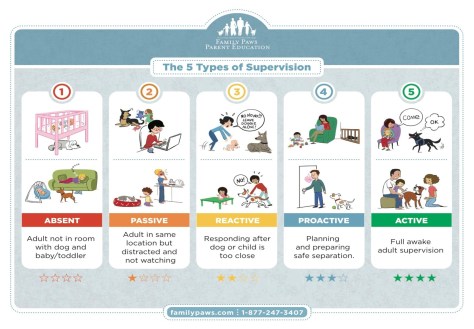
Make sure to directly and actively supervise all child-dog interactions. I know it’s hard to monitor everything that’s going on in the house, especially right now. But, when you can’t supervise, separate.
Set up a quiet place for your dog, where he can rest, have all his stuff and where he won’t be disturbed. In a spot where the dog won’t be approached, where children can’t access and so that you can relax, just a little, too.
While supervision has become a mantra when it comes to dogs and kids, clarity is required. What does the adult need to do to supervise safely?
Talking dog
Supervision is only helpful if you have an understanding of how dogs communicate their discomfort, when they need help and want a break from the action.
To learn more on ‘talking dog’, check out these excellent resources:
- Learn how to speak dog (then teach your kids) – from Dog Gone Safe
- Learn from Living with Kids and Dogs
And if you really want to learn more about canine communication: clip here and here.
The Ladder of Aggression shows the escalation in signalling a dog might demonstrate to request some time and space from an interaction, as their stress increases. If the dog’s more subtle and polite signals (green and yellow on the ladder) are not responded to appropriately, the dog’s discomfort will escalate and climb the ladder.
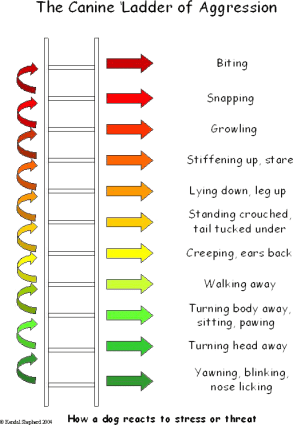
Children are very unlikely to read dogs accurately, and therefore might not respond appropriately when the dog is uncomfortable.
Teach your dog that you will always listen to his more polite signals, so he never feels the need to escalate.
Aside from these behaviours on the Ladder, other behaviours may be of concern if they are carried out in the presence of a child, in relation to a child’s belongings, and/or during and/or just after interaction with a child:
- yawning, blinking, turning their head away
- dog very still, deliberately not interacting with the child
- licking the child, even just once
- caching behaviour à attempting to hide or hoard belongings; directing this behaviour toward the child (the dog might try to push a child’s blanket with their nose, for example, and it’s often mistaken for ‘tucking the child in’)
- sniffing nappies, intense interest in the child
- taking food or toys from the child
- urinating (marking) in the presence of the child, or on or near their belongings
- changes in behaviour or behaviours seen in the presence of the child, and related goings on
- the dog removing itself from the child
- humping the child, or in the presence of the child
- zoomies, bowing or pouncing toward child (often misinterpreted as play behaviour)
- dog is chasing the child, or the dog is jumping up toward a child
These behaviours of concern are demonstrated, by the dog, because he needs space. This is functional behaviour – distance increasing or distance seeking behaviours.
If the dog cannot get distance, or time, from an interaction they will experience distress and many of these behaviours are associated with the dog seeking a way of dealing with that stress.
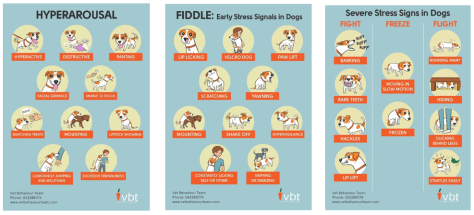
Generally, normal baby and child behaviour is very exciting and often overwhelming to dogs.
The changes that are ongoing at the moment, on top of the presence of children for longer periods may be all too much for normal functioning.
This lowers dogs’ stress thresholds, making them more sensitive to triggers for stress, which may often include interactions with and the behaviour of children.
Management
Management is important for dog-child safety:
- to prevent adult mistakes, especially in relation to supervision (parents might be busy and have a million things on their minds so of course, may be distracted easily!)
- to prevent the child practicing inappropriate behaviour toward and around the dog
- to prevent the dog being put in a situation that causes him to feel uncomfortable around kids – every interaction the dog has is informing his attitude toward children…we must make sure we are building happy, calm, pleasant associations between the dog and children
- to prevent the dog learning to behave inappropriately around children – if the dog isn’t happy, calm and loose, remove him from the interaction
- to prevent inappropriate interaction between dog and child, especially where there is a risk posed to either or both – let’s keep it pleasant, for life-long friendships
Management might include:
- separating dog and child, by a closed, locked door where necessary
- take the dog with you so as not to leave the child and dog alone
- have the dog drag a lead or houseline so that he can be easily restrained or removed – make sure he drags the lead only when supervised, otherwise they might chew it or become tangled
- confine the dog safely
- instruct children to play carefully around the dog – provide constant supervision and guidance to help children develop appropriate skills (it’s not enough just to tell them “no” or to tell them once) – tell the child what you would like them to do
- give the dog plenty of downtime from the action, some place quiet and calm
- extra care is required with children’s friends who may not know the rules
- escape routes for the dog so he can access resources e.g. his food, bed, and so that he can get away from the interaction and activity – especially when the child is active
Be aware of Grumble Zones! - teach children how to touch dogs gently and help dogs learn to enjoy this type of appropriate contact
- never force contact between children and dogs
- make sure good things happen when children are around dogs – so scolding or telling the dog off shouldn’t be happening around children
- giving dogs plenty of space from the child, their toys and baby equipment, especially if it’s big, moving or noisy
Separation is a good thing and can give everyone a break – your dog can take a break away from children and you can have a break from supervision. Separation is especially important when children are being particularly active, running around, jumping or wrestling, or on the floor – that’s the time the dog can go settle in their quiet place for a break.
Appropriate and Inappropriate Interactions
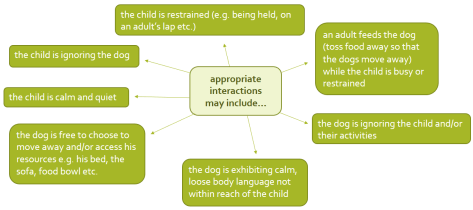

Never allow children:
- lean on the dog
- climb on the dog
- sit too close/crowd the dog
- sit or lie on the dog
- hug the dog
- handle or manipulate the dog
- tease or chase the dog
- take things from the dog
- scold the dog
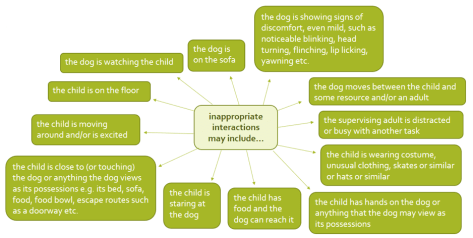 Concerning situations:
- the dog has food, a chew, toy or other possessions
- the dog is active, especially if a larger dog
- the child is on the floor and/or active
- there is more than one child, or more than one dog
- the dog is sleeping or resting
- tight spaces
- difficult for the dog to find an escape route
(dogs may find it difficult to move away from a bonded person like an adult or parent)
Rules of engagement
Teach and model appropriate interactions with dogs:
- wait for the dog to approach you – don’t call or lure and don’t go to the dog, especially when they are resting, eating or chewing
- when the dog comes over, reach to pet them on their shoulder, side or chest – not their head or neck
- one hand on the dog at a time
- pet or interact for a three count (1-2-3) and then withdraw hands to ask the dog if they would like more; repeat only if the dog wants more
Teach children to Be A Tree:
This is especially important to prevent the dog jumping up and biting at clothes or feet.
This also helps prevent dogs learning to associate chasing and high excitement with children.
As soon as the dog approaches, be a tree!
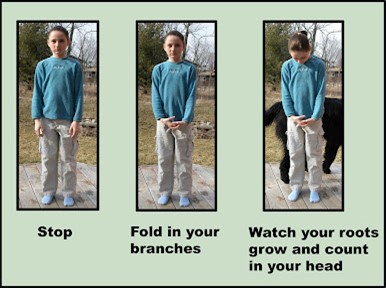
To help reduce jumping up, mouthing or chasing, teach kids and dogs to play follow me/freeze:
Activities for kids and dogs
The suitability of ideas will largely be related to the child’s age, developmental stage and interests so adjust accordingly.
Lots of the challenges set over #100daysofenrichment are kid-friendly and most of the instruction is in video form so kids can easily take part, with adult guidance and supervision.
- teach kids to toss food rewards for dogs, rather than hand it to them to reduce the need for contact between small hands and teeth
- flat palm delivery will need to be guided – children need help with developing the skills and coordination to deliver treats safely, and that’s why tossing is better
- the same goes for toys so the adult takes the toy from the dog and gives to the child to toss or kick and playing games, where the dog is focused on the toy, are best
- teach children how to prepare the dog’s food, fill their water bowl, get enrichment challenges and puzzles ready
- there are simple training exercises that can be wonderful for children to work on like hand targeting, capturing polite behaviours in the kitchen and at the table
- draw up charts so that kids can monitor dog care tasks, behaviour or training exercises – kids love to keep an eye on the adults in the house and keep everyone on track!
Children love to train the adults:
- if safe, children can accompany an adult and dog on walks and outings
Some great child-dog resources
- Dogs and Babies blog
- Doggone Safe
- Pets & Kids and Family Paws blog
- Living with Kids & Dogs
- For parents, from Dog Gone Safe
- Playlist of information about dogs and children from Jennifer Shryock
- Free webinar: Dog Safety: what to teach kids (from Joan Orr)
Stay well!
AniEd wishes you all the best during this challenging time. Little refinements to your dog’s daily life can help with all these lifestyle changes that dogs are so likely to find distressing.
We are here to help with your dog’s behaviour through all this and are available for in-person and virtual help.

RUN3 Day 6 Challenges
Today is Saturday and every Saturday during this program is SNIFFING SATURDAY. This is the day devoted to making sure your dog gets to be a dog. Doing all the dog things.
And you, the human, is just along for the ride. Sniffathon Rules must be in place today, and should be, any time possible.
Play along with the Day 6 Sniffathon challenges here!
RUN3 Days 4 & 5 Challenges
Because we are starting on Tuesday this round, due to short notice, each day in Week 1 will be doubled up. This essentially means that we will be using Sunday Fun Day to catch up (which is what it’s for!).
But, don’t worry if you fall behind – do this in your own time. Nobody needs more pressure right now and you can always access this program, at any time.
- What you need for Week 1 here
- Day 4 Challenges: Hanging Out – Just be
- Day 5 is Freestyle Friday – we give you the ingredients to design an enrichment challenge and leave the rest up to you!
I can’t wait to see how you and your pet get on with these challenges. Come and join our Facebook group for guidance, support, interactions with a wonderful community of enrichers, and to see how everyone else is getting on!
RUN3 Day 3 &4 Challenges
Because we are starting on Tuesday this round, due to short notice, each day in Week 1 will be doubled up. This essentially means that we will be using Sunday Fun Day to catch up (which is what it’s for!).
But, don’t worry if you fall behind – do this in your own time. Nobody needs more pressure right now and you can always access this program, at any time.
- What you need for Week 1 here
- Day 3 Challenges: Handling & Husbandry: Handling comfort
- Day 4 Challenges: Hanging Out – Just be
I can’t wait to see how you and your pet get on with these challenges. Come and join our Facebook group for guidance, support, interactions with a wonderful community of enrichers, and to see how everyone else is getting on!
RUN3 Day 2 & 3 Challenges
Because we are starting on Tuesday this round, due to short notice, each day in Week 1 will be doubled up. This essentially means that we will be using Sunday Fun Day to catch up (which is what it’s for!).
But, don’t worry if you fall behind – do this in your own time. Nobody needs more pressure right now and you can always access this program, at any time.
- What you need for Week 1 here
- Day 2 Challenges: Release the toy, release the joy!
- Day 3 Challenges: Handling & Husbandry: Handling comfort
I can’t wait to see how you and your pet get on with these challenges. Come and join our Facebook group for guidance, support, interactions with a wonderful community of enrichers, and to see how everyone else is getting on!
RUN3 Day 1 & 2 Challenges
Time for another guided run through of #100daysofenrichment to help ease the blues and keep you busy, along with your pets!
Because we are starting on Tuesday, due to short notice, each day in Week 1 will be doubled up. This essentially means that we will be using Sunday Fun Day to catch up. But, don’t worry if you fall behind – do this in your own time. Nobody needs more pressure right now and you can always access this program, at any time.
- What you need for Week 1 here
- Day 1 Challenges: Stuffables
- Day 2 Challenges: Release the toy, release the joy!
I can’t wait to see how you and your pet get on with these challenges. Come and join our Facebook group for guidance, support, interactions with a wonderful community of enrichers, and to see how everyone else is getting on!

Starting tomorrow!
#100daysofenrichment will be starting, with Day 1, tomorrow, St Patrick’s Day!
The entire program is always available for you to access, but this will be a guided run via this blog and the Facebook group.

I made the decision hastily late last week as Ireland was effectively shutdown until at least the 29th March. That means I haven’t really had time to give you all sufficient notice or to prepare; so, this might be a little more fly-by-the-seat-of-our-pants deal.
Get the Week 1 Prep list here. And read all the background information here – this is all good stuff, so dig in!

Given that most of the world is now experiencing some level of lock-down or limits to activity, I really hope that this helps to provide pet owners all over a bit of a project/distraction from the chaos and concerns, while also facilitating social outlets, with their pets,which might be very limited right now.
As always, our wonderful community of enrichers brings such positivity and joy, and not just to their pets!
We will make it a Corona-free zone and just bask in the good times we are having.

Sign-up to follow/subscribe to the blog and join in via the Facebook group and let’s make the best out of a bad situation, enriching and entertaining not just out pets, but ourselves too!

Corona Virus Policy & Pets
We have added some updates in relation to business and self-employment supports at the end. At this time, our policies in relation to client contact and sessions remain the same – we have not been exposed and will notify all appointments if that happens with alternatives or rescheduling arrangements.

Our priority is, of course, the health and safety of our staff and clients. The COVID-19 pandemic is pretty scary, and we certainly don’t want to alarm anyone or appear to over-react. We have qualifications and training in animal healthcare, including biology and biochemistry, and are doing our best to take an evidence-based approach.
We also have staff and colleagues who are in regular contact with vulnerable persons so it’s important we bear that in mind too, in terms of transmission.
Straight forward information here:
First, there is no evidence, at this time, that dogs or other pets can become infected and spread this Coronavirus.
You might have heard of a dog in Hong Kong that has been quarantined after testing a ‘weak positive’. It is likely that this is a result of environmental transmission, given that the dog’s owner is infected. The dog is not infected or showing signs of illness.

But, pets and their belongings may be a source of transmission, if they have come into contact with an infected person, e.g. spread via touching their coat or bedding.
Lots of in-depth information here:
For Human Courses
To avoid disappointment and disruption, we have moved all our (human) courses (for March and April) to online delivery and given our students a break from deadlines and course starts so as not to add to the pressure. This may be extended as required.
All students have been informed well in advance; last month, as we foresaw this development.
We have also suspended all assessment deadlines and course starts to further relieve learners’ pressure. Students can choose how they wish to proceed and we will revise again at the end of April.

For training and behaviour clients
- we ask that if you are ill, have been in contact with an infected person and/or have been in a relevant country or area within the last month, that you let us know before our session
We will, of course, do the same and arrange alternatives for you. - you can let us know right up to the time of your session and we will discuss this with you – we are relaxing our cancellation policy during this time
- if you must postpone your session, are ill and/or under self-isolation, that doesn’t mean we can’t train! There are so many things that we can do remotely via Skype or other tech and we use it regularly. Your session can still go ahead and we will still be able to provide you with top-notch service, instruction and support.
- we recognise that lots of people may have to give up work (and salary) to care for children off school or due to restrictions in their business/place of work, for example, and/or invest in child care or pet care outside their normal budget, for example, and as such welcome you to discuss payment plans for any services
- we tend not to handle your dog a whole lot during training and don’t often take your dog’s lead or equipment, for example, and from now on, we won’t do that at all during sessions unless absolutely necessary (for safety).
Disinfectant wipes can be used on equipment after handling, for example. We will be using disinfectant wipes on any equipment we share with you too. - we will wash our hands regularly throughout the day, whenever possible, and will apply appropriate hand sanitiser before entering your home.
Hand sanitiser can pose a health risk (alcohol poisoning) to pets so we will not apply it during our work with you and your pet.
We will not be booking consecutive sessions at this time, so will not be moving from one house to another. This allows us to change and clean up before attending a session. - We won’t shake hands when meeting with you, as we so often do, and will follow social distancing guidelines during sessions too.
To aid this, we request that only a small number of family members participate, ideally just the primary care giver/s. Don’t worry, we will send you your report/handbook with lots of videos and resources so everyone can practice.
Our Corona Virus Policy can be downloaded here.

#100daysofenrichment
Given this ongoing shut down affecting normal life, we also want to make sure you feel that you have continued support for you and your pet. Isolation, and indeed panic, can affect mental health too. Advice here for dealing with concerns, anxiety and maintaining your mental health; from the NY Times, A Brain Hack to Break the Coronoavirus Anxiety Cycle, and I think this from AFSP is particularly helpful and practical: Taking Care of your Mental Health in the Face of Uncertainty.
We are, as dog trainers, limited in what we can do but certainly want to do what we can!
To help, we will be running another REBOOT of #100daysofenrichment again next week. Subscribe to this blog and each day’s challenges will be sent to your email inbox every morning.
Join our Facebook group to share your experiences, interact with other participating pet owners, have some fun and bask in the loveliness of this group of devoted enrichers. More on this to come!
General Guidelines
The keys to limiting spread (and ‘flattening the curve’) include:
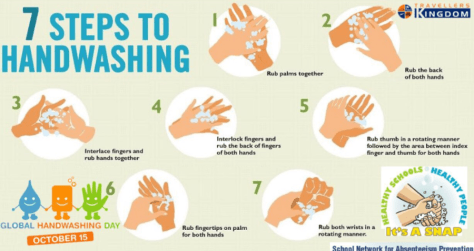
- wash your hands properly and regularly (sing “Happy Birthday!” twice while hand washing)
We are particularly interested in behavioural science; here is more on this new hand washing trend from a behavioural sciences point of view.
- use hand sanitiser (at least 60% alcohol) when you can’t wash your hands and keep it away from pets; let it dry into your hands before touching your pet or their belongings
- maintain social distancing (at least 2m)

- avoid hand-to-face actions

Check out this instruction on teaching yourself, using behaviour science, to reduce face touching:
- comply with guidelines in relation to social gatherings, self-isolation and so on
- there is no need to wear a mask unless you are concerned you might spread disease
- look out for and help vulnerable individuals while maintaining caution
- use appropriate cleaners to clean and disinfect surfaces you touch and handle regularly
Caring for your pets:
- make sure you have enough of any specific food or medications for your pet for two weeks, in case you can’t get to a shop, the vet, or order online
- construct an emergency plan for your pets, just in case you are taken ill or must go to hospital, e.g. who will care for them, how will they be exercised. Discuss their care with a trusted person and make sure your pet has some time to become familiar with them, especially them entering your home
- if you become ill, you are advised to reduce contact with pets, as with other family members. If you must care for your pet while ill, wear a mask during contact and close-up interaction, and wash your hands before and after contact.
Clean pet equipment carefully and regularly.

This is an evolving policy as things are changing fast, but we will keep you all updated with changes as we go.
Business procedures and concerns
Aside from illness, economical concerns are also running high and it’s likely that small businesses and the self-employed will be hardest hit.
First, play safe!
You are welcome to pull from our policy and resources for your own needs. Different pet businesses will require different procedures, however, that aren’t relevant to our policy.
For example, you might need to add some variation of the following:
- organise electronic payments so that you don’t have to handle cash
- go to the client’s car to take the dog in or drop off
- use your own lead on the dog
- ask pet owners not to leave belongings with their pets, but if it’s required, e.g. bedding, wash it in a 60C wash before use and advise they do the same when taking it back
What other procedures work for your set-up and safety?
Consult the HSE, WHO, CDC, ECDC and Department of Health for updates and information.

Business supports
Ireland, just today, has been shut down, to some extent, until 29th March. Small businesses, like ours, struggle in the face of even slight down-turns in trade, so this is likely to be very impactful.
We won’t know how much our businesses are affected by these closures, but it’s clear that we will have plenty of catching up to do out the other side of this. This means it may be important to examine your business planning and perhaps not invest in anything too hefty at the moment.
The Department of Business, Enterprise and Innovation has announced all sorts of packages that may be made available to businesses affected – Minister’s announcement here. Summary here.
The Department is providing resources for businesses in responding to this pandemic here.
The Department of Employment Affairs and Social Protection also provides supports (summary here) and Corona Virus specific advice here.
How available these will be to individual businesses is going to be the responsibility of each business owner to investigate their eligibility.
More on Jobseeker’s Benefit for the self-employed here from Citizens Information and a summary of how to apply, in these extraordinary circumstances here.
In order to access information about eligibility and payments, I recommend that you apply for a PSC, if you haven’t done so yet. This will allow you to access everything you need online so may be important as this rolls on.
There is a bit of rigmarole in the application, with an in-person interview required in low-risk circumstances, but once that’s done, it’s all much easier.
More on this here: Public Services Card.
There’s detail and links with the Minister’s announcement including lower cost loans, expanded loaning, increased loan brackets; see SCBI and MFI. Discuss allowances your personal and business banking may afford you, should you and your business be affected.
I highly recommend you seek advice and help via your Local Enterprise Office; I have always found them enormously helpful. Enterprise Ireland also offer excellent supports and advice.
As scary as all this seems, it’s important to channel your concern into proactively looking into what might be available to your business, what you might need and the extent to which you may be affected.

Take care of yourself.
Being self-employed and working for yourself, can be very lonely. This is compounded even further when social isolation is recommended, on top of extra stresses surrounding work and fincances.
Having to take all this on, while also interacting less, travelling less, just having less freedom and being concerned about our health and that of our loved ones, is very likely to add to your normal level of day-to-day stress.
You are certainly not alone in all that.

We have written about self care for dog trainers and related fields before here, and the unique challenges we often face in our chosen profession here.
Please take some time to consider how you are going to care for yourself during these testing times.
Reach out and create a community, or nurture the one in which you already participate – we will all need help and support through out…just via remote means rather than face to face contact!


Blue is best, but red works too…
If you want to play ball searching games while out and about, choosing a red ball might be the best for hiding from your dog. But if fetch is your game, blue might be better!
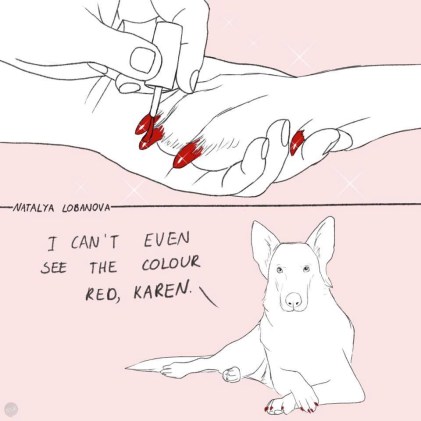
2017 research (Siniscalchi et al 2017) shows that dogs likely have dichromatic vision, similar to that of a person who is red-green colour blind. Indeed, this research devised a test for dogs like that which is used to assess human colour vision.
On top of previous works that have shown that the dog’s eye structure allows for colour vision, given the abundance of cones within retinal structure (Neitz et al, 1989), we can put the myth to bed that dogs see in black and white only.
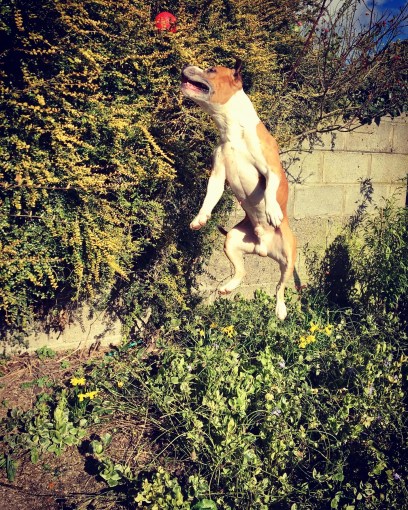
All of this means that your dog’s toy colour matters!
If you want to play fetch out and about, blue is a better toy colour than red. Red, against green grass and vegetation will appear, to your dog, as about the same shade of grey-ish, making it hard to spot.
But, if you want to play toy search games, red might just be the best colour, causing your dog to have to really use their nose, rather than just immediately seeing the toy.
Decker has difficulty locating the red ball in all that greenery, until he engages his nose!
Read more about fetch games and incorporating search games into your dog’s fetch-repertoire here and here.
 AniEd Ireland