Category Archives: Top Training Tips

Doors, greetings and all that drama

Doorbells ringing and people coming and going, amid the excitement, can cause dogs a lot of distress. Not to mention the distress their dog’s behaviour can cause pet owners, who are trying to welcome guests while wrangling canine greeters.

20190621_175024740_iOS

There’s no time like Christmas and holiday celebrations to really test any control you thought you had over door and greetings goings-on!

20191126_174257205_iOS

Safety First!

While most people believe that their dog’s behaviour at the door is motivated by excitement, that’s not always the case. And it’s more than likely that most dogs experience a range of expectations when they hear the door.

Dogs can’t be expected to differentiate between intruders and welcome guests, but yet we want them to welcome visitors with calm and friendly behaviour, while scaring away gurriers up to no good.

For the most part, door action will cause arousal for dogs. This makes them more likely to become excitable, to bark, and even to aggress or have other strong responses.

Dogs who approach the door with a wiggly body, they may or may not be barking, and generally calm and quieten once the guests enter are probably ok. The exercises described here will help.

But if a dog barks and continues to bark at the person coming in, jumps repeatedly, lunges or moves forward directly toward the guest or slinks away and attempts to avoid interaction, get some help before putting advice into play.
Management that includes confinement away from doors and incoming guests may be best, at the very least.

20190326_212801170_iOS

Dogs barking at boundaries, when people are approaching or passing, is related to distance increasing behaviour and the inner conflict they experience. Of course, most of the time, people pass on or leave shortly after arriving, and your dog’s behaviour functions for them in achieving that relief and distance.
Dogs do behaviour that works, so they bark each time.

You can imagine then, that when a stranger doesn’t leave, the dog may feel they have no choice but to try harder to scare them away. So, for some dogs, it’s safer for them to be confined away from the action altogether.
IMG_3779

Even if you think your dog is excited to greet guests coming into the house, it’s important that we keep greetings low key. There’s a lot going on, with lots of excitement, so your dog’s normal tolerances may be stretched thinly.

Enthusiastic greetings, with lots of touching, petting and hugging, is not going to help you or your dog remain even a little calm as people enter or move about. Helping your dog learning to like being out of the way a little during the festivities is probably going to be better in the long run.

20191117_002631329_iOS

An ounce of prevention

Use leashes, baby gates and other management strategies to keep the peace at doors and greetings.

  • confine and secure your dog in another room, with a tempting treat, chew or toy to work on before guests arrive (More on preparing your dog for confinement here.)
    Have your guests call or text, rather than ringing the doorbell or knocking.
IMG_6826
  • let your guests come in the door and settle before introducing your dog
  • bring your dog in on lead to prevent jumping
    Guests will probably be wearing nice clothes, specially for the occasion, so even a friendly dog jumping up or getting too close may be uncomfortable.
IMG_6863
  • you (don’t have guests feed your dog) have high value food rewards for the dog and drop them every couple of seconds, or scatter a handful – this HIGH rate of reinforcement will help your dog to focus on this game, rather than losing control in excitement
    Guests don’t need to pet or greet your dog too emphatically – let things settle before you think about letting your dog choose to interact, or not.
20190818_212733000_iOS
  • some dogs like to hold something in their mouth when excited; have a favourite toy type available at various spots around the door and areas where guests will be welcomed. Give this to your dog to carry before they greet guests.
  • don’t yell at your dog for barking – scatter treats, ask him for behaviours or tricks, hold a stuffable toy for them to lap, or remove them from the room
20181204_001635502_iOS

If your dog is more cautious meeting guests, try a new guest greeting routine to see if that helps them settle. Practice NOW with familiar people so your dog learns the pattern, without all the excitement of greetings at Christmas.
Many dogs are more comfortable greeting new people outside in more open spaces:

  • have your guests call or text when they arrive
  • they wait outside on the street, away from the house
  • bring your dog, on lead, out and walk in a wide loop around your waiting guests
  • your guests move into the house and ahead of you and settle
  • keep your dog back far enough that they are not reacting, barking, staring or straining on the lead to get them
  • once your guests are settled, enter with the dog on lead and feed him really high value food rewards really regularly
  • remove the dog after a couple of minutes and confine in a safe room with plenty of things to keep him entertained

Clip link

A dog this uncomfortable with guests may not settle enough to be truly comfortable and may be better off confined away safely, with regular visits and outings on lead, or may do better with a pet sitter or with familiar people having quieter celebrations.

If a dog is unable to settle and can’t largely ignore guests after a few minutes, remove the dog and give them a break in another room.

Please be aware that sometimes, a dog appears to have settled because he has stopped barking and is ignoring the guests. The absence of barking or growling does not indicate comfort or happiness.
If your guests move, laugh or talk loudly, get up or come back into the room, your dog will start to bark or become unsettled again. This is a good indication that your dog has not been comfortable, and can’t cope with the extra stimulation and change to the guest.

Remove your dog and settle them in a safe confinement spot.

Sniffing & Snuffling for door management

One of the most effective ways to control your dog’s arousal related behaviour is to redirect them to an equally absorbing task, but something that gives them more appropriate outlets for their excitement.

Lapping (a lickimat, for example), sniffing and snuffling are the perfect alternative behaviours because they really encourage the dog to focus on the task at hand (finding food rewards), while helping them calm and preventing them practicing unwanted behaviour.

Start practicing today so that doors and greetings don’t cause drama at all this holiday season!

IMG_6347

Calm entries

Practice this simple exercise each time you come into the house on the run up to Christmas.

Establish a Sniffing Station inside the door, or other appropriate greeting spot, at which you greet your dog. Use a snufflemat or similar snuffling puzzle, or just scatter treats onto the floor as soon as you enter.

Have treats in a tub in the car or your pocket so you are prepared as soon as you walk in, or just inside the door. Enter the house and excitedly bound to the Sniffing Station; scatter treats liberally for your dog to snuffle.

Clip link

This helps to change your dog’s expectations. Instead of anticipating this spike of arousal and great excitement when someone comes to the door, they will think sniffing is best instead.

If others practice this too, and you put this into place with guests entering, you will have a calmer door situation, with lots of snuffling and sniffing!

20181217_125330048_iOS

Doorbell = Snuffle Party

Teach your dog that the doorbell signals a snuffle party! Instead of your dog running to the door, they run to you and their Sniffing Station to snuffle for treats; then you can bring your guests in calmly and quietly.

Establish a Sniffing Station with a snufflemat, a snuffle puzzle, or simply scattering treats on the floor, on a blanket or towel, or in their bed.

Practice in short sessions of just a minute or so at a time.

Begin working close to the door so your dog can quickly check that there’s nobody actually there. But as their comfort increases, you can move your Sniffing Station to the spot you want your dog to go to when the door bell sounds, such as another room, a confinement area, a crate or their bed.

Be exciting as you bound to their Sniffing Station – it’s a snuffle party after all!

Clip link

Use a recording of your door bell or a similar sounding bell. The one I use can be found here.

You gotta practice door management games before you really need them but they are simple to work into your daily routine and require only 30-60 seconds practice per day.

Christmas Bites: Entertaining Canines

If you want a FULL program of teaching, fun and entertainment, check out our #100daysofenrichment project.

49781582_1232323453573103_5590358500812259328_n

Festive Entertainment

In general, during social gatherings, parties and meals, you likely need your dog to be pretty low key and out of the way.

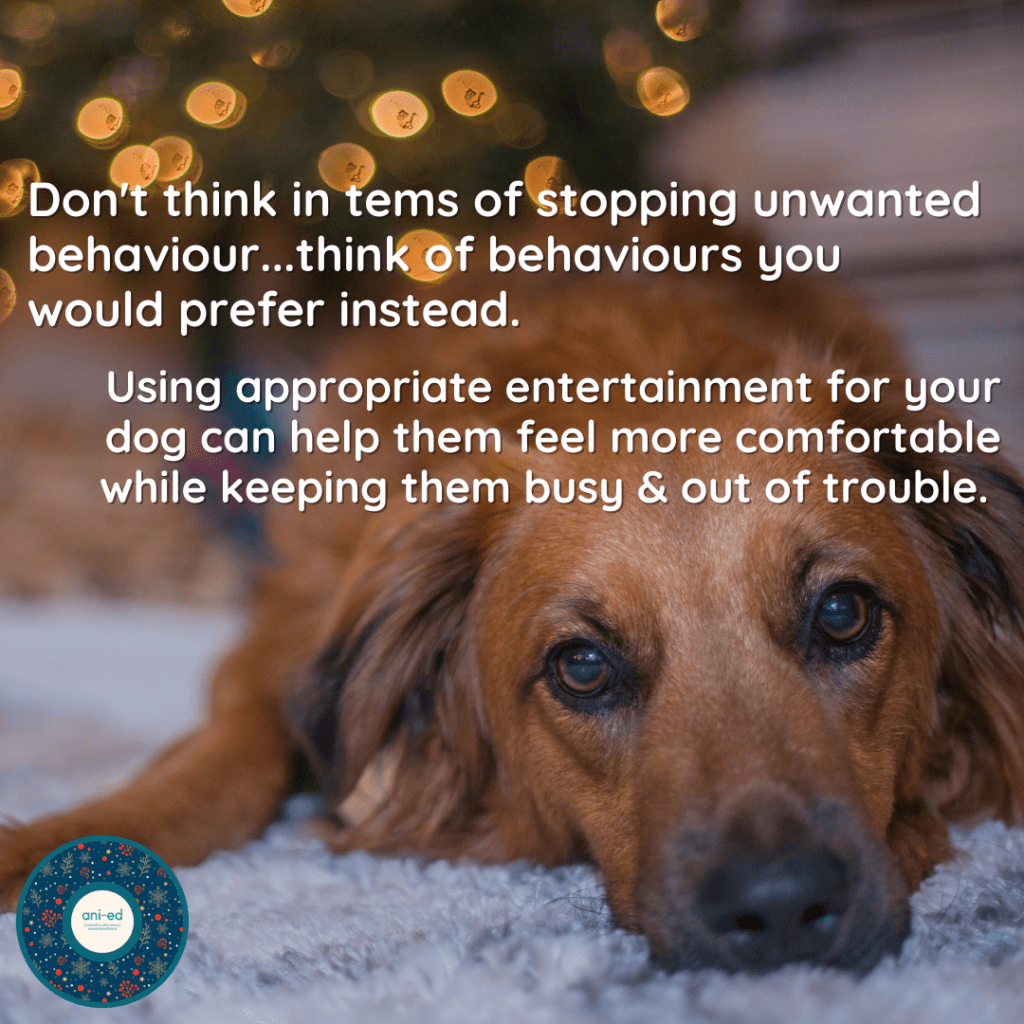
The easiest way to manage their behaviour is to provide them with appropriate behaviours to keep them busy and entertained. Instead of thinking how to stop them doing things you don’t like, think what you would prefer them to do instead!

20190404_202829225_iOS

Get your dog hooked on entertainment!

Start practicing now with simple activities that your dog can work on themselves, without too much input required from you.

Pacifying Activities: 

This category is great for confinement, for calming and when you want your dog to take themselves away and stay busy.

IMG_4175

Introduce these now:

Day 1 Stuffables

Day 11 Chewing

Day 37 Lickables and Lappables

Get practicing now so you can find the best approach for your pet – it’s too late to discover they don’t like a certain thing or can’t work a toy on the day, when you really need it.

Activating Entertainment:

Before it all kicks off, provide your dog with plenty of appropriate mental and physical exercise so that they are relaxed and satisfied before the celebrations begin.

20190305_003000355_iOS

Always think in Rollercoasters: if you bring your dog up, they need help coming down again. This is why, it’s not necessarily a great idea to provide exerting exercise right before your guests arrive; your dog will still be wound up and now, with the extra excitement, will find it even harder to come down again.

20190428_210516726_iOS

Introduce some of these activities, and always follow with some down time and something from the pacifying category above.

Day 2 Play: Release the toy, release the joy

Day 6: Sniffing Saturday – Sniffathon!

Day 13: Sniffing Saturday – Scatter Feeding & Snuffling

Day 27 Sniffing Saturday: Adventure Time

Day 32 Play: Fun with Food

Day 55 Sniffing Saturday – Sniffing Courses

Day 57 Rollercoaster Games

Day 62 Sniffing Saturday: Searches & Scavenger Hunts

Day 69 Sniffing Saturday: Drag Hunts

Day 71 Chasing!

Day 76 Sniffing Saturday – SNIFFARI

Day 93 Watersports

Put these in place on the morning of your party, and even in the days leading up to celebration.

20190226_144140607_iOS

Puzzles!

Puzzles can be a great way of providing vital mental exercise and putting them together can be a great to get kids involved. When creating puzzles, think safety first!

Day 9: Busy Boxes

Day 16 Tubs

Day 18 Eggboxes

Day 23 Pulleys

Day 25 Dissection & Destruction

Day 29 Blankets

Day 31 Foraging Boxes

Day 39 Bottles

Day 44 Puzzle Chains

Day 46 Teasers

Day 51 Compound Puzzles

Day 53 Suspended Puzzles Pt1

20190302_190951093_iOS

Day 58 Paper

Day 67 Suspended Puzzles Pt. 2

Day 72 Food Dispensers

Day 74 Snuffle Roll Ups

Day 79 Box o’ Stuffables

Day 85 Tubes!

Day 87 Stacked Puzzles

Day 88 Suspended Teasers

Day 92 Winebox Puzzles Pt. 1

Day 94 Winebox Puzzles Pt.2

Day 99 Pockets

Day 100 Pockets (again)

Puzzles are a great way to use up all that Christmas wrapping and packing!

20190304_150628746_iOS

The Quickest Fix is Sensible Management

With little time between now and the big day, and a busy time in general, elaborate training just isn’t going to be done or successful. When you can’t train, manage. Management means to prevent the dog practicing behaviour we don’t like, because the more they do it, the better at it they become!

20190421_120954584_iOS

Don’t worry too much about teaching new behaviours, and instead, make it easy on you and your pet, and plan to manage.

Does my pet really need to participate in this?

Parties and celebrations can be a bit much for pets and they will often benefit from a break.
This may be just as beneficial for you too, as the festivities might stress you too causing you to feel frustrated with your pet’s behaviour.

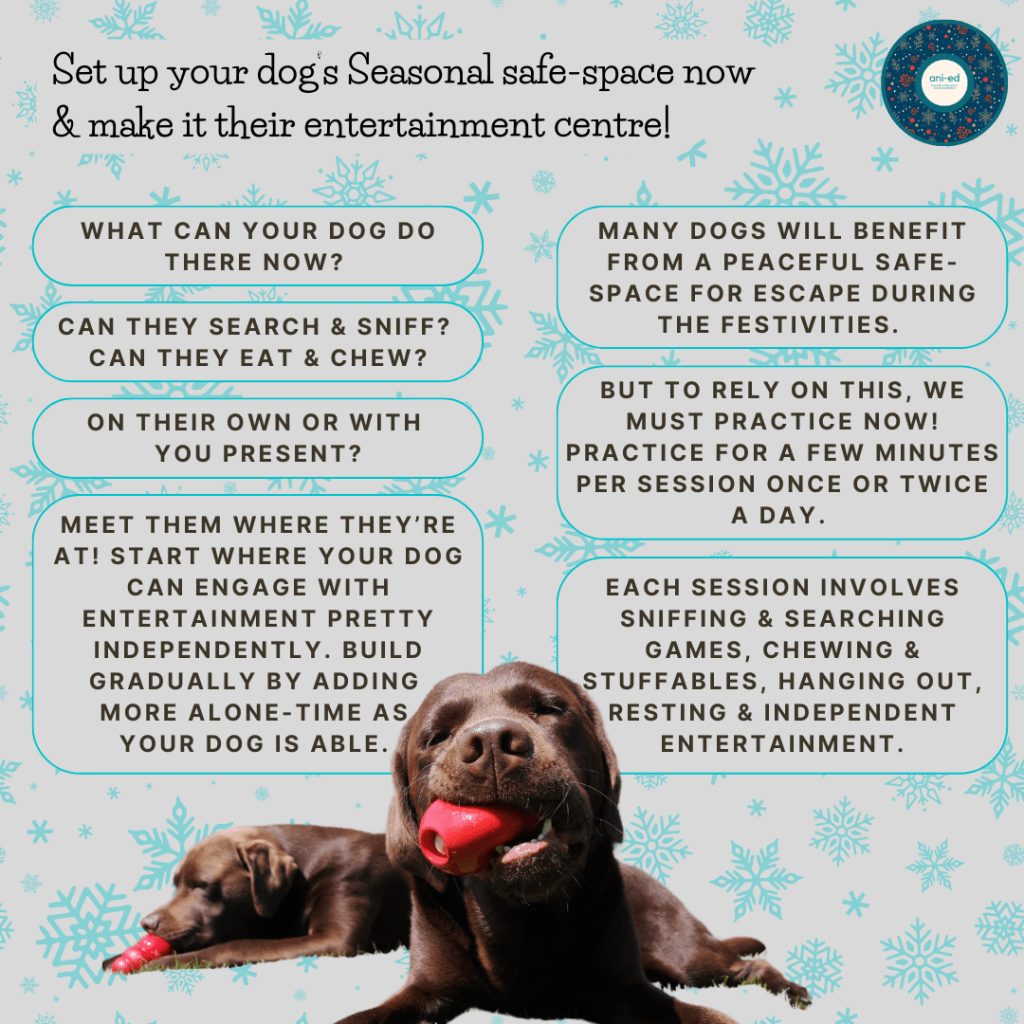
Set up a safe space!

Set up a safe space for your pet to retreat to, that’s out of the way, and easy for them to access. It might be their bed, a mat, their crate, or a corner of a room.

Think about where will be best given the plans you have for the celebrations; where your pet can be away from the action safely.

Start practicing now!

  •  set up your pet’s safe space now
  • make sure everyone is aware of the rules – nobody approaches or  interacts with your pet while they are there
  • every day, give them at least one tantalising stuffable or similar there

Make confinement a winner!

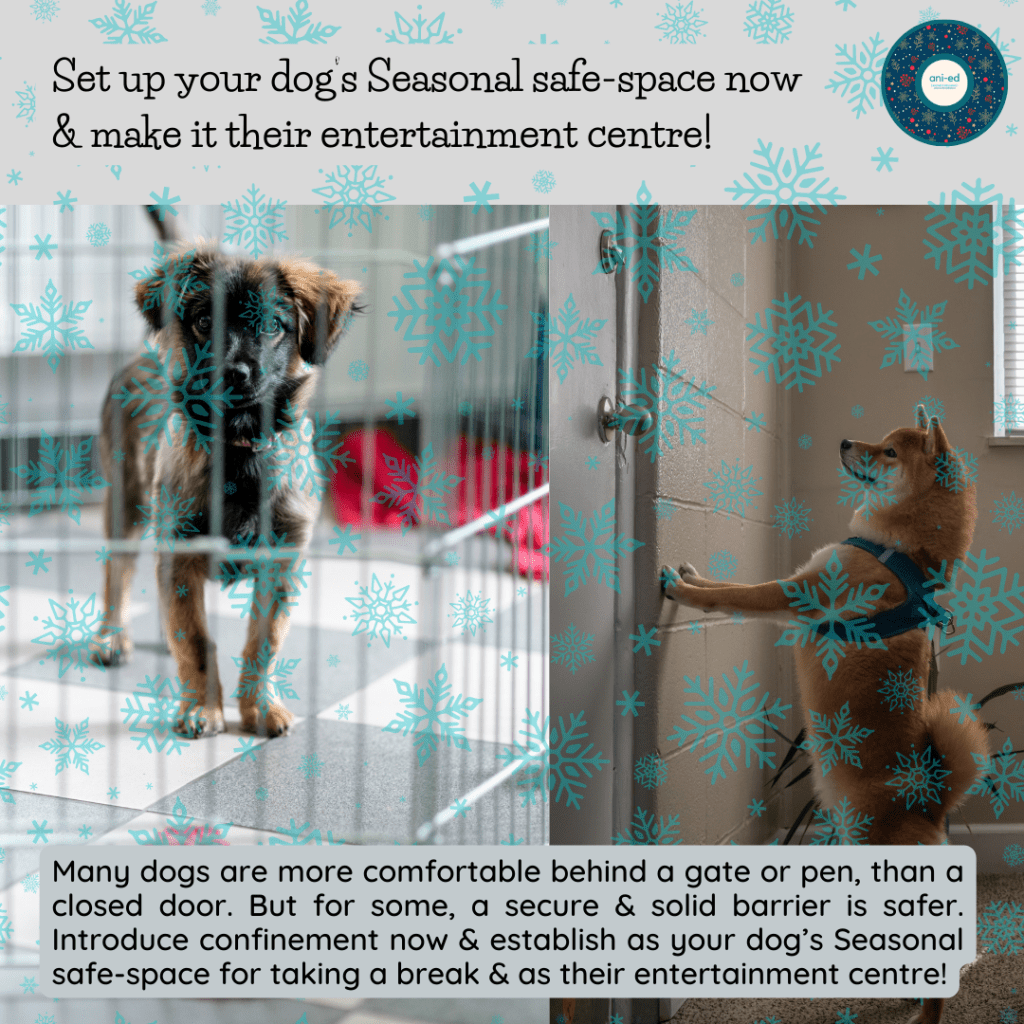
Having a safe space is great, but you might need to confine your dog to provide relief for all and to safely manage their behaviour.
Having your dog behind a closed door, baby gate or in a crate can help ease your mind from worrying about your dog getting into mischief.

Start practicing today!

  • pick your safe confinement area
  • every day, and I do mean every day, even if only for a few minutes, confine your dog with absolutely the best, most tempting, tantalising stuffable, chew or treat
  • release your dog before they become distressed and go back to normal

Consider letting your dog retreat or putting them away regularly during the festivities to give them a break, before they become over-excited or stressed.
It’s also a good idea to confine your dog just before gusts arrive so you can get everyone in calmly and safely, and then bring your dog out to greet.

IMG_8586

Keep away!

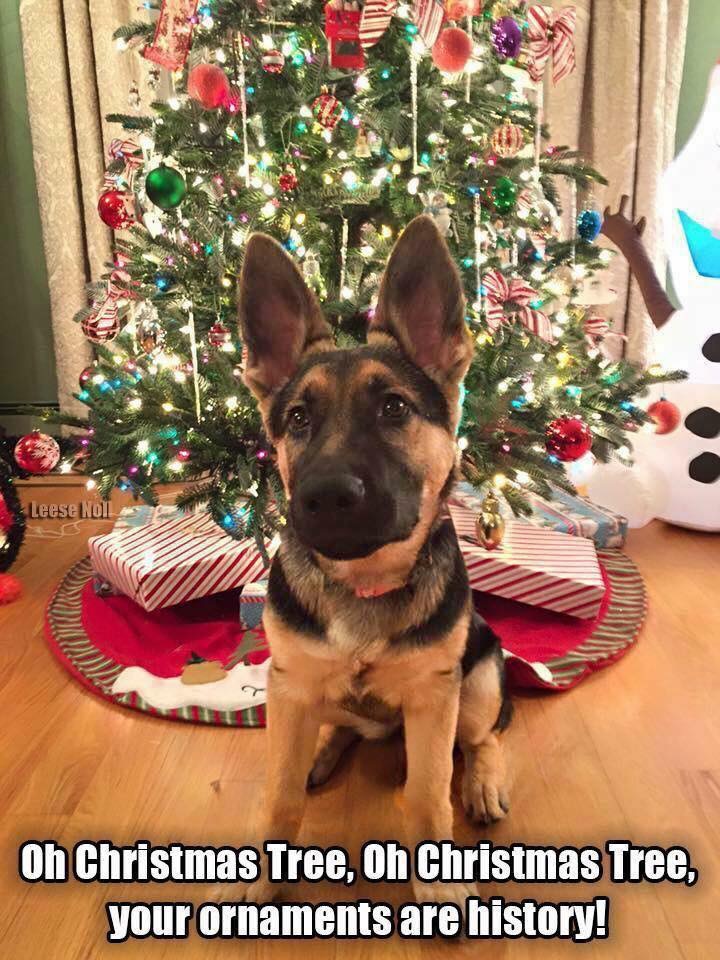
Presents, toys, decorations, Christmas trees, forbidden foods and tasty, tantalising treats everywhere makes it tough for dogs to resist.

Think prevention first!

  • Confine your dog from areas where decorations are within reach.
    If you have a puppy or a particularly interested dog, decorating elaborately in just one room makes it easier to keep an eye on all the bits and pieces.
  • Keep foods up and out of reach, so that your dog doesn’t get to practice even considering trying to counter-surf.
  • Confine your dog during particularly active times, when children are on the floor, when toys are ramping up the excitement, when food is flowing.
20181129_012944225_iOS

Start practicing today!

  • think of the situations in which your dog gets into mischief…
  • give your dog an alternative activity before these situations start
  • for example, before starting to cook or prepare food, or before sitting down to eat, give your dog a puzzle, a stuffable, a chew or something tempting to keep him busy in his safe zone
  • for practice, you can time confinement and safe zone work with these situations so that you are getting more bang for your buck!

Some excellent ideas from around the web (please let me know if you own one of these pictures or know who does for credit) and in this clip here:

Baby-gates and leashes solve problems

Management is simple with just three tools: stuffables or similar, your dog’s lead, and a baby gate here and there.

50956323_396353451128075_2145242100273250304_n

Baby-gates: 

  • prevent access to the tree and decorations
  • prevent access to the kitchen and food prep areas
  • prevent access to rooms where foods and toys are within reach
  • stops dogs getting up stairs, where they might knock someone over
  • keeps dogs safe in a confinement area
  • prevents dogs getting to the hallway or doors to stop escapes or over-the-top greetings
IMG_9466

Leashes: 

  • tether your dog in their safe zone so that they are safely confined but not shut away from the action
  • bring your dog to greet guests on leash to prevent jumping up
  • sit with your dog’s leash under your foot so you can eat or relax in peace
  • allow your dog to drag their leash so that you can easily and safely restrain them should things get tense, when the door is opening, and when things get exciting
IMG_3960

Start practicing today!

  • erect baby gates now so that your dog has time to get used to them before they are really needed
  • practice confining your dog, behind a baby gate, with a yummy stuffable to work on while you cook, prep, eat and relax
  • Park your Pup every day, while you relax or eat a meal:

Clip link

Kids & K9s

With excitement ramping up, the mix of children and dogs will take extra care. Neither dogs nor children are doing anything wrong – seasonal excitement might just cause everyone to lose a little control, be a little less tolerant and decrease attentiveness.

  • more active and direct supervision is needed
  • more separation will be required
  • dogs don’t need to be involved when things get exciting so that they don’t associate such excitement with children and also to prevent jumping up, mouthing, knocking over or the development of discomfort in association with children
  • give children dog-care activities to keep them busy, rather than allowing them to hug, lean on, or lift pets
  • don’t allow children to take stuff from dogs and make sure to provide guidance about leaving the dog alone while he is in his safe zone or when he has possessions
20191123_193146201_iOS

Take care taking seasonal photos. Have an adult sitting between dogs and children and give children something to hold so they are not tempted to grab at or hug dogs, things that most dogs will find uncomfortable.

We often exert a lot of social pressure on dogs when taking photos – encouraging, luring and telling them to “stay!” and this can really cause dogs discomfort. Ease up, have an adult hold a chew or toy for the dog to work on during the photo shoot so that they stay put, without too much pressure.

Here’s an excellent webinar from Family Paws founder, Jennifer Shryock and it’s free! Check it out:

Clip link

Start practicing and establishing management practices that you might come to rely on during the celebrations.

Everything is in flux around your pet in the run-up to the holidays so putting this in place now, will help to set up some stability for them.

This practice helps you develop confidence in these routines too, making it easier for you to implement them sensibly when everything is exciting and feels a little out of control.

Seasonal Stressors

Plan ahead

Well, if you’re here, that’s likely what you are considering. We know that celebrations and festivities can be a bit hectic; add in some over-excited pets and it’s chaos-to-the-max!

Getting ahead of it and making it a normal part of your Christmas planning and preparation will help things run more smoothly on the day.

IMG_5858

Holiday Hazards

Lack of routine and lots of potentially harmful food available can lead to ingestion of toxic and harmful substances, sometimes requiring urgent veterinary care.

  • chocolate, ‘sugar free’ treats, sweets and wrappers/packaging
  • grapes, raisins, Christmas puddings, mince pies
  • alcohol, caffeine, pain killers and medications (even those for pets)
  • cooked bones, high fat foods
  • decorations, Christmas trees, poinsettia, holly, mistletoe…yes, pets often eat these…
  • garlic, onions (and similar), some nuts like macadamia nuts
IMG_7796
  • bins, rubbish and recycling – there’s lots of it about so make sure it’s out of pets’ reach
  • lots of dog treats and toys, and many other general products, come with little silicon or silica packets in the packaging, bag or box; if eaten by pets, they can cause serious problems and these packets in dog treats will smell of food making them more tempting – dispose of them before you give your pet their present and make sure that you put them well out of your pet’s reach, for example, in the wheelie bin outside or other inaccessible area
  • doors opening, comings and goings – make sure your pet is secured, one person is responsible for the, they are wearing a collar and ID, microchip is up to date
  • candles and extra electricals may lead to burns, singing of coat, chewing of electrical wires, hazards associated with oils and similar for burning
  • it’s best not to put wrapped foods under the tree or in reach – the dog’s nose knows and they may break through wrapping paper and packaging to access tasty treats, some of which may be harmful to them

Have your pet’s emergency OOH vet details ready, just in case!

Holiday Stress

I am sure most humans will agree that holiday celebrations bring about all sorts of stress. Your dog is no different. But the things that bring your joy, might be the very things that cause your pet stress.

  • changes to the house, garden and world around them

With decorations becoming more and more elaborate each year, pets may become overwhelmed by the transformations in their own house and garden, as well as in their neighbourhood.
Extra cleaning and re-configuring furniture, including things relevant to the dog such as his bed, feeding areas and so on, may cause them confusion and concern.

IMG_7554

Some decorations, particularly outdoor ornaments, can really spook dogs such as life-size figures, moving or noisy displays, and hanging things, especially as they seem to suddenly appear. If you notice this, bring your dog away calmly and choose another walking route.

Some dogs show extra interest in projected lights (often projected onto the exterior of houses) and reflections caused by twinkling lights. Bring your dog away, try to reduce their exposure by removing the dog or removing the decorations and contact us or another suitably qualified behaviour pro.

20191204_202944905_iOS
  • routine changes and lack of routine

Dogs find holidays hard – they don’t know what day of the week it is, after all. With the hustle and bustle during holiday periods, dogs may get less exercise, entertainment and attention, putting them out of sorts.
These changes can lead to disruption to toileting behaviour, sleeping and nighttime behaviour, eating behaviour, and may see the resurgence of destructive behaviour, over-excited behaviour, barking, jumping up and other unwanted behaviours.

20190906_161204562_iOS

If you’re off work and home for a period of time, it’s important to attempt some level of routine in terms of alone-time for your dog throughout. This helps prevent the dog becoming upset when you go back to work and leave them alone again.

48426492_687329641660865_5827069958269435904_n
  • lots of comings and goings

Social gatherings, energetic children, shopping outings, deliveries and guests leads to more doorbells and knocking, which most dogs, at the very least, will find arousing.
This can lead to susceptible dogs becoming sensitised to door-activity, making their behaviour more difficult to manage and possibly even dangerous.

Know your dog!
A dog who barks at the doorbell and then recovers once visitors enter, is probably doing ok. But, dogs who continue to bark when guests come in, dogs who move forward in a direct manner, or dogs who move away and attempt to avoid interaction, will require closer management and care.

IMG_6400
  • resource guarding

With the availability of lots of high value food, new possessions and toys, items left lying around, most dogs will be very tempted. So-called ‘stealing’ behaviour may increase, leading to inappropriate interactions between pets and their people.

This can lead to resource guarding related behaviour where dogs will take items, cache them, show aggressive responding (e.g. whale eye, freezing, growling, snarling, snapping and even biting) and may attempt to ingest items to prevent anyone else getting them.

IMG_8034
  • children, vulnerable guests and general increases in activity within the house

Celebration means everything is go-go-go, children are hyped, new gifts and toys must be explored and tried out, elderly guests may be present, and everything is up a notch on normality.

Children, and their activity, may be particularly worrisome for dogs, and with holidays from school, dogs may not get their usual relief from this sort of activity.
Kids will often have costumes, new noisy and moving toys, and will be excited – this can increase the risk of dog bites, so extra supervision and separation will be required.

Elderly or vulnerable individuals may be bowled over by an exuberant dog, be jumped on or knocked on the stairs.

It’s a great idea to assign one sensible adult responsibility for the dog throughout the gathering so there is someone consistently monitoring the dog, supporting them and keeping them safe.
Get the entire family on board with planning and preparation so everyone is on the same page.

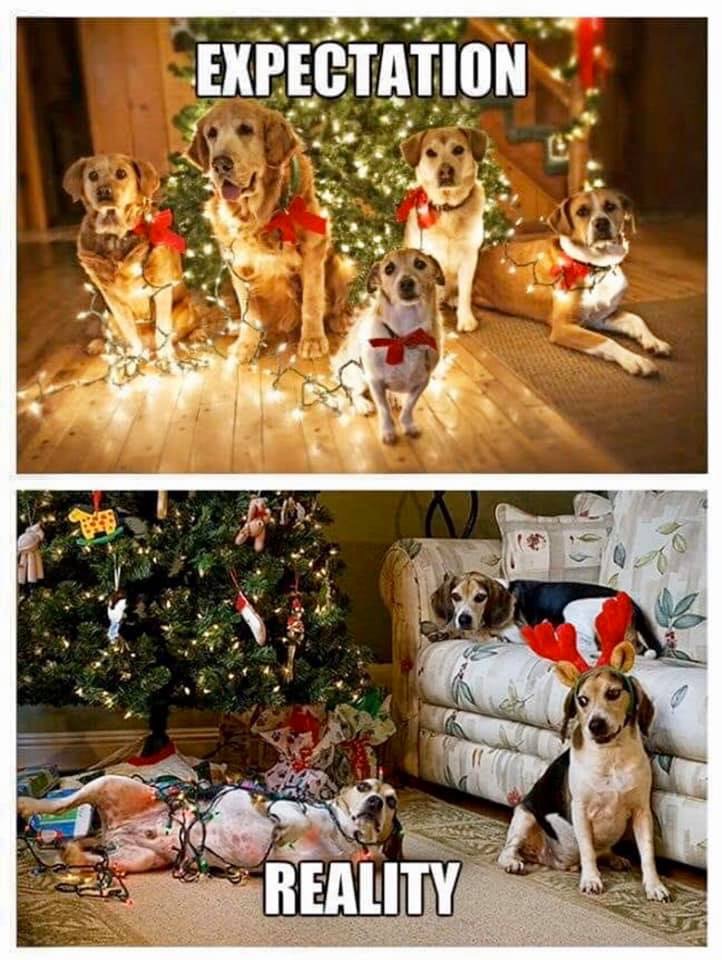
  • great expectations

We expect our dogs to deal with whatever we present, regardless of how well, or not, we have prepared them. Dogs need support during holidays and it’s up to you to help them. Planning and preparation goes a long way, but a sensible approach to managing your pet during celebrations is really the key.

Start by lowering your expectations and re-aligning them with reality, understand that all this will be overwhelming for your pet and that they will respond accordingly.

Feeling under pressure about our pet’s behaviour may lead us to exert more pressure on them, resort to scolding and reprimanding, and letting your frustration get the better of you. If you feel that frustration bubbling, remove your pet to another room with an irresistible stuffable or chew to work on in peace – everyone can get a minute to take a breath and gather themselves.

Ask, “does my pet need to be part of this?”. Their behaviour is information telling you how well they are coping, or not, so removing them from the action may be best for everyone.

During holiday seasons, dressing our pets up and posing them for photos can add to the pressure they feel.
Dogs who show reluctance to have costumes fitted or freeze when wearing silly jumpers or props are experiencing a high degree of distress.
You don’t need to put yourself or your pet through it – there are countless apps that allow you to add emojis and animations to photos and videos, without your pet every knowing about it.

IMG_7285
  • stress related behaviour

‘Crazy’ & excitable behaviour is often interpreted as happiness, but more often than not, it’s the first tier of stress-related behaviours indicating that the dog is losing control and not coping well.

This means your dog can’t listen or respond normally, is more likely to have a more demonstrative response, and his behaviour may appear less predictable.

All this excitement may be associated with trigger stacking. Just this list of stressors, one on top of another, will cause your pet’s behaviour to intensify, even though one or a small number of stressors may normally cause your pet no concern at all.

stress signals

Join us for Christmas Bites to help you prepare your pet for festive fun!

Forks in the road

It has long been touted that a dog’s walk, The Walk, was an important event, allowing the dog’s owner to assert their ‘dominance’ and implement all-important control. But, really, there is no social significance to exerting such control on walks and outings.

For most dogs, while walks and outings are certainly significant events, getting out of the house or garden is limited. Most pet dogs have very limited access to the outside world – their humans work long hours, weather is so often unpleasant, their dog’s behaviour might be difficult, and so on.

Earlier this year, a survey from Forthglade dog food revealed that over half of the pet dogs, whose owners had responded, didn’t get a daily outing. While I don’t believe traditional dog walks to be the be-all-and-end-all, and in some cases they are not appropriate for individual dogs, my concern is that it is terribly unlikely, unfortunately, that these dogs have sufficient appropriate enrichment in place to make up for the lack of outings. And in addition to outings, which is also important.

In my experience, and that of many of my colleagues, the bottom line is that most pet dogs don’t get sufficient appropriate enrichment and entertainment. (This impending pet dog welfare crisis is the subject for another post, and a topic I discuss often.)

This is why #100daysofenrichment came to be.

The dog’s nose knows

Choice and choosing features big throughout #100daysofenrichment. In the modern study of captive animal behaviour, it is recognised that opportunities to choose what happens to them allows animals to feel more confident and reduces the stress of captive living.

At the very heart of what makes an activity enriching or not, is how the animal chooses to interact, how they choose to engage, and the behaviours they choose to use. Without choice, enrichment isn’t enriching.

Here’s some clips of recent outings with Decker. There are lots of trails established in the long grass, some mechanically but most just by human and animal activity, as we meander about.

Clip here

About a month ago, Decker seriously injured his foot and as part of recovery, we’ve been gradually building his exercise back up after almost 3 weeks of next to no activity. This includes walks/trots on lead so that he takes it somewhat easy. We are in the Phoenix Park, which is the most wonderful facility, and there are lots of these crosses eeked out in the long, summer grass.

I have no idea what criteria he uses to choose but you can see him actively consider the best route to take. But it doesn’t matter. How or why he chooses isn’t my business.
Case in point, here he is choosing a specific tennis ball from his collection. 11 identical balls but one is special…

Clip link

It is not possible to give dogs unlimited choice and often times, if dogs were left to choose in some contexts, they would not make appropriate, safe choices because dogs.

But there are lots of significant ways that we can add choice to their lives, so that they can get a little say in their day, in what happens to them, in their enjoyment.

What can you do to add choice to your dog’s outings?
Can they choose the direction, the location, the activities, the twists and turns, how long they stay..? What else?
After all, there’s no point following my nose…that would not be a fun dog-outing at all! The dog’s nose knows so let them choose what to do with it, every day. 

Where will your dog’s nose bring you today?

Make dog walks more dog

Dog walks don’t have to be elaborate or even lengthy. We just need to make sure they are more dog!

Clip here

Clip here

#100daysofenrichment emphasises making sure that sniffing and other doggie pursuits are central so that outings are more about quality than quantity…time spent sniffing is never a waste so go for a SNIFF instead of a walk:

There are even lots of options for when you can’t get your dog out and about and even more options if you check out the entire program.

Bring your dog places that allows them freedom to choose (safely), to truly follow their nose. Get ready, leash up and tag along for the ride!

Where will your dog’s nose take you today?

When playing footsie ain’t funny any more

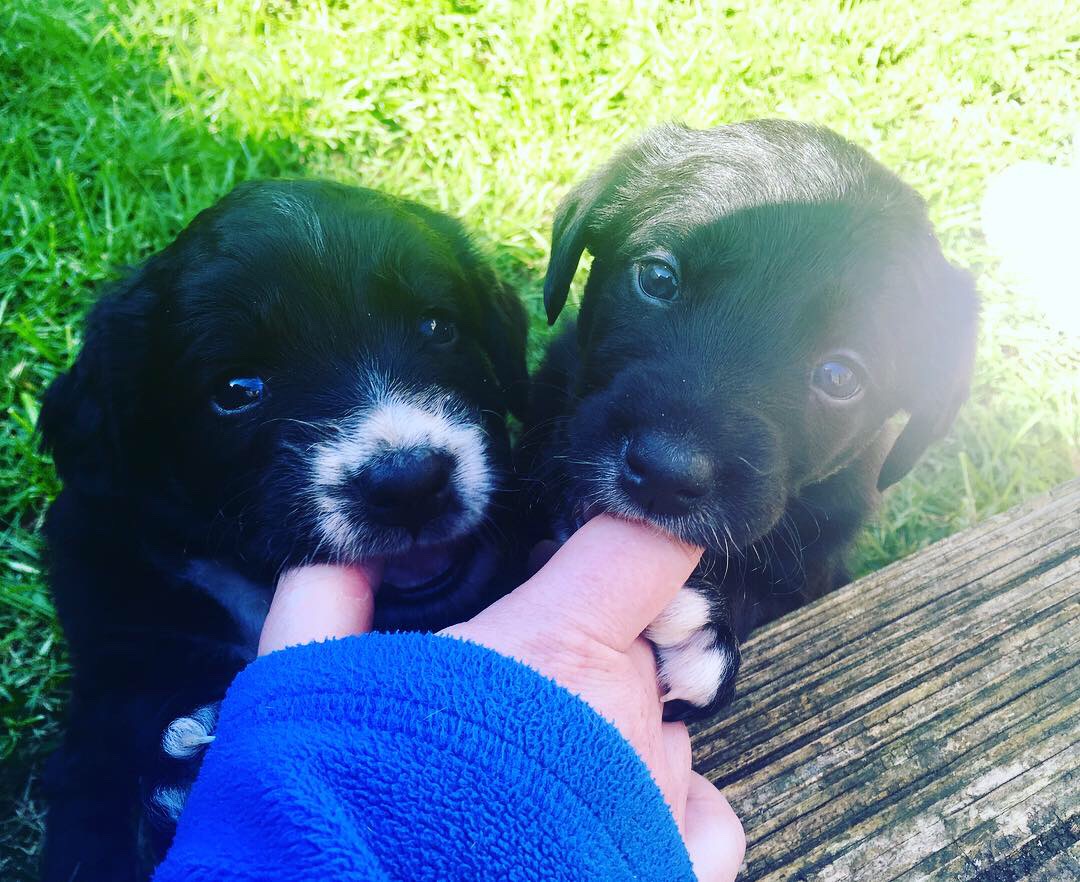
Almost consistently, puppy owners will want help with puppy biting & nipping behaviour (including foot chasing) and toilet training. Although they will understandably have lots of concerns and questions, those top the polls.

Most puppies, by the time I see them, will show well established foot biting/chasing behaviour. But, this behaviour didn’t start in their new home; swinging out of conspecifics is a normal part of puppy-puppy and puppy-dog interactions. When they go home, that comes to an end so human feet become a clear favourite.

While this behaviour isn’t terribly concerning in terms of the dog becoming ‘aggressive’ as an adult, it’s irritating and possibly dangerous (in tripping someone up), plus might indicate puppy needs help with managing internal conflict and arousal.

CDNL3392

Your Toolbox

No one tool alone is going to resolve this, or any other unwanted behaviour, but, rather, a variety of tools that are best applied in different contexts.

  • STOP making it fun!
    When you move, squeal and pull your foot back, this is likely to add to the fun puppy is having…you are basically acting like a dog toy…
    Puppy is getting lots of jollies out of this – getting to bite, chew and rag your feet, shoes, slippers or trousers gives puppy an outlet for their excitement, providing relief from stress (feeling wound up) and soon this game becomes the source of fun in and of itself.
    When puppy approaches, stop moving. Be boring.
    While this might be most effective for puppies whose behaviour isn’t really well established, it also stops a seasoned-foot-biter getting any further pay off.

QVXH1268

  • Redirect their focus.
    You’ve stopped moving. The little monkey is swinging out of your trouser leg or dressing gown strap. Now what?
    Puppies are pretty easy to distract so make a fuss about something else.
    Pretend to be embroiled in a very interesting imaginary task, complete with lots of ooohs and aaaahs, rustling of packaging, moving of items, tapping of surfaces.
    Very often puppy will be enticed and wonder what you are up to.
    Now you will be able to redirect puppy to a different activity by, for example, tossing some kibble onto the floor for searching, toss a treat or chew into another room, throw or wiggle their toy. Once they have moved away and forgotten about foot chasing, you can engage them in another activity that will keep them busy a little longer while also helping them calm such as a stuffed toy, a sniffing game or chewing.

IHTR9153


  •  Provide them with an alternative outlet.
    All behaviour serves a purpose, meaning the dog is doing behaviour to get something they need. A puppy biting, chewing and ragging on something, especially in a greeting or exciting situation, is seeking an outlet for their excitement.
    They might not be quite sure how to cope with a greeting or the associated excitement so may be experience some internal conflict, not sure how to proceed.
    Have a long toy, ready to wriggly on the floor, as soon as you come in the door so that puppy has something to rag on and tug. (Clip below)

Spend lots of time playing with puppies in short two minute sessions, practicing tug & thank you. A typical tug session should look like this (clip link):

This not only encourages play between human and puppy, but you are also teaching puppy to respond even when excited and helping puppy learn to regulate their own excitement, before things become too crazy and bitey.

  • Change puppy’s expectations
    Instead of expecting a big greeting and lots of foot chasing, help puppy’s expectations change to some other activity.
    Practice coming in and out of confinement, in through a door or baby gate for example, presenting a different activity straight away. Puppy doesn’t even get to think about foot chasing. Toss food to move puppy away as soon as you enter and keep them sniffing and moving away as you move about. (Clip below)
  • Play FOLLOW ME! games, a lot
    Follow Me! teaches puppy to walk close to you for food rewards. It’s a simple game that must be practiced often, even outside foot-chasing contexts. Puppy learns that there are other ways to get and keep your attention.
    It’s simple. Stroll about and each time puppy catches up with you or walks beside you, stop and feed a small food reward. Puppy can earn an entire meal during practice for this one.
    Puppy learns that you moving about doesn’t need to involve chasing or biting your feet and by rewarding very regularly initially, puppy is prevented from even thinking about it. (Clip below)

This simple and fun exercise quickly establishes a really nice walking position for awesome loose leash walking and builds an excellent level of engagement. Lots of benefits to this one!

In this clip we practice Follow-Me! with Klaus. He happens to offer a sit behaviour that is rewarded and from then on, he offers an auto-sit each time the human stops moving. While this isn’t required, it’s a nice side-effect of puppy learning to human train. From Klaus’ point of view, he’s learning to get the human to produce food rewards – he just sits (and looks cute) – irresistible! (Clip below)

  • teach LEAVE-IT! for feet or moving things
    Help puppy learn that “leave it” means to reorient to their person, away from the moving thing, for a big pay-off.
    Start by practicing in non-chasing scenarios and don’t make the moving thing too enticing to begin with. As soon as puppy looks toward it, say “leave it” and immediately offer a great reward. (Clip below)

You can work on mop chasing in the same way too, and apply ‘leave it’ with a toy to foot chasing. (Clip below)

Foot chasing and biting isn’t confined just to puppies; lots of adolescent dogs will do it too, often when greeting or going out for a walk. The excitement is more than their teenage brains are able for and biting is a neat way for them to channel that.

This usually is an initial response to getting out into the world, and soon dies down as the dog finds other forms of entertainment.
Use sniffing stations to get out the door – drop a few food rewards every couple of steps until you can get to an area where you can encourage your dog to sniff or engage in other activities.

Clip link

Similarly, you could use a tug toy or other toy that the dog can carry or bite on. This can also help to redirect them from leash biting, which might be seen at the beginning of walks too.

Play the Go Find It! game on walks or in areas where the dog might redirect their excitement to biting or mouthing. This simple game can help to improve loose leash walking and engagement, while changing their motivations and helping to provide them with an outlet for their excitement.

Lots of tools and tricks to help!
If you would like more help or advice with puppy training or adolescent training, please get in touch!

To the extreme

Reading my social media feeds this week, you would think that the only way to train a dog is NEVER with this tool or ONLY with this tool, to ONLY feed this diet because this diet KILLS dogs, to NEVER allow your dog carry out this behaviour, ONLY get dogs from this source…and so on and on.

I understand that social media, as a communication tool, facilitates this polarisation, but as professionals, surely we have responsibilities in recognising and understanding the nuances in human-dog interactions.

We espouse “science” and “evidence” bases but yet commit science- sins of absolutism and declarations of ‘fact’ and ‘proof’ based in anecdote and bias.

The bottom line is that dogs and humans have been together, in one way or another, for many tens of thousands of years (if not longer). Both humans and dogs are complex social creatures, who bring lots of variability and flexibility to the table. Dogs are super-dooper adaptable, which is a feature that has probably allowed them to develop such close and intense relationships with us.

My clients are, for the most part, regular pet owners. They have busy lives, to which their dog is an addition, and their pet must slot in. My job is to help them help their dog to do that.
In essence, what I am doing is helping them meet their pet dog’s needs, improving its welfare, so that their relationship blossoms.

Sharing extremes is likely not helpful. My responses to queries about trying or avoiding such recommendations tend to range from “maybe that’ll work” to “that might not work in this situation”.

Behaviour is such a loose and flexible phenomenon that binding it in absolutes is not helpful. Many, many factors contribute, some within our control and some without.
What works for this person, this dog, this context, on this day, may be very different for another person or dog, or another context or day.
I am not at all suggesting that rules and laws don’t apply to behaviour, but rather the application of same, in every day life, may be a greyer area altogether.

My clients need help fitting their dog and its needs into their lives. That requires compromise and discussion, rather than dictating and self-righteousness.
Social media is powerful, but can be a dangerous place for novices, who may be impressionable or naive.

Yes, lots of training-cultural norms need to be challenged and re-challenged, and I enjoy that and the accompanying learning curve, but not at the expense of discussion, preference and appreciation for variation in approach.

By opening up, rather than shutting down arguments for or against, we can debate and discuss, and learn and adapt. Absolutes and definites shut that down, scare away newbies and make dog training a dictatorship, rather than an applied science that can be molded and shaped to help pet owners and their pets.

Got Puppy. Now what?

Regardless of whether getting a puppy or new dog around Christmas is actually a bad thing (for that puppy or new dog), is up for debate; arguing the point is not relevant now.

If new puppies are in new homes, which they undoubtedly are, we want to keep them there by supporting new puppy owners, giving them the best advice and helping them avail of the best resources on puppy care.

We have a FREE trouble-shooting seminar for all puppy owners in January to help, and make sure everyone gets off on the right paw.

When – Saturday 6th January, 2018
What time – 2pm-4pm
Where – at the AniEd centre in Glasnevin, Dublin 11; just off J5 M50

What will we cover?

It will be two hours of puppy-people’s questions. All those niggling, puppy problems and behaviour mysteries will be discussed, so that puppies and their families can stay together in peace and harmony.

We will cover topics such as:

  • what puppies need to know
  • social experience – puppy and people
  • social experience  – puppy and other dogs
  • social experience – puppy and other animals
  • environmental experience – growing puppy brains and building confident, resilient puppies
  • puppy’s first walks
  • travelling in the car
  • importance of mental exercise
  • care with physical exercise
  • puppy nipping, biting and bite inhibition
  • puppies & children
  • management – prevent unwanted puppy behaviour
  • crate and confinement training – benefits and pitfalls
  • alone training
  • night-time training
  • passive training – catch your puppy doing the right thing!
  • Park your Pup – teach your puppy to relax and settle, and be ignored
  • preventing resource guarding
  • handling and grooming comfort
  • toilet training
  • playing with your puppy

We have lots to cover, and no doubt there will be more to discuss.

Who should attend?

This is vital for new puppy owners, if even if they have had puppies before. There’s nothing like going from an adult dog to a new, young puppy!!

We will be discussing puppy training & behaviour relating to puppies five months and younger.

This will also be great for those thinking of getting a puppy so that they can be prepared.

Pet professionals and veterinary personnel are welcome to come along too, as they will often be in positions to advise puppy owners.

Please book!

This is a people-only event, and requires booking so we know how many to expect.

You can book by emailing info@anied.ie, messaging our Facebook page, or calling and leaving your details (01 8308380 or 086 044 9275).
We are closed for Christmas and New Year’s but will make sure to respond to all bookings for this event as soon as possible. Rest assured, that if you have contacted us and left your details, you have a spot on this seminar!

Please share, far & wide so we can get the best support to new puppy people, and prevent an onslaught of unwanted, difficult puppies in 2018.

SNIFFING STATIONS!

This will not be news to you, at all, that dogs love sniffing. Sniffing isn’t just a fun past-time for dogs, it’s essential behaviour that they MUST do for behavioural health.

Not only that, sniffing can be a great training tool.

Sniffing for training

Dogs pull on lead for lots of reasons:

  • they’re excited to be out and about
  • the world is an exciting place
  • they have twice the number of legs we do
  • they want to get sniffing and sniffing and sniffing
  • they want to get to things
  • they want to get away from things
  • we have trained them to pull

Pet owners spend lots of money on all sorts of, often times, scary equipment and lots of time on training exercises, to improve their dogs’ loose leash walking skills.

Changing the dog’s motivation for behaviour, and reducing his expectation (that crazy behaviour is required) will help to prevent pulling behaviour, making walks more enjoyable for all.

SNIFFING STATIONS

Is there a time or area in which your dog really, really pulls?

Do you find it difficult to get your dog from point A to point B, on lead?

Are there particular distractions that you find difficult to manage?

Establishing Sniffing Stations will help:

  • to get your dog out the door, without too much craziness
  • to get your dog from the house to the car, or from the car to the park or from one spot to a very exciting place
  • your dog get passed, toward or through particularly distracting situations
  • your dog get to another person or dog in a calmer fashion
  • to get a dog from a kennel to an exercise area
  • to get a dog to an exit (or entrance)
  • the dog to associate good things with potentially distracting or worrying triggers
  • your dog’s focus on you to increase

Clip

Start with your dog on lead, and use really yummy food rewards.

  • say “Go Sniff!”
  • drop a couple of treats to the ground, across your dog’s eyeline if possible but just point them out if he misses them
  • let your dog eat the treats
  • repeat approx. every two metres

We start out with Sniffing Stations close to one another, and can move them further apart as the dog improves, or closer together for really tricky distractions.

If you know that you need to move the dog over the same short route, make more permanent Sniffing Stations.
Use double-sided tape to secure little bowls or even lids to each spot. Pre-load with treats for each trip.
For more temporary but pre-loaded Sniffing Stations, use little pieces of double-sided tape at each station and place treats on each one. This will also take the dog a little longer to eat, so is great to get dog past tricky distractions.
(Securely stick tape so that the dog doesn’t take that too!)

Teach sniffing on cue

Put sniffing on cue:

Clip

Sniffing is a handy training exercise because:

  • your dog loves to sniff (and is already really good at it)!
  • sniffing is a polite dog behaviour and can be used to diffuse the tension between two dogs at a distance
  • sniffing is a calming behaviour for your dog
  • sniffing can help to divert your dog’s attention away from a trigger
  • sniffing can be used as a release cue, to let your dog know they they can go be a dog again
  • sniffing can be used to keep your dog busy or entertained when you are otherwise engaged
  • sniffing can be used to help your dog calm after excitement
  • sniffing can be used as a reward, after recalling for example
  • sniffing can be used to help your dog form more pleasant associations toward some trigger

Sniffing as a past-time

Make sure your dog has lots of opportunities to sniff. Forget about taking your dog for walks, instead make outings about sniffing.

Take your dog on a sniff, rather than on a walk. Who’s walk is it anyway!?

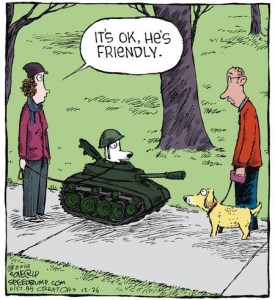
No, your dog is not just being “friendly”

Set the scene…you are walking your dog, interacting or playing, your dog might even be on lead, or at the very least is engaged with you and not looking to meet and greet…in the distance a loose dog approaches, directly, attempting to interact with your dog, who is not really in to it…

Regardless of how this interaction goes, it’s not appropriate behaviour.
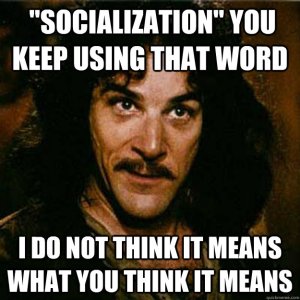
You are, I am sure, a ‘socialised’ person. This means that you can pass other people without having to approach them, attempt to interact or touch them. Strangers running up to strangers, attempting contact, especially if one person is clearly not looking to interact, would be weird and concerning human behaviour.

Same goes for dogs. A socialised dog doesn’t need to greet every dog, doesn’t get excited by the presence of other dogs, and can read another dog’s signalling without having to get right up in their face.
This negatively impacts a dog’s comfort levels and behaviour, and is probably not great for either dog involved.

Dealing with Uninvited Approaches

Safety first

Not only does this behaviour present risks for your dog’s safety, but also yours. Lots of your first reactions may be borne out of panic, and that may not be helpful.

Picking up your dog, trying to move them with the lead, or even putting your body between them and the interloper, may increase the tension or arousal in the situation leading to an escalation in their behaviour.

When your dog is at risk, you might be tempted to put yourself in harm’s way, to attempt to prevent your dog being injured or scared.

I get that. As much as I might advise you don’t do that, to be honest, I am going to do whatever I need to do to protect my dog from inappropriate contact with another dog who may potentially cause injury or stress.

  • picking up your dog may cause the other dog’s arousal to increase, pursuing your dog up into your arms. This may lead to a more persistent ‘attack’, with the dog frustrated and trying to reach your dog, and may lead to injury to you as the other dog attempts to get to your dog, or re-directs onto you.
    In a panicked state and being lifted and losing control, it’s also possible that your own dog will re-direct on you or catch you with his teeth or claws.

If you must pick your dog up, try to tuck him inside your jacket and turn your back on the other dog immediately.

It might be possible to put your own dog up on to something high such as a log, a rock or even on a vehicle.

Regardless, keep your balance, and possibly implement some of our other recommendations to reduce the impact on you, and your dog.

  • restraining your dog on lead may offer some protection in that your dog doesn’t have the opportunity to go after another dog, but dogs on lead are more likely to react and aggress when they feel under pressure.
    But when another dog comes close, we can feel the temptation to tighten the lead, and even use it to move our dog out of harm’s way.
    Doing so may cause your dog’s reaction to escalate faster and increase in intensity.
    If your dog is in an interaction with the other dog, them being moved suddenly and stiffly may cause the interaction to go south fast.
    Moving them by the lead, may even cause greater damage and injury should there be a bite.

Your dog being on lead may very well contribute to an interaction becoming more tense, more serious, leading to more harm.

Dropping the lead and allowing your dog to move and escape may well offer greater protection as your dog can move faster without you, but may put your dog at greater risk in other ways. Your dog running may even increase another dog’s interest, leading to intense chasing behaviour.

As counterintuitive as it sounds, loosening the lead, may be your best bet, especially if the other dog’s intentions are social, albeit obnoxious.
Keep the lead loose, stay at your dog’s shoulder, and move with your dog as he moves or circles may help. Stay calm, hum or sing softly to yourself (“Happy Birthday” is a great one to sing as it’s hard to be tense during that one!), and be ready to move.

  • you moving between your dog and the approaching dog is often a go-to move…indeed I have done it myself. Sometimes this can be enough to deter an overly-exuberant greeter, but sometimes it may just draw the other dog’s attention to you, making you the focus.
    Where an interaction has begun or where there is tension, you moving may certainly cause fireworks.

Although we are tempted to try and intimidate the other dog so that they move away, this doesn’t always work as intended, instead leading to an increase in arousal and a lowering of already impaired inhibitions, possibly in both dogs.

We can teach a dog to move behind us on cue which might help to diffuse tension, and paired with some of our other recommendations, may help to cool the situation.

Diffuse

Being proactive, and looking to keep interactions low key is probably going to be safest and most comfortable for everyone, but this requires time and space, which you might not always have.

  • assess the situation – how is your dog feeling, how is the other dog responding – how direct, tense and intense are they, how much control does the other owner have, how responsive is your dog, how well will you be able to escape?
  • scan your environment for signs that loose dogs may be present, such as people who look like dog walkers and other dogs in the distance, listen for dog tags and paws on concrete.
  • walk in places that require dogs to be on lead, that offer you good vantage points with lots of places that you and your dog can escape to that provide visual barriers
  • remain alert close to blind corners or concealed entrances, which might reveal loose dogs suddenly
  • keep your dog’s attention on you with trained cues for simple behaviours such as hand targeting, and high value motivators such as food rewards and toys.
    It’s best to avoid stationary behaviours such as stay, sit or down, as this can cause your dog to feel less well able to control the goings-on.
    Remember, the introduction or availability of high value motivators may cause your dog’s discomfort to increase as he attempts to keep the other dog away from his prized possessions. It may also make you more attractive to rude dogs looking to score a treat from a stranger, or take another dog’s ball (someone else’s is always better, right?!).
  • get your dog sniffing – head down and sniffing can communicate a desire for a calmer, slower interaction among dogs which may be heeded. Your dog staring and making eye contact with another dog, may encourage it to approach.
  • walking away calmly and/or taking sudden direction change can help to keep your dog focused on you and less likely to interact with another dog, and may cause the other dog to give up in its pursuit
  • this is the opportunity for you to have your dog behind you, and you between your dog and the other dog, before tensions rise and direct approach is imminent. It may also give you time to call to the other dog owner, asking them to get their dog.

The other owner

While some of you will scoff at this, sometimes another owner may not be aware of the distress their dog potentially causes.

Culturally, among dog owners, it’s presumed that their dog running directly up to another dog or person is just an expression of their dog’s friendliness and joie do vivre. This interaction may be a teaching moment, if there’s enough time and everyone is open to discussion.


  • call to the other dog owner and ask them to get their dog, to leash their dog, to remove their dog
    There’s no point asking them to call their dog as doing so doesn’t necessarily mean that their dog will return to them.
  • as frustrating as it is when they say their dog is “just being friendly”, (we, of course know different), it’s best to stay as calm as possible so as not to increase the tension, or possibly get their back up, making them less cooperative
  • if your requests are not successful, tell them that your dog is not friendly, is sick or old, or is “contagious”
  • muzzle training your own dog, and having them wear a muzzle is a sure-fire way to get other dog owners to avoid you…
  • taking out your phone and really or mock filming them will often cause them to remove their dog and move away quickly
  • informing them that you will do what you need to do to protect your own dog, should they be unable to remove their dog immediately, is a last resort but threats may be necessary

React

Sometimes you won’t have time for any of the above, and are left with no choice but to react and to hope that you can minimise emotional and physical damage to all involved.

Repellents & Shields

Some you might be able to carry with you, but you may also be able to use things you find around you.

Repellents might include:

  • compressed air (Pet Corrector)
  • small aerosol can, citronella spray
  • water gun or spray
  • a Dog Stop alarm (very loud!)

The problem with these is that they will only be effective when the other dog is quite close. Outdoors the wind may blow a spray back into your or your dog’s face.

If something is designed to scare away another dog, it may also have that effect on your dog possibly leading to a greater level of distress in association with that context.

Shields might include:

  • an umbrella with a button pop
  • a length of cardboard, like a flattened box
  • a clipboard, sheet of Styrofoam, chopping board
  • your bag

Shields might act to intimidate a dog sufficiently that they move away, or may give you a few seconds to redirect and escape.

Again, anything intended to startle an oncoming dog might also distress your own dog.

Carrying a small back pack is a good idea, not only to carry things safely and out of reach, but also to use as a shield or as something to redirect a persistent interloper.

Other deterrents

Carrying a walking stick, or even an umbrella folded up may be enough to deter other dogs. Swinging it or cracking it on the ground can help to move them away.

Swinging a lead or line, or even the heavy handled end of a retractable leash may also help. Cracking the line in the air or on the ground may also cause sufficient startle to halt an approaching dog.

Try:

  • turn your attention to your dog immediately and keep them engaged
  • move away briskly, keeping your dog moving away, rather than directly
  • keep yourself between your dog and the other dog as you move
  • toss treats or something (such as pebbles) into the dog’s path (not at them), across their eyeline
    Tossing something bigger like a stick, or even your bag or jacket.
  • using a shield or repellent, and then using the couple of seconds it buys and get out of there
  • stepping forward and shouting “NO!”, “STAY!”, “SIT!”, “GO HOME!” or growling – might just buy you a couple of seconds of redirection so you can get out of there
  • get something between you and the other dog

Although the temptation is to ‘go big’, try calm and cool first and attempt to diffuse. Up the ante as needed.

Don’t:

  • grab collars
  • put your hands in the middle, or near mouths
  • pick up a dog
  • hit, kick, or punch
  • put your body or body parts in the middle

No magic wand

There is no one solution that is going to work every time. One of these may work in one context, but may be ineffective in another. The key is to have plenty of tools at the ready, and to practice when there’s no panic, so that you are ready when the shi1t hits the fan.

Sadly, loose dogs, under poor control, are an every day occurrence for the majority of my clients (and my friends, and me!), many having dogs who have been injured and are seriously distressed by other irresponsible owners’ actions (or lack thereof). Not only that, but a number of friends and clients have been hurt, frightened and injured by these dogs themselves, as they try to do their best to deal with the onslaught.

Understand that it’s not appropriate for dogs to behave like this (just as it wouldn’t be OK for people to behave this way), and that your dog is allowed to say they don’t want another dog in their face by ignoring them or even snarking. In that context, that’s appropriate behaviour. Do your dog a favour, and get them out of there quickly and calmly.