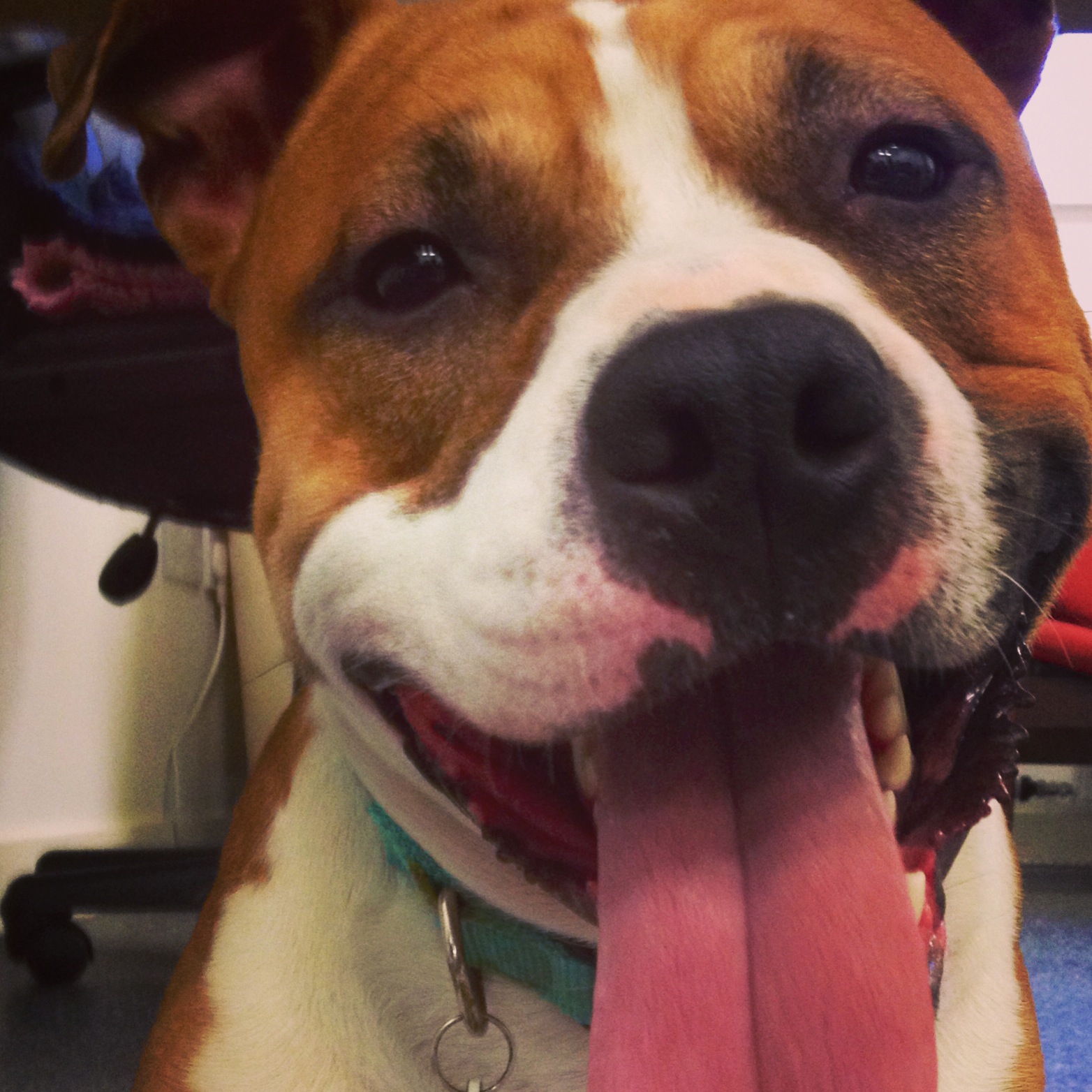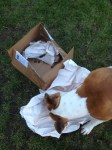
If you started with Train Your Dog Month yesterday – try some of the more advanced options today – don’t forget to let us know how you get on!
Don’t worry – you can start today too – check out Training Game 1.1 and get your dog sniffing!
If you started with Train Your Dog Month yesterday – try some of the more advanced options today – don’t forget to let us know how you get on!
Don’t worry – you can start today too – check out Training Game 1.1 and get your dog sniffing!
Well, yes and no….

Dogs need a balance of physical and mental exercise to keep them healthy and so that they continue to be easy to live with. If we don’t provide both and in balanced proportions we could run into trouble…
Physical exercise causes stress on the body – not necessarily bad stress, but the body needs to adjust to compensate for activity, for example, increased heart rate, increased breathing rate and so on.
Please note that mental exercise can cause this too so we must be aware of balancing this within each physical or mental activity, not just broadly balancing physical and mental challenges.
Stress, at a body chemical level, causes the body to become wound up, to prepare for this exertion, to cope with the stressors.

Look at your dog when they are physically exerting themselves…panting, tongue lolling, enlarged pupils, keenly focused on the ball (or whatever is the subject of their exertion)…maybe they jump up a little more than usual, maybe they mouth a little harder than normal…
When we push that physical exertion we can cause the dog to become more and more wound up – you may have made the observation that even after running around like a lunatic, your dog is still up for more even when you have had enough activity.
Where we might run into problems is with the excitement-addict…
Ever heard of the marathon runner who has become ‘addicted’ to the highs produced by exertion?
You will have certainly heard of so-called adrenaline junkies; canine excitement-addicts may experience this and want to put themselves in situations where they will hit those highs, over and over.
Don’t despair – you’re in the right place…
A few things can help here:
A dog that is relaxing peacefully, can calm himself and bring himself down from the highs will have had lots of practice and guidance in this and will be living a balance of mental and physical challenges.
(Is your dog getting up to 18 hours of sleep each day?)
How do we strike that balance between physical exercise and mental challenge to ensure our dog’s happiness and health?

The amount of physical and mental exercise that is healthy, will depend on many factors, including:

Considerations for the challenges we present to puppies and young dogs are some of the most important.
Generally the rule for young and growing dogs is to allow them to decide how much exercise they take – allow them to potter, to sniff and to wander.
We often recommend to provide about 5 minutes per month (age) of structured exercise, such as leash walks.
Therefore for example, a 12 week old puppy should have about 15-20 minutes of structured exercise per day.
On top of those important concerns, mental exercise, downtime and appropriate challenges are vital for puppies and young dogs. Adolescent dogs particularly will benefit from extra attention to teaching them how to calm themselves and cope with excitement.

Puppy Culture from trainer and breeder Jane Messineo Lindquist has some really great resources on all aspects of puppy rearing, and this fantastic area on Appropriate Exercise.
It’s often the case that most petslive too sedentary a lifestyle so in many situations more and better physical exercise is required. But, if we bring in physical exercise we also need to put lots of effort into mental exercise too.
For some great ideas on introducing lots of mental challenges, without adding too much more physical exertion check out the book No Walks, No Worries (available from Amazon.co.uk) by Sian Ryan.

Look no further, you’re in the right place – our Train Your Dog Month 2016 program offers lots of ideas and guidance so that you can help your dog develop skills vital to becoming a pleasure to share your life with.
Check out one of our followers really getting into the Train Your Dog Month spirit!
Here they are practicing a scavenger hunt as a reward for a really long and very impressive recall with their Cockapoo Riley!
So, who else had fun with scavenger hunting today?
Did you know that domestic dogs have evolved from scavenging animals? That probably explains some of your dog’s behaviour!
Instead of your dog getting his scavenging-jollies by counter surfing and stealing, let’s give them an acceptable outlet for this behaviour with our scavenger-hunting games.
Time Allowance:
Each game will take you 30 seconds – 3 minutes to set up. Your dog does all the work!
Try two or three of these games today and tomorrow.
Family Participation:
Fun for all the family – children will love to scatter food (it’s just like making a mess that someone else cleans up!), hide food and set up sniffing courses.
Always supervise child-dog interactions and make sure children learn to leave the dog alone while he works on his puzzle.
Top Tip for Today’s Games:
Add a cue to these games so that you can ask your dog to search. Say “go find it” just before releasing your dog to search.
The easiest way to feed your dog, while still providing them with a challenge, is to have them sniff out every piece of food.
Take your dog’s food and instead of feeding them from the bowl toss their food on the ground.
Beginner Level ideas:
Advanced Level ideas:
A slightly more formal version of scatter feeding involves setting up specific hiding places for your dog’s food.
Beginner Level ideas:
Advanced Level ideas:
Check out our video guide to simple Kong stuffing:
You and your dog are probably hooked on scent games by now – YAY!
How about setting up a sniffing-games course? Use various household items such as boxes, overturned chairs, cones, plant pots or dog beds.
Set up each course while your dog is in another room and then release them to search.
Beginner Level ideas:
Advanced Level ideas:
Sniffing games are perfect for rainy days or for dogs on limited activity!
That’s Day 1 done – introduce these games today and tomorrow and we will have new games for you and your dog on Wednesday.
Now, don’t forget to share how you are getting on – we would love to see video and pics of your dogs sniffing out their dinner and see how you have come up with ways to challenge your dog’s nose!
Go on, show off….
Animals naturally want to work for food – when we feed them for free they may not have acceptable outlets for those feeding behaviours that they don’t need for finding food…
Dogs come with lots of behaviours that are inbuilt; most of these behaviours are in conflict with what we humans like…
Providing your dog with entertainment and enrichment will allow your dog to carry out these behaviours in a more appropriate and acceptable way.

So, this week we are going to work on teaching your dog to earn their keep by working for their food (food is currency to dogs!). This way your dog gets lots of opportunities to carry out doggie behaviours (without annoying the humans!) and you get plenty of time to relax while your dog does the work (this is lazy dog training)!
Dogs with plenty of mental exercise (along with appropriate physical exercise) are happy, healthy and a joy to live with.
See? This is more than just fun and games…
You can download a more printer friendly, but abbreviated, version of the Week 1 plan here.
Wohoo! Let’s start preparing for the start of our plans on Monday – here’s your first task:
Rather than introduce lots and lots of treats for our training program, we will use our dogs’ regular, everyday food in our games.
But, no more getting their food for free – this program will encourage your dog to work for each piece!

No matter what you feed your dog you will be able to use this food, rather than in a food bowl, for many of our games over the entire program.
Here’s our video showing you how to use your dog’s regular food for training games:
Option 1 (low-cal)
Option 2 (higher-cal)
If you are worried about handling wet or raw food during training exercises, keep a pair of surgical gloves with your training-mix so that you are always ready to reward desired behaviour.
You’ve signed up and are getting ready, but what’s this training program really about?
Our Train Your Dog Month 2016 program is all about foundation skills – these are the ones that you will build your continued training upon.
So often we go straight into the sexy stuff without paying attention to the training that supports our dog’s life long learning – that can be why our training sometimes crumbles and collapses.
Spending a little time (remember, just ten minutes each day) putting these basics in place provides you and your dog the perfect foundation on which to build.
Reality Check
As important as these exercises and having the right foundation are, it isn’t a magic-wand!
Just signing up for our program will not ‘fix’ any behaviour problems you might experience with your dog. But, the exercises we will introduce will help work on some of the root causes to training and behaviour issues from pulling on lead to aggression.
The plan
Each week is themed and we will post three-to-five different exercises for you to work on during that week.
Every couple of days or so, we will post a new exercise with options to suit you at various stages of training. We will provide video and printer friendly versions too so that everyone can participate.
Remember, just ten minutes a day but if you want to do more that’s OK too!
Be ready for your first plan on Monday and Happy 2016!
Happy New Year!
Ringing in 2016 means it’s time to start getting ready for this month’s dog training challenge!
What do I need for Week 1?
Sounds weird? Well, we’re going to keep you guessing for a couple more days!