Welcome to Day 46 of #100daysofenrichment and thank you for joining us on this journey!
Although our challenges are directed mainly at dogs, we want all species to enjoy and benefit from #100daysofenrichment so, please join in, adjust and adapt to help your pet or companion live a more enriched life.
puzzles that require the dog to move an item to reveal hidden food
food and cognitive based enrichment
adjusting the difficulty is easy so these are very adaptable puzzles
get the family involved in this one – kids love making puzzles for pets and these challenges offer lots of opportunities for children to use their imagination to come up with the best teasers for their pets.
Remember, supervise children in all enrichment activities and interactions with pets.
prepping teasers will take 5-10 minutes and you can use lots of the bits and pieces we use in other puzzles
What do you need?
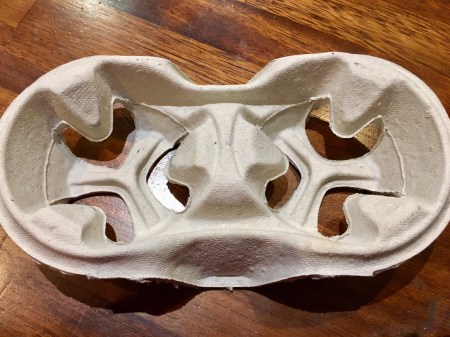
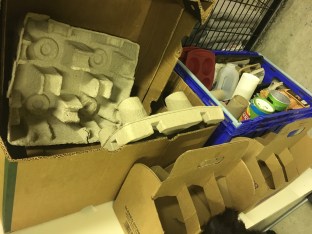
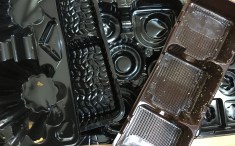
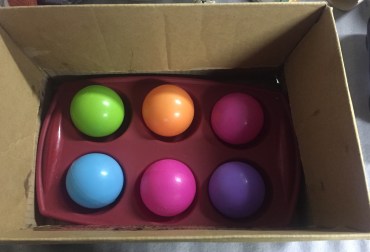
a base for each teaser puzzle is anything that has slots or hollows such as bowls, eggboxes, muffin pans, cup holders, plastic inserts from biscuits/chocolates
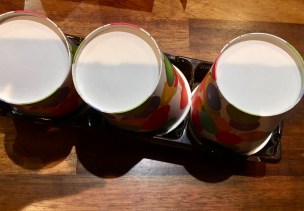
blockers are items to fill each gap such as paper cups, toilet roll tubes, paper, balls & toys
a range of food rewards
Enrichment Goals:
to encourage a wide range of foraging and exploratory behaviours
to do more feeding related behaviour than eating
to encourage the development of strategies (behaviours) for getting the food out of the boxes
to help the dog develop skills in thinking through puzzles
While this challenge is certainly food based, they are also experiencing cognitive, sensory and environmental enrichment, with lots of crossover between categories.
Working out how to manipulate the teasers to get to the food and developing dexterous skills are examples of cognitive challenge.
Sniffing out, tasting and chewing food all offer sensory pay off, but so does finding their way through each food puzzle, determining its value, and engaging in the puzzle of getting to the good stuff.
Teasers encourage pets to interact with their environment – just the very interaction with the puzzle is encouraging the pet to manipulate their surroundings, to get the things they like.
By offering a variety of teasers, we can help the dog expand their range of puzzle-busting behaviours and facilitate your pet applying strategies from other puzzles to new ones; that’s a true cognitive gift and is growing your dog’s brain!
What goals can you add to this list for your pets?
How can we achieve these goals?
give your pet plenty of space for working on teasers and bear in mind there will be mess, so think about spaces that are easier for clean up
the more difficult you have made the challenge, the higher the value the reward must be so use HIGH value foods to motivate exploration and experimentation and make it VERY easy to get the food (no frustration!)
if your dog just dives in, in full on destruction mode that might also be an indicator that they need an easier challenge so they get to experiment with a broader range of behaviours
What adjustments will you make for your pets?
Applications of Teasers:
Teasers, just like many of our homemade ‘rubbish’ puzzles, can keep dogs occupied as they offer different possibilities for expanding the dog’s behavioural range, truly engaging them cognitively. They are truly adaptable and again you are only limited by your imagination!
I love to use Teasers for puppies, as these puzzles allow for great brain stretching. Puppies develop confidence in putting more pressure on the item to move it to reveal the food.
Toilet Roll Tube Teasers are a favourite of many puppies; they love to manipulate the tubes and the box, and build confidence and enthusiasm for snuffling between the tubes.
While it’s great to go for challenge, it’s important that enrichment remain enriching. That means that the challenge must be made appropriate and doable for the individual puzzler.
Because of the home made nature and variable materials used in teasers, it’s best to supervise your pet carefully when they have access to this puzzle.
Many eggboxes and other cardboard bases like cup holders, are made of pulp, which makes for a crumbly cardboard. This likely feels quite novel to many dogs and they may investigate this texture with their mouths; it also makes it very easy to eat.
Know your dog! If you have an ingester, teasers may not work for you and at the very least, careful supervision will be required. Using a metal muffin pan might be a better option!
If you are concerned about your dog ingesting non-food items during puzzling, have a pocketful of HIGH value treats and be ready to toss a couple toward your dog, across their eyeline, if you think they are thinking about eating the puzzle.
Making sure the challenge is very doable and they can get to the hidden food rewards quickly is key to modifying their behaviour and expectations during puzzling.
Check all your equipment for this challenge carefully and make sure to remove tape, staples, other fasteners, small pieces and plastic pieces. Play safe!
Enrichment Options
The level of difficulty with Teasers is set in how well the blocker fits into the base. If the ball, cup or tube fits snugly, it will be more difficult for the dog to get to the food.
Building Teasers:
choose a base such as a box, basket, muffin pan, eggbox, plastic insert, cup holder, small bowls
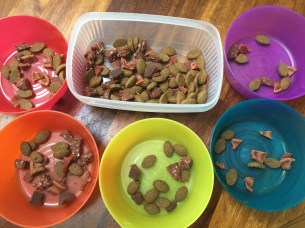
scatter food rewards so that every gap is filled and there is a good covering over the base
Now it’s your turn. Show us what you and your pets, of any species, can do with these challenges!
Post to your social media accounts, using the #100daysofenrichment so that we can find you and join our Facebook group to share your experiences, ideas and fun!
You can comment right here too 🙂
We look forward to hearing from you and your pets – have fun & brain games!
Welcome to Day 45 of #100daysofenrichment and thank you for joining us on this journey!
Although our challenges are directed mainly at dogs, we want all species to enjoy and benefit from #100daysofenrichment so, please join in, adjust and adapt to help your pet or companion live a more enriched life.
We’ve talked a bit about just being with your dog (Day 4), adding mindfulness to really appreciate the connection (Day 38).
Today, we’re going to take this on the road and try just being somewhere else. Doesn’t need to be a new or unfamiliar place; but try to choose somewhere quiet, that allows for being.
Today, there’s no big plans or training exercises. Today, we are dialing it way back and hanging out.
Learning to just be is not necessarily a skill that comes to most pet dogs easily, and indeed to many people. Just being is a lost art; in the age of smart phones and on-demand entertainment, we don’t have to be very often or for very long.
But, this is such an important skill for companion animals, who, at the whim of their humans, must be able to be in environments that don’t always cater for their natural tendencies.
Run away for a day
Take a trip. Move away from normal patterns; the hum drum of everyday life.
Where and when you both can just be. You don’t have to be engaged in any particular activity, just be. Together.
There are no training cues or food rewards, or even toys, required. No smart phones for the humans, no thoughts about what you should be doing.
Be calm and quiet. Sit close or just in one another’s presence.
You don’t have to touch. Humans are tactile, we grip and use our fingers. Dogs are not so much into that. They don’t need petting, touching or grabbing to be.
Dogs often like to lean or touch off one another’s bodies. They might lie back to back, or they might spoon.
Closer to home
Can’t runaway? Stay home. Stay close to home.
Sit at a window: dog TV. For some dogs, that’s too frustrating but for others it’s pensive; join in.
Sit in the car. You don’t have to go anywhere. You don’t even need to look out and about.
This can be a useful tool in training and behaviour work. Bringing puppies, new dogs, older dogs, worried dogs, to watch the world from a safe spot in a vehicle can be an excellent way to have controlled exposure, without putting them at risk or overwhelming them. (Link)
Find a quiet spot, inside or outside. And be.
Hang out
Dogs and other companion animals must learn how to be around people and people-goings-on. Dogs gain these skills by being around people, especially when they are young.
Spending time isolated from opportunities to be around people is detrimental to behavioural and social development. Dogs who are alone for large portions of the day, especially young dogs, may be at risk of suffering negative effects.
To help these dogs, we are tempted to spend the little available time with them go, go going. We think we are making up for lost time by providing the dog with activity, exertion and excitement. While all that stuff may be a good addition, consider just being as just as important a skill and a vital part of helping and supporting them, when you can spend time with them.
Here I am hanging out with Theo while he was spending time in kennels. Helping him be. So that he can cope with life in kennel accommodation, in virtual isolation.
How to be
This can be tricky for dogs, and people. If this is a dog who is in kennel accommodation, it might be easier to do this from outside the kennel, while the dog has something stuffable to work on initially. Or it might be better to try this away from kennel life, out and about.
For dogs who find it hard to be, try when they are already calm, initially when they are settling with a stuffable, when the house is quiet. It can take some time to build this ability, for both species.
Put away your phone, concentrate on being, in the moment, with your pet.
They may or may not want contact or touching. Try not to make this a grooming or scratching session. Massage them calmly and briefly, withdraw and allow them to be. Repeat if they want that. But, it’s not necessary, to be.
How you be
There are no rules. Work on being. Work on finding what helps your dog be. Work on finding what helps you be.
Build slowly. Develop being incrementally. Avoid frustration, fidgeting, agitation and excitement. Maybe, you will only be for very short durations, seconds, minutes. That’s ok. It’s a work in progress.
Where will you BE today?
Your challenge
Now it’s your turn. Show us what you and your pets, of any species, can do with these challenges!
Post to your social media accounts, using the #100daysofenrichment so that we can find you and join our Facebook group to share your experiences, ideas and fun!
You can comment right here too 🙂
We look forward to hearing from you and your pets – just be!
Welcome to Day 44 of #100daysofenrichment and thank you for joining us on this journey!
Although our challenges are directed mainly at dogs, we want all species to enjoy and benefit from #100daysofenrichment so, please join in, adjust and adapt to help your pet or companion live a more enriched life.
string up different puzzles on a cord or stake and let the puzzling begin!
food and cognitive based enrichment
get the family involved in this one – kids love making puzzles for pets and these challenges offer lots of opportunities for children to use their imagination to come up with the best puzzle for their pets.
Remember, supervise children in all enrichment activities and interactions with pets.
Puzzle chain prep will probably take you about 10 minutes – having a collection of puzzle stuff is a good idea…it will resemble a pile of rubbish or recycling!
What do you need?
cord, rope, dog lead, shoe lace or a bamboo stake or similar
all sorts of puzzling stuff such as bottles, toilet roll tubes, cloths, paper, egg boxes
to encourage a wide range of foraging and exploratory behaviours
to do more feeding related behaviour than just eating
to encourage the development of strategies (behaviours) for getting the food out of the puzzle
by varying the design of puzzles we will facilitate carrying out a range of different behaviours, broadening the dog’s repertoire
While this challenge is certainly food based, they are also experiencing cognitive, sensory and environmental enrichment, with lots of crossover between categories.
Working out how to get to the food and developing dexterous skills in manipulating the puzzles are examples of cognitive challenge.
Sniffing out, tasting and chewing food all offer sensory pay off, but so does finding their way through each food puzzle, determining its value, and engaging in the puzzle of getting to the good stuff.
Puzzle chains encourage pets to interact with their environment – just the very interaction with the bottle is encouraging the pet to manipulate their surroundings, to get the things they like.
By offering a variety of puzzle chains, we want to help the dog expand their range of puzzle-busting behaviours and facilitate your pet applying strategies from other puzzles to new ones; that’s a true cognitive gift and is growing your dog’s brain!
What goals can you add to this list for your pets?
How can we achieve these goals?
give your pet plenty of space for working on puzzle chains and bear in mind there will be mess, so think about spaces that are easier for clean up
the more difficult you have made the challenge, the higher the value the reward must be so use HIGH value foods to motivate exploration and experimentation and make it VERY easy to get the food (no frustration!)
if your dog just dives in, in full on destruction mode that might also be an indicator that they need an easier challenge so they get to experiment with a broader range of behaviours
What adjustments will you make for your pets?
Applications of Puzzle Chains:
I love to use compound puzzles; a puzzle with other puzzles…the Russian Doll of Puzzles, if you will.
These Puzzle Chains are adaptable and offer a straight forward start to compound puzzles, more of which will come over the #100daysofenrichment
Puzzle chains are truly adaptable – there really is no limit to how they can be adapted to suit different puzzling levels.
What I tend to see, though, when puzzles are given to dogs, is that well-meaning owners go waaaaay over board, coming up with the most elaborate designs to really challenge their pet.
While it’s great to go for challenge, it’s important that enrichment remain enriching. That means that the challenge must be made appropriate and doable for the individual puzzler.
Our job is to adjust the puzzle difficulty so that our dog uses a range of behaviour and gets to the goal pretty quickly.
This is the true way to improve the dog’s confidence in puzzling (and in life) and help them expand their behavioural repertoire.
Because of the home made nature and variable materials used in puzzle chains, it’s best to supervise your pet carefully when they have access to this puzzle.
Know your dog! If you have an ingester, these may not work or you may need to think about what types of materials and puzzles you include.
If you are concerned about your dog ingesting non-food items during puzzling, have a pocketful of HIGH value treats in your pocket and be ready to toss a couple toward your dog, across their eyeline, if you think they are thinking about eating a puzzle.
Making sure the challenge is very doable and they can get to the hidden food rewards quickly is key to modifying their behaviour and expectations during puzzling.
Check all your equipment for this challenge carefully and make sure to remove tape, staples, other fasteners, small pieces and plastic pieces. With bottles, remove the lid and plastic ring before giving to your pet. Play safe!
Enrichment Options
Today’s options are really just going to be a variation on the one theme – you guys can come up with sorts of adjustments to make this a fun and interesting challenge.
Loops, washing line or kebab?
String up each puzzle on to a cord, or similar, and tie the ends together.
String up each puzzle on to a cord or stake, or similar, and hang it up creating a suspended puzzle.
Add each puzzle to a stake and hang it up creating a suspended puzzle.
Secure the loop under a chair or table leg, or hang up a loop, washing line or kebab!
Bath ball loop
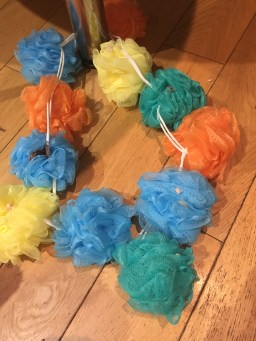
Bath ball scrubbers can be easily chained together and make a great snuffle toy, with food added in between the netting. Note, they are very easily destroyed!
Now it’s your turn. Show us what you and your pets, of any species, can do with these challenges!
Post to your social media accounts, using the #100daysofenrichment so that we can find you and join our Facebook group to share your experiences, ideas and fun!
You can comment right here too 🙂
We look forward to hearing from you and your pets – have fun & brain games!
Welcome to Day 43 of #100daysofenrichment and thank you for joining us on this journey!
Although our challenges are directed mainly at dogs, we want all species to enjoy and benefit from #100daysofenrichment so, please join in, adjust and adapt to help your pet or companion live a more enriched life.
teach your dog that their recall cue makes the magic happen
the amount of training to build a 100% rock solid reliable recall is vastly underestimated by most pet owners and pros…better get started working on it now!
cognitive based enrichment
while children might be able to participate with some of these exercises, there will be lots of canine excitement and activity so might not be safe for kids
Remember, supervise children in all enrichment activities and interactions with pets.
training exercises can be practiced in individual sessions of 1-2 minutes at a time; have as many sessions as you can!
Because today challenges will be pretty exciting, make some time, after each session, for some lapping and chewing on stuffables.
What do you need?
food rewards – you can use your dog’s regular food, a training mix, commercial treats, home prepared treats such as cut up meats, cheese, vegetables or homemade treats such as liver or tuna cake
if you are working in an unsecured area, use a long line for safety and to prevent your dog practicing not recalling and having lots of fun, in the environment, with out you
you might need a new recall signal or cue!
If you don’t have a 100% rock solid reliable recall, it’s best to start afresh, with a new cue that you can condition from the beginning.
A recall cue can be anything that will get your dog’s attention easily in a variety of situations. For the most part, words and whistles work best, but individual variation may apply.
Your recall cue should mean, to your dog:
that there will always be the best reward available, once they hear their recall cue
that their recall cue means they get to return to whatever you recalled them from
We condition the dog’s recall cue to mean wonderful things so we mind it so it always means good things will happen.
This is what your recall cue should mean to your dog – recalling makes the magic happen!
Enrichment Goals:
associate fun with the recall cue or signal
to teach the dog that recalling means you make the magic happen!
to teach the dog that their human will ask for behaviour and will make sure reinforcement is available – this reduces stress by improving predictability and controlability
to build that bond between dog and human
to have a fun and rewarding experience in social situations, between dogs and humans
to learn about learning – this is just another puzzle to your dog…”how do I train the human to make rewards available?!“…it’s all human training, for dogs!
While training exercises certainly fall into the cognitive enrichment category, they can provide so much more.
Providing dogs with cues allows for a complex level of communication between two species; you are merely requesting that the dog perform behaviour (he already knows how to do the behaviour…they can already run to you) and that request comes with a contract. Respond appropriately to this signal and rewards are coming your way. That’s the deal…that’s what being a good teacher is about – keeping your word and making it easy for your dog to train you.
This forges the most healthy of relationships between our two species. This is a level of social enrichment that’s tricky to replicate.
When we talk about enrichment being enriching, this is never more clear than when we start to teach behaviours intentionally. It’s the human’s job to set the dog up for success by making sure the behaviour is doable and that rewards are fast-flowing.
There’s no test at the end of this and you and your pet are not under any pressure. Learn to enjoy the time together, whether you achieve the goal behaviour or not. That’s what’s enriching here…the social and cognitive outlets such exercises provide (for both species).
What goals can you add to this list for your pets?
Whiplash Recalls from play don’t come naturally to dogs! But, they are a foundation behaviour for our playgroups so that everyone stays safe and to keep interactions and play beneficial. Everyone develops a whiplash turn recall from play; here are just some awesome whiplash recalls from play:clip, clip, clip, clip, clip, clip, clip, clip, clip, clip.
Here’s an interesting recall-related thought-experiment: how might you effectively teach a dog NOT to recall to you each time you call?
don’t reward them and largely ignore them when they return to you
ignore their check-ins and voluntary eye contact
take them away from the fun and sniffing each time you catch them
scold them when they get back to you eventually or when you catch them
be pretty boring and not very interactive when out and about
just expect them to do it
don’t spend much time on effective, structured recall teaching
allow them to run away, run up to other dogs and people or chase animals, without too much input from you
….hmmmmm anything there sound familiar?
How much work are you putting into your dog’s recall? Recall is an ongoing project:
to teach a new behaviour, in each context, will take you about 10,000 reps so you can build up a reward-account for that behaviour; each time there’s a withdrawal (your dog has fun away from you, or your dog doesn’t recall), add another thousand
reward recall EVERY time with something your dog LOVES
only use your recall signal when you are sure the dog will be able to come to you
build value in recalling when everything else is boring
recall your dog on average every two minutes
recall your dog, reward him or her, and then let them go again – recall/reward/return
practice at least ten recalls everyday around the house and garden
play games with your dog every day – five 30 second games each day minimum
be fun and a source of good things so that you can compete with all those distractions like sniffing and chasing and playing with other dogs
Today’s challenges will be about building speed, enthusiasm, and most of all, fun, into recall games. Your dog’s recall cue will cause him to anticipate feeling that way so they will want to recall, will want to get back to you quickly, regardless of what’s going on.
For this to work, you gotta bring it! You need to compete with all the things your dog would rather engage with, than recall to you. YOU must be more fun then poop, pee and other dogs’ butts!
How can we achieve these goals?
although you can use any reward that your dog will work for, using small food rewards that are quick to eat are best for these exercises so we can have lots of fast repetitions
keep it simple and split behaviour – reward approximations toward the final behaviour, rather than hoping that your dog will offer the goal behaviour quickly
take your time and work in many short sessions
try for a couple of minutes at a time, 5-10 rewards each session, and then take a break
plan each session – what behaviours are you looking for and rewarding?
watch the clips and try out the exercise
portion out your dog’s daily food and allot some for training exercises
make a training mix by adding in something yummier and leaving it all to ‘cook’ together in the fridge; the smells will mingle, harder foods will soften a little, and everything will become more valuable
remember to adjust your pet’s diet accordingly to accommodate the extra calories from treats added, where relevant
split your food rewards into little bowls with just the right number of rewards in each bowl so that you are ready to go; stick bowls of rewards in places where you may need to teach and reward behaviours so that you have rewards ready to go
Build excitement and movement, we will be using rewards that you can toss easily.
What adjustments will you make for your pets?
Applications of fun & fast recalls:
Dog training is discussed, most often, from the human’s point of view. We teach behaviours that, invariably, make it easier for us to live with dogs. #100daysofenrichment is about filing those gaps so that our dogs have lots in their day to day life, just for them.
But, we can apply that same thinking to ‘training’. When we teach, why not teach them behaviours that prioritise their needs – training that’s really enriching.
Our species is obsessed with control, obedience and dominance. Instead, let’s think in terms of providing our dogs with experiences, rather than just training exercises, that help them navigate this world, teaching them behaviours that will truly benefit them, day to day. At the same time, making sure their needs are met, that they have outlets for their most doggie of dogginess.
While we might insist that because we teach lots of behaviours with a reinforcement based approach, that they will be enjoyed by our dogs. And as much as that might be the case, it’s still about us.
I am guilty here too. I teach behaviours, to my dog, for the sake of teaching, for the love of teaching. It’s one of the reasons, I don’t really like “trick” training – it should all be tricks to the dog! But more so, it should be valuable, applicable and useful to the dog.
When I help people professionally, I am prioritising behaviours that help the dog live happily with their humans, so that they stay in their home.
Next time you teach a behaviour, next time you think about behaviour you would like to do, stop and ask, who really benefits from this behaviour?
Our fast and fun recalls should allow our dog more freedom, give them joy in interactions with their humans, help them choose to engage with their human to keep them safe and happy. Reframe it. How will this benefit your dog?
Enrichment Options
Today’s recall games will emphasise building fun and enthusiasm. We have looked at some exercises that can help with recall before:
on Day 3 we worked on collar handling exercises to work them into Collar Grab Games and Runaway Recalls
on Day 15 we introduced different targeting exercises. Hand/nose targeting is a wonderful foundation in recall training.
Add lots of enthusiasm to those games, and you are on track to cover today’s challenges too!
Take care of your recall cue. Don’t use it unless you are pretty sure your dog can respond and make sure to say it just once!
Game 1 Elastic Recalls
This is one of my favourite ways to build speed in responding to cues that require the dog to reorient to their human.
This is also a great rainy day game and can be played anywhere, any time.
For this game, you need rewards of two different values: one higher value, one lower value.
This might be two different food rewards, two different toys or a food reward and a toy.
In this clip, Decker gets to chase and eat a food reward, and when I recall him, he gets to TUG!
Food is fine but tug is king! So, he’s learning that distractions out in the world, away from me are fine, but I make the magic really happen when he recalls.
For this one you might be using two rewards again. It’s not as important that the rewards differ in value, but try to make sure that the reward the dog gets for recalling is of good value.
Toss out a reward and let your dog get it. When they have it, say your recall cue. As soon as they look at you, reveal the reward and toss it behind you, between your legs or just past you so that they can see it moving away.
This game really gets your dog approaching fast; their recall cue tells them they will need to move with enthusiasm and speed to get the reward!
Toss out a reward and let your dog get it. When they have it, say your recall cue. As soon as they look at you, run away or back away from them.
If you have tossed a toy, have a second toy ready to play with when they recall, just in case they drop the first.
If you have used food, have more food rewards ready so that you can reward handsomely.
Here, I toss out a tug toy and when he recalls, we have a game. I have limited space on camera here so don’t really go too far; just getting a couple of steps away from them will encourage the dog to approach more enthusiastically.
Only attempt this game if you have put the groundwork in to build a ton of value in collar grabbing. Otherwise, you might poison any recall work you have done as your dog will be reluctant to approach for fear of having his collar taken.
You will know that you are ready for this game if you have done the foundations in collar comfort & grabbing, and when your dog returns to you and tries to put their collar in your hand.
Go back to Day 3 to practice, building greater collar comfort, which is an important life skill for dogs.
Now it’s your turn. Show us what you and your pets, of any species, can do with these challenges!
Post to your social media accounts, using the #100daysofenrichment so that we can find you and join our Facebook group to share your experiences, ideas and fun!
You can comment right here too 🙂
We look forward to hearing from you and your pets – have fun & brain games!
Welcome to Day 42 of #100daysofenrichment and thank you for joining us on this journey!
Although our challenges are directed mainly at dogs, we want all species to enjoy and benefit from #100daysofenrichment so, please join in, adjust and adapt to help your pet or companion live a more enriched life.
Every Sunday during #100daysofenrichment is Sunday Funday! This means you and your pet repeat your favourite challenge or challenges from the week.
You can do it exactly as you did first time round, you can try a different option, build on your progress already established, reinvent and rejig it…what ever you want to do with the last week of challenges!
Now it’s your turn. Show us what you and your pets, of any species, can do with these challenges!
Post to your social media accounts, using the #100daysofenrichment so that we can find you and join our Facebook group to share your experiences, ideas and fun!
You can comment right here too 🙂
We look forward to hearing from you and your pets – have fun & brain games!
Welcome to Day 41 of #100daysofenrichment and thank you for joining us on this journey!
Although our challenges are directed mainly at dogs, we want all species to enjoy and benefit from #100daysofenrichment so, please join in, adjust and adapt to help your pet or companion live a more enriched life.
Saturdays during #100daysofenrichment are all about emphasising the dog in all our dogs; all about sniffing and doing dog things.
Last week, Day 34, we looked at how to embrace sniffing in training, rather than just view it as an annoying habit and distraction.
And we recently looked at how our dogs choose reinforcers (Day 36)…because sniffing is so often referred to as a distraction, it’s going to feature high up on a lot of dog’s lists of favourite things.
Today, we will put those things together!
We start with sniffing on cue, which means to sniff and search when given a particular signal, such as a word, and then we can begin to apply that skill to reinforcing behaviours. This works especially well for recall training so today, we will be (hopefully) reinforcing recalling with opportunities to sniff!
Start with teaching sniffing on cue
We don’t need to teach our dogs to sniff; they got that down. But, we can teach them the meaning of a specific signal: ‘get your nose down the on the ground and search for food!’.
Cues (or antecedents) are the things that tell an animal to do a behaviour because it results in reinforcement (or tells them to avoid a behaviour that results in punishment). All behaviours are naturally cued by things that happen around the animal and teaching is about helping the animal learn the meaning of cues we introduce.
Cues can be sounds, words, hand signals, gestures or other environmental signals; anything that the dog can perceive.
Different types of cues work better in different environments, for different dogs, and for different behaviours. But, for the most part, dogs learn about body movements, gestures, positions and facial expressions better than they do words (and other environmental and contextual cues, even more efficiently).
We often believe our dogs are performing behaviours on verbal cues or words, but often, the dog is reading our signals and movements (that we might not be aware we are doing) or the context in which behaviour happens and performing behaviour any way.
To add a cue to a behaviour, you will need to make sure that the presentation of the cue is clean.
The cue must be presented just before the behaviour and just before any other signals that trigger behaviour, such as you moving your hand into a hand signal, or you moving your hand or body toward the food rewards.
These are just some of the basic mechanics of teaching animals.
Because dogs don’t actually understand words, you can use any verbal cues you like. We just need to be consistent in teaching the meaning of the word to the dog.
For this exercise for Decker, I use “Go Find It!” to mean search the ground for food, and “Go Play!” to mean ‘you’re off the clock, go be a dog’.
Why put sniffing on cue?
Sniffing is a wonderful behaviour, enjoyed immensely by our dogs, so really, they shouldn’t need too much encouragement but there are situations in which we can use sniffing to redirect our dog and help them cope.
Applications of a “go sniff!” cue:
a fun searching game because dogs love scavenger hunts!
Putting sniffing on cue in these contexts is really looking at how sniffing benefits you, the human. And while that’s important, our #100daysofenrichment program emphasises sniffing for DOGS every day, as well as on Sniffing Saturdays.
Sniffing is the key to promoting exploratory behaviour for dogs. Exploratory behaviour is motivated by engaging the SEEKING system (Panksepp’s Affective Neuroscience, more here.) or the dopamine systems within the brain – this feels good and is rewarding, at brain level.
Sniffing and exploring feels good, increases focus and good stress – a real winner for dogs!
2019 research, Duranton & Horowitz, demonstrates how getting to use their noses increases dogs’ positive judgement bias (what we might call, optimism). This promotes positive stress (the good kind that helps reduce the effects of ‘bad’ stress), improving welfare.
It is concluded that all these positive outcomes are related to the increases in choice and exploration and in successful problem solving that sniffing, exploring dogs get to do.
Sniffing helps shy or worried dogs and giving these dogs a signal that tells them when sniffing is available is particularly helpful. Sniffing games can easily be associated with feeling happy and relaxed, as well as giving the dog opportunities to explore and investigate.
Familiarising themselves with their environment and gathering information about new things helps to reduce fear. When we cue sniffing, we certainly are associating that with food (because that’s a smelly thing we can control and produce) but the dog will also take in olfactory information from all sorts of sources.
Repeat in lots of different places, until your dog is actively searching for the treats he didn’t see landing.
Today work on establishing a sniffing cue and over the 100 days, we will be applying this in lots of ways for training & enrichment fun!
Sniffing for food
Ideally, we would like our dogs to be sniffing out their regular meals, as much as possible. But, some dogs will need a little help to get them going and we can have our dog sniffing for treats too!
Kibble is a pretty versatile food type for enrichment type feeding, and works well for this exercise.
You can add kibble in with other yummier treats and toss those. Or you can make a Training Mix so that kibble smells and tastes yummier, but without having to add extra calories or other foods, should the dog be sensitive or restricted.
You can improve the smell/taste of kibble by grilling it a little, so that it becomes crunchier and oilier. You might also soak it in stock or other flavouring.
Wet and fresh foods can be a little more challenging:
Fresh meats and meat mixes (e.g. raw and home prepared diets) – cut up into small pieces, boiled or baked, frozen in small ice cube trays or pyramid baking mats for small individual treats.
Alternatively, you could use dried or semi-moist meats and cut them into small pieces for tossing. (Note that you feed a smaller volume of dried or dehydrated foods as they are more concentrated.)
Wet feeds (e.g. canned foods) – frozen in small ice cube trays or pyramid baking mats for small, individual treats.
Don’t forget fruit and vegetables too, if you’re dog likes them. Frozen peas are one of Decker’s favourite for sniffing!
Option 2 Sniffing as a diffuser
Remember that behaviour is reinforced by behaviour, and sniffing is one of those behaviours dogs love to do, strongly reinforcing behaviour.
Sniffing helps engage the dog’s brain so reducing vigilance, it causes them to feel better about the world, it gets the seeking system going which is essentially a neurological reward system…there is nothing about sniffing dogs dislike!
Sniffing can be used to provide your dog with relief before, during and after a tense, arousing, scary or exciting interaction or situation.
Not only might you divert your dog’s attention away from a trigger, but you are also giving them the opportunity to use a better coping skill for dealing with a triggering situation.
See a trigger? Cue “Go Sniff!” and toss some food on the ground…we call that a Carpet Bomb!
In Crazy2Calm class we teach Carpet Bombs in response to the dogs hearing their names said in a firm, panicked tone to start to countercondition their responses to their human’s sometimes less than cool reactions to triggering situations. (Link)
If your dog is in or about to be in a tense social interaction, with them staring at another dog or person, cue “Go Sniff!”.
Not only will this help to divert intense focus, but lowering of the head is a diffusion signal in dog.
After excitement, a fearful response or any form of arousal, providing your dog with some sniffing opportunities will help them to reset, calm their arousal systems and take some time to get back in control.
If you make lots and lots of “Go Sniff!”s happen, your dog will be recalling without you even asking! Work on engagement, so that your dog chooses you, means you have a dog that wants to be with you ‘cos you make the magic happen.
This clip with Max, and family, shows how engagement can be turned into recall:
Next week, we will be talking about lots of recall fun, but today, practice calling your dog and as soon as they move toward you, cue “Go Sniff!” and toss some treats on the floor, in the grass, in a Snufflemat.
Teach focus cues, LOOK!, with sniffing as a reward. Not only is this a great reinforcer for this behaviour, but it helps to redirect your dog away from a distraction.
Now it’s your turn. Show us what you and your pets, of any species, can do with these challenges!
Post to your social media accounts, using the #100daysofenrichment so that we can find you and join our Facebook group to share your experiences, ideas and fun!
You can comment right here too 🙂
We look forward to hearing from you and your pets – have fun & brain games!
Welcome to Day 40 of #100daysofenrichment and thank you for joining us on this journey!
Although our challenges are directed mainly at dogs, we want all species to enjoy and benefit from #100daysofenrichment so, please join in, adjust and adapt to help your pet or companion live a more enriched life.
Now it’s your turn to get creative! Every Friday is Freestyle Friday. We’ll give you the ingredients for a puzzle or enrichment device and you build it.
Rules:
you must use all the ingredients
you can add anything else you like, or nothing at all
You can add food or toys or anything else appropriate, if you like. Or you can use this as it is.
We can’t wait to see what fun and brain games you and your pet get up to with this one!
Your challenge
Now it’s your turn. Show us what you and your pets, of any species, can do with these challenges!
Post to your social media accounts, using the #100daysofenrichment so that we can find you and join our Facebook group to share your experiences, ideas and fun!
You can comment right here too 🙂
We look forward to hearing from you and your pets – have fun & brain games!
Welcome to Day 39 of #100daysofenrichment and thank you for joining us on this journey!
Although our challenges are directed mainly at dogs, we want all species to enjoy and benefit from #100daysofenrichment so, please join in, adjust and adapt to help your pet or companion live a more enriched life.
plastic bottles can make versatile food puzzles and toys
food and cognitive based enrichment
add food, wrap it up, add it to a Busy Box, suspend it, make a toy
get the family involved in this one – kids love making puzzles for pets and these challenges offer lots of opportunities for children to use their imagination to come up with the best puzzle bottles for their pets.
Remember, supervise children in all enrichment activities and interactions with pets.
Puzzle bottle prep will probably take you about 5-10 minutes – having a collection of puzzle stuff is a good idea…it will resemble a pile of rubbish or recycling!
What do you need?
plastic bottles from milk or soft drinks, for example
a range of food rewards – kibbles or cube shaped/sized treats work best for most of these puzzles
dog lead, cord, show lace, rope or similar (you cold even use a bamboo stick or similar)
socks, ideally thick, adult size
Enrichment Goals:
to encourage a wide range of foraging and exploratory behaviours
to do more feeding related behaviour than eating
to encourage the development of strategies (behaviours) for getting the food out of the bottles
by varying the design of puzzle bottles we will facilitate carrying out a range of different behaviours, broadening the dog’s repertoire
While this challenge is certainly food based, they are also experiencing cognitive, sensory and environmental enrichment, with lots of crossover between categories.
Working out how to get to the food and developing dexterous skills in manipulating the bottles are examples of cognitive challenge.
Sniffing out, tasting and chewing food all offer sensory pay off, but so does finding their way through each food puzzle, determining its value, and engaging in the puzzle of getting to the good stuff.
Puzzle bottles encourage pets to interact with their environment – just the very interaction with the bottle is encouraging the pet to manipulate their surroundings, to get the things they like.
By offering a variety of puzzle bottles, we want to help the dog expand their range of puzzle-busting behaviours and facilitate your pet applying strategies from other puzzles to new ones; that’s a true cognitive gift and is growing your dog’s brain!
What goals can you add to this list for your pets?
How can we achieve these goals?
give your pet plenty of space for working on puzzle bottles and bear in mind there will be mess, so think about spaces that are easier for clean up
the more difficult you have made the challenge, the higher the value the reward must be so use HIGH value foods to motivate exploration and experimentation and make it VERY easy to get the food (no frustration!)
if your dog just dives in, in full on destruction mode that might also be an indicator that they need an easier challenge so they get to experiment with a broader range of behaviours
What adjustments will you make for your pets?
Applications of Puzzle Bottles:
Bottles are certainly a favourite for many dogs; they offer different possibilities for expanding the dog’s behavioural range, truly engaging them cognitively.
Lots of dogs simply like to chase, chew and play with an empty discarded bottle. Decker likes to remove the lids of bottles…job done!
Puzzle bottles are truly adaptable – there really is no limit to how they can be adapted to suit different puzzling levels.
What I tend to see, though, when puzzles are given to dogs, is that well-meaning owners go waaaaay over board, coming up with the most elaborate designs to really challenge their pet.
While it’s great to go for challenge, it’s important that enrichment remain enriching. That means that the challenge must be made appropriate and doable for the individual puzzler.
Our job is to adjust the puzzle difficulty so that our dog uses a range of behaviour and gets to the goal pretty quickly.
This is the true way to improve the dog’s confidence in puzzling (and in life) and help them expand their behavioural repertoire.
Because of the home made nature and variable materials used in puzzle bottles, it’s best to supervise your pet carefully when they have access to this puzzle.
Know your dog! If you have an ingester, these may not work.
If you are concerned about your dog ingesting non-food items during puzzling, have a pocketful of HIGH value treats in your pocket and be ready to toss a couple toward your dog, across their eyeline, if you think they are thinking about eating the bottle.
Making sure the challenge is very doable and they can get to the hidden food rewards quickly is key to modifying their behaviour and expectations during puzzling.
Check all your equipment for this challenge carefully and make sure to remove tape, staples, other fastners, small pieces and plastic pieces. With bottles, remove the lid, labels and plastic ring before giving to your pet. Play safe!
Enrichment Options
Lots of different challenges you can present with just some plastic bottles!
Option 1 Add Food
Basically, the challenge can be increased or decreased depending on the type and size of bottle and the amount of food used.
The smaller the bottle, the wider the opening and the more food added, equals an easier challenge, perfect for starting out and for dogs who may become frustrated easily.
When you come to the end of a plastic bottle of milk or juice, you can give it to your dog to lick and lap at, if they like and can tolerate that.
Beginners:
start with a smaller bottle with a wider opening
small plastic milk jugs (500ml) and juice bottles often fit the bill
add lots of food for a quick solve
as your dog develops strategies to confidently get the food out, without having to do a whole lot of chewing of the opening, reduce the amount of food added
Don’t let your dog get frustrated; if your dog shows behaviour that would help to move or flip the bottle, toss some food rewards on the floor. Continuing to do this will help them to refine this behaviour so that they develop behaviours that they can apply to solving the puzzle.
Beginners: Bottle Jumbler
secure the lid of the bottle so that the bottle is firm, full of air and sealed
make three holes, large enough for the food you are planning to use, around the bottle at different places
pierce the end of a bottle
remove the lid and ring
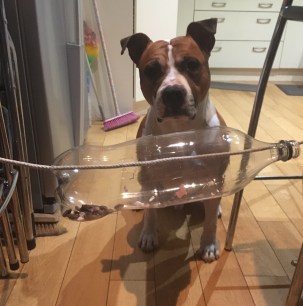
feed a dog lead, cord or shoe lace through the bottle from the opening through the hole you made in the bottom
The higher up on the bottle that you run the cord through, the harder it is so start easy with the cord running through the middle of the bottles as in the clip above.
Advanced: Hanging Bottle
use a dog collar to hang a bottle with a handle, such as a milk jug
adding more food and using a smaller bottle makes it easier to solve
Hiding the bottle, allowing them to chase or catch it, and chew for a little. Be careful as chewing plastic may cause it to split and cut your dog, or they will ingest broken off bits. Play safe!
Decker just chews off a tightly closed lid from plastic bottles and is then done with it! But, he doesn’t attempt to ingest any part…know your dog!
Adding a bottle to a sock can make a fun, crackly tug or throw toy too!
Supervise your pet carefully!
Your challenge
Now it’s your turn. Show us what you and your pets, of any species, can do with these challenges!
Post to your social media accounts, using the #100daysofenrichment so that we can find you and join our Facebook group to share your experiences, ideas and fun!
You can comment right here too 🙂
We look forward to hearing from you and your pets – have fun & brain games!




























 AniEd Ireland