All the challenges for Day 1 here!
Category Archives: AniEd
Reboot: Week 1 Equipment List
Everything you need to participate in Week 1’s challenges: here!

Stress: the good, the bad & the ugly
When talking about stress, most people are referring to the negative effects largely associated with chronic stress. Stress is a normal part of life and nobody can be insulated from it.
Stress responses are experienced at neurobiological, physiological, psychological and behavioural levels. This involves a complex interplay between body and brain systems.
Dogs, like other mammals have similar biological ‘equipment’ for experiencing stress – the parts involved in stress responses are very ancient and likely evolved in more simple creatures. That’s because stress keeps us alive.
If stress keeps us alive, how can it be bad?
Stress acts at a number of different levels, depending on the nature of the stressor. Different stressors elicit different types of stress responses.
Any time the body is faced with challenge, it must produce a response that helps it cope with that challenge. If the individual has the neurobiological, physiological, psychological and behavioural tools to rise to the challenge, all is good.
This version of stress is beneficial – it involves goal oriented behaviour, it enhances performance and the more practice an individual gets at ‘good’ stress, the better they become at coping with their world.
But, where the individual doesn’t have the right tools, they may experience the negative effects associated with stress such as neurological damage affecting learning, memory and future sensitivity to stress, feelings of loss of control and anxiety, physical damage to organs and behaviour that may appear fearful, anxious, or aggressive.
Avoidance of the stressor is really the brain’s main aim – the brain would rather be stressed than dead. So, stress causes the individual to be more vigilant, on the look out for stressors to avoid. In dog training, we often called this raised state of awareness arousal.
Your dog on stress
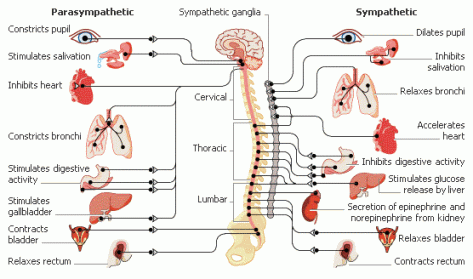
When the stress systems engage (when the brain perceives or anticipates challenge), everything is escalated: the individual’s sensitivity, vigilance, activity. But the body can’t perform in this heightened state over long periods; increases in breathing, heart rate, blood pressure, circulation of stress related hormones and neurochemicals will have detrimental effects on body and brain over time.
To counter this, an opposing system is activated to help turn off the stress response and bring the body back to a more even keel. That’s certainly how things are supposed to work but this is where it can get tricky…
Just like us, animals develop skills (or behaviours) for coping with stress, helping the body calm. And they need help in developing these skills, especially during adolescence.
Stress responses happen in and around the Limbic system, and when this is engaged in monitoring the environment and keeping the body safe, higher thinking parts of the brain, in the cortex, are inhibited.
This makes sense – if the brain is worried about safety, wasting time on thinking may not be terribly helpful.

When stressed, the brain and body are in a more reactionary state and not as well able to think through problems.
Enrichment, challenge and stress
Replace the term stress with ‘challenge’ instead; this may be a better fit in terms of understanding how stress can benefit us, as well as have negative effects.
When the body is challenged it must be able to adapt so that it can cope with and recover.
Good stress will be appropriately challenging, motivating the animal to respond – they will have the tools to cope with the challenge and therefore recover once they have dealt with it.

This might not be the case, where the animal doesn’t have the necessary behaviours allowing it to rise to the challenge, where it is exposed to cumulative or sequential stressors so doesn’t have sufficient time to recover in between, or where they are unable to escape exposure. That’s when things get bad – we refer to those experiences as distressing.
The point of enrichment is to provide the individual with opportunities to practice the good stress -> appropriate challenge. This strengthens the brain’s ability to cope with challenge, making it more and more immune to the effects of distress.
Enrichment must be enriching; that means that appropriate enrichment must provide the animal with outlets and opportunities for good stress. Otherwise, it’s not enrichment.
- make sure it’s individual – set it up so that it’s enriching for your individual pets
- have a goal – what should your pet get out of a particular challenge? what behaviours should they demonstrate or would you like to evoke via this particular challenge?
- be adaptable – be ready to step in, adjust the challenge, rearrange the set-up
- maintain appropriate challenge – how will you know when your pet is beginning to feel in over their head? how do they show frustration? when do they look to give up?
- it’s better to prevent them becoming overwhelmed than to wait for frustration before jumping in – that means you start with the easiest challenge and build challenge to coincide with their progress
- the buck stops with you – always think how you can adjust each challenge to work for your pet so they experience good stress
Food & Beyond
Food based enrichment is the most popular approach to enrichment for most animals in captivity; it’s probably the easiest and most obvious way to add entertainment to a pet’s life.
Although I’m not a big fan of food bowl feeding, and I do believe that reducing their use generally does good things for pets and their people, we are not going to get religious about this stuff during this program.
You do what works for you and your pet – you are here, adding enrichment to your dog’s life and we are delighted to have you.

Food Based Enrichment
Animals come with installed motor patterns that relate to feeding behaviour. All dogs have inbuilt predatory behaviours that are also found in wild canids including tracking, stalking, chasing, pouncing, biting, dissecting & chewing, caching and consuming.
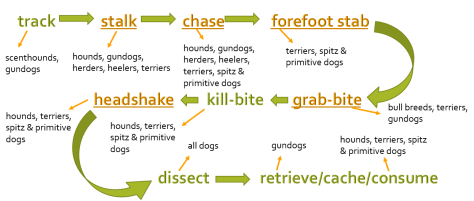
Food bowl feeding limits a lot of this, so providing enrichment is important; feeding is more than just eating, after all.
Sometimes food based enrichment may not be beneficial
For some dogs, feeding their regular food in challenging ways may contribute to problems, rather than solve them.
A dog who shows intense feeding behaviour may become overwhelmed by distress when trying to access such a valuable and finite resource from a tricky puzzle or food dispensing toy.
Indeed many ‘treat dispensers’ rely on generating a level of frustration for the dog to access the food, especially toys that need to be moved around.
Dogs who show escalated resource guarding behaviours, toward people or other dogs, may not benefit from food puzzles; because food becomes harder to access, it becomes higher in value which may contribute to an increase in intensity of resource guarding behaviour.

Care should be taken using food-toys to manage a dog’s behaviour.
Food toys are often suggested for dogs who show distress related behaviour at separation from their family, for example. While this may certainly form part of a program to help, it shouldn’t be considered a solution in and of itself. The dog will engage with the toy, and then become distressed, if they are able to eat from the toy at all.
The presence or preparation of the toy may even become a trigger for distress as it predicts being left alone.
Engaging with high value food may mask the dog’s experience in lots of scenarios, and while distraction and management can be helpful, if learning new skills can be done, it should be done. Management and distraction, especially with food, may only be of short term use.

And extra challenges, in general, are not needed by dogs who have just moved to a new home, into kennels or changed environments. The changes around them provide sufficient challenge without making anything else too difficult.
Letting them find their feet and reveal their preferences will allow their humans to provide appropriate enrichment that will help them settle as the acute
Using food for #100daysofenrichment
No matter what diet or type of food you feed your pet, food can be used as part of our enrichment program.

It is preferable that you use your pet’s daily ration, or part there of, to help control calorie intake and makes sure that your pet is eating a balanced diet.
If your dog falls into any of the categories talked about above and may find working for their food too frustrating or distressing, feed them some food in an easy way and then present some food in a puzzle. That will reduce a ravenous approach, reducing stress and making it easier for the dog to learn behaviours that help them solve the puzzle.
Higher value foods will generally be higher in fat, protein and calories – that’s what makes them yummier. A small amount of higher value foods may be required to build motivation and help pets learn behaviours they need for challenges.
Boosting the value of regular food:
If you are watching your pet’s weight closely, your pet has dietary restrictions or your would prefer to stick to their regular food, there are things you can do to boost the value of regular food:
- a Training Mix can be adapted to suit the individual’s needs
- warming food, to just about body temperature, can help increase motivation to eat it
- putting kibble under the grill/broiler briefly can bring out the oils, making it tastier, and make it crunchier, adding sensory variety
- getting the pet working for food can increase its value as it becomes harder to get…#100daysofenrichment will help!
- making sure the challenge is appropriate to prevent frustration and giving up
- playing with the animal first can raise arousal just a little, increasing their motivation to eat
Food types:
While kibble is often an easy to use, versatile food type for many enrichment applications, all food types can be adapted too.

Using kibble and dry feeds:
- use as is
- soak it, soften and swell it
- mash it into a paste
- grill it
- suspend, mix or freeze it in water, low-sodium stock, or other flavouring
Meats and meat mixes, fresh foods (e.g. raw type diets, home prepared diets):
- cut into smaller pieces
- boiled or baked
- mashed into pastes
- frozen in small ice cube trays or pyramid baking mats to make small, individual treats
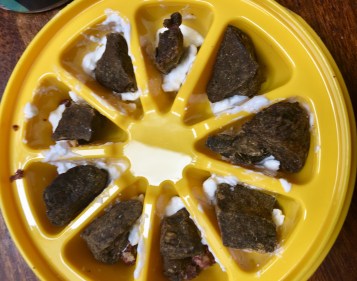
Wet feeds (e.g. canned foods)
- feed in smaller, individual portions from a spoon or spatula
- lining enrichment devices
- frozen in small ice cube trays or pyramid baking mats to make small, individual treats
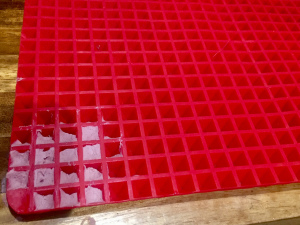
Adding foods:
If we are to add other foods to our pets’ diets, we must make sure they are safe and that the individual can tolerate them.
Decker has a very varied diet, consisting of a limited number of proteins, and in an average day he will have kibble, raw and cooked foods as part of his normal diet. He can tolerate a wide range of foods and this is likely associated with some genetic predispositions as well as careful introduction to a range of food as a youngster.
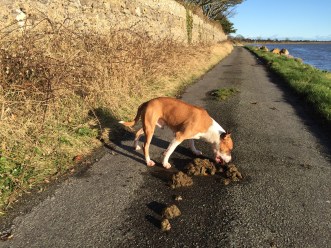
But again, this relies on you knowing your pet.
If you are adding foods, you need to take care, as additions can increase calorie intake and change the nutritional balance of the pet’s diet. This is particularly important with young, growing animals, those with dietary or environmental sensitivities, pets with specific dietary needs and so on.
As such, additions may not be possible and, at the very least, if you are adding stuff, you will need to adjust the pet’s diet to compensate.
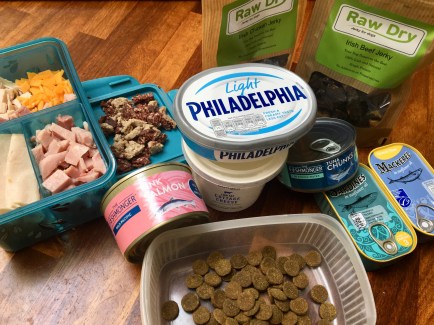
Examples of foods that might be useful for #100daysofenrichment:
- spreadables for lining and freezing like pate, cream cheese, soft cheeses, yoghurt, peanut butter, wet/canned foods, baby foods (watch out for added onion powder).
Use very small amounts, really as tantalisers, as these will generally be quite high calorie.
Make sure to use peanut butter that is just peanuts, rather than with lots of sugars and sweeteners, some of which can be dangerous to dogs, e.g. xylitol.
Pates are usually LOVED by dogs but must be used in small amounts as most will contain onion and garlic powders. There are some brands that do without and in general, fish pates tend not to have these additions.
You can also try kibble-mashes, cooked and mashed vegetables like carrot, sweet potato or mashed fruits like apples (remove the seeds) or bananas. - good quality kibbles, commercial wet foods, some prepared raw diets like nuggets
- various meats, offals and similar – to reduce calorie content choose leaner cuts and boil then skim the fat to prepare
- tinned fish – probably the best addition as they provide a more well rounded nutritional profile (for the most part), and especially when added to a kibble diet, are usually cheap and can be an effective flavour enhancer in even small amounts
- edible chews – commercial or “natural” dried chews and treats
- commercial treats and biscuits
- fruits and vegetables – take care and make sure they’re safe for dogs.
Small pieces of carrot, apple (seeds removed), small amounts of mashed banana, cooked broccoli, frozen peas, water melon, blue berriers and raspberries are often favourites, safe and well-tolerated by the majority of dogs - cereals such as rice, pasta and so on are unlikely to be a high value or adequately nutritional addition, unless as part of a balanced diet, breakfast cereals like Cheerios, porridge

Beyond food
Throughout #100daysofenrichment we will be adding in lots of enrichment activities that are not primarily food based.
You might add in food rewards, for example, but we have lots of activities that involve other categories of enrichment.
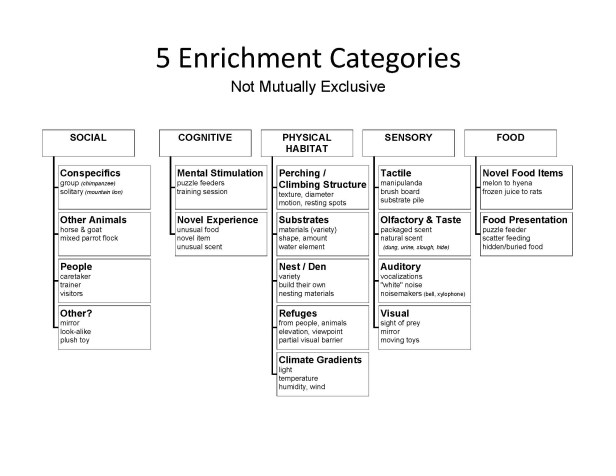
We loosely base our approach on the Shape of Enrichment categories: social, cognitive, habitat, sensory and food.
Each week I have tried to cover as many of these as possible and also develop enrichment devices and strategies that incorporate as many as possible, in one, to get more enrichment bang for your buck!
Most people, when thinking of enrichment, think food based and Kong toys, and while these are some of our favourites, there are gaps, especially for lots of pet dogs. Food based enrichment and food dispensing toys alone will not plug those gaps and a more rounded enrichment experience is needed.
Within the enrichment literature, as limited as that is for dogs, active (enrichment interacts with the animal) and socially based enrichment strategies seem to be the most beneficial and welfare friendly. As such, providing dogs with outlets for social contact is important and for pet dogs, or dogs destined to be pets, that must mean social contact and interaction with humans.
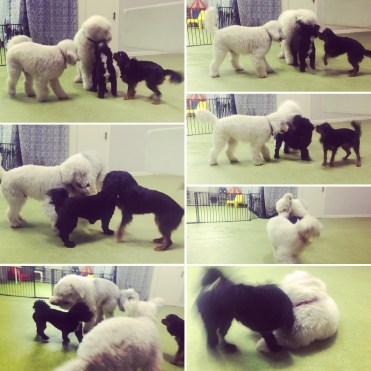
So, what does that mean for dogs who are home alone while their owners work and commute all day? What about dogs in ‘rescue’ and kennel accommodation?
Different categories of enrichment are super important for these dogs, and all dogs too, while also maximising the time humans can hang out with them; we want to make sure it’s quality time, and not just quantity.
Over the #100days we will not be discussing social interaction among dogs, or other animals, for various reasons, but interaction with their humans will be central, in combination with many other categories of enrichment. As well-rounded an approach as possible is most beneficial.
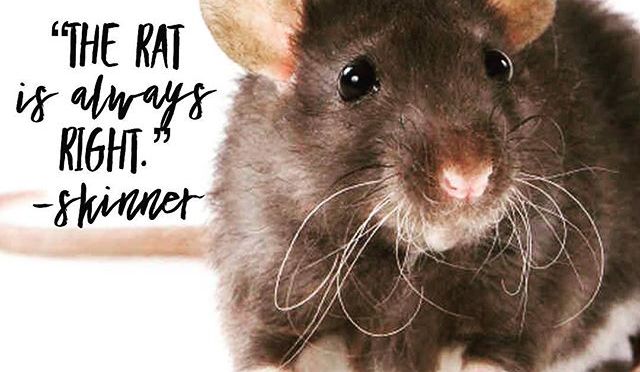
The animal is always right
In training. In enrichment.
The animal’s behaviour is feedback telling us humans how well we have set up their environment for success. Or not.
It lets us know what we can refine, adjust, improve.

In enrichment, we take that notion even further than often we allow ourselves to in training. (We should be approaching training in the same manner, but that’s for a different day!)
How the animal chooses to engage, or not, with the enrichment activity or device is up to them. Regardless of our intentions or how we think they should approach the challenge – the animal decides. This allows enrichment to be enriching.
We should have goals, and we should plan, but the animal writes half of that plan…so we must observe and adjust based on their behaviour, based on their opinion of how this works for them.
Look carefully at the sorts of behavioural outcomes associated with enrichment activities – don’t get bogged down with a specific solve – how the dog does it is always right! Instead consider what the animal is getting out of it, what behaviours are they trying and what behaviours are winning.
This clip, doing the rounds on social media, attempts to suggest that the dog has the wrong idea. But that, in itself, is inaccurate. However the dog chooses to engage and ‘solve’ the puzzle is correct – the animal can’t be wrong.
These slow feeders are often a source of frustration for many dogs and as such might not be all that enriching for many. This dog has developed a strategy that allows him/her to solve the puzzle and win the prize. That’s just perfect!
Enrichment enhances the animal’s behavioural repertoire. They learn to apply different strategies to solve puzzles, to deal with challenge, to cope with their life.
Animals will do behaviours that work. That’s how enrichment can help broaden a dog’s behavioural repertoire. Behaviours that win are strengthened to be rolled out again and again in the right contexts.
How does your dog do theirs?
With more and more practice, and more and more enrichment, the animal develops strategies that they might apply to new contexts, stretching their repertoire even further.
Decker tries a winning strategy, that’s worked for lots of other puzzles, with a completely novel set-up. If this wins here, he’ll try it again, and if not, he will try something else.
You can easily see how appropriate challenge helps to build resilience and grow brains. By presenting appropriate challenge in a safe environment, the dog can try without failing so that offering behaviours is a go-to – developing ways to modify their environment so that it works for them.
Confidence building and stress busting!
Enrichment must be enriching!
With the popularity of discussions of ‘enrichment’ in dog-care, it’s really become very trendy to talk about it and ‘enrichment’ has become a bit of a buzz word.
That has led to some misuse and misapplication of this term, describing activities that are not truly enriching for the individual animal.
And in turn, as is the way within the animal care industries, there has been backlash.
Sigh.
The popularity and awareness of enrichment for dogs is a good thing, but, it’s important that it is implemented correctly to actually help dogs, rather than contribute to harm.
Just giving a dog some puzzle or food dispensing toy doesn’t necessarily equate to enrichment – the only way we can ascertain how enriching enrichment is, is by asking the dog.
Enrichment must be goal oriented (the main goal being, that enrichment must be enriching) and the dog’s behaviour should be observed to ensure those goals are met. If not, it’s back to the drawing board and plan, plan, plan.
That’s what #100daysofenrichment is for. I’ve done the planning for you – it’s up to you to adjust it according to your dog’s behaviour, according to what your dog is telling you about whether this is enriching, or not.

Enrichment planning
Enrichment planning requires just that, planning. And enrichment programs are generally goal oriented.
Let’s explore that a little.
What behaviours might your dog show now that you feel are troublesome, for you or your pet?
What enrichment have you in place already?
What would you like to get out of this program?
There are no right or wrong answers. But there are some rules to our enrichment endeavours to make sure enrichment is enriching.
Enrichment can be enriching if:
- enrichment is individualised
- enrichment is goal oriented
- enrichment provides choice
- enrichment allows the animal a little control over what happens to them
- enrichment facilitates the demonstration of species and breed typical behaviours

Enrichment must be individualised.
Although each day’s challenge will be presented with adjustments providing some options, you can further adapt each one to your pet’s preferences and abilities.
Take their response to the challenge as information and use that feedback to adjust and upgrade the challenge to best benefit your pet.
For example, make the puzzle simple and straight forward and use highly valued motivators for beginner-puzzlers to keep them engaged in the process.
This helps to keep a beginner engaged and interacting with the challenge, and motivates them to participate.
The Wobbler wobbling is a little worrying to Billie, so we break it down and introduce it to her first by teaching her the skills she will need, for a big payoff!
This clips shows Benny, a senior dog, working on a snufflemat. Lay out blankets or runners for older dogs or those with injuries, joint discomfort or mobility issues so that they are better able to move about, so that they don’t have to move too much after a sliding enrichment device, and to encourage them to lie down should they need to.
Enrichment must be goal oriented.
This entire program is designed to make sure your dog gets to be more dog, which will lead to improvements in lots of areas of behaviour health.
You might have specific goals for you and your pet, or goals may reveal themselves as we journey through the 100 days.
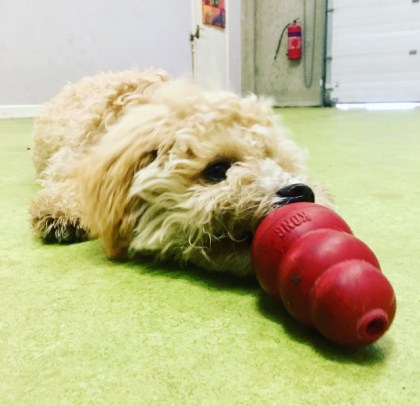
Decide what behaviours you want to see less of and what behaviours you want to see more of. Very often, the underlying contributors to behaviours we don’t like, lie in a lack of appropriate outlets for normal, natural, necessary behaviour. Think of this approach, rather than in terms of obedience or manners behaviours.
For me, providing an enriched life for my dog means that I provide him with experiences through which he learns how to choose appropriate behaviour, while also making sure that he gets to be a dog, doing doggie things A LOT.
Enrichment must provide choice.
The animal gets to decide if they participate, what they do, how they participate and how much they engage.
Your job is to make sure they are safe to choose and that their choices keep them safe.

In this clip, Decker has a ball stuffed with Husky hair that we use in Sniffaris for olfactory enrichment. Or certainly, we intend that the dog will find it enriching from an olfactory point of view but as you can see, Decker comes up with all sorts of other forms of entertainment!
While Billie was originally working her way through this brain-teaser puzzle, she also finds chasing the loose balls as just as if not more entertaining, as shown in the following clip.
(There are food rewards hidden in there and she does engage in sniffing and hunting for them.)
We need to stand back and allow the dog work it out. Ensure that it’s safe and will not cause them fright, frustration or any other distress and let them do the rest.
What one individual finds distressing is different to others so care must be taken, along with close observation.
Don’t lure or encourage too much – let them be dogs.
Enrichment must allow the animal a little control over what happens to them.
Each challenge will emphasise helping your dog to learn that their behaviour matters, that when they do things stuff happens that they might like, that their world is safe and predictable.
Making sure that the amount of challenge is appropriate, rather than frustration inducing, is an important part of the deal. Enrichment should generate the good kind of stress that is seen with a level of challenge that’s just enough to hold the individual’s interest but not quite so difficult that it causes them frustration or to give up.
Enrichment must facilitate the demonstration of species and breed typical behaviours
We should be seeing more of these in appropriate ways as we go through an enrichment program – these may form the basis for your goal setting and planning.
Living with humans means that dogs must inhibit their very doggieness a lot of the time. We want each dog to be more dog!
Puzzling encourages exploration, learning about the world and increased cognitive abilities. Puzzling makes them a better puzzler!
Decker uses a range of strategies, applied to lots of different puzzles, to solve a new one. Enrichment grows brains!
In other words, enrichment must be enriching!
#100daysofenrichment…Yet Another Reboot!
The 100 Day Project has been running for a number of years, specifically in relation to IT/tech stuff, creativity and the arts, and on social media #100day challenges have been applied to various areas, including dog training.
We started our first run through of #100daysofenrichment in January 2019 and it was so successful that we run it again at the end of 2019 too, to round out the year.
We had RUN3 last year, to help with some of the first rounds of COVID-19 lockdown to help us all have some fun and distraction. Corona related lockdown and distress continues and we had RUN4…and now, with COVID still impacting our everyday lives, we’re back for more with RUN5!

Cutting down on social contact, isolation, staying put, along with the stress of health fears, financial responsibilities, can have massive impacts on mental health. As many facets of our lives are going back to normal, our dogs may need extra support.
I am hoping that #100days will facilitate increased positive interactions with pets, providing a valuable social outlet for both species.
And in having a project to do, we will all have a focus that is not all about virus spread and the related chaos.
Most importantly, the dogs in our lives might greatly benefit from a structured program enriching their day to day lives.
What is enrichment?
Enrichment includes ways to add to, subtract or adjust our pets’ worlds so that they have more opportunities to choose to engage in species typical behaviours.
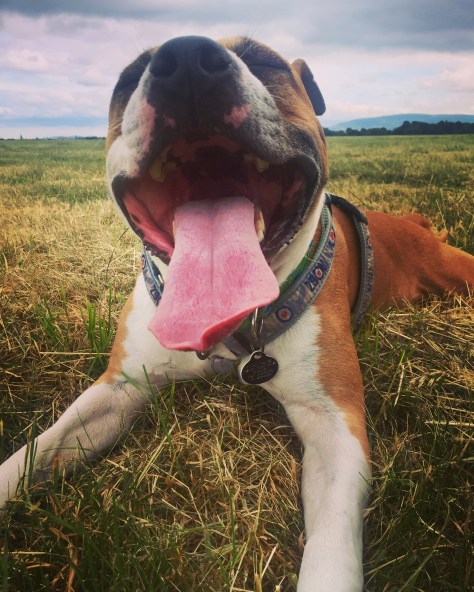
Species typical requirements for dogs include lots of social contact (with people, other dogs or other species – whatever floats their boat), a resting and hideaway space, functional spaces (separate toileting, resting and feeding areas, for example), mental & physical exercise, novel experiences to explore, and lots of opportunities to be a dog, doing dog things.
With dogs being such a variable species, we need to consider breed/type requirements too.
Enrichment is designed to provide animals with more choice – they get to decide how they interact with enrichment, with the things happening around them in their world.
It also helps them to have a little control over what happens to them. Enrichment can help them to learn that their behaviour works to get them things they like and avoid things they don’t like. That’s confidence building and stress busting!

Animals will find ways to enrich their own lives, if we don’t provide outlets for them. Those behaviours can be ones that their humans find troublesome so enrichment is important in preventing problems by giving your dog an acceptable outlet for dog behaviour. Everybody wins!
Think of enrichment as being a behaviour vaccine!
While the Kong toy range might just one of our favourites, we will look beyond Kongs, and food toys, adding challenges from lots of categories of enrichment.
Why #100daysofenrichment for dogs?
- Don’t let domestication fool ya!
Dogs might be pet animals but they still come with an extensive range of ‘natural’ dog behaviours including feeding behaviours, social behaviours, scavenging and hunting behaviours. They must do these behaviours – you, the human in control, decides how acceptable or not the demonstration of these behaviours will be.
- Boredom affects the welfare of captive animals, that includes domestic pets, because captive living allows them a limited repertoire of species typical behaviour.
We are not just talking at species level either, but also breed/type requirements. We know that lots of people get breeds or types of dogs that require more than a sedentary pet life can provide. Enrichment allows us to plug some of those gaps.

- Feeding behaviour is more than just eating and dogs need outlets for feeding behaviour (predatory and scavenging related), as well as social, social, sensory and exploratory behaviour.
- Dogs are natural puzzlers and are in it for the challenge and not just the end goal.
- Enrichment increases cognitive and learning abilities, reduces stress and therefore disease, and ensures animals are happier and more content.

The question should be, why wouldn’t you do #100daysofenrichment for dogs?
Who is #100daysofenrichment for?
Dogs. All dogs.
Each day will have different levels of challenges, options and adjustments so just about every dog can benefit.
These dogs’ humans will benefit too.
Each day’s challenge requires just mere minutes of your input or some adjustments to stuff you are already doing. But the effects can be much longer lasting for your dog.
We haven’t forgotten about other pets too and with a little editing and imagination, lots of other species can join in as well.

The best way to stick to the program is to tell everyone that you are doing it – share your photos and videos, post on social media, and best of all, let us know how you and your dog are doing! Tag @aniedireland and use #100daysofenrichment
Join our group to stay in with the discussion and sharing 🙂
How do I participate?
AniEd WordPress Blog
The entire program is available here too, so you can find them easily and follow along at any time.
This time around, we won’t be sharing each day on this blog.
Social Media
Keep an eye on our Facebook page and like/follow it to keep up with progress. Each day’s challenges will be posted there.
Join our Facebook group AniEd #100daysofenrichment to really participate, join the community and share your progress – each day’s challenges will be posted there.
Follow us on Instagram too, to stay up to date. You can also subscribe to our YouTube channel for lots and lots and lots and lots of videos on enrichment and entertainment for dogs.
What happens?
Each week, we will post the list of what you will need for the following week – that way you can be prepared!
Each day, a new challenge will be posted that will include adjustments to suit lots of pets. You just need to participate and let us know how you are getting on.
You can post pictures and clips too, which we LOVE to see, and get lots of support and feedback to help you and your dog.
When?
Week 1 starts Monday 6th September 2021 and that brings us up to mid December for day 100.
There will be new challenges covering all sorts of categories of enrichment on Mondays, Tuesdays, Wednesdays and Thursdays.
On Freestyle Fridays, a challenge for the humans will be posted. We will provide you with the raw ingredients to develop a puzzle or enrichment device or set-up for your pet. No limits, no rules other than all the ingredients must be used in some way and it must be enriching.
Sniffing Saturdays are self explanatory! Challenges on Saturdays will be all about getting your dog’s nose working even more. The only rule – humans are not allowed to hurry them along…they get to sniff to their heart’s (nose’s) content!
On Sunday Fundays you and your pet get to repeat your favourite challenge of the week and do it again, upgrade it, re-jig it, relive it.

#100daysofenrichment REBOOT!
The entire #100daysofenrichment program is available for free but it can certainly be challenging to keep the motivation up to complete longer-term projects (which is why 100 days challenges, like this, exist!).
To round out 2019, let’s run our #100days project again from the start. I will be able to update any challenges as we go too.
This will give everyone the opportunity to jump back in and revive good enrichment habits, while also allowing newbies enjoy the challenges and the community participation.
#100daysofenrichment will be starting again on Monday 9th September, just in time for Back-to-School!
Join in by subscribing to this blog so you never miss a new posting, Like & follow our Facebook page where each day’s challenge will be posted and, best of all, come join our fantastic community of enrichers on our Facebook group: AniEd #100daysofenrichment.
Here you can chat with other project participants, share photos and clips of your enrichment adventures, introduce your pets and learn more and more about enriching and entertaining our animals (and ourselves).
So, get ready for Day 1, join in and have fun with your pet!

Enrichment on a budget
Enrichment doesn’t need to cost the earth – you can pretty much pay what you can afford while still providing your dog with a variety of experiences to entertain.
Most of #100daysofenrichment challenges are free, but priceless: spending time with your pet, exploring the world together, opening your eyes and seeing what your pet is really asking for.
Indeed, #100daysofenrichment is free in and of itself!
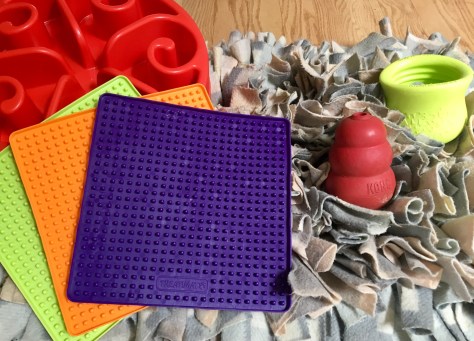
Some of the most popular food-based enrichment toys right now: a snufflemat, a slow-feeder bowl, “Treatimats”, and stuffables, large Kong and a large Toppl.
But, what if I told you that enrichment is not about the toy?!
Enrichment is about the behavioural outcome from which the animal benefits as a result of choosing to participate in the enrichment activity.
Don’t be turned off providing an outlet for your pet’s normal, natural, necessary behaviour just because you don’t have, can’t get, not able to afford a particular toy.
Look carefully at the sorts of behavioural outcomes associated with these toys – that’s what we want to replicate and we can do that without the toy itself.
But, don’t get bogged down with a specific solve – how the dog does it is always right!
This clip, doing the rounds on social media, tries to suggest that the dog has the wrong idea. But that, in itself, is inaccurate. However the dog chooses to engage and ‘solve’ the puzzle is correct – the animal can’t be wrong.
These slow feeders are often a source of frustration for many dogs and as such might not be all that enriching for many. This dog has developed a strategy that allows him/her to solve the puzzle and win the prize. That’s just perfect!
Affordable Alternatives
Making enrichment affordable allows every one to participate and benefits every pet, whether they live with a family, in foster, in kennels.
Make sure you know your dog and consider safety with ALL enrichment devices and activities.
Stuffables
Stuffable toys are generally costly as most are longer lasting and tough. Buying appropriate stuffable toys is a bit of an investment and might even last you through your next pets too.
I love the Toppl from West Paws as a stuffable but it’s not quite as hard wearing as many of the Kong toys so I take care with it with Decker.
But, you don’t necessarily need to invest.
See Day 1 for more on stuffables and Day 37 on lappalbles and lickables that can be adapted to budget options.

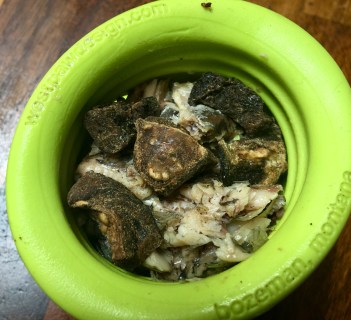
Any toy with holes in can be used as a stuffable toy, like the range above.

Stuffables don’t have to be stuffed; you can add the filling to the outside which is especially helpful for novice dogs or dogs that get frustrated with hard-to-reach goodies.
Freeze it to add more challenge and a different sensory experience.
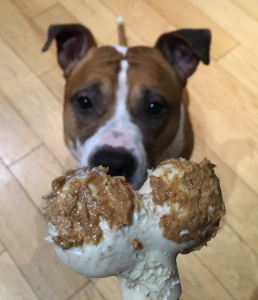
Take a durable chew toy, like a Nylabone or similar, and smear something yummy in the uneven surface created by chewing.
Freeze it to add more challenge and a different sensory experience.
Try edible stuffables, like these cored and stuffed apples.

Freeze just the stuffing and enjoy a stuffable without a stuffable!
Lappables
Like Lickimat or Treatimat from ALDI.
While licking and lapping can certainly be relaxing for dogs, make sure to keep frustration low, especially with the more challenging designs. Enrichment must be enriching!
See Day 37 for lots of ideas.


Alternatives to these are so wide and varied and include using plastic inserts from biscuits or chocolates, paper plates, muffin pans, ice cube trays, and upturned dog bowls.
Suspend lappables such as paper plates to keep things safer and to change the challenge.


Just smearing the sides of the bath, or the table, for grooming and husbandry procedures is efficient and fast. Securing silicone devices to the sides of the bath or shower makes clean up easier.
Slow feeder
This ALDI slow feeder bowl is quite nice as there’s lots of space, just encouraging the dog to use their tongue, and hopefully not become too frustrated.
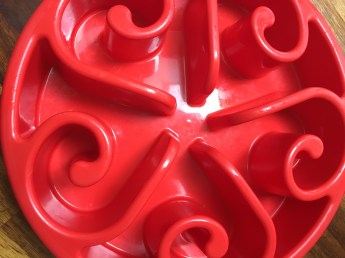
You can use the underside of this slow feeding bowl, as a mould or as a slow feeder too:

While these can certainly be used with kibble, to slow the enthusiastic eater, they also make excellent feeders to encourage lapping of soft foods. Raw feeders might prefer to feed raw diets in these, rather than in stuffable toys, as there will be less mess.
Adding kibble, with water or something to suspend it in, tinned foods, meats, mixes and so on and then freezing within slow feeders and alternatives can be fed in the container itself or tipped out to create a pupsicle.
- each gap in a muffin pan, right side up
- each gap in a muffin pan, upside down
- each gap in an ice cube tray, right side up
- each gap in an ice cube tray, upside down
- in an upside down non-slip dog bowl
- a dish drainer
Cardboard eggboxes make great slow feeders too!
Snufflemat
Snufflemats really started as home-made enrichment devices and making one yourself is a sure way to keep the costs down.
Purpose made and re-purposed snufflemats offer great snuffling and sniffing challenge and most dogs love it!
See Day 13 for lots of snufflemat ideas, including commercially made, re-purposed and how to DIY one.
Grass and vegetation are Nature’s snufflemat so whenever you can scatter some of your pet’s food and treats to get them sniffing and snuffling.
Foraging boxes are a great way to encourage snuffling and exploration, while using what ever safe and appropriate items you have to hand.
Day 31 gives you lots and lots of ideas from ballpit balls to bottles, from toilet roll tubes to toys.
Enrichment is for everyone
No matter the budget or your abilities, there are lots of simple and cheap ways to enrich and entertain.
Charities such as rescues can start a donation campaign for enrichment devices and pet owners can go through your pet’s toys regularly to see what could be donated to a rescue organisation or another needy pet owner.
Add your best budget ideas too so we can all benefit from our community by putting our heads together!
Check out the full #100daysofenrichment program for so much more!
When playing footsie ain’t funny any more
Almost consistently, puppy owners will want help with puppy biting & nipping behaviour (including foot chasing) and toilet training. Although they will understandably have lots of concerns and questions, those top the polls.
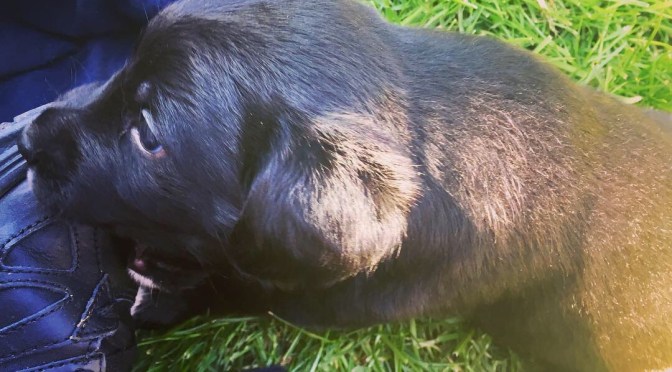
Most puppies, by the time I see them, will show well established foot biting/chasing behaviour. But, this behaviour didn’t start in their new home; swinging out of conspecifics is a normal part of puppy-puppy and puppy-dog interactions. When they go home, that comes to an end so human feet become a clear favourite.
While this behaviour isn’t terribly concerning in terms of the dog becoming ‘aggressive’ as an adult, it’s irritating and possibly dangerous (in tripping someone up), plus might indicate puppy needs help with managing internal conflict and arousal.

Your Toolbox
No one tool alone is going to resolve this, or any other unwanted behaviour, but, rather, a variety of tools that are best applied in different contexts.
- STOP making it fun!
When you move, squeal and pull your foot back, this is likely to add to the fun puppy is having…you are basically acting like a dog toy…
Puppy is getting lots of jollies out of this – getting to bite, chew and rag your feet, shoes, slippers or trousers gives puppy an outlet for their excitement, providing relief from stress (feeling wound up) and soon this game becomes the source of fun in and of itself.
When puppy approaches, stop moving. Be boring.
While this might be most effective for puppies whose behaviour isn’t really well established, it also stops a seasoned-foot-biter getting any further pay off.

- Redirect their focus.
You’ve stopped moving. The little monkey is swinging out of your trouser leg or dressing gown strap. Now what?
Puppies are pretty easy to distract so make a fuss about something else.
Pretend to be embroiled in a very interesting imaginary task, complete with lots of ooohs and aaaahs, rustling of packaging, moving of items, tapping of surfaces.
Very often puppy will be enticed and wonder what you are up to.
Now you will be able to redirect puppy to a different activity by, for example, tossing some kibble onto the floor for searching, toss a treat or chew into another room, throw or wiggle their toy. Once they have moved away and forgotten about foot chasing, you can engage them in another activity that will keep them busy a little longer while also helping them calm such as a stuffed toy, a sniffing game or chewing.
- Provide them with an alternative outlet.
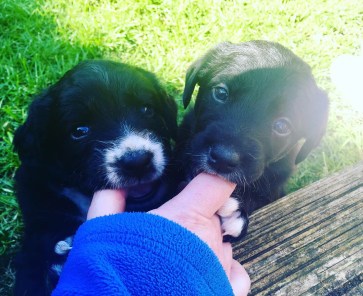
All behaviour serves a purpose, meaning the dog is doing behaviour to get something they need. A puppy biting, chewing and ragging on something, especially in a greeting or exciting situation, is seeking an outlet for their excitement.
They might not be quite sure how to cope with a greeting or the associated excitement so may be experience some internal conflict, not sure how to proceed.
Have a long toy, ready to wriggly on the floor, as soon as you come in the door so that puppy has something to rag on and tug. (Clip below)
Spend lots of time playing with puppies in short two minute sessions, practicing tug & thank you. A typical tug session should look like this (clip link):
This not only encourages play between human and puppy, but you are also teaching puppy to respond even when excited and helping puppy learn to regulate their own excitement, before things become too crazy and bitey.
- Change puppy’s expectations
Instead of expecting a big greeting and lots of foot chasing, help puppy’s expectations change to some other activity.
Practice coming in and out of confinement, in through a door or baby gate for example, presenting a different activity straight away. Puppy doesn’t even get to think about foot chasing. Toss food to move puppy away as soon as you enter and keep them sniffing and moving away as you move about. (Clip below)
- Play FOLLOW ME! games, a lot
Follow Me! teaches puppy to walk close to you for food rewards. It’s a simple game that must be practiced often, even outside foot-chasing contexts. Puppy learns that there are other ways to get and keep your attention.
It’s simple. Stroll about and each time puppy catches up with you or walks beside you, stop and feed a small food reward. Puppy can earn an entire meal during practice for this one.
Puppy learns that you moving about doesn’t need to involve chasing or biting your feet and by rewarding very regularly initially, puppy is prevented from even thinking about it. (Clip below)
This simple and fun exercise quickly establishes a really nice walking position for awesome loose leash walking and builds an excellent level of engagement. Lots of benefits to this one!
In this clip we practice Follow-Me! with Klaus. He happens to offer a sit behaviour that is rewarded and from then on, he offers an auto-sit each time the human stops moving. While this isn’t required, it’s a nice side-effect of puppy learning to human train. From Klaus’ point of view, he’s learning to get the human to produce food rewards – he just sits (and looks cute) – irresistible! (Clip below)
- teach LEAVE-IT! for feet or moving things
Help puppy learn that “leave it” means to reorient to their person, away from the moving thing, for a big pay-off.
Start by practicing in non-chasing scenarios and don’t make the moving thing too enticing to begin with. As soon as puppy looks toward it, say “leave it” and immediately offer a great reward. (Clip below)
You can work on mop chasing in the same way too, and apply ‘leave it’ with a toy to foot chasing. (Clip below)
Foot chasing and biting isn’t confined just to puppies; lots of adolescent dogs will do it too, often when greeting or going out for a walk. The excitement is more than their teenage brains are able for and biting is a neat way for them to channel that.
This usually is an initial response to getting out into the world, and soon dies down as the dog finds other forms of entertainment.
Use sniffing stations to get out the door – drop a few food rewards every couple of steps until you can get to an area where you can encourage your dog to sniff or engage in other activities.
Similarly, you could use a tug toy or other toy that the dog can carry or bite on. This can also help to redirect them from leash biting, which might be seen at the beginning of walks too.
Play the Go Find It! game on walks or in areas where the dog might redirect their excitement to biting or mouthing. This simple game can help to improve loose leash walking and engagement, while changing their motivations and helping to provide them with an outlet for their excitement.
Lots of tools and tricks to help!
If you would like more help or advice with puppy training or adolescent training, please get in touch!
 AniEd Ireland