The entire #100daysofenrichment program is available for free but it can certainly be challenging to keep the motivation up to complete longer-term projects (which is why 100 days challenges, like this, exist!).
To round out 2019, let’s run our #100days project again from the start. I will be able to update any challenges as we go too.
This will give everyone the opportunity to jump back in and revive good enrichment habits, while also allowing newbies enjoy the challenges and the community participation.
#100daysofenrichment will be starting again on Monday 9th September, just in time for Back-to-School!
Join in by subscribing to this blog so you never miss a new posting, Like & follow our Facebook page where each day’s challenge will be posted and, best of all, come join our fantastic community of enrichers on our Facebook group: AniEd #100daysofenrichment.
Here you can chat with other project participants, share photos and clips of your enrichment adventures, introduce your pets and learn more and more about enriching and entertaining our animals (and ourselves).
So, get ready for Day 1, join in and have fun with your pet!
Enrichment doesn’t need to cost the earth – you can pretty much pay what you can afford while still providing your dog with a variety of experiences to entertain.
Most of #100daysofenrichment challenges are free, but priceless: spending time with your pet, exploring the world together, opening your eyes and seeing what your pet is really asking for.
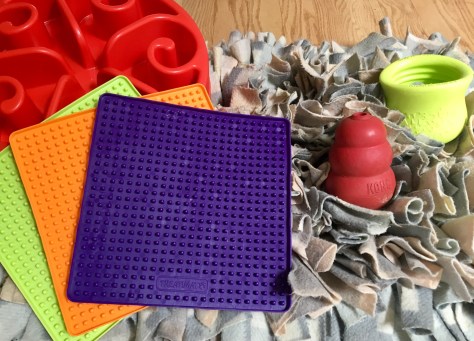
Some of the most popular food-based enrichment toys right now: a snufflemat, a slow-feeder bowl, “Treatimats”, and stuffables, large Kong and a large Toppl.
But, what if I told you that enrichment is not about the toy?!
Enrichment is about the behavioural outcome from which the animal benefits as a result of choosing to participate in the enrichment activity.
Don’t be turned off providing an outlet for your pet’s normal, natural, necessary behaviour just because you don’t have, can’t get, not able to afford a particular toy.
Look carefully at the sorts of behavioural outcomes associated with these toys – that’s what we want to replicate and we can do that without the toy itself.
But, don’t get bogged down with a specific solve – how the dog does it is always right!
This clip, doing the rounds on social media, tries to suggest that the dog has the wrong idea. But that, in itself, is inaccurate. However the dog chooses to engage and ‘solve’ the puzzle is correct – the animal can’t be wrong.
These slow feeders are often a source of frustration for many dogs and as such might not be all that enriching for many. This dog has developed a strategy that allows him/her to solve the puzzle and win the prize. That’s just perfect!
Affordable Alternatives
Making enrichment affordable allows every one to participate and benefits every pet, whether they live with a family, in foster, in kennels.
Make sure you know your dog and consider safety with ALL enrichment devices and activities.
Stuffables
Stuffable toys are generally costly as most are longer lasting and tough. Buying appropriate stuffable toys is a bit of an investment and might even last you through your next pets too.
I love the Toppl from West Paws as a stuffable but it’s not quite as hard wearing as many of the Kong toys so I take care with it with Decker.
Any toy with holes in can be used as a stuffable toy, like the range above.
Stuffables don’t have to be stuffed; you can add the filling to the outside which is especially helpful for novice dogs or dogs that get frustrated with hard-to-reach goodies.
Freeze it to add more challenge and a different sensory experience.
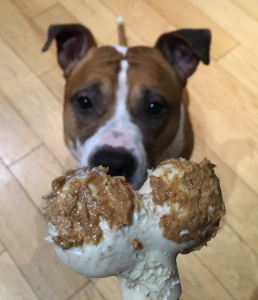
Take a durable chew toy, like a Nylabone or similar, and smear something yummy in the uneven surface created by chewing.
Freeze it to add more challenge and a different sensory experience.
Try edible stuffables, like these cored and stuffed apples.
Freeze just the stuffing and enjoy a stuffable without a stuffable!
While licking and lapping can certainly be relaxing for dogs, make sure to keep frustration low, especially with the more challenging designs. Enrichment must be enriching!
Alternatives to these are so wide and varied and include using plastic inserts from biscuits or chocolates, paper plates, muffin pans, ice cube trays, and upturned dog bowls.
Just smearing the sides of the bath, or the table, for grooming and husbandry procedures is efficient and fast. Securing silicone devices to the sides of the bath or shower makes clean up easier.
Slow feeder
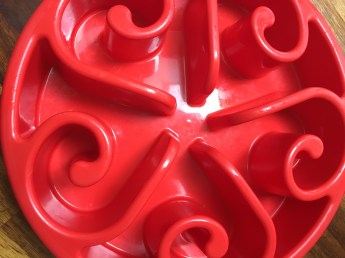
This ALDI slow feeder bowl is quite nice as there’s lots of space, just encouraging the dog to use their tongue, and hopefully not become too frustrated.
You can use the underside of this slow feeding bowl, as a mould or as a slow feeder too:
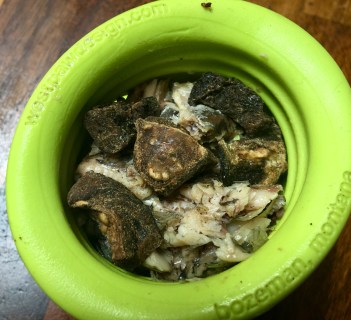
While these can certainly be used with kibble, to slow the enthusiastic eater, they also make excellent feeders to encourage lapping of soft foods. Raw feeders might prefer to feed raw diets in these, rather than in stuffable toys, as there will be less mess.
Adding kibble, with water or something to suspend it in, tinned foods, meats, mixes and so on and then freezing within slow feeders and alternatives can be fed in the container itself or tipped out to create a pupsicle.
Foraging boxes are a great way to encourage snuffling and exploration, while using what ever safe and appropriate items you have to hand.
Day 31 gives you lots and lots of ideas from ballpit balls to bottles, from toilet roll tubes to toys.
Enrichment is for everyone
No matter the budget or your abilities, there are lots of simple and cheap ways to enrich and entertain.
Charities such as rescues can start a donation campaign for enrichment devices and pet owners can go through your pet’s toys regularly to see what could be donated to a rescue organisation or another needy pet owner.
Add your best budget ideas too so we can all benefit from our community by putting our heads together!
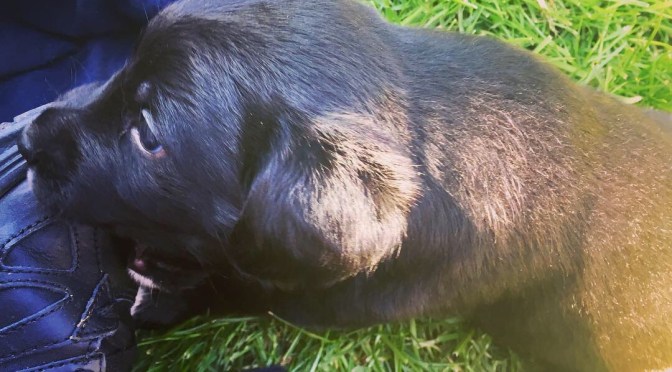
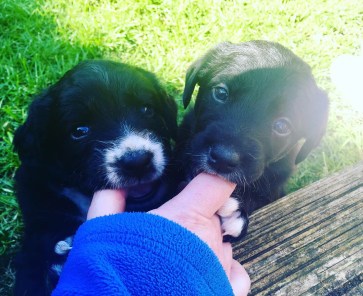
Almost consistently, puppy owners will want help with puppy biting & nipping behaviour (including foot chasing) and toilet training. Although they will understandably have lots of concerns and questions, those top the polls.
Most puppies, by the time I see them, will show well established foot biting/chasing behaviour. But, this behaviour didn’t start in their new home; swinging out of conspecifics is a normal part of puppy-puppy and puppy-dog interactions. When they go home, that comes to an end so human feet become a clear favourite.
While this behaviour isn’t terribly concerning in terms of the dog becoming ‘aggressive’ as an adult, it’s irritating and possibly dangerous (in tripping someone up), plus might indicate puppy needs help with managing internal conflict and arousal.
Your Toolbox
No one tool alone is going to resolve this, or any other unwanted behaviour, but, rather, a variety of tools that are best applied in different contexts.
STOP making it fun!
When you move, squeal and pull your foot back, this is likely to add to the fun puppy is having…you are basically acting like a dog toy…
Puppy is getting lots of jollies out of this – getting to bite, chew and rag your feet, shoes, slippers or trousers gives puppy an outlet for their excitement, providing relief from stress (feeling wound up) and soon this game becomes the source of fun in and of itself.
When puppy approaches, stop moving. Be boring.
While this might be most effective for puppies whose behaviour isn’t really well established, it also stops a seasoned-foot-biter getting any further pay off.
Redirect their focus.
You’ve stopped moving. The little monkey is swinging out of your trouser leg or dressing gown strap. Now what?
Puppies are pretty easy to distract so make a fuss about something else.
Pretend to be embroiled in a very interesting imaginary task, complete with lots of ooohs and aaaahs, rustling of packaging, moving of items, tapping of surfaces.
Very often puppy will be enticed and wonder what you are up to.
Now you will be able to redirect puppy to a different activity by, for example, tossing some kibble onto the floor for searching, toss a treat or chew into another room, throw or wiggle their toy. Once they have moved away and forgotten about foot chasing, you can engage them in another activity that will keep them busy a little longer while also helping them calm such as a stuffed toy, a sniffing game or chewing.
Provide them with an alternative outlet. All behaviour serves a purpose, meaning the dog is doing behaviour to get something they need. A puppy biting, chewing and ragging on something, especially in a greeting or exciting situation, is seeking an outlet for their excitement.
They might not be quite sure how to cope with a greeting or the associated excitement so may be experience some internal conflict, not sure how to proceed.
Have a long toy, ready to wriggly on the floor, as soon as you come in the door so that puppy has something to rag on and tug. (Clip below)
Spend lots of time playing with puppies in short two minute sessions, practicing tug & thank you. A typical tug session should look like this (clip link):
This not only encourages play between human and puppy, but you are also teaching puppy to respond even when excited and helping puppy learn to regulate their own excitement, before things become too crazy and bitey.
Change puppy’s expectations
Instead of expecting a big greeting and lots of foot chasing, help puppy’s expectations change to some other activity.
Practice coming in and out of confinement, in through a door or baby gate for example, presenting a different activity straight away. Puppy doesn’t even get to think about foot chasing. Toss food to move puppy away as soon as you enter and keep them sniffing and moving away as you move about. (Clip below)
Play FOLLOW ME! games, a lot
Follow Me! teaches puppy to walk close to you for food rewards. It’s a simple game that must be practiced often, even outside foot-chasing contexts. Puppy learns that there are other ways to get and keep your attention.
It’s simple. Stroll about and each time puppy catches up with you or walks beside you, stop and feed a small food reward. Puppy can earn an entire meal during practice for this one.
Puppy learns that you moving about doesn’t need to involve chasing or biting your feet and by rewarding very regularly initially, puppy is prevented from even thinking about it. (Clip below)
This simple and fun exercise quickly establishes a really nice walking position for awesome loose leash walking and builds an excellent level of engagement. Lots of benefits to this one!
In this clip we practice Follow-Me! with Klaus. He happens to offer a sit behaviour that is rewarded and from then on, he offers an auto-sit each time the human stops moving. While this isn’t required, it’s a nice side-effect of puppy learning to human train. From Klaus’ point of view, he’s learning to get the human to produce food rewards – he just sits (and looks cute) – irresistible! (Clip below)
teach LEAVE-IT! for feet or moving things
Help puppy learn that “leave it” means to reorient to their person, away from the moving thing, for a big pay-off.
Start by practicing in non-chasing scenarios and don’t make the moving thing too enticing to begin with. As soon as puppy looks toward it, say “leave it” and immediately offer a great reward. (Clip below)
You can work on mop chasing in the same way too, and apply ‘leave it’ with a toy to foot chasing. (Clip below)
Foot chasing and biting isn’t confined just to puppies; lots of adolescent dogs will do it too, often when greeting or going out for a walk. The excitement is more than their teenage brains are able for and biting is a neat way for them to channel that.
This usually is an initial response to getting out into the world, and soon dies down as the dog finds other forms of entertainment.
Use sniffing stations to get out the door – drop a few food rewards every couple of steps until you can get to an area where you can encourage your dog to sniff or engage in other activities.
Similarly, you could use a tug toy or other toy that the dog can carry or bite on. This can also help to redirect them from leash biting, which might be seen at the beginning of walks too.
Play the Go Find It! game on walks or in areas where the dog might redirect their excitement to biting or mouthing. This simple game can help to improve loose leash walking and engagement, while changing their motivations and helping to provide them with an outlet for their excitement.
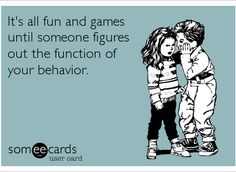
Behaviour functions for the behaver. This means that the animal is doing the behaviour to get things that they like or to avoid things they don’t like – dogs do behaviour that works for them!
Culturally, we are pretty obsessed with stopping behaviour we view as bad but to modify behaviour, stopping unwanted behaviour might be short sighted but often appeals to the quick-fix addicts.
Attempting to stop behaviour after the fact by, for example, administering punishers is so often too little too late. The dog has already got his jollies.
Instead we prevent the dog practicing behaviour we don’t like (practice makes perfect, after all!) so that we can clean the slate and establish new, alternative, more desired and ideally, incompatible behaviour.
To modify unwanted behaviour, we need to know the whens, whats and whys.
How does behaviour happen?
Dog training is generally thought to be about telling the dog to do something, using commands and making sure they’re followed through on.
While that satisfies a traditional attitude to our dogs, that’s not really what’s happening at all.
Dogs do behaviours that work. These behaviours work because things around the dog, in the environment, tell them to do a behaviour to access something or avoid something.
The things in the environment that tell the dog it’s the right time to do that behaviour are called antecedents (A) and the things they access as a result of doing the behaviour are called consequences (C).
When the A’s happen, the dog is getting prepared to do the behaviour and expecting a specific outcome. The A’s tell the dog to anticipate the availability of something the dog likes or to anticipate a way to avoid something they don’t like.
A little mention of management here, before we go on
The conditions in which behaviour happens, the A and the C, have nothing to do with the dog – they are in the environment. That’s why we say that behaviour is in the environment and not in the dog!
To stop behaviour, we must prevent the dog’s exposure to A’s and their access to C’s. That’s what management is – we stop the dog rehearsing behaviour by rearranging their environment.
Management clears the way for teaching and learning new and more desirable behaviour, providing a foundation upon which to build.
Consider the function of behaviour when teaching new behaviour
This is Ollie and one of his awesome humans. He’s a puppy and has been taught that tugging the mop is the BEST game ever. This commonly happens with puppy behaviours – they are cute and funny, providing endless entertainment for both species.
But the reality is that, in just a couple of short months, Ollie will be able to quickly destroy the mop as soon as it’s produced and that doesn’t make it so fun after all.
Over time, his mop-tugging behaviour has become very intense, more so than with toys.
Have a think about the A’s and C’s for this behaviour.
The C’s are pretty clear – there is a big pay off in getting to tug the mop; it moves and it’s soft and squishy, which are textures dogs often like to bite; this behaviour causes a surge in arousal with all the component neurochemicals causing him to feel good about it all.
Don’t forget the A’s! In dog training there is an inordinate amount of time devoted to discussion of C’s and not nearly enough about A’s and related factors.
As soon as Ollie’s human walks toward the mop, he is following and watching. You can see his excitement building with jumping up, trying to grab it, even vocalising.
He responds this way when in another room and can only hear the mop too! Ollie might just be a proper mop-addict!
He anticipates a whole lot of excitement when the mop comes out (you’re on your own there, Ollie!). This arousal means it’s really tricky to redirect his attention on to something else and to get him to let go of the mop.
As soon as the mop comes out, Ollie is geared up for some tugging – that behaviour functions for him, providing an outlet for his excitement. If we just take that away, in that context (ABC), where does that excitement go?
Our goal in modifying behaviour is to teach a suitable alternative behaviour – what would we prefer the dog to do?
But that behaviour needs to also plug the gap of the unwanted behaviour so that the dog still gets his jollies, just in a more appropriate manner. The new behaviour functions for the old, unwanted one.
Often times, in reward based training (or what ever label you care to use), we get hooked on throwing food rewards at new behaviour without considering that there was a real need there, on the part of our learner, and a real function being satisfied.
When we remove that outlet for that animal, we may be effectively suppressing behaviour but because we are reinforcing a more desired behaviour, often with food, we think that’s ok. And it might be.
But, our training plans must include consideration for the function of unwanted behaviour, ensuring that those functions are satisfied.
(Want to learn more about this? Check out this introduction to the A-B-Cs of Behaviour webinar for the tools to design training plans. )
For Ollie, we will tick lots of these boxes, with the help of his awesome family:
no mopping when Ollie is around – management
short one to two minute training sessions of ‘leave the mop’ exercise in the clip above – he learns that he gets his tugging jollies when he hears “leave it” and that the mop coming out makes his toy available for tugging…we are switching up those A’s and C’s
continued practice on play and tugging in other contexts too to really get some control and responsiveness built in
plenty of outlets for normal puppy behaviour in lots of different ways throughout the day (#100daysofenrichment is great for puppies too!)
As we move forward, we can start to build other alternative behaviours into this context; for example, the mop coming out means crate time or garden time with a yummy stuffable or sniffing game.
And we might use some strategies that have been successful with less intense mop chasers too.
Ultimately, the presentation of the mop will mean chill out over there but first we gotta make sure he’s getting what he needs out of this mop business. Training is a journey, not a destination, and we’re in it for the long haul!
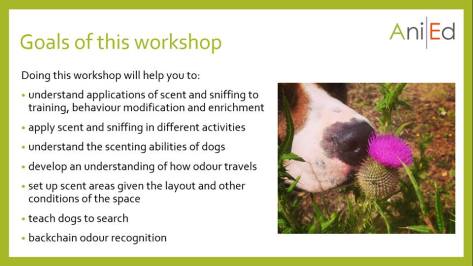
Last weekend we had a Scent & Sniffing workshop for our trainers. We hold workshops about every month to provide continuing education for our trainers, and where there is space, for other trainers and dog lovers too.
Certainly my favourite part of this is the application of scent and sniffing to improving the welfare of pet dogs. But, we covered lots on related sports and training, the biology of scent and learning about airflow and the ‘behaviour’ of odour.
It was a great day, with lots of engaged trainers and willing dogs – after all this is their thing!
By far the favourite part of the day, for humans and canines alike, was the Sniffari we set up, at the front of the training centre.
What’s a Sniffari?
I would love to say that I originated the term, but I think the credit goes to dog trainer Kristi Benson. And I would also love to claim that I came up with this idea, but I saw some similar version of this on a training company’s Facebook page and I can’t find it now – if anyone knows, please share so I can give credit.
(UPDATE: found it, tucked away in resources folder! This comes from the mobile Snuffle Park by Dog Solutions, an Australian company!)
AniEd’s version of this is possibly a little different and I am hoping to develop it more and more.
Sniffari is an olfactory adventure for your dog. It can be as elaborate or as basic, as large or small, and as complex or simple as you like. You are limited only by your imagination, and how far you want to take this.
We went all-out-elaborate for our workshop. Attendees from around the country brought lots of bits and pieces to build the Sniffari. AniEd is already filled with “rubbish” that we use for puzzling and enrichment, so we contributed lots too.
Our Sniffari is not just an olfactory journey, but a multi-sensory one. The dogs are drawn in and around many substrates, obstacles, sights AND smells. Many layers of cognition are engaged, meaning that so much brain power is involved.
That it was outside, to give us lots of space, also provided extra challenges in the way the breeze moved through the obstacles.
There were five dogs at the workshop and each had a different experience but all were enthralled. Afterwards they were tired, but chilled out rather than exhausted from exertion.
If you would prefer just to watch little snippets from each dog’s adventure see the next clip, but if you would like to watch an edited clip of each dog’s journey, that follows too (in alphabetical order!).
Cooper is an adolescent Cocker, a pretty high-arousal fella who is always moving and whirling. I particularly enjoyed watching him do this and felt that he may benefit the most from this sort of slower-paced activity. I don’t think I have seen him as calm, engaged, and moving as slowly and controlled as he did through the items of interest.
He systematically sniffs every item and methodically moves around the course, ensuring he doesn’t miss anything. What a wonderful experience for this guy; really taking time to think and sniff, take his time, relax and take in information without worry or arousal. Good job Cooper!
Decker on Sniffari
Decker is a mature entire male and although he is a serious sniffer, this was probably a little less enriching for him. Most of the items are from AniEd and he’s here almost every day, and many are from the beach he goes to most days too, so lots of these things are just not as interesting to him – he’s sniffed it all before!
Decker also believes that all people who come to AniEd are here to see him, so he feels obliged to greet everyone and make sure he shows his gratitude to his fanbase.
He spent lots of time on feathers and does a great double-take passing the duck feathers, going back to give them some intense attention. He’s a pretty methodical sniffer too, but this is how he is when sniffing in general and during specific trained sniffing related activities.
Eric on Sniffari
Eric is a mature neutered male and is a cautious fella. He finds new things, new environments and change a little concerning so would rather keep his distance. However, Eric was able to engage with this activity and was certainly keen to investigate and explore.
You can see Eric’s worry and apprehension but his senses took over and led him in and around obstacles he wouldn’t normally approach, helping him cope and allowing him to gather information about the world around him. Such an awesome experience for him.
He worked for a shorter period than the other dogs – they all got to decide when they had enough and wanted to move on but, he certainly immersed himself in Sniffari-ing. We left it up for the rest of the day, so each time the dogs went out for a break, they could choose to engage in the course at any stage.
Well done Eric – Sniffari’s are excellent for soft, sensitive dogs too!
Ivy on Sniffari
Ivy is a mature ex-racing Greyhound, spayed female, and is a slightly cautious and very dainty lady. She also sniffed methodically and seemed to be particularly interested in animal related items.
She shows a little apprehension when passing between items so a more sparsely populated Sniffari might be preferred by her.
She spends lots of time sniffing every inch of the snufflemat that one of our trainers had made for her pet rats. Ivy is pretty interested in small-furries and chasing, so this intense interest makes sense.
What a great way to provide her some outlets for her interests, without causing the high high high arousal associated with chasing and hunting.
Sniffaris work as an outlet for chasers – go Ivy!
It’s interesting to note that Ivy marked, with urine, twice; once after sniffing the rat snufflemat and a second time, after sniffing a mound of seaweed. Both times she showed marking behaviour with leg lifting.
It is to be expected that dogs will urinate after sniffing, especially lengthy sniffing sessions. Shafik, 1994, demonstrates a link between sniffing and urinating so the dogs were given lots of toilet breaks throughout the day between olfactory adventures.
It might also be interesting to note that the two girls marked in the Sniffari and the boys didn’t, even though two of them followed the girls’ rounds.
Lottie on Sniffari
Lottie is a mature Boerboel spayed female. She is a pretty social girl but did show a little concern at some of our attendees, who sat across the road to watch, and, also at some patrons from another business up the road a bit. Regardless, she methodically sniffs her way around, not missing a thing with her nose!
Upon reviewing her footage I note that she spends a lot of time sniffing and studying other dogs’ bedding and items. To dogs, this is social interaction, even though there’s no contact.
This may be an important outlet for dogs who prefer not to hang out with other dogs, for dogs who are worried by other dogs, and for dogs who are not going to be able to be exposed to other dogs due to their age, health and so on.
Gathering that information may also be important in developing comfort with other dogs, assessing the potential level of threat or determining that the dog hasn’t been in the area for a while (as in, it’s an old or weak smell).
Sniffaris might be a great way of giving dogs who don’t hang out with other dogs access to social interaction. Way to go Lottie!
Along with Ivy the other bitch, Lottie also marked, at the side of the tent. This may have been overmarking as it’s possible that another dog had marked there previously (but not for a while as this was the first time this tent had been used in a long time).
Puppy1 on Sniffari
We are continuing to develop our Sniffaris so we added some to Puppy1 class this week. Puppy class includes different cognitive, physical and environmental challenges each week, and this week’s was puzzle feeding. We combined this with some Sniffari ideas.
There are lots of differences in the puppies’ experience and that of the workshop dogs. First you will notice the level of activity is higher and their ability to sniff and explore methodologically is lower.
Although the fact that they’re puppies has a little to do with this, it’s also affected by the group dynamics and the presence of food in some of the puzzles.
This increases activity relating to competition between the dogs and it increases the intensity of their searching.
Also, it’s Galaxy’s (Pug) first class so he’s likely pretty overwhelmed by the entire sensory explosion that evening. It’s also likely that these puppies haven’t had a ton of experience with other dogs, outside of class, and that the world is relatively new to all of them. Puppies, of course, approach most interactions with exuberance and enthusiasm, and that’s certainly evident here.
Sniffari’s, providing multi-sensory experience and multi-level challenges are good for puppies, helping to grow puppy brains!
Take Your Dog On Sniffari!
We will be continuing to develop this idea as we feel it, like many of the sniffing applications we use regularly, has the potential to provide many benefits to lots of dogs.
Dogs live in the human world and as such must inhibit a lot of their most dogginess. Providing sniffing outlets is essential for making sure pet dogs are healthy in both body and mind.
Sniffaris may be ideal for:
young dogs
kenneled dogs
dogs living in less enriched environments
dogs on rest or exercise restriction
dogs who will benefit from some confidence building
dogs who are excitable and easily aroused
dogs who find the outside world a little overwhelming
dogs who might be very interested in hunting
dogs who might not want to be around other dogs a whole lot, or don’t get the opportunity to meet other dogs a lot
dogs new to the home – everything is a Sniffari to them as they settle into their new world
older dogs who may not be able to get about as well as they once did
But really, all dogs will benefit and enjoy the opportunity to get lost in their olfactory world.
In our Sniffari we had a tent, chairs and tables to add different dimensions. We used a wooden frame, pool noodles, streamers, mats of different substrates, tubs of water, platforms and hula-hoops to add in physical and tactile challenge. We used seaweed, plants, old shoes, fur, feathers, toys, boxes, old food and cosmetic containers, vegetation, twigs and branches, sweeping brush, different containers, and lots of bits and pieces to add real olfactory interest.
Make sure the item/s aren’t dangerous and safe to be sniffed, that they don’t contain or have never contained substances toxic to dogs, and make sure they’re appropriate for your dog. For example, it’s not a good idea to bring back vegetation that strange dogs may have peed on to unvaccinated puppies.
Display the items in as wide a space as possible so that odour can circulate and leave space for your dog to move between items.
Start today by promising to take your dog on Sniffari as often as possible. When you go somewhere, without your dog, bring back at least one item and allow your dog to sniff, sniff, sniff. This might simply be allowing them to go to town on your shoes, tracing your steps in olfaction.
Crazy dogs are often misjudged, much maligned and blamed for their crazy ways but that very crazy behaviour is more than likely associated with high arousal (emotional excitement), difficulty to cope with frustration and poor stress-control skills.
How might you identify a crazy dog?
The crazy dog comes in many forms, but in general these dogs have trouble with bringing themselves down after getting wound up; they might :
show reactive behaviour on lead or in confinement – barking, lunging, growling toward triggers such as other dogs, cyclists, other people
show attention seeking behaviour and/or bark excessively
have difficulty settling
have difficulty focusing
jump up
pull on lead
be excitable
be destructive
show frustration related behaviour such as pulling on lead, grabbing, vocalising when they want something
dislike confinement or being left alone
The crazy behaviour itself isn’t really the full issue, it’s more that the dog has trouble bringing themselves down from this high and often this manifests in over the top behaviour.
These are my favourite dogs to work with (and live with…ahem…Decker…) because they offer lots of behaviour (lots of crazy behaviour) and are just begging to be shown which ones are more appropriate.
Crazy to Calm Training Class
This training course is perfect for those crazy dogs, and their humans but also for dogs:
who are expected to cope with pretty exciting environments such as dogs who attend shows and competitions, dogs who assist their humans or dogs who attend work with their humans
who have spent time in a kennel environment such as a shelter
who are working through a training or behaviour modification program to help with reactive or stress-related behaviour
Crazy to Calm class will help you to:
prevent crazy behaviour by giving the humans a better understanding of their dog’s behaviour
manage crazy behaviour by helping your dog develop better focus skills and improved on-leash behaviour
tackle the underlying causes of crazy behaviour by working on self-calming skills
We will do this through lots of games, using a high rate of reward with food rewards, interaction with their human, toys & play.
We will not be suppressing crazy behaviour, as is so often the approach, but instead building more appropriate behaviour, while helping your dog learn to cope with excitement better – giving you both tools to harness that crazy into focus, fun and engagement.
Details:
10 class course starting soon, Thursday evenings 7-8.30pm
4 dog/handler teams
each class is 90 minutes
costs €250
You will have access to course online area where videos and homework exercises, along with comprehensive course manual, will be available so that you and your dog can practice at home and where you really need these developing skills.
You will need:
your dog!
your dog’s flat collar and regular lead
a range of food rewards of different values to your dog
tug toys – a longer one and a shorter hand-held one
specific mat or blanket (just for classwork)
a jacket or top with pockets to hold rewards (rather than a treat pouch)
optional: flirt pole
optional: a crate, at home
Course content includes:
human training
tools for managing your dog in class and crazy situations
settling & self-calming
mindfulness
focus & engagement
release cues
patience & frustration control
targeting and applications
handling comfort & restraint
on-leash responsiveness & behaviour
focus points
body awareness
confinement training & Crate Games
escape & emergency cues
play & rollercoaster games
appropriate application of enrichment
counterconditioning & trigger work
Register for class here, or email info@anied.ie, comment here or on our Facebook page!
When?: Course seminar on 9th and 10th June, 2018. Four months to complete optional assessment work from there – ends 31st October 2018
Where?: at the AniEd centre, Glasnevin, Dublin 11 (M50, J5)
How much?: Course fees: €120 includes weekend seminar, comprehensive course materials and supplementary resources
Assessment fee: €20 payable at submission
Who should do it?: anyone working with dogs, for example, trainers, kennel and petshop staff, groomers, rescue staff and volunteers, and pet owners with a keen interest in canine health
Booking: register here and we will respond to you as quickly as possible.
We will ask you how you would like to pay, and raise an invoice for you by which you can pay.
Upon receipt of payment we will send you your Learner Handbook and ask that you sign and return the declaration at the back.
A couple of days before your course starts, we will send you details, directions and so on, for your seminar and then you’ll be good to go!
Why do this course?
This course will provide you with an excellent overview and understanding of canine health, from a biological point of view. You will not find this tricky, even if you have never done science before, or even if you find science too difficult.
This approach, allows you to understand how diseases and disorders affect dogs, and, how treatment is devised and implemented.
This can be applied to building knowledge in terms of first aid, preventative care and humane husbandry care for dogs.
What will you learn?
This course comprises three parts:
Part 1: Canine Physiology & Disease
Part 2: Monitoring & Maintaining Canine Health
Part 3: Responsible Dog Ownership
Each course part covers a wide range of topics.
Part 1 Canine Physiology & Disease:
cell anatomy & physiology -> zooming in, we start by looking at health and disorder at microscopic level to provide you with an understanding of the workings and treatment of serious disorder such as deydration and shock, tumours and cancer.
skeletal & muscular systems -> a common source of concerns such as lameness, bone, joint & muscle disorders, cancer, the effects of skull shape on health, and vertebral health & disease
blood vascular system -> covering blood and related disease, heart functioning and disorder, the lymph system and cancer, plus first aid and the control of bleeding
immune system -> the effects, disease and treatment relating to pathogenic organisms such as bacteria, viruses and fungi, and vaccination
respiratory system -> how these organs work, and disease and treatment of disorder
digestive system -> how these organs work, and disease and treatment of disorder
urinary system -> how these organs work, and disease and treatment of disorder
reproductive system -> how these organs work, and disease and treatment of disorder
integumentary system -> the skin and related systems are exposed to the external and internal environment so may be associated with a wide range of disorder and disease
endocrine system -> how these organs work, and disease and treatment of disorder
neurological system -> how these organs work, and disease and treatment of disorder
sensory organs -> anatomy, physiology and disease affecting the eyes, ears, and nose
Part 2 Monitoring & Maintaining Canine Health
how to assess and evaluate canine health
care required when in contact with animals, particularly in relation to zoonotic conditions
providing healthy nutrition
providing healthy environmental condtions
carrying out health care procedures
preventative health care & parasites
cooperative husbandry care for dogs
Part 3 Responsible Dog Ownership
canine related legislation in Ireland
responsible ownership guidelines & choosing a dog responsibly
canine reproductive control & the effects of neutering
Assessment
All assessment work is optional, unless you are completing a Specialisation.
But don’t worry, there are no tests or exams! All assessment will be conducted over a number of months, and as part of your course materials, you are provided with a study planner to help you organise your studies.
Even if you don’t plan to submit, you are encouraged to complete assessment work.
For this course, there are four separate assessment pieces:
using course material, develop a healthcare checklist of signs for urgent, less urgent and non-urgent care
carry out practical work with your dog (or any suitable dog to which you have access) demonstrating non-invasive health evaluation procedures
design a suitable environmental enrichment program for a specific dog you know
design a responsible ownership handout for pet owners
You have four months of complete this assessment work.
Regardless of whether getting a puppy or new dog around Christmas is actually a bad thing (for that puppy or new dog), is up for debate; arguing the point is not relevant now.
If new puppies are in new homes, which they undoubtedly are, we want to keep them there by supporting new puppy owners, giving them the best advice and helping them avail of the best resources on puppy care.
We have a FREE trouble-shooting seminar for all puppy owners in January to help, and make sure everyone gets off on the right paw.
When – Saturday 6th January, 2018
What time – 2pm-4pm
Where – at the AniEd centre in Glasnevin, Dublin 11; just off J5 M50
What will we cover?
It will be two hours of puppy-people’s questions. All those niggling, puppy problems and behaviour mysteries will be discussed, so that puppies and their families can stay together in peace and harmony.
We will cover topics such as:
what puppies need to know
social experience – puppy and people
social experience – puppy and other dogs
social experience – puppy and other animals
environmental experience – growing puppy brains and building confident, resilient puppies
puppy’s first walks
travelling in the car
importance of mental exercise
care with physical exercise
puppy nipping, biting and bite inhibition
puppies & children
management – prevent unwanted puppy behaviour
crate and confinement training – benefits and pitfalls
alone training
night-time training
passive training – catch your puppy doing the right thing!
Park your Pup – teach your puppy to relax and settle, and be ignored
preventing resource guarding
handling and grooming comfort
toilet training
playing with your puppy
We have lots to cover, and no doubt there will be more to discuss.
Who should attend?
This is vital for new puppy owners, if even if they have had puppies before. There’s nothing like going from an adult dog to a new, young puppy!!
We will be discussing puppy training & behaviour relating to puppies five months and younger.
This will also be great for those thinking of getting a puppy so that they can be prepared.
Pet professionals and veterinary personnel are welcome to come along too, as they will often be in positions to advise puppy owners.
Please book!
This is a people-only event, and requires booking so we know how many to expect.
You can book by emailing info@anied.ie, messaging our Facebook page, or calling and leaving your details (01 8308380 or 086 044 9275).
We are closed for Christmas and New Year’s but will make sure to respond to all bookings for this event as soon as possible. Rest assured, that if you have contacted us and left your details, you have a spot on this seminar!
Please share, far & wide so we can get the best support to new puppy people, and prevent an onslaught of unwanted, difficult puppies in 2018.