Because we had a massively popular response to our PWYC webinars last year, we are bringing them back with even more! We want to get the best education, that’s evidence based and focused in critical evaluation of the status-quo, to as many of you as possible. And the best bit? You can pay what you are able to pay. No questions asked.
each webinar is 2.5-3 hours long
be ready for lots of detail & content!
slides will be sent afterwards
live attendance and participation is encouraged & recommended
Find out more about this webinar program here and register for your chosen events here.
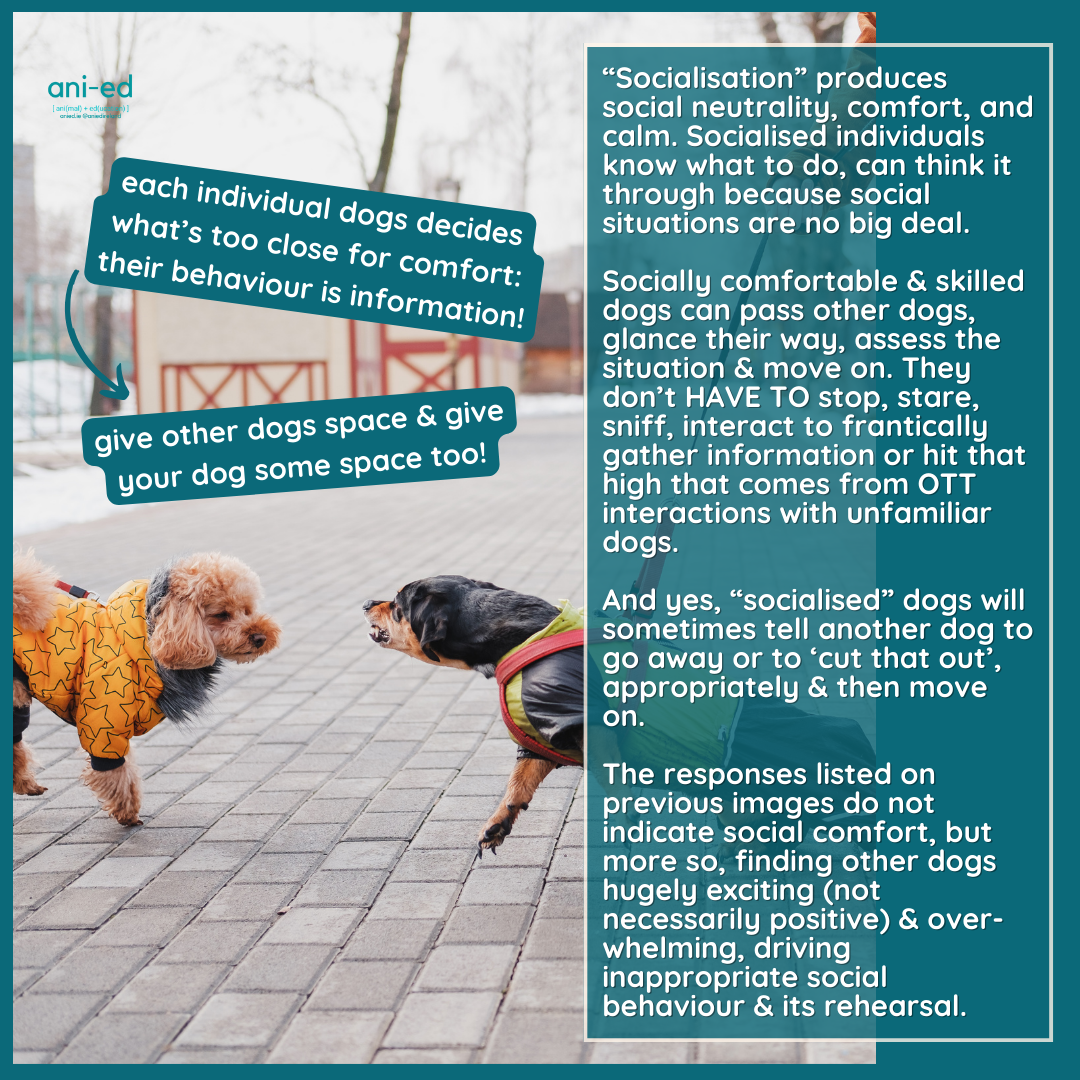
(AniEd is in Ireland and all times are in IST.)
We have six great webinars scheduled for this initial program, with more to come.
Each webinar is 2.5-3 hours long; they are mini-courses really! There will be plenty of time and facility for full participation, questions & discussion.
Slides will be available after each event. It’s recommended that you attend live for most benefit. That’s what these webinars are for!
We are taking deep dives on these topics & will be making careful analyses of the available evidence. This will sometimes challenge your & established practice and we are so thankful for you being open to joining us & confronting our biases.
All professionals, volunteers & dedicated dog lovers are welcome and will benefit from participation. We will explore the complexities of these fascinating topics so be prepared for in-depth coverings & lots of detail.
You can book one at a time or the whole lot! Find out more about this webinar program here and register for your chosen events here.
In not a lot of time, the lives of dogs have changed dramatically. As have our lives. Dogs’ and humans’ lives are intertwined so when we become more sedentary and less outdoorsy so too do our dogs.
Never fear! The pet-product industry has us covered!
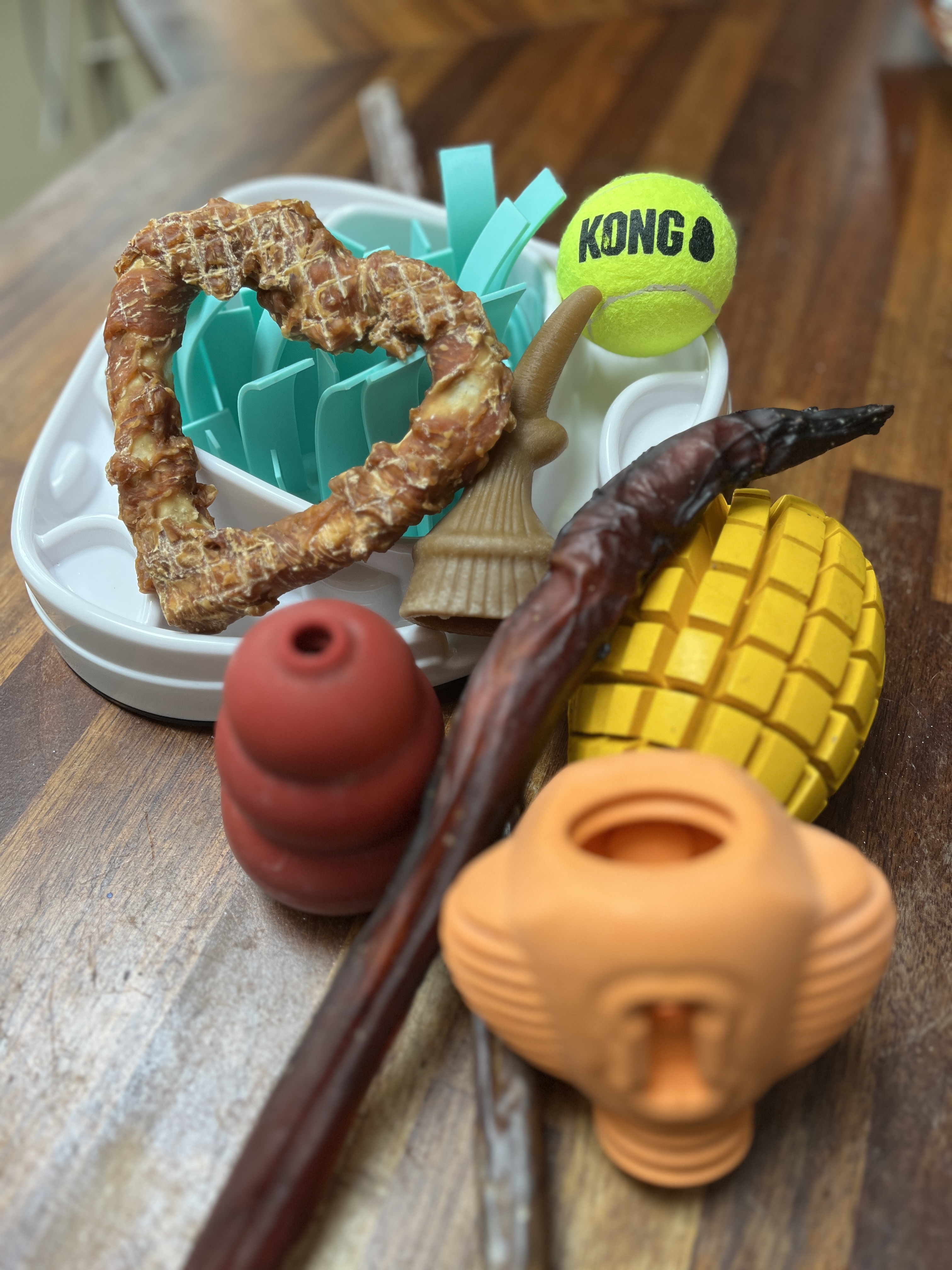
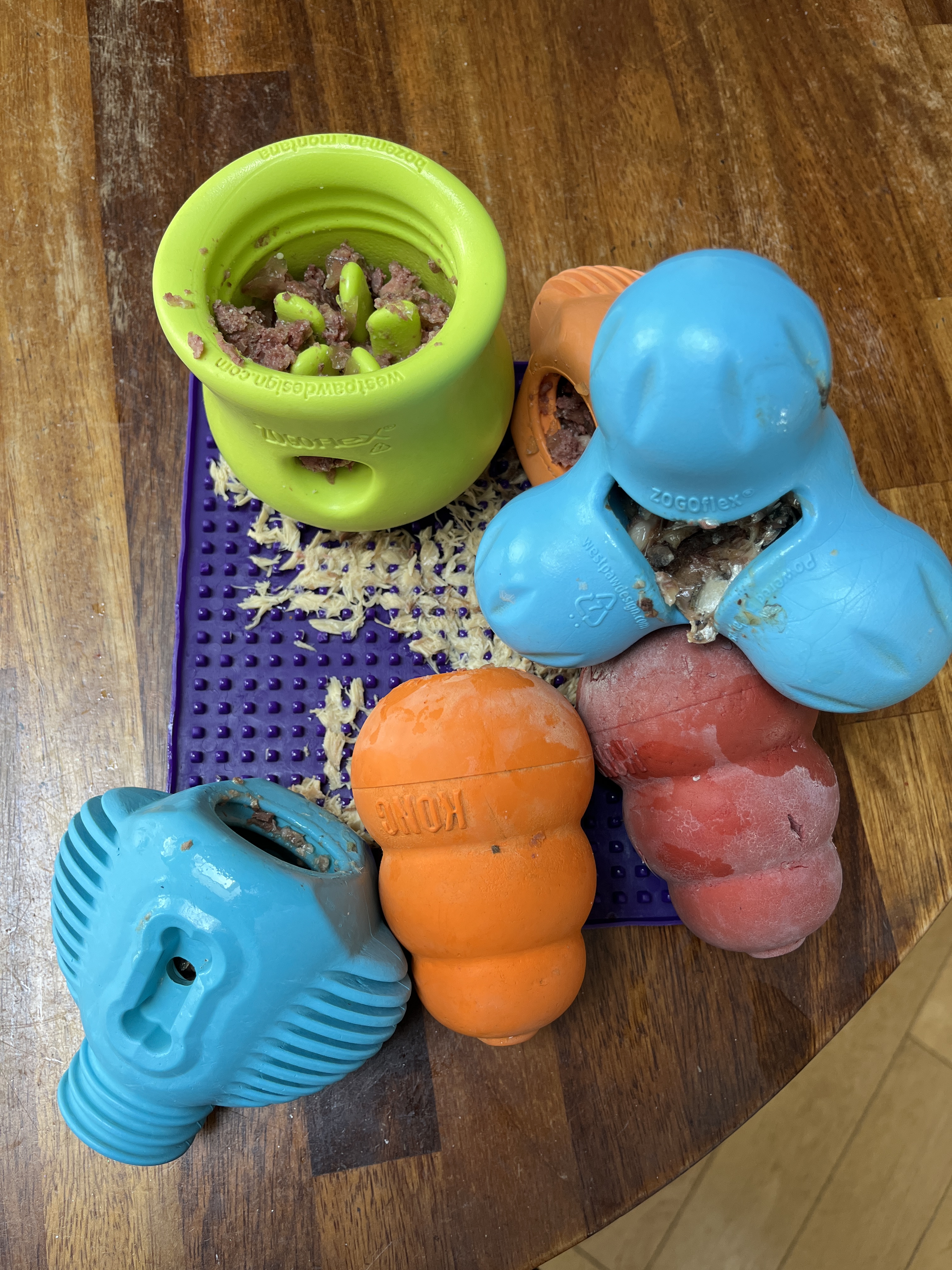
To make up those deficits, so-called “enrichment toys” of every weird and wonderful shape, colour and design have been marketed.
I’m being cynical, of course, but only just. I love food toys, I have so many (I have a serious dog toy buying problem) and I give them to my dog every day.
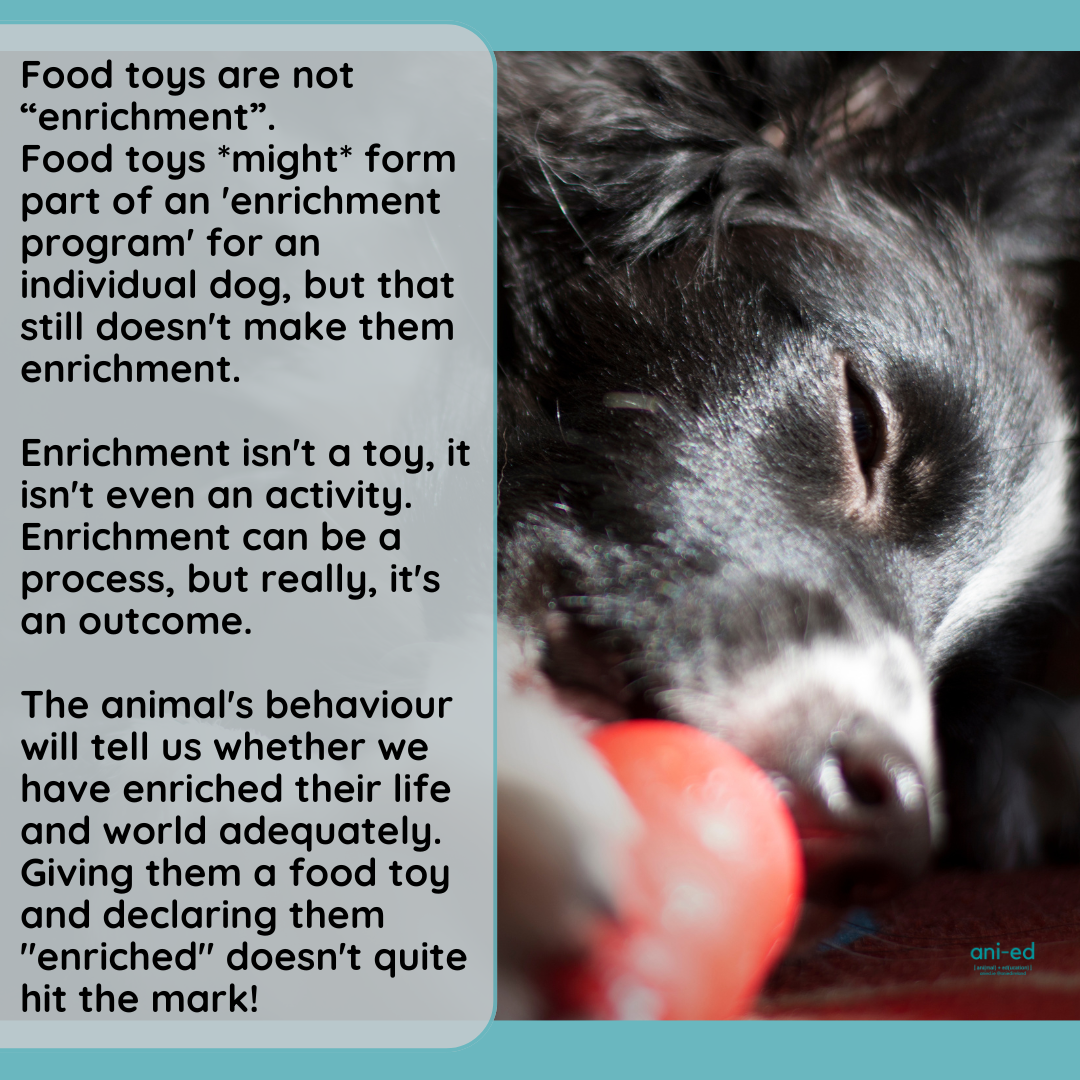
BUT! Food toys are not “enrichment”.
Food toys *might* form part of an ‘enrichment program’ for an individual dog, but that still doesn’t make them enrichment.
(This is another long one, over 2000 words, so take 10-15 minutes to digest it all… The social media images throughout this piece provide the summary.)
Enrichment must be enriching!
Enrichment isn’t a toy, it isn’t even an activity. Enrichment can be a process, but really, it’s an outcome.
While ‘enrichment’ is defined in different ways, it can be considered additions or modifications made to an animal’s environment that lead to measurable improvements in behavioural/physiological welfare (Fernandez 2022).
The important bit here is the measurable improvements bit. The animal’s behaviour will tell us whether we have enriched their life and world adequately.
Giving them a food toy and declaring them “enriched” doesn’t quite hit the mark!
Ask the dogs!
While research on enriching the lives and worlds of captive live animals in zoos and collections is relatively common, research in dogs is far more sparse. Zoos are really where enrichment originally started, after all. (See the wonderful works of Hal Markowitz.)
Most works looking at the addition of food toys have focused on lab dogs (Schipper, et al., 2008) and shelter dogs (Herron, et al., 2014) (Sampalo, et al., 2019) (Wells 2004). Dogs who, sadly, are living in pretty under-enriched environments and who might greatly benefit from the addition of the most basic elements to add some novelty to their days.
Many of these works report increased activity, increased rest, and improved kennel presentation (e.g., less barking, sitting or lying, less jumping etc.) (Perry, et al., 2020), with food-toys being the most commonly implemented intervention (Miller & Zawistowski 2012).
Hunt, et al., 2022, conducted a pilot study looking at enrichment for a small population of guide-dogs-in-training in an office environment. This might be somewhat comparable to companion dogs in homes…maybe?
They measured specific behavioural outcomes after the dogs had engaged in different enrichment activities and found that different enrichment activities had different effects on the individuals’ behaviour.
Food toys were found to be the least impactful on the dogs’ behaviour scores. Dogs were observed for 15 minutes before and after each enrichment intervention, with increases in relaxation behaviours and decreases in alert and stress behaviours noted.
However, the food toys were removed once the food was finished to prevent chewing the toy. Might this have limited the benefits of food toys? The food toys were also the only intervention given in the dogs’ pens rather than in a specific room associated with all sorts of other fun. There are also some methodological issues largely excused due to this being a pilot.
Gaines, et al., 2008, also found that the addition of food toys didn’t really impact the behaviours of military dogs in training.
Perhaps dogs who are already engaged in pretty exciting activities, who have ready contact with humans or other dogs and lots of exercise, don’t show extra benefits to the addition of food toys.
What about regular companion dogs?
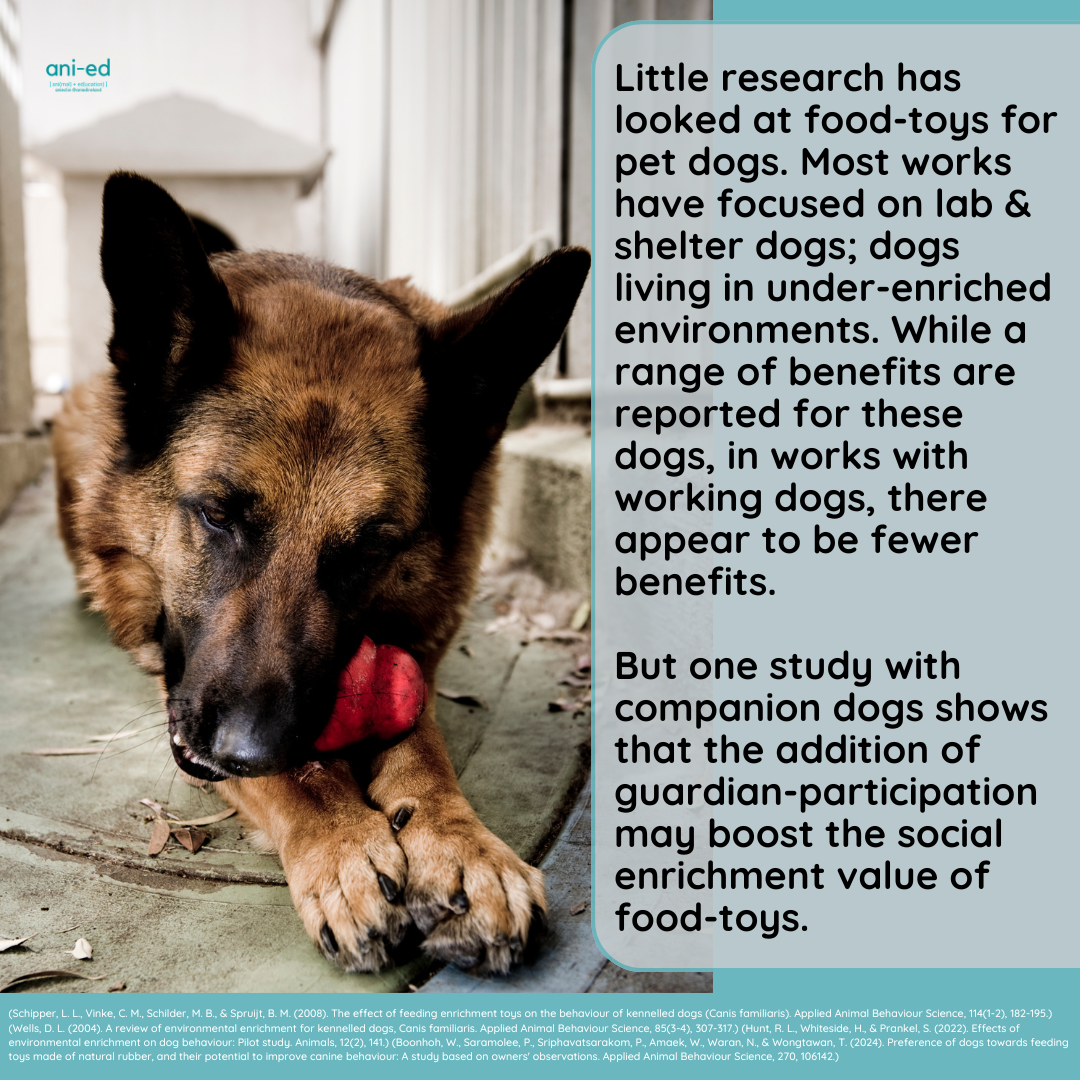
Boonhoh, et al., 2024, developed a couple of food-toys to give to dogs and had participating guardians complete the Thai-version of C-BARQ before providing the toys and after a month’s use of the toys. While they report that there were improvements in the dogs’ behaviour, particularly in excitability-reduction, there are some problems with this study.
About a third of participants didn’t complete the work and this is level of drop-outs is associated with increased risk of bias (and possibly an indication of lack of effectiveness or poor applicability) and there were no control conditions explored. Guardians taking part in research to see how a toy might support behavioural improvements may have a bias toward seeing and recording improvements observed.
When the dogs were given the toys, guardians stayed with them, and that teamwork might enhance benefits associated with toy use providing social enrichment elements.
No one study is perfect, or confirmation of anything, but there are some interesting bits here. There is some analysis of the sorts of the behaviours the dogs engaged in with the toys and this is a great start in exploring the applications of different and combine interventions with companions.
The colour and scent of toys may also impact dogs’ preferences with some suggestions that blue or yellow toys are preferred (not clear between existing works) and vanilla scented over beef scented is a winner too.
Maybe food toys do provide enrichment for companion dogs, but perhaps lots of extra attention and interaction with their humans, during foraging activities, is the key to enriching their world.
What is enriching about enrichment?
Wells 2004, discusses the differences between animate and inanimate enrichment. Animate enrichment involves provision for social contact, while inanimate interventions involve environmental adjustments and additions, including food toys.
Social contact, communications and interactions likely provide the most benefits, enriching the lives and worlds of social animals like dogs. While dogs living in labs or shelters are probably lacking in access to social interactions with people, appropriate pair and group housing has been found to provide increased benefits, enriching the lives and worlds of many of these dogs (Hecker, et al., 2024) (Grigg, et al., 2017).
Animate enrichment provides immediate and ongoing social feedback for the dog. This facilitates dynamic changes, adaptations and adjustments for the animals involved and ticks many enrichment-category boxes all in one go, including cognitive, social and sensory outlets.
Fernandez 2022, argues that enrichment should be considered a contingency, an interaction between the dog’s response and some environmental stimulation. Creating dynamic contingencies might be the key to providing dogs with enriched worlds and lives.
Foraging is more than eating!
Fernandez, 2021, conducted a number of experiments with captive Polar Bears to find the best reinforcement schedule (how and when reinforcers are presented) to reduce pacing behaviour.
They found that providing smaller meals and food scents on response-independent schedules, encouraging more appetitive behaviours relative to consummatory behaviours, reduced pacing.
It’s difficult to provide foraging related outlets to captive animals within ethical and welfare frameworks. Providing live prey for Polar Bears to track and stalk is just not acceptable and not possible.
Reducing the predictable-routine delivery of meals reduces pacing (Wagman et al, 2018). This is important for pet dogs too. Don’t feed your dog according to the clock; predictability and routine are not the same!
What time is dinner?
Have you noticed your dog becoming more agitated as the clock ticks toward dinner time? Just like the Polar Bears, your dog might start to show increased locomotory, social, and even vocalising behaviours in anticipation of dinner time.
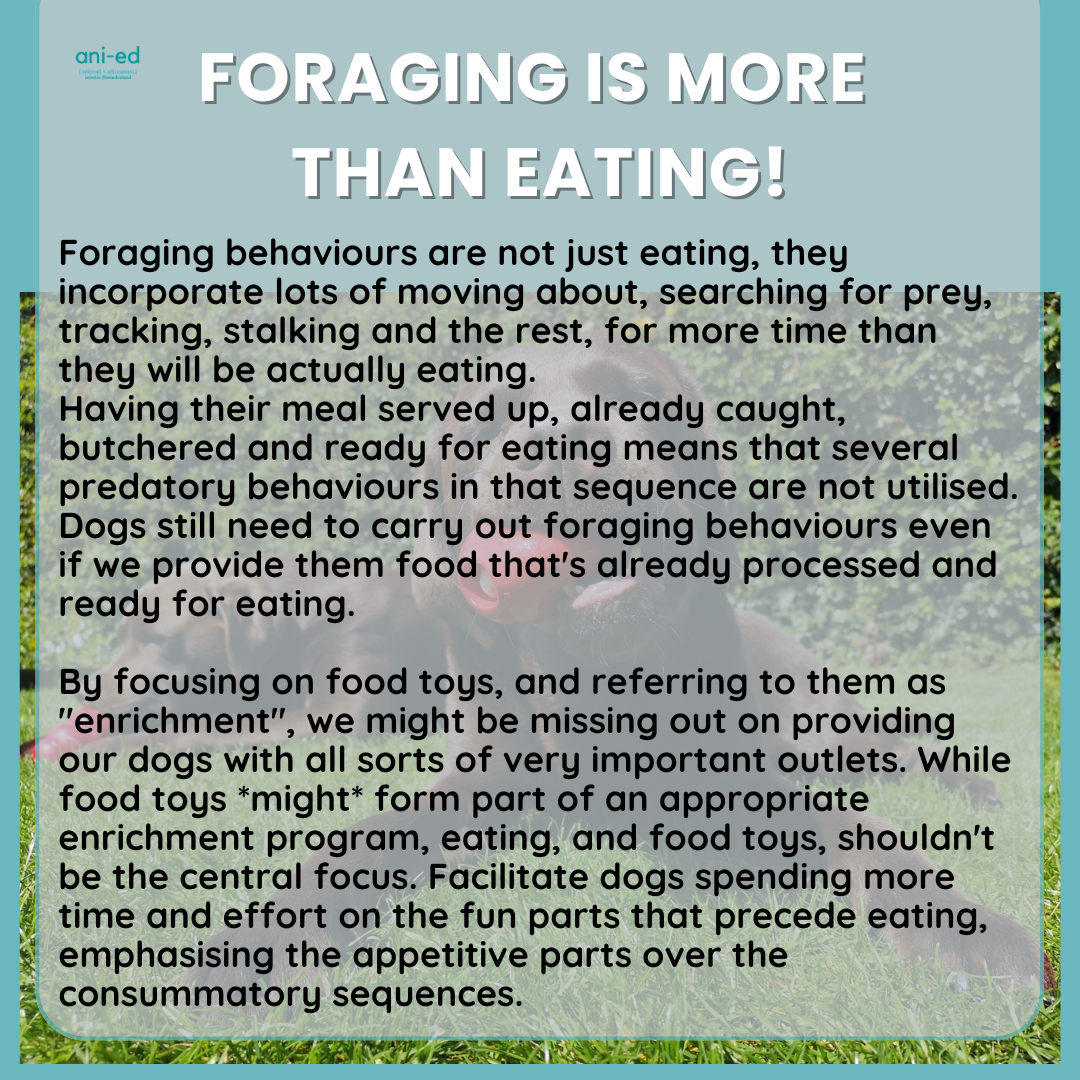
Think of the Polar Bears pacing in anticipation… Foraging behaviours are not just eating, they incorporate lots of moving about, searching for prey, tracking, stalking and the rest, for more time than they will be actually eating. Having their meal served up, already caught, butchered and ready for eating means that several predatory behaviours in that sequence are not utilised.
And here’s a core concept of ‘enrichment’: animals still need to carry out those behaviours, even if the goals are provided. Polar Bears and dogs still need to carry out foraging behaviours even if we provide them food that’s already processed and ready for eating.
While dogs certainly show a range of foraging behaviours, often illustrated in a ‘predatory sequence’, they have evolved from scavengers and selective breeding has exaggerated and inhibited various foraging behaviours, particularly predatory behaviours. We have often selected against some consummatory behaviours, namely eating the quarry, because dogs were hunting for us!
Now consider the most commonly applied “enrichment” intervention for pet dogs…food toys! By focusing on food toys, and referring to them as “enrichment”, we might be missing out on providing our dogs with all sorts of very important outlets.
While food toys *might* form part of an appropriate enrichment program, they probably don’t need to be central.
Cora-Avila, et al., 2022, concludes that, “animals should experience sufficient amount of “wanting” before they experience “liking”.” Our enrichment programs should provide more opportunities for appetitive behaviours, e.g., searching, stalking, tracking, chasing behaviours, relative to consummatory behaviours, e.g. catching, killing, eating behaviours. Eating shouldn’t be the central focus, with dogs spending more time and effort on the fun parts that precede eating.
Enrichment must make sense…
What behaviours is your dog doing when engaging with food toys? (Indeed, the first question to ask is, is the dog engaging with food toys?!)
How does having outlets for those behaviours help your dog?
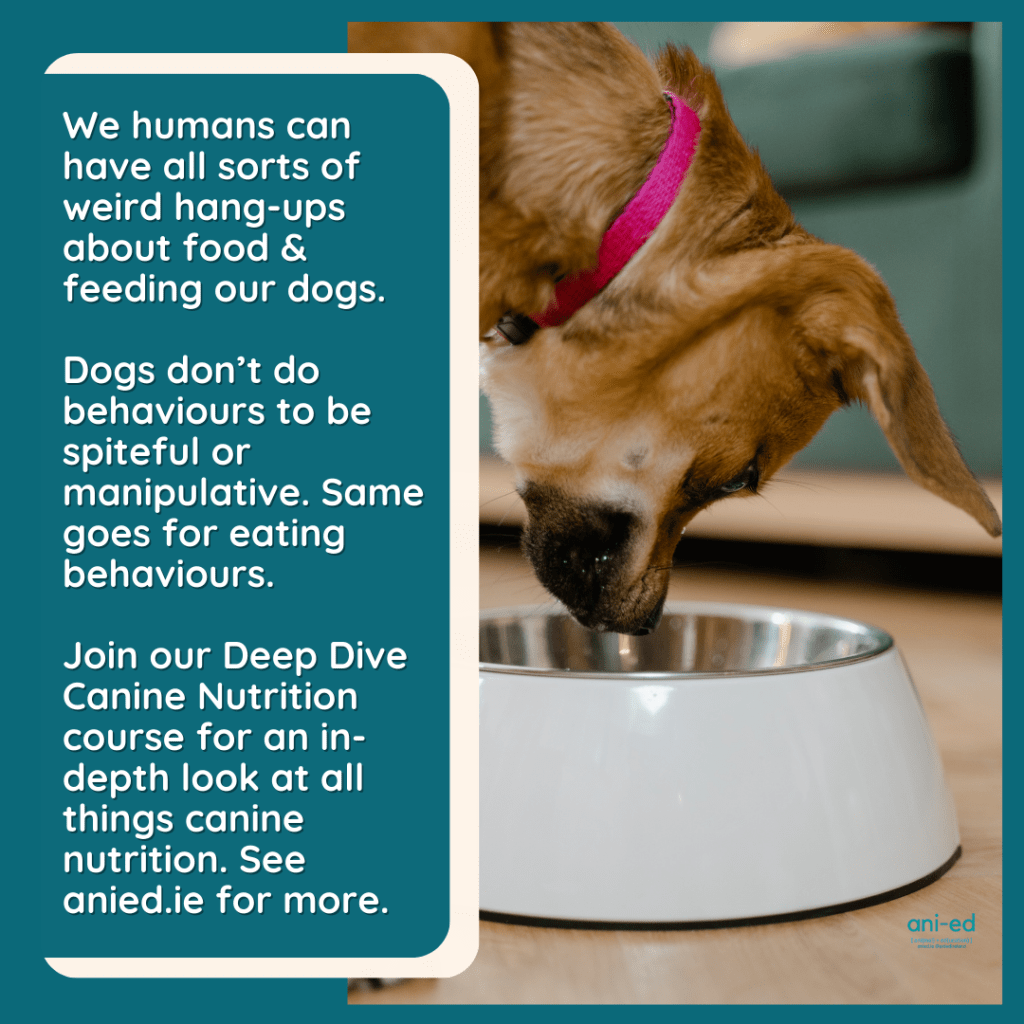
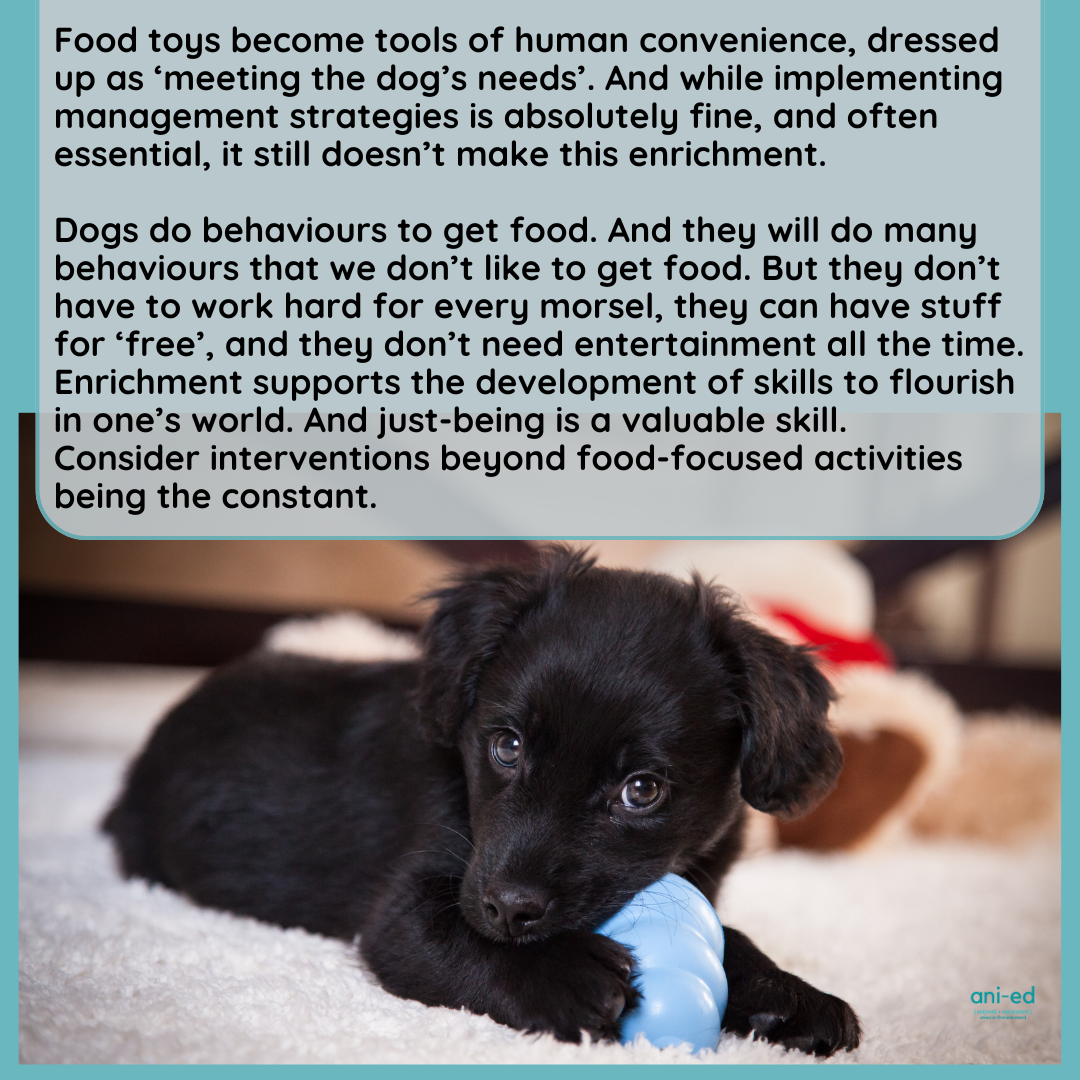
These toys are so often promoted for human convenience, to manage unwanted canine behaviours, and to entertain dogs for lengthy durations. And while that can certainly be useful, it’s not necessarily going to be enriching.
Behaviours function for food
Dogs do behaviours that get them food. No doubt.
There might even be some evidence that some animals, including dogs, may choose to do more behaviours to get food (“work” for food), when food is available for ‘free’. This is referred to as contrafreeloading. (Rothkoff, et al,. 2024)
But most dogs are pretty enthusiastic about doing things to get food. Lots of times, they’re doing things we don’t want them to do…but dogs will enrich their own lives and worlds if we don’t do it for them.
There is so much individual variation when we talk enrichment and behaviour (Grigg, et al., 2017) that there is no prescribed recipe. Plus variation might just be the spice of enrichment too.
Your dog can get food, and anything else they enjoy, for “free”. That’s ok too. You can have fun with food, you can use food toys, you can just chuck their food all over the place to find. Mix it up and provide them with ways to fit plenty of appetitive behaviours in there too.
And make sure your dog is getting food they enjoy. That’s enriching too.
Part of providing an enriched world and life for them means we are doing lots of things that don’t involve food too, and aren’t necessarily food directed behaviours.
Dogs don’t need to be entertained all the time. An enriched life involves lots of ‘rest & digest’, lots of down time and, dare I say it, plenty of boredom. Boredom is often aversive so animals will behave to resist its effectts (Burn 2017), but is likely to be part of the companion dog’s life. What are the behaviours we can teach dogs to help them to cope with boredom? Just being can be enriching too.
We can certainly facilitate this by providing physical exercise and even using food toys to promote settling, but it comes down to teaching. To setting up those contingencies.
Focus on Flourishing
We enrich our dogs’ lives and worlds by providing them with access to the conditions under which they can carry out reinforcing behaviours.
Dogs live in our world which is designed to enrich the lives of humans. And when dogs do behaviours, in our human worlds, to disrupt that, we get angry, we further restrict their lives, we reprimand and label.
But in our efforts to promote enrichment, we use popular euphemisms. Yes, enrichment is great, it’s required, but the term has lost meaning such is its popularity. Related concepts like “choice”, and “meeting needs”, are so revered and shared that I’m not sure we have shared meanings any more.
Enrichment must make sense. And it must make sense to the individual:
must be important and salient to the individual
alternative behaviours must make sense
it’s not just novelty & varitey
it’s not just distraction & entertainment
Providing random choices may not be good enough, declaring their lives enriched because we’ve providing “choices” and food toys is not sufficient.
Choices must be meaningful, and the behaviour options available must be adaptive and accommodate species needs.
Enrichment increases predictability and controlability by teaching dogs the skills they need to live successfully in their/our worlds. By facilitating the development of behaviours that focus on flourishing.
What behaviours would the dog be doing if there were no barriers? What behaviours would the dog be doing if they weren’t doing unsafe, unwanted, unacceptable? What’s your dog seeking by doing unwanted behaviours? How do those behaviours function?
Your dog is already telling you how best to enrich their lives and worlds. Their behaviour is information.
Want help understanding how to enrich your dog’s life and world? Start with 100 Days of Enrichment – always free and available, plus there’s a new update coming soon! Get in touch with AniEd at any time to discuss how best to really enrich your dog’s life and world: info@anied.ie
When we work from a functional perspective, taking a constructional approach, stopping behaviour is not the goal, and not really part of our teaching journey. Even when we don’t like that behaviour.
Instead we build behaviours (constructional) that provide our learner with access to the same outlets they seek with ‘unwanted’ behaviours. These new behaviours become more efficiently reinforcing so those other behaviours are less attractive.
Behaviour works!
Animals do behaviours that work for them, that lead to them accessing reinforcers; outlets satisfying their behavioural needs. Our animal learners tell us about these needs through their responses.
We tend to categorise behaviour via our human-lens, as good or bad, as being acceptable or unacceptable in human society.
But behaviour is just behaviour. And your dog has already chosen preferred outlets for their behaviours; what they’re doing works for them.
Try as we might, humans coming along and telling dogs that they need to change their ways and do behaviours for these tantalising treats instead may not be good teaching or even good welfare.
Our dogs are already telling us about their needs…we just need to listen.
Don’t stop!
Our cultural approach to unwanted behaviour is to stop it; we live in a punishment based society, after all.
But behaviour works! And that’s why I emphasise that behaviour is information. Our dogs’ behaviour is telling us what they need so it’s not really up to me to decide that this individual doesn’t get outlets for those needs.
There are still behaviours that we can’t allow our dogs to engage in exactly as they may like, however. Behaviours that are unsafe, unacceptable or inappropriate will require redirection.
(Indeed, there is an argument for not getting dogs who are likely to show behaviours relating to needs for which outlets we are not able or willing to provide.)
Don’t chase that. Chase this.
Think about the situations that get your dog all riled up… What is your dog anticipating that gets them excited? What are they preparing for? That means we must also ask, what they getting out of that interaction?
Getting all wound up helps the body and brain prepare for the challenges ahead. These are stress responses that get the body ready for social interactions, ready for physical exertion, ready for behavioural challenges.
Instead of allowing the dog engage in behaviour that may be inappropriate and unsafe to hit those highs, I want them to get their jollies through engagement with their human.
In this clip, I’m using a herd of deer as an example.
Working through these stages allows you to teach your dog that the stress-cue (e.g., deer) are a cue or signal to engage. Initially engagement cues their human to provide an outlet for movement, for release, for fun, for crazy.
Instead of inhibiting the crazy, harness it and become the source.
Working through these stages at different distances and under different conditions can lead to engagement cue by these so-called triggers, but also allows your dog to engage in behaviours they choose.
You can build these stages into any part of the sequence of behaviours. For example, how far into the sequence of approaching other dogs or chasing deer will you work through before that cues engagement with you. All the time bearing in mind how your dog’s behaviour may impact others…
Improving engagement, particularly cued by environmental goings on, is most often part of our goal, but we can continue to build real neutrality (as opposed to the effects of intimidation, restriction/restraint and/or fear) in response to these triggers.
Here’s Decker pottering through these deer during another outing:
Note the lack of tension on the line, his ability to potter about, and loose, pretty relaxed body movements. This is built through a foundation in engagement and making sure that his needs are so abundantly met.
Focus on Flourishing
Decker has always been a chaser. He has also killed numerous small rodents, including rats, mice and squirrels in the wild. He doesn’t consume and doesn’t do a lot of stalking of real prey animals.
The first time he encountered deer in this same park, when he was just over one year of age, he was pretty excited, interested and weirded-out…all at the same time!
Not only do we work tirelessly on engagement, but also making sure that he has so many other outlets for predatory behaviours, social behaviours and ways in which he can control what happens to him. Across many contexts.
I don’t work with stopping his behaviour in mind. I provide outlets for his behavioural needs and he chooses the fun!
With our ready access to the information superhighway and more efficient access to the world’s ears at our fingertips, getting the right information out there shouldn’t feel so challenging. But communication, online particularly, is fraught with complexities.
Current trends emphasise the sharing of short form, quick fire, snazzy bites, simplified for rapid assimilation until we scroll on until the next bite.
Indeed it has been, in some quarters, considered helpful to provide short form education to trainers and emphasise the simplicity of reward-based training to recruit more to “our side”. And that’s certainly coming back to bite us in the a**.
Dumbing down behaviour information doesn’t sit well with me. I will admit I am not a fan of the proliferation of shorts and reels, particularly those consisting of to-camera talking. They make me scroll on and fast.
But the use of shaming and blaming to facilitate behaviour change, particularly directed at guardians, is inexcusable.
The internet makes shaming easier, more efficient and impactful, fueled by anonymity and by rousing community support. One online community decides what’s acceptable and another opposes…and round and round we go. These attacks may suit the orgnaisation or government institution that originated the tension.
Blame culture
Attempting to shame and guilt people into behaviour change may not be effective, particularly where they may already experience negative emotions. Indeed, further shaming and guilting can lead to the exact opposite outcomes to those intended. (Agrawal & Duhachek 2010)
Indeed shamers often don’t believe their behaviour contributes to blame and shame (Muir et al, 2023). I truly believe that most are doing so because they want to make a positive difference and care deeply for their cause.
When it comes to canine welfare, and the well-being of their people, there are copious examples of the failure of our messaging and the reliance on shaming and blaming. But this piece is already almost 2500 words so I’ve just discussed two…
My relationship with social media.
The Brachycephalic Dog Paradox
Classifying dogs as brachycephalic refers to head shape and proportions. Round faces, high foreheads and forward-facing, round eyes likely appeal to humans due to our care-seeking tendencies directed toward “cute” and infant-like features (Lorenz 1943) And as humans we have selected for these features, in our dogs (and other animal companions), that satisfy this ‘cute-effect’. (Paul, et al, 2023)
Extreme Communications
While some degree of brachycephaly may have been functional for breeds of dogs doing some historic jobs, exaggerating these features is associated with a range of diseases, disorders and welfare challenges. (e.g., O’Neill, et al, 2015 & Packer, et al, 2015 & O’Neill, et al, 2019)
These dogs have been labelled as “extreme” brachycephalic dogs, usually directed toward the most popular, French Bulldogs, Pugs and English Bulldogs. While BOAS testing for breeding dogs is being rolled out in Ireland (e.g., here), it’s difficult to find what exactly defines “extreme”. There appears to be circular explanations for the term’s use, one paper applying it because another paper did (e.g., Ekenstedt et al, 2020, & explanation of its use here)
This is an inflammatory word, and perhaps, that’s the intention of its use. We have a cephalic index (e.g., illustration in Bognar, et al, 2021) but this system may be inadequate in encompassing the features that contribute to health and welfare concerns and describe the variations across domestic dogs (see below).
Inflammatory language is designed to convey a particular and strong position through the generation of ’emotional’ responses.
These same texts exclaim disbelief that, despite well publicised health issues associated with “extreme” bracephaly, the labelled breeds become more and more popular. (Paul, et al, 2023) (Packer et al, 2019)
This “paradox” has been further explored by Packer, et al, 2019, revealing “extremely strong” relationships between brachycephalic dogs and their humans.
Cognitive dissonance processes are concluded to be behind believing that one’s own dog’s health is fine versus the health of others of the breed. Difficulty breathing and other conformational problems have become normalised and as breed traits, sometimes, even considered “cute”. (Rohdin, et al, 2018) (Packer, et al, 2012) For example, I regularly see videos and photos of bulldogs resting with their heads propped up, with their tongues out or sleeping while holding a toy in their mouths. (Niinikoski, et al, 2023) For sure this might create an adorable picture but on the flip side is likely due to difficulties with breathing when resting. Not so adorable at all.
Might these perceptual errors increase and intensify the emotional attachment felt toward one’s own dog? What’s the best way to approach cognitive dissonance and distortions? What’s the best way to appeal to the love and relationships people have for their dogs? I don’t think we have these answers yet, but this is worth consideration before we shame and blame.
Selecting for many conformational features, and deformities, in dogs leads to compromises to their welfare. (Packer & Tivers, 2015) Closed gene pools (and unwillingness to outcross) and selection of popular sires are making breeding our way out of these problems more challenging. A BOAS assessment compromising largely of a 3-minute activity test certainly makes it seem like “responsible” breeders are doing something, but is that really going to make the widespread and multi-level changes that are required?
I cringe when I see open discussions, usually online and via social media, demonising people’s choices, making accusations and blaming and shaming. Given the continued and growing popularity of these dogs, perhaps our messaging isn’t doing what’s intended. And that means we might need to change our approach…
Monday 22th April 2024; Heather Humphreys, Minister for Social Protection and Minister for Rural and Community Development, with John Twomey, Chair of the Dog Control Stakeholder Group, mark the start of a major advertising campaign on ‘responsible dog ownership’, Picture credit: Damien Eagers / Julien Behal
The Department has gone to great lengths to develop working groups on dog control and on companion animal welfare. The former has produced a report outlining their recommendations largely prioritising legal instruments and legislative approaches. While the latter have recommended against the use of brachycephalic dogs in advertisements, banned the importation of cropped dogs unless specific documentation/licensing criteria are met, and most recently, pushed for the banning of ‘shock collars’ but under very specific conditions (not for dogs already using them and only hand-help remote devices). Apparently a database will be established of all those already using these collars and that will somehow be enforced.
This latest campaign aims to remind owners of their legal responsibilities and is built upon a slogan: “If your dog attacks a child, it’s not your dog’s fault. It’s yours.“. The focus, so far, is on increasing fines, investing some money in dog pounds, and the formation of the working group.
What does “responsible dog ownership” mean anyway?
When we are shocked by a dog “attack” that’s reported, when we are disgusted by dog poop that’s not scooped, when we’re annoyed by barking dogs, and when we are shocked by cruelty, we call on “responsible” ownership to fix it all. Just be responsible….right?! If that’s all that’s required, why is it so hard to improve safety and welfare?
With our companion dogs becoming more and more a part of our human worlds, increasing controls and regulations are implemented. Guardians are viewed as having moral obligations and legal requirements in keeping their pets.
But here’s the problem…we don’t have a much of an idea of how to be “responsible owners”.
Are we owners?
Some time ago I made a declaration on social media to make efforts to change the language I used in several different professional contexts. I did this for accountability and to seek others’ insight. One of these declarations reviewed my use of the term “owner”, favouring “guardian” instead.
There are long standing arguments about how we identify in terms of our relationships with our animal companions.
He’s my dog and I am his human.
Am I my dog’s owners, as I am my car’s owner? Legally, I am compelled to do various things as evidence of ownership such as holding a dog license and his microchip certificate. In the eyes of the law, I am an owner of this living being as I am the owner of my inanimate car.
He’s certainly my dog, just as I’m sure he views me as his human. But legal ownership doesn’t quite hit the mark in fully representing our relationship. I certainly view our relationship as more than that shared with items of property; for starters, my car is replaceable…my dog is not.
I am his caretaker, responsible for his safety, nurturer of his well-being. And that brings responsibilities extra to the bare minimum required by law.
While waiting for the legalities and societal views to catch up, I’m settling on the term “guardian”, but the implications of this may not be evident just yet.
More than scooping the poop!
Westgarth, et al, 2019, argues that calls for “responsible dog ownership” echoes “civic responsibility”, seeking people to take responsibility for their actions, understand their roles in their communities, and collaborate to promote the welfare of others.
It’s pretty tricky to find discussions of this outside of basic legal requirements of living in society. But humans are somewhat prepared for living in human society by virtue of being humans and being reared within human cultural rituals. Dogs are not…unless their humans make specific efforts to guide them. And therein lies a problem.
Responsibility evolves
As our relationships with our animal companions evolve, integration of some of these species increases, and more culture clashes between humans and non-human animals develop.
While legislative frameworks must scramble to keep up, our understanding of animal behaviour continues to grow. But for dog guardians, and society in general, educational standards regarding canine behaviour and welfare requires improvement.
Dog behaviour is very very rarely unpredictable; dogs behave like dogs every time. It’s our perception of their behaviours that requires updating.
How can we be responsible?
Responsible ownership is a vague concept and commonly supported by statements such as keeping your dog under control (“effectual control” is specified in Irish legislation…) and to “socialise your dog regularly with other dogs” from this guidance. (“Socialise your dog” is another vague and inaccurate concept!)
The application of these concepts is vague and subjective. And to emphasise blame-messaging based on this weak foundation is irresponsible and not helpful. Much like BSL, which firmly places the “fault” on dogs based on phenotypic characteristics, this messaging does little to affect change but sure makes it look like politicians are doing something, are taking a stand, despite evidence of effectiveness and enforcement being sorely lacking. (e.g., according to Karlin Lillington of the Irish Times)
In my discussions with guardians, impressions of responsible ownership often boils down to poop-scooping. Westgarth, et al, 2019, argues that “responsible dog ownership is a construction that emerges at the intersection of the needs of dogs, owners, and society.” Our relationships with dogs are contextual and variable, as are our views of our obligations to them and our responsibilities in ownership.
Before we can attempt to blame and legislate, we must educate and directing that requires an understanding of guardian-perception of responsible human behaviour.
Westgarth, et al, 2019, concludes “that what appears to be factual descriptions of responsible dog ownership practices that should be easy to follow are, in reality, a complex interplay of beliefs grounded in issues of ethical practice; perceived best interests of the dog; and the nature of the social relationship with the dog. Responsible dog ownership means different things to different people at different times.”
How do we change minds? Well, we don’t.
Think back to the heights of the Pandemic and the controversies and discomfort generated toward daily and weekly updates from the science teams. While it’s normal in science for our approaches to change based on new and emerging evidence, this might seem like a fault in our work to outsiders.
Trying to change others’ minds with facts, data and information is not terribly effective. Considering information that doesn’t confirm our biases is rejected and rejigged by our protective cognitive systems which filter out these inconvenient truths, these ‘alternative’ facts’.
Challenging our own beliefs is uncomfortable and requires much awareness and practice. We can help ourselves and guardians understand that our previous position was based on what we knew then, and that we can update our thinking and our position based on what we understand now. Instead of shaming and blaming, give ourselves, give them, an out.
Our beliefs are intertwined with our identity and particularly when it comes to those we care about, like our pets, of course we will take any challenge defensively.
How can we empathise with guardians to understand what they are really concerned about? What happens if they accept that their behaviour has led to their dog suffering or to their dog’s behaviour being unsafe? How can we help them acknowledge this, accept this, and activate solutions?
They are not wrong, no more than I am right. Right/wrong black/white is not an achievement. Another problem with us seeking out community online is that we are existing in that echo chamber.
Scrutinise that which satisfies your biases more closely. Challenge your own beliefs, no matter how strongly you believe.
Goal-Sharing
Looking at some interesting qualitative and ethnographic works on dog guardianship shows that multi-level interventions aimed at addressing a number of factors may be most effective. (Westgarth, et al, 2017)
For there to be progress regarding both examples here, we first acknowledge the care and love that guardians have for their dogs, rather than ‘othering’ and villainising them. Guardians want to understand their dogs’ needs but will need guidance and support in applying their developing understanding.
We all care about the outcomes for our dogs’ health and welfare.
Multi-factorial elements must be considered and applied. Shame and blame are unnecessary, ineffective and short-sighted.
While it’s believed, and heavily marketed, that having dogs is overwhelmingly beneficial for humans, the evidence is mixed at best. However, there are many challenges to caring for and loving dogs. (Owczarczak-Garstecka, et al, 2021)
Guardians require social support, practical guidance and empathy to maintain their dog’s welfare and for their relationship with their dogs to be mutually beneficial. (Merkouri, et al, 2022) Let’s start there.
(This went longer and longer than I expected. At about 12500 words this will be at least a 10 minute read. The images shared on our socials, and here, provide a slimmed down summary.)
While I’ve written a lot about this and adjacent topics a lot, I talk with other guardians about it more and more. Off-leash, out-of-control dogs have become a scourge in public places and while this issue was relevant pre-pandemic, during and since COVID-19, it’s really exploded as a very serious and dangerous trend.
We are a society still reeling from a generation-defining experience, and likely won’t fully understand the implications for years and perhaps decades.
And the Pandemic led to an increase in the dog population, that hasn’t always been beneficial to dogs. Because dogs were viewed beacons of hope and defenders against loneliness, there were cultural changes in how dogs are viewed and kept.
Bringing our dogs out and about during those lockdown days, months and years, presented so many difficulties. Lots of on-leash and suburban sniffs, along with everyone else doing the same, meant that dogs’ behaviour was being shaped, much like our own experiences under restrictions. We wrote about those challenges at the time: A Good Walk Spoiled.
While pandemic and lockdown conditions certainly presented lots of challenges to supporting our dogs’ behavioural development and support, many of those challenges were perceived as problematic because of a warped understanding of “socialisation”. (Example here.)
Sun’s out
I notice that each year when the clocks spring forward at the end of March, there is an explosion of off-leash dogs and an increase in incidents involving off-leash dogs. Writing this in the middle of April, I have had two client dogs, and one foster dog, injured by off-leash dogs who ran up to these dogs while they were on lead and engaged with their humans. All of these dogs required veterinary treatment after these interactions and we won’t know yet the behavioural implications.
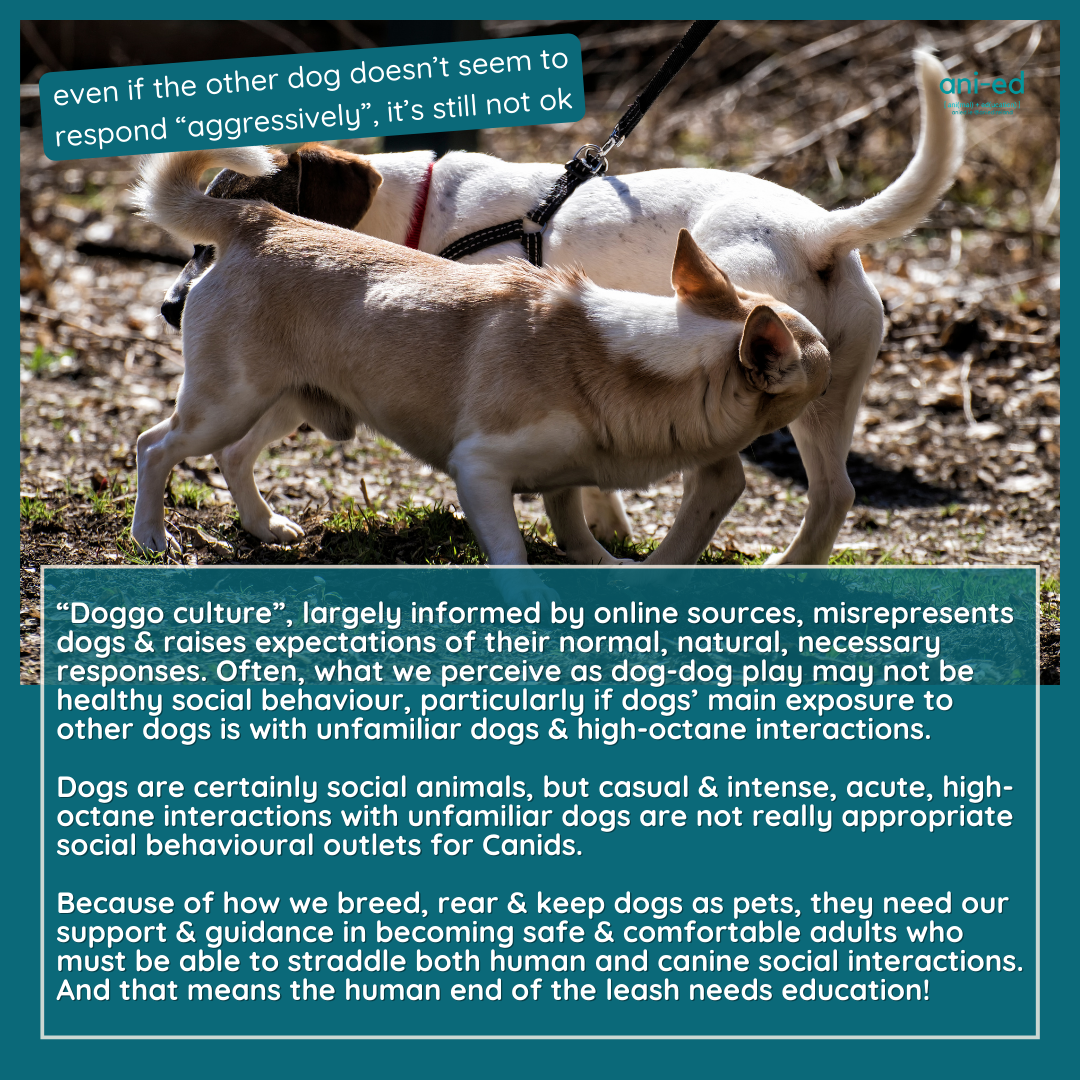
Regardless of how “doggos” are portrayed on social media, dogs are not benign animals. Normal dogs have complex social lives and they display social stress in multi-dimensional ways. To respect and love dogs, we must recognise that.
It’s not safe for your dog or for other dogs to approach and interact with dogs unfamiliar to them or you.
Other dogs exist. And that’s none of my business.
We play a cruel trick on companion dogs. We ask so much of them, to straddle (at least) two complex social orders, at the same time keeping them in environments suitable for humans, that facilitates human behavioural development and health. Companion dogs often live in social isolation, in under-enriched worlds, and we expect them to like it.
In our attempts to compensate, we provide acute, intense and often inappropriate social and environmental enrichment.
Not only are increased expectations thrust upon dogs, but also guardians. Social media “doggo” culture is not kind to either end of the leash.
Guardians require guidance to understand how to support their dogs, and help them develop appropriate social skills.
The pressure on guardians and their companions to have dogs who love everyone, who are tolerant of all types of social interaction, who can go to all sorts of “dog friendly” (or what we often consider dog-unfriendly) places and events. And that their dogs will enjoy every second.
Let’s reframe and develop a new mantra:
I will support my dog in developing friendships & learning that other dogs exist. I will prioritise supporting my dog through appropriate environmental management to maintain my dog’s comfort in social contexts.”
Our goals are to help our dogs live successfully and comfortably in our human world. That’s no mean feat! Dogs must be able to cope with all sorts of experiences that even humans can find challenging.
What’s more, we have a limited time during which we can safely and effectively prepare dogs for all this human-world nonsense. We ask dogs to develop social skills to survive and thrive in human and canine social contexts.
What is “socialisation”, anyway?
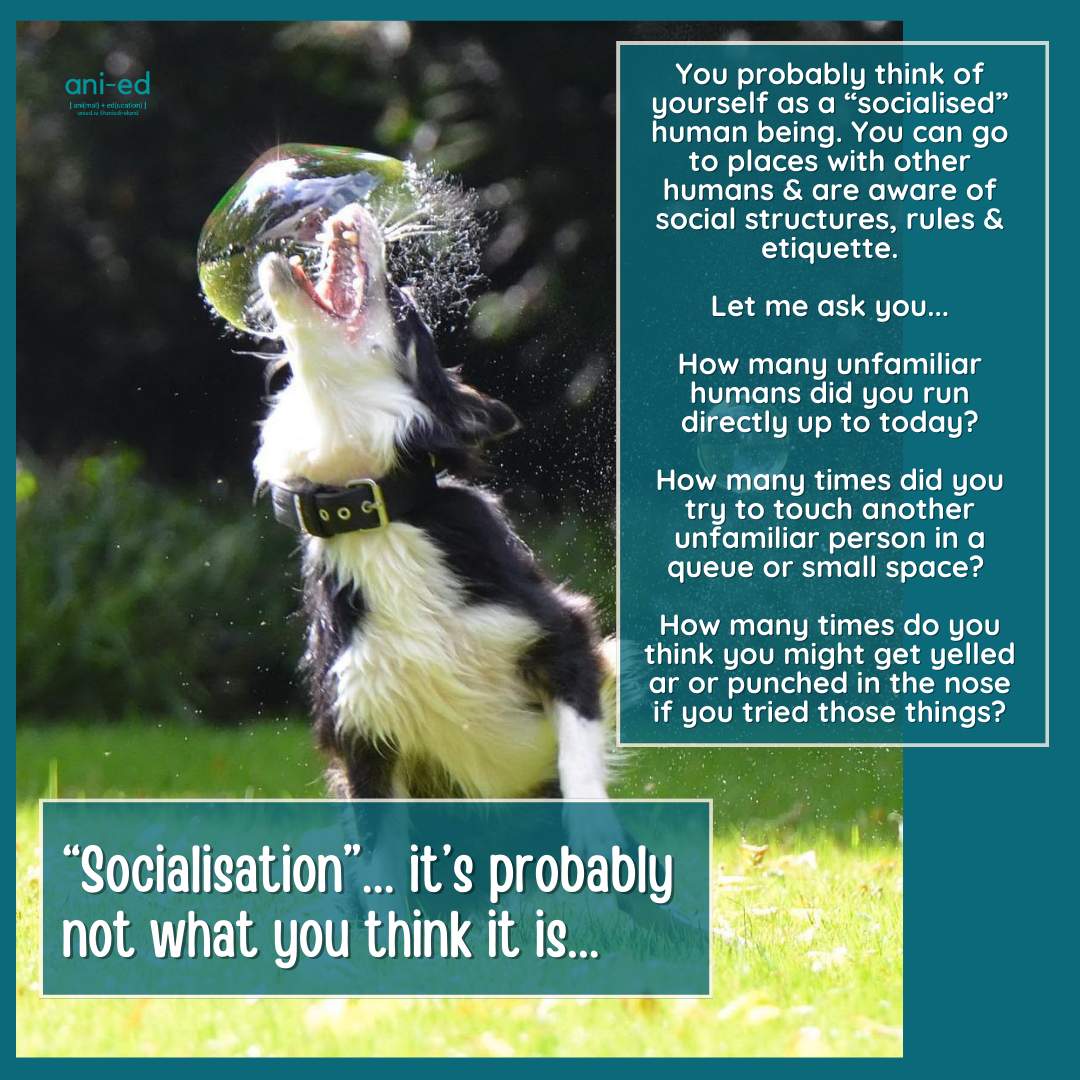
It’s great that people are aware of dogs’ needs for “socialisation”, but this term, in its popularity, has lost meaning. “Socialisation” has become synonymous with puppies and dogs ‘playing’ with others. And that skewed understanding meant that puppies and dogs during the Pandemic missed out because puppy classes weren’t available. But preparing our dogs for life in the human world requires so much more than class and puppy-play, and indeed might not even need those things at all for success.
Learning through play is absolutely valuable for puppies and dogs of all ages but the sorts of behaviours that many people believe to be play should not be our focus and might not be beneficial at all.
But here’s a problem. The use of the term “socialisation” is confused among dog-professionals too so could we expect guardians and non-pros to get it right?
Terminology Tumult
In animal training, as an applied science, terminology is drawn from lots of fields. And to add further confusion, lots of terms are used in every day language differently too.
But we have a problem in our professional and applied field. We don’t have standardised entry routes, educational minimums or well-organised literature from which we can draw consensus on terminology.
“To socialise“, in our everyday uses and understanding, might mean to hang out, to participate in social groups. But “socialisation” in our everyday language, has more specific meanings as a process.
“Socialisation” as a dog-training process
Most of what we understand about socialisation and early rearing needs of puppies stems from classic studies from the 1950/60s, such as Pfaffenberger & Scott, 1959, and Scott & Fuller, 1965.
These works showed us that puppies must have social contact, with other dogs and humans, during their Socialisation Period between 3 weeks and 3 months of age approximately. This period provides a primary socialisation window allowing puppies to form social attachments. If puppies don’t have adequate social exposure in these first months of life, social comfort will be unlikely with later exposure.
During this time, puppies are more likely to interact with novelty (because everything is new!) and their brains are particularly open to learning about how to be a dog and how to interact with humans.
To start with, socialisation happens during these first few months of puppy’s life and is about facilitating the formation of healthy social bonds.
The sorts of experiments designed to identify the limits to developmental periods in puppies required isolation and treatment of puppies and dogs that would not be considered ethical today.
While research has certainly continued looking at this topic, it’s largely been survey and questionnaire based with some validated surveys and independently developed questionnaires. But a common problem in our field is that the literature is relatively small and disjointed; these works have studied early exposure effects in different ways, with different tools, and have described diverse socialisation procedures.
The research we base our understanding of ‘socialisation’ is muddled so it’s no wonder that professionals and pet guardians alike might not always be clear about what it is and how best to do it.
Indeed we don’t really have much valid evidence that confirms most of the procedures we recommend to puppies and their people.
Is “socialisation” for life, and not just for puppies?
In terms of those classic works, socialisation describes a developmental stage early on in puppies’ lives. However, some further works have shown that puppies and dogs must continue to have appropriate social and environmental exposure throughout puppyhood and into adolescence, for example, Serpell & Duffy, 2016.
What is “socialisation” and what does it matter?
Exhaustingly, our field attributes great importance to all sorts of processes and procedures, without a level of valid evidence or clarity to warrant such emphasis.
For sure, puppies and dogs must be reared in enriched environments so that their behavioural development is healthy. Nobody is arguing with that!
The term “socialisation” has come to be applied to providing puppies with social outlets but also with exposure to traffic, substrates and noises. Decidedly non-social stimuli.
Scott, 1957, discusses “localisation” during which puppies appear to form attachments to a particular physical environment, becoming upset, especially when isolated, in novel environments. It is suggested that may be a related process to socialisation.
Perhaps, instead, the importance is on how exposure happens, within appropriate and healthy social contexts. Puppies develop environmental comfort through social comfort, and vice versa. Social environment matters.
Appropriate Social & Environmental Exposure
Because there is so much up in the air about what “socialisation” might mean and how the term is used, I prefer to emphasise the importance of appropriate social and environmental exposure tailored to the puppy’s or dog’s behavioural development as indicated by their behaviour.
Regardless of what we call it, dogs becoming overwhelmed by the presence of other dogs, showing behaviour that indicates they have difficulty recovering from proximity, that’s associated with loss of control, is not in any way akin to preparing dogs for coping with their social world. Dogs and humans are certainly different but we have lived together for thousands of years, sharing much in terms of social etiquette.
Because we poorly select for behavioural attributes and then keep dogs in under-enriched environments, dogs, particularly young dogs, need support in becoming dogs and being dogs. This is extra challenging for young dogs who are often highly socially motivated but instead of free-for-alls, they need support to develop appropriate social skills…behaviours that allow them to succeed in relevant social environments.
Bringing our dogs out should provide appropriate enrichment; just enough challenge to maintain interest and learn behaviours that allow them to access reinforcers.
That can include social contact but remember that social interaction for dogs will include sniffing and marking too, not just physical contact. I know guardians express great joy at watching their dog romping with others but our perception of canine excitement is often skewed and doesn’t necessarily mean we’re observing healthy behaviour and interactions that will forge appropriate behaviours over life.
It all starts with focusing on friendships.
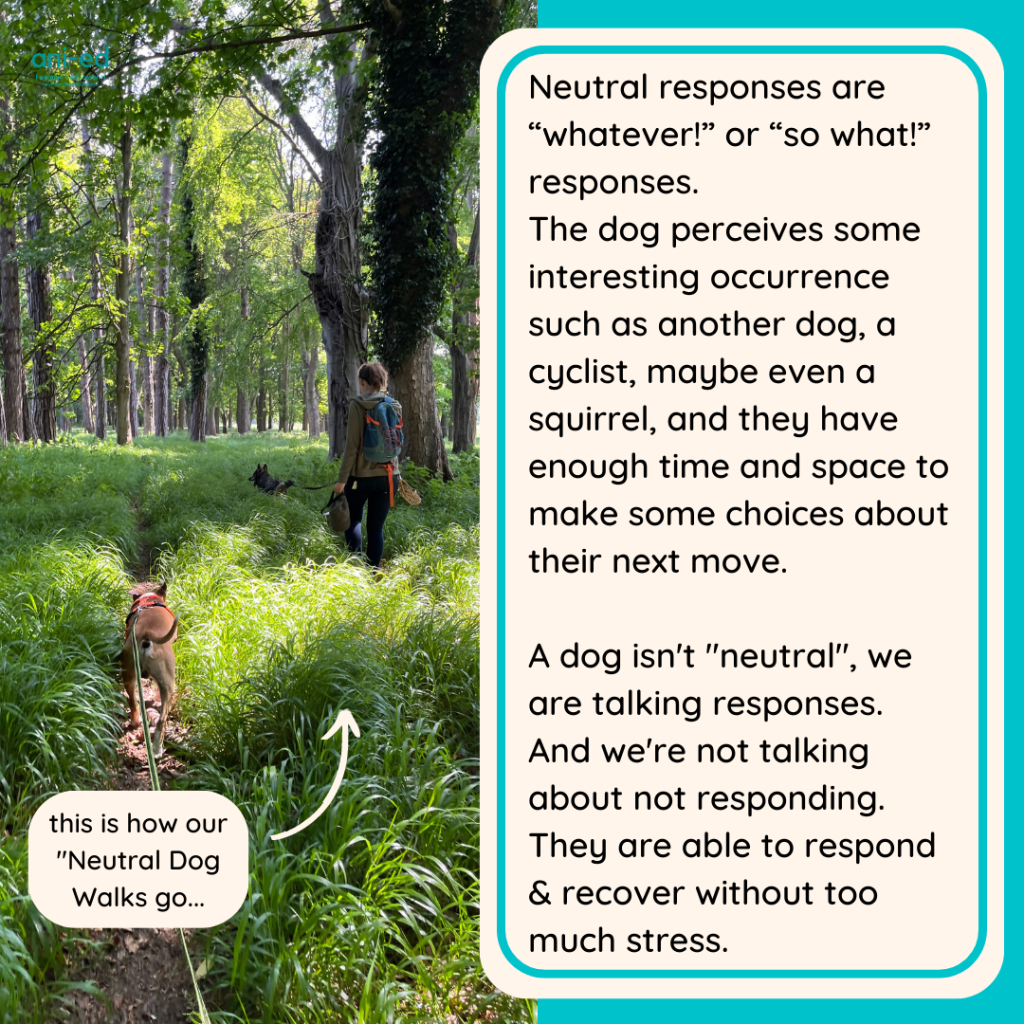
The popularity of “neutrality” in dogs has been driven by a need for us to help our dogs appear more comfortable around other dogs. This is a good awareness. But, as with “socialisation”, the devil is in the details.
We can help dogs, particularly young dogs, develop improved comfort and build more appropriate dog-dog skills, but that might not require direct contact and certainly doesn’t need tight leashes, marching drills and “corrections”.
a process relevant to specific times during behavioural development in puppies
not just about puppy play and excitement
about the facilitating the development of neutral responses to their world as adults
important
poorly understood, defined and applied
Think of how we might help our children develop healthy social relationships. Our primary approach is unlikely to be focused on high-octane interactions with randomly encountered kids in poorly controlled environments. Instead we nurture, model and guide, and provide well supervised outlets in enriched environments.
No, dogs and kids, and dog-guardianship and parenting, are not the same. But there are similarities at various levels. Building family and friendships is multi-species, for both us and our dogs. And that’s why we have been such great companions for so long.
Join Anne from AniEd for an Instagram Live with Kilian from Ruby Reese, an Irish luxury dog-care brand.
Kilian hosts regular Tuesday Talks on the Ruby Reese Instagram channel (@rubyreeseoffical). And this Tuesday, I will be joining him to talk about what enrichment really is.
If you’re here, you probably already know about our enrichment program, 100 Days of Enrichment. And that will form the basis for our discussions, along with the frameworks behind enrichment for companion dogs (and other species too).
While it’s great that “enrichment” has become widely known, as a buzzword its meaning if often lost or misunderstood. Join Anne & Kilian to get the low-down and start to develop a real understanding for enriching our dogs’ lives and worlds.
Bring your questions and discussion points as I would love to collaborate with you all and make this an immersive event.
I too laugh and these are witty, but also illustrative of our anthropocentric attitude to non-human animal behaviour. The animal’s behaviour is appropriate to them. It might not make sense to us…that’s a bed, isn’t it?!
We have decided that this seemingly arbitrary shaped cushioned item is where cats should sleep. And dammit, they should like it!
But what happens when we ask cats? See those links above for the answers!
The animal never misbehaves.
The animal’s responses are appropriate to the conditions to which we expose them. The responses they produce are correct according to their ethology, their experiences, their current conditions.
There is no wrong or right, good or bad, of behaviour. There’s just behaviour and behaviour is information.
Cats sleep in short bouts…literal cat-naps. They fall asleep relatively easily and they sleep where they feel safe and secure. Their bodies are flexible and when they pour themselves into a space, they appear liquid. Cats sleeping anywhere, any table, any chair…and so on…is because cats choose to sleep in those places. Not arbitrarily, but because of how their ethology, experiences & current conditions have prepared them.
The cat’s behaviour is information telling us humans about their needs and preferences.
Behaviour is information.
I got Decker a memory foam bed before Christmas ’23. He’s old and we’re doing all sorts of medical stuff and conditioning exercises to minimise the impacts of aging joints on stiffness and strength.
He has lots of beds, several within just metres of this one that lives beside me while I work. Sun traps are the only main draw away from this bed and he will lie for hours in the sun, in a lounger bed, that I move about for him as the sun moves.
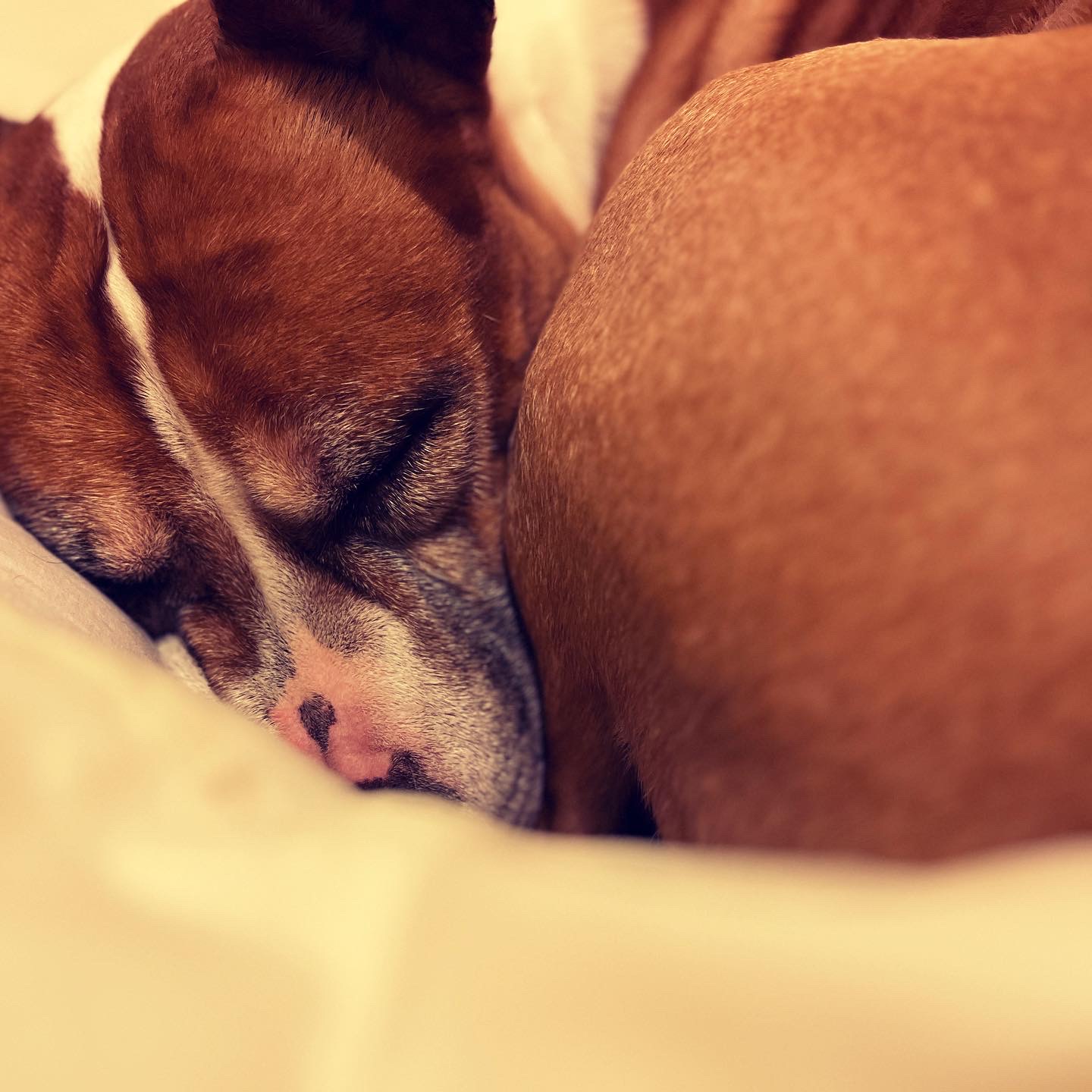
In the memory foam bed, he spent most of his resting and sleeping time curled up, in a ball.
Enter the pink Muppet-skin bed
His behaviour was telling me he sought something that he found more comfortable and comforting. So I went hunting beds with which to experiment.
I started with a less than pretty pink Muppet-skin bed and the hunt pretty much ended with this…
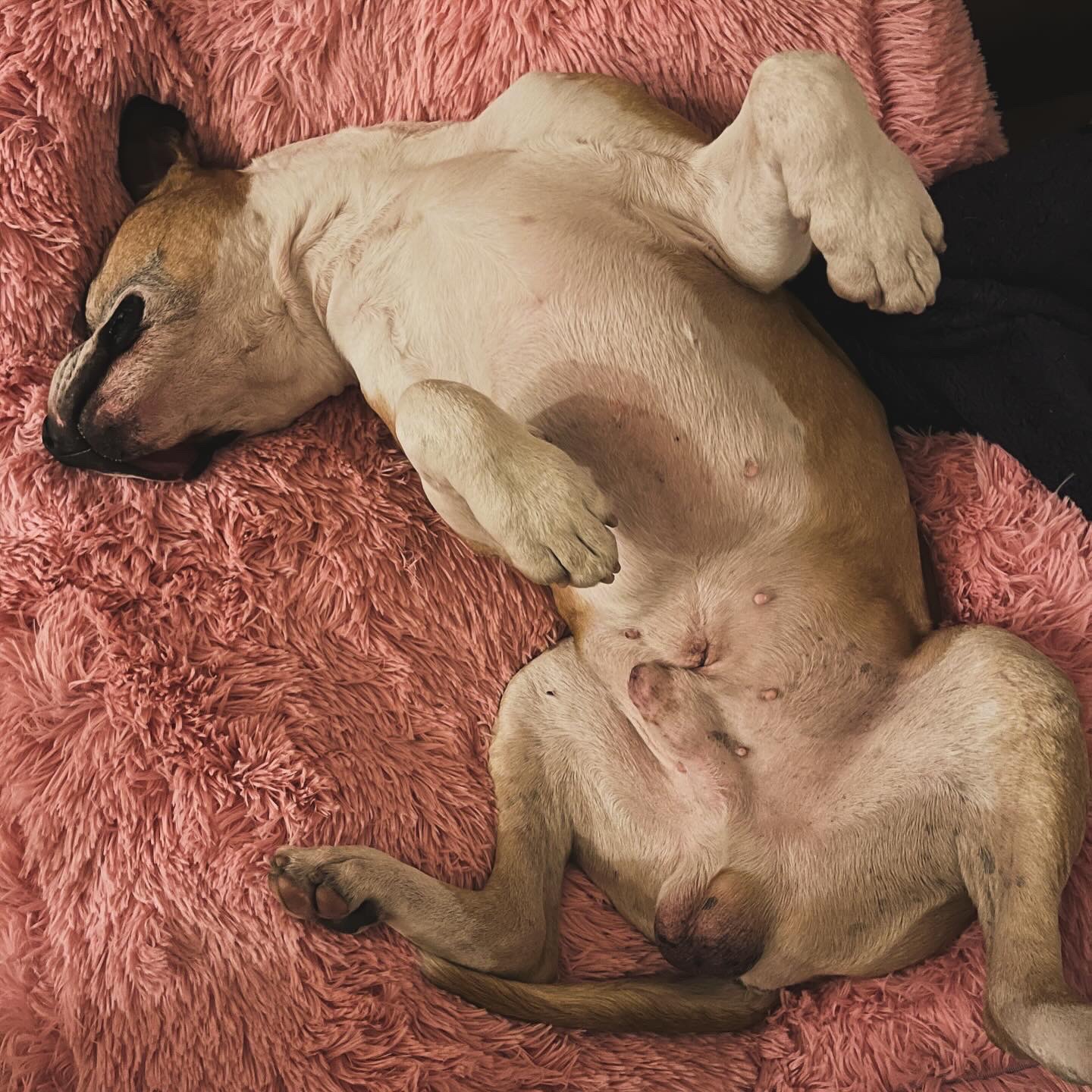
From the get-go, he spends most if his time sleeping like this. While he almost always starts out sleeping curled up, and always has no matter where he sleeps, he now blossoms and opens out to sleep on his side or on his back.
He sleeps deeply, breathing rhythmically, snoring contently. This was definitely missing, or at least, less with the healthy memory foam bed alone. Now his Muppet-skin bed is piled on top of the memory foam bed, and he can choose which one he sleeps in. Not once has he picked the memory foam alone.
Providing options is important, and a feature of creating an enriched world for them. And listening to their preferences is trusting that their behaviour matters.
There are many features of aging that guardians of an older dogs expect and find unsurprising. But there a few aspects of aging that are cause for pause, that guardians are often not expecting… (Wallis et al, 2023)
Age-related cognitive decline is normal as we, and dogs, age, and because it affects executive functioning, impulsivity increases (Szabo et al, 2016).
Increases in impulsivity is associated with aging in humans too (Morales-Vives & Vigil-Colet, 2011) (Sakurai et al, 2020). In dogs, impulsivity may be pretty consistent over life (Riemer et al, 2014), but the individual’s abilities to inhibit their responses and tolerate delay of reward can be context specific.
Dog trainers often refer to teaching impulse or “self” control, which is not quite accurate and is more “training lingo” that we could probably lose. Rather, we are teaching dogs that doing some behaviour, e.g., sitting or standing waiting, under certain conditions, leads to access to reinforcement.
These abilities may decline over time due to age, but also because we might stop practicing (reinforcing those contingencies) as diligently with our aging dogs as we do with our puppies and teenage dogs.
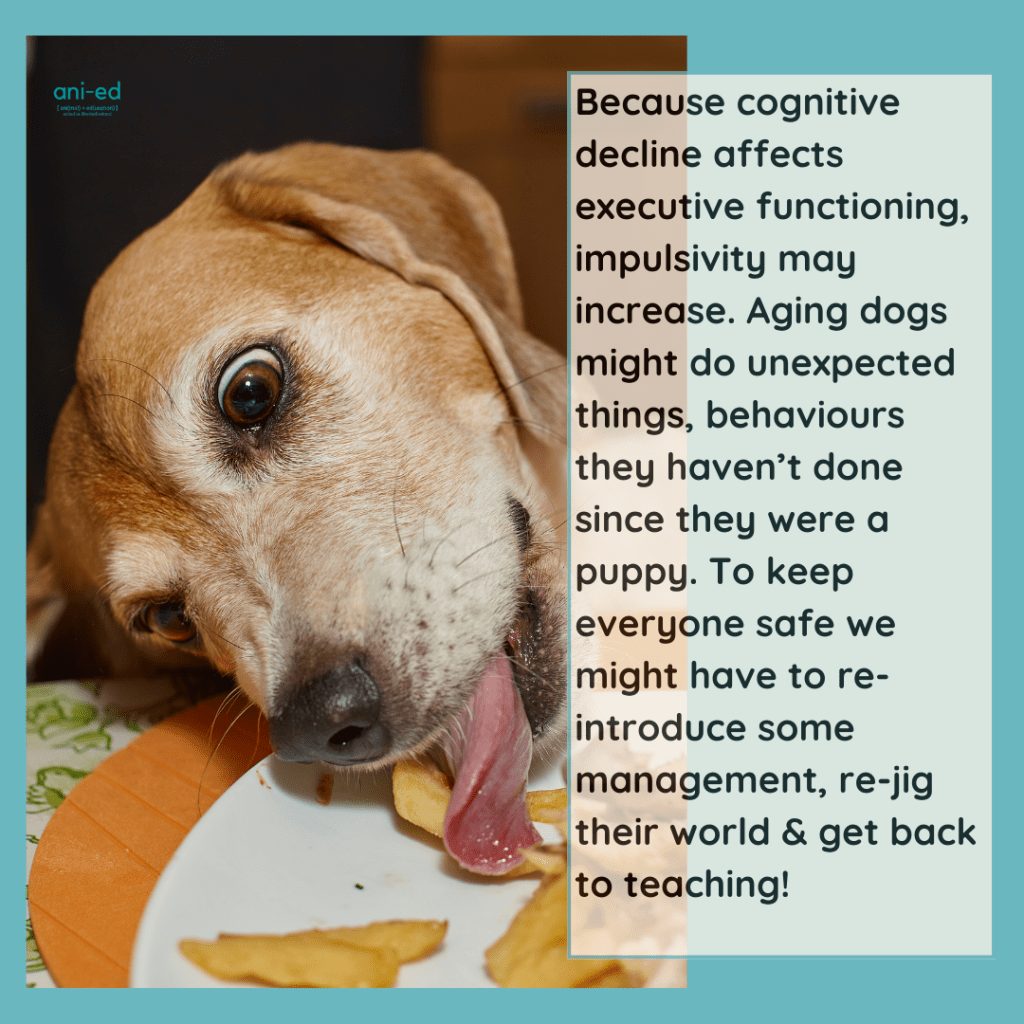
Aging dogs might do unexpected things, behaviours they haven’t done since they were a puppy. To keep everyone safe we might have to re-introduce some management, re-jig their world & get back to teaching!
And we certainly need to get back to practicing carefully building or rebuilding tolerance for reward delay, without frustration. Another effect of aging is decline in learning so that means we have to become better and clearer teachers.
Decker has consistently scored high for impulsivity. When he was about nine and a half, he developed cachexia, secondary to gut impaction & intussusception, and that marks a significant increase in his impulsivity, to my mind. It makes sense that his enthusiasm for food would increase after his body was experiencing starvation; he was very enthusiastic for food before and an increase wasn’t thought possible!
I try to build waiting and patience into lots of contexts, particularly relating to eating and toy-biting. And we still practice. A lot. He’s just about 12 years old so this will likely continue.
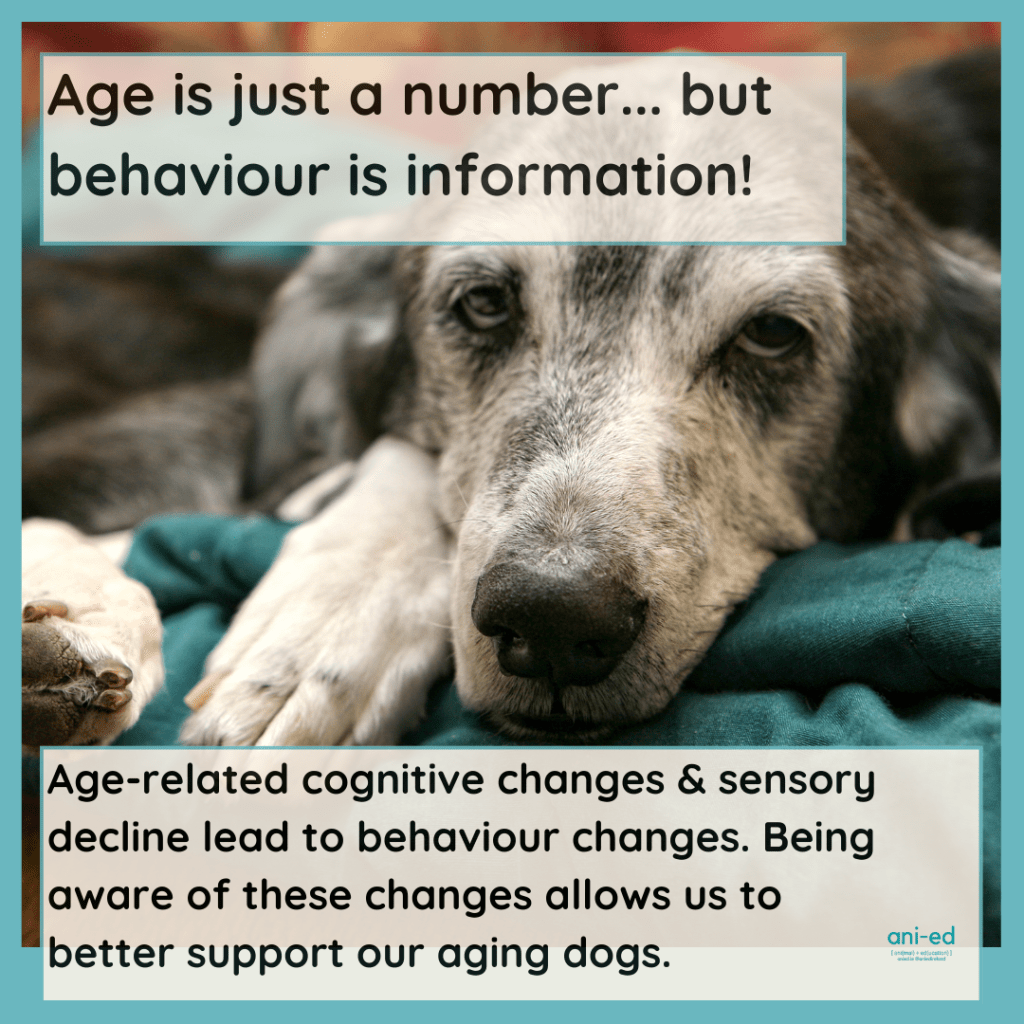
Age-related cognitive changes & sensory decline lead to behaviour changes. Being aware of these changes allows us to better support our aging dogs.
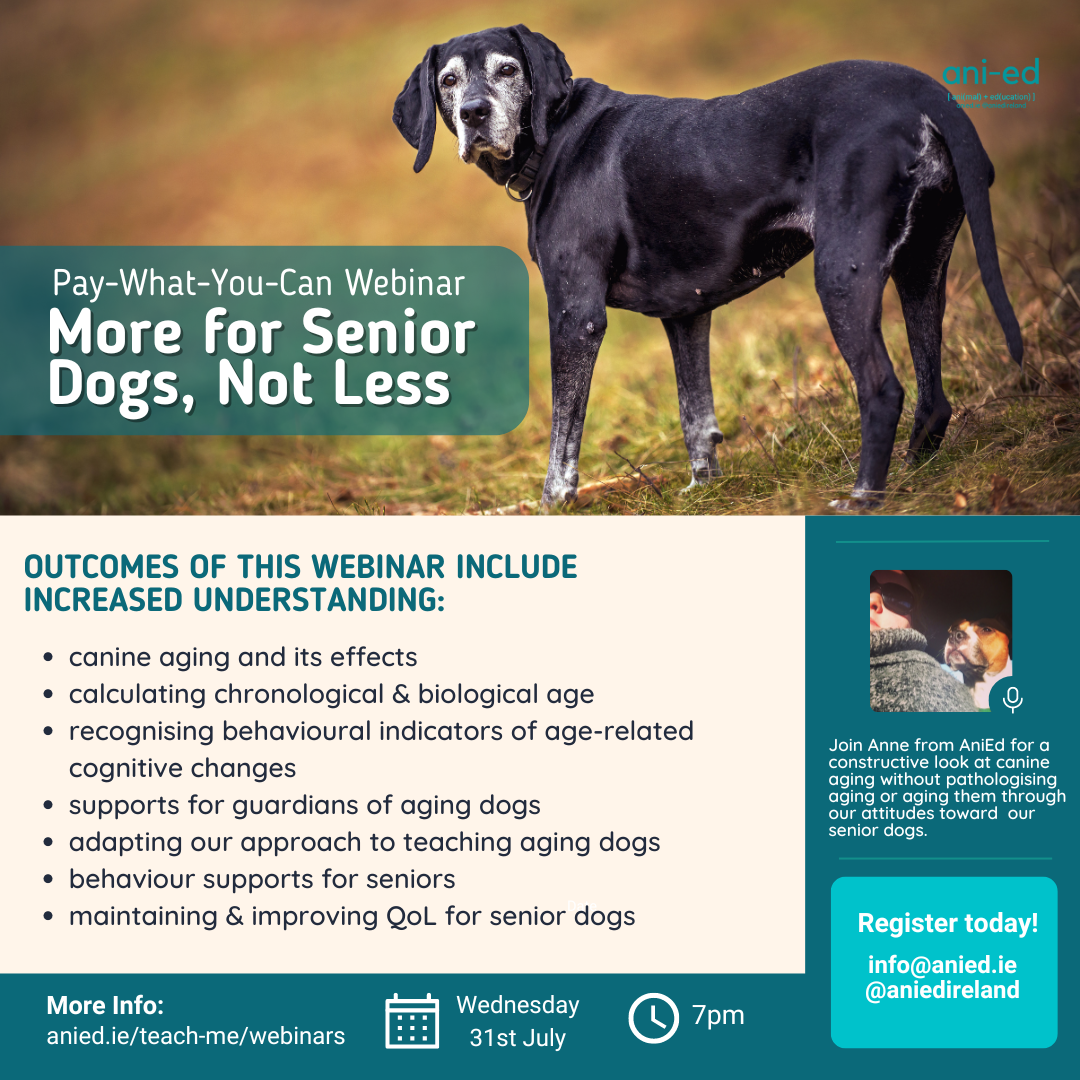
Aging dogs need more, not less!
Cognitive aging leads to sensory decline & declines in learning, memory & executive control and changes in social responsiveness, to comfort with novelty, to attentiveness & to sleeping patterns.
We often assume that these changes are part of aging and tend to presume that aging dogs need less activity.
First, it’s important that we don’t normalise aging related effects that can and should be treated and supported. For example, we presume that older dogs will be stiffer and slower, and many are. But, these are signs of pain and pain must be treated. Older dogs must be comfortable, even if we presume their pain, stiffness, slowing down, lameness and so on, are associated with normal aging effects.
We thought that Decker had slowed down a little, walking more than trotting, but no clear or distinct deterioration. He had a little bit of arthritic change in the TTA knee, but less than his surgeon expects. However, we started him on Librela in October 2023 and the difference has been…insane… The level of his deterioration didn’t appear as great, but the improvement in activity, strength and other mild effects has been significant. While no medication can be considered a cure-all or miracle, this monthly injection has truly provided a new lease on life…as if he needed to be more gung-ho…but it’s so awesome to see him so full of beans. And I do mean, FULL.
Aging dogs need guardians who:
bring their dogs for regular vet checks
keep a log of their dog’s day to day
recognise and monitor for signs of chronic pain
make adjustments for now and the future
make those changes gradually and carefully
monitor their dog’s worlds to maintain their safety and comfort
implement appropriate and evolving environmental and behaviour supports and adaptations
What’s more, aging dogs don’t need a less interesting life! Just because we think aging dogs are less active, less social and less fun…perhaps it’s our inhibiting their entertainment that’s contributing.
Aging dogs need us to:
be better teachers
provide more and appropriately enriched worlds and lives
modify their world so it’s safer and more comfortable for them
And all this according to their current and future needs.
Extending healthspan is lifelong
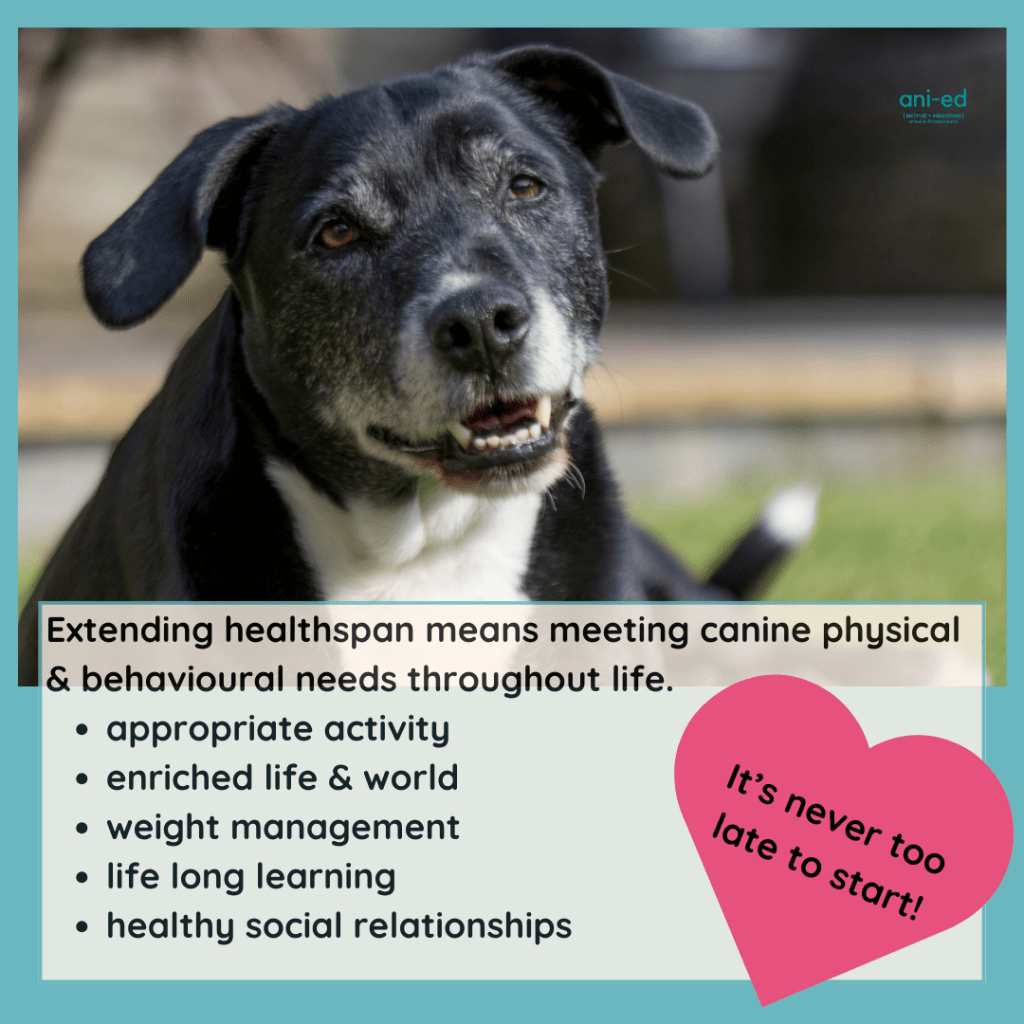
Extending healthspan means meeting canine physical & behavioural needs throughout life.
appropriate activity
enriched life & world
weight management
life long learning
healthy social relationships
It’s never too late, or too early, to start!
Age is just a number…
but, behaviour is information to guide us.
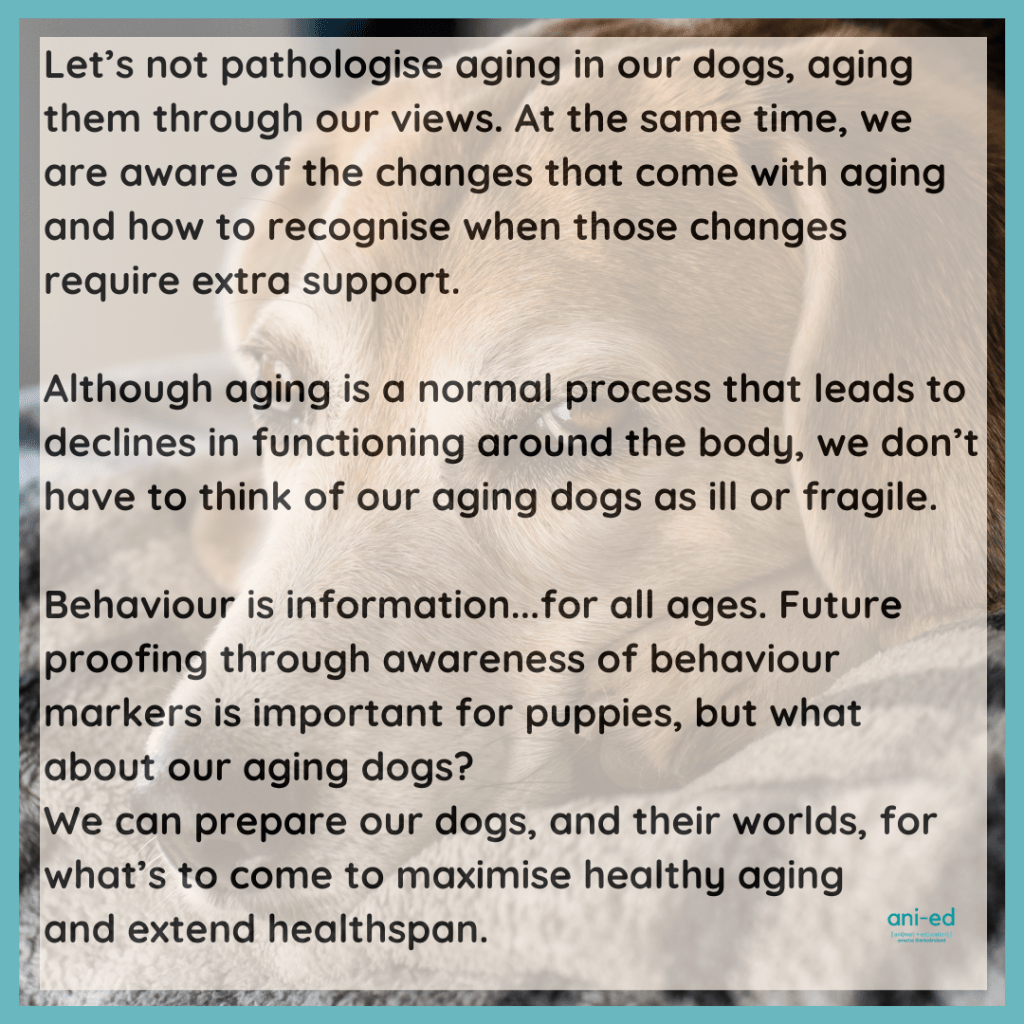
Let’s not pathologise aging in our dogs, aging them through our views. At the same time, we are aware of the changes that come with aging and how to recognise when those changes require extra support.
Although aging is a normal process that leads to declines in functioning around the body, we don’t have to think of our aging dogs as ill or fragile.
Behaviour is information…for all ages. Future proofing through awareness of behaviour markers is important for puppies, but what about our aging dogs?
We can prepare our dogs, and their worlds, for what’s to come to maximise healthy aging and extend healthspan.
Regret is a pretty human experience, or so we believe so far. Those woulda-coulda-shouldas tend to replay in our big ol’ primate brains, torturing us over things we can’t ever control.
Lucky for dogs, they don’t seem to experience regret, or certainly in the tortuous way that we do. But certainly, they continue to experience the outcomes of interactions with their environments, often times over long periods.
Recently, my dog had a big vocal response to another dog right at the doorway in the vet’s. I knew I shouldn’t have put him in that situation, I had the option to slow things down that I didn’t take. Why oh why did I let it happen?!
Put the blame on me.
Make it make sense
Not 20 minutes before, this same dog was visiting a large chain pet shop where a small breed dog, also visiting, barked and lunged and snarled at him at every glimpse at varying distances. And this same dog barely glanced his way despite the barking, lunging and snarling.
Not 18 hours later, this same dog pottered along ignoring a sensitive dog who needed some help with proximity with other dogs. And this same dog gave his new buddy space and time to develop comfort, without social pressure.
The Animal Never Misbehaves
Behaviour functions. But more, behaviour functions under specific conditions. The picture, or context, to the dog, tells them which behaviours result in which outcomes.
No “bad” or “good” behaviours, just functional.
When this same dog snarked, it was a very tight spot, right at the door, the other dog was not restrained and he moved forward into the door as we moved in.
Big dramatic vocalisations function. The other dog is moved out of the way and the path is cleared. Efficiently.
Think about this context:
at the vet’s where all the stressed and sick dogs are
tight space, right at the door in a space only the width of the door
anticipation of pain, stress, separation from their human, feeling ill
For this same dog, he didn’t really show strong stress-related responses. Huh?! He just vocalised, he didn’t lunge or pull forward…he continued on to pass three more dogs also in the waiting room within less than a metre, and had a couple of relatively invasive procedures that he tolerated well, all in the following few minutes.
All he wants to do is to get into the consultation room for treats. He pulls in and immediately engages to play treat chasing and catching games.
The presence of that obstacle, on top of all those other layers, creates a picture where more urgent responses get results more efficiently.
Behaviour works!
Labels are convenient
But they’re not much more useful than that. We like to label dogs because it reduces our accountability, it organises their responses in ways we find easier to rationalise and most of all, saying that “The dog is —-” puts it on the dog.
When we call this same dog “reactive”, “aggressive”, “over-reactive” or whatever, we are probably not helping that dog, and not representing behaviour accurately.
While behaviour is most certainly in the environment and not in the dog, I do want guardians to feel better and I don’t want them to feel blamed. Loving and living with a dog who show behaviours of concern can be lonely, humiliating, frustrating, upsetting…well, you get the picture…
But because our dogs’ behaviours function for them within the worlds we have created for them, we can adjust those environments so that healthier, safer, more acceptable and appropriate behaviours can function too.
That’s empowering, right?! And that’s why I emphasise this with guardians. With this understanding, we start to view behaviour differently, we start to look at the picture from our dogs’ points of view, we can take actions to adjust those conditions.
Guardians’ behaviour is in the environment too. Our behaviours are reinforced by our dogs’ behaviours and our dogs’ behaviours are reinforced by that of their humans. It’s a loop and it’s all in the environment.
Labels Pathologise
Our labelling of behaviours contributes to pathologising behaviours that function. This can be the focus of some approaches to helping with behaviours of concern, and may even be necessary in relation to some categories of behaviours. Regardless, behaviours function.
When we label, we not only put the focus on behaviour being in the dog (“the dog is x”), we remove focus from where adjustment is needed; we remove focus from the systems, from the environmental conditions where behaviour functions.
Dogs who have learned that vocalising works most efficiently to gain distance and social relief have learned this because they haven’t been able to gain distance in other ways. They’re confined, they’re restrained, they don’t feel able to move away. The systems. The environmental conditions.
Distance is your friend
Even where guardians are skilled and knowledgeable at helping and supporting their dogs, sometimes, those environmental conditions are not so easy to adjust.
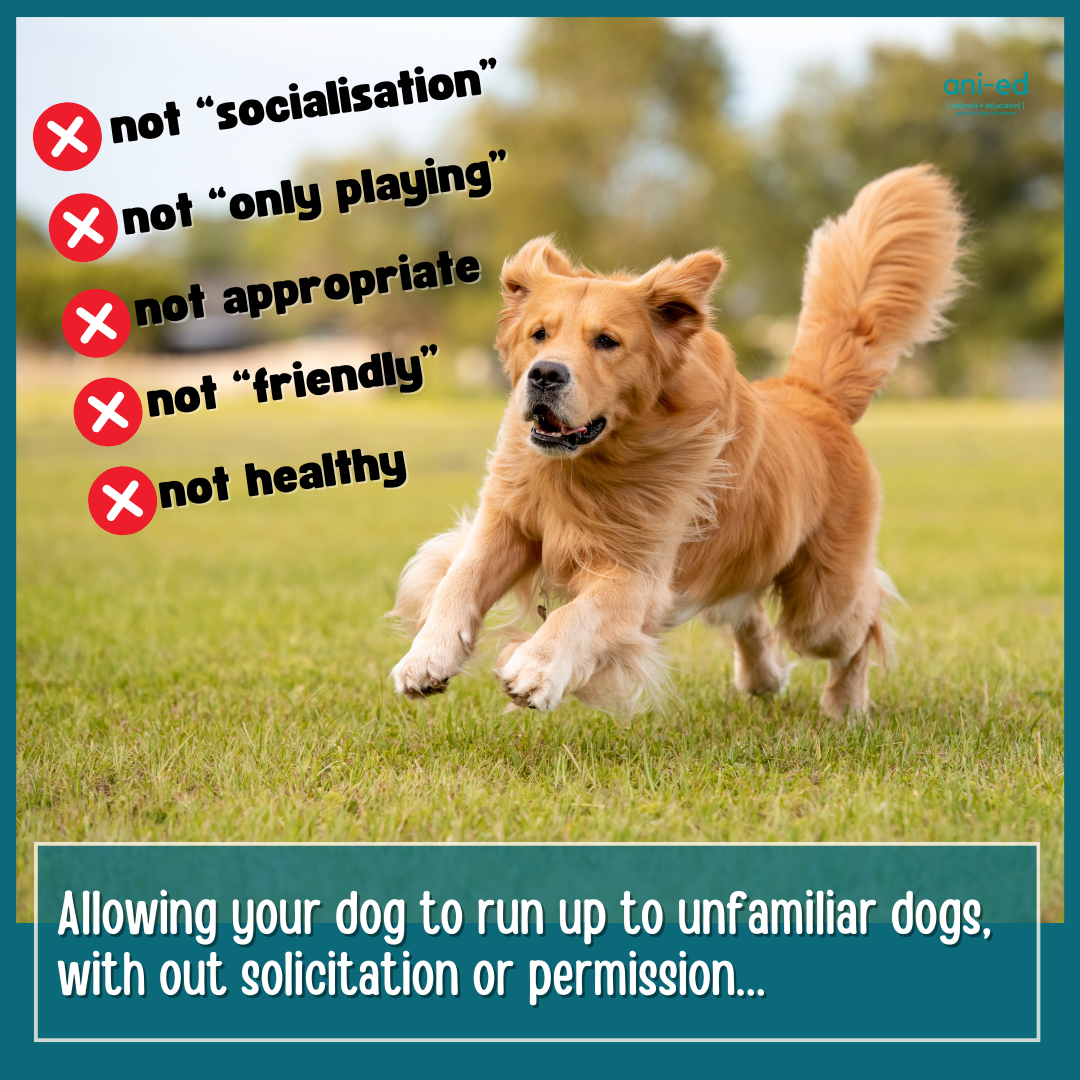
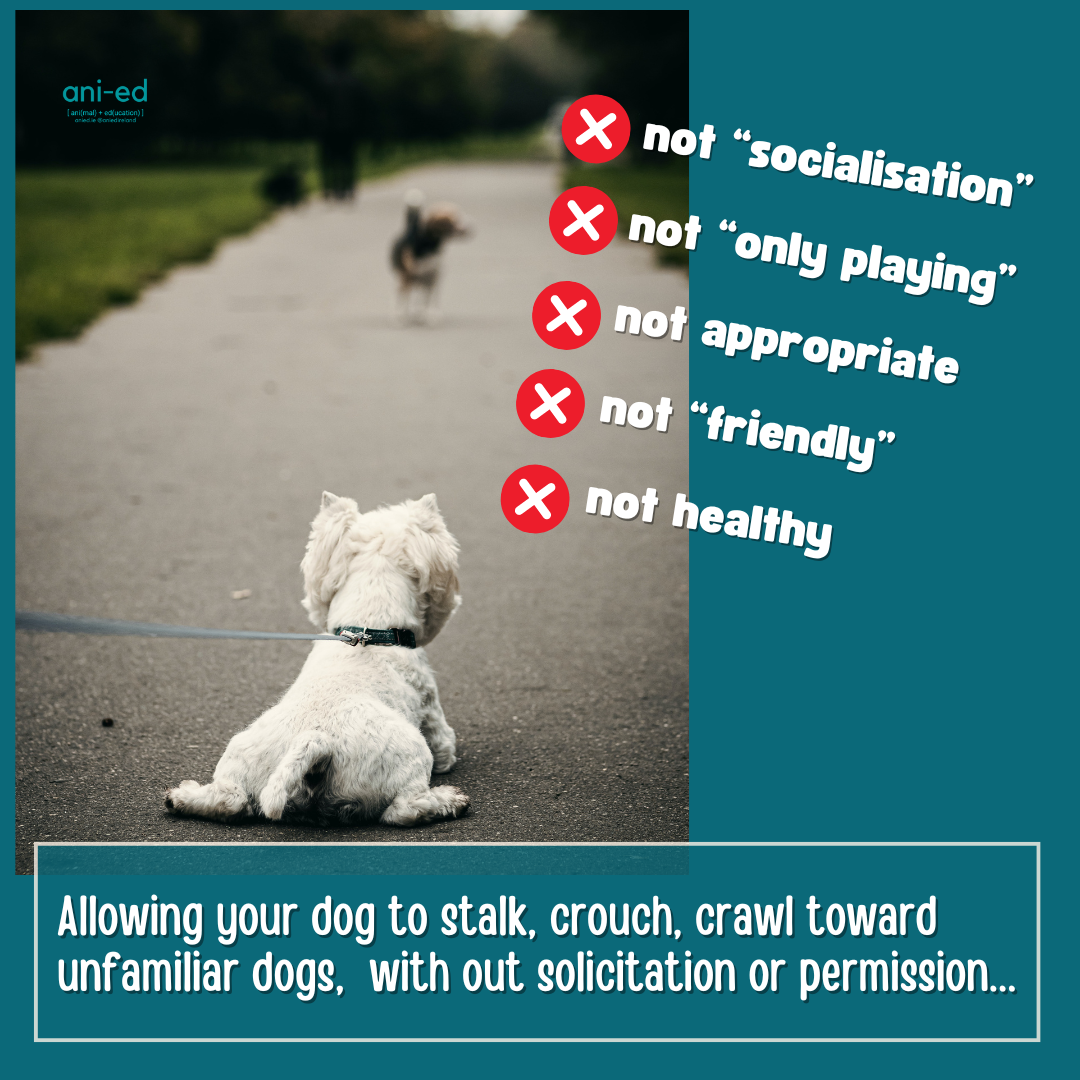
Off-leash, out of control dogs are frequently allowed, and often encouraged, to run up to other dogs who are not comfortable or not interested. This has become a defining issue in dog-culture, the impacts of which are wide-reaching and terribly damaging.
Recently published work, Hart & King, 2024, found what so many guardians report, that other dog handlers allowing their dogs to behave inappropriately is the greatest challenge.
Remember those big ol’ primate brains? They allow us to understand the experience of others, without ever having to share that experience. Yet, many many people relay to me that they never understood the challenges of having a dog showing behaviours of concern until they had their dog.
A lack of understanding of normal canine behaviour informs unrealistic expectations. Not understanding that a dog running up to another uninvited is just as rude and inappropriate as a person doing the same to an unfamiliar person or not understanding that dogs in a tight veterinary context need more space and clear doorways.
These are still environmental issues, systems issues, and most of all, education issues. With our big ol’ primate brains, so capable of regret and empathy, why isn’t this a piece of cake?
Labelling allows for cognitive short cuts and cognitive dissonance. Other skills of our big ol’ primate brains.
The main focus of toilet training is to establish appropriate substrate preference and understanding these processes, and realigning expectations with reality, help to reduce the considerable distress often experienced by guardians.
New dogs, regardless of age, and dogs in new or exciting places may have toileting lapses. And obviously when dogs are ill, they may have accidents.
So much so, toileting accidents in dogs who have been pretty reliable, indicate that a vet visit is needed.
Dogs for adoption, advertised as ‘toilet trained’ may raise unrealistic expectations. Instead, new dogs who may have appeared toilet trained previously should be given some time after a move. They need time to learn where they go, how they get there, if and when it’s safe, and so on. Expecting them to be clean right off the bat is not realistic, or fair. As with all aspects of settling in, it takes time and usually more time than we expect.
With young dogs, it’s not physically possible for them to wait and control their urge to toilet, for very long and this isn’t mature until dogs are into adolescence. I tend to find that toileting becomes more reliable by 9-12 months of age, but with so much individual and situational variation.
Establish a toileting routine
Make it easy for the dog to access preferred substrates and toileting spots with very regular trips and extra trips after any changes, activity or excitement.
Most dogs will prefer to toilet on absorbent substrates which makes sense from a hygiene point of view.
be clear about choosing appropriate toileting areas and recognise how they might be perceived by the dog
bring the dog to suitable toileting areas regularly, rather than just leave the door open or leave them outside
prepare a little pot of AWESOME treats and leave them just inside or outside the door
remain outside with the dog and be boring…business first, fun after
learn to spot your dog’s behaviours that tell you they need a toilet break and just before they go Most dogs will circle, apparently move aimlessly close to doorways and then will circle or pace more purposefully just before they squat.
remain pretty still and quiet while your dog prepares and goes
wait for them to move away from the magic-spot and then praise enthusiastically (or whatever works for your dog) and bound back in toward the toileting-treat-pot It’s very important that you let them finish – we reward emptying most generously!
have a treat party: scatter some treats (away from toileting areas), toss treats for catching, play food-games, have some cuddles or relaxing time to bring them down again
spend some time with your dog after successful toileting This is an important step often missed. Our dog toilets, we might reward and then go about our business. The dog learns that toileting ends the fun & interaction so they are trying to hold it…usually unsuccessfully! This is often a troubleshoot for dogs who have accidents after being brought out for toileting.
With that ongoing…and going and going and going…make sure to do your best to prevent accidents in other areas. The dog having an accident is no big deal – don’t sweat the small stuff, we can build appropriate toileting behaviour.
Accidents are to be expected and dealt with quietly and calmly. Making a fuss, or worse, scolding a dog, about accidents will lead to a dog who is worried about toileting when you’re around rather than teaching them not to toilet in that spot.
Clean it up carefully and limit the dog’s access to that area or context unless they’re empty. Get help for extra guidance and support, the earlier the better.
A note about marking
Marking, as opposed to toileting, often requires extra considerations. It’s social behaviour, rather than just needing to toilet, and can be intensified after sniffing, social interactions, and particularly relating to increased stress levels, social or otherwise.
Establishing a solid toileting routine is still important but there may also be some analysis required to get to the root of marking behaviours.
Get help! Keep a diary of toileting behaviour and the goings on surrounding it, and learn to diligently manage accidents. The fewer toileting accidents your dog has had by the time you call in the cavalry, the more successful we all can be!