Welcome to Day 70 of #100daysofenrichment and thank you for joining us on this journey!
Although our challenges are directed mainly at dogs, we want all species to enjoy and benefit from #100daysofenrichment so, please join in, adjust and adapt to help your pet or companion live a more enriched life.
Every Sunday during #100daysofenrichment is Sunday Funday! This means you and your pet repeat your favourite challenge or challenges from the week.
You can do it exactly as you did first time round, you can try a different option, build on your progress already established, reinvent and rejig it…what ever you want to do with the last week of challenges!
Now it’s your turn. Show us what you and your pets, of any species, can do with these challenges!
Post to your social media accounts, using the #100daysofenrichment so that we can find you and join our Facebook group to share your experiences, ideas and fun!
You can comment right here too 🙂
We look forward to hearing from you and your pets – have fun & brain games!
Welcome to Day 69 of #100daysofenrichment and thank you for joining us on this journey!
Although our challenges are directed mainly at dogs, we want all species to enjoy and benefit from #100daysofenrichment so, please join in, adjust and adapt to help your pet or companion live a more enriched life.
Saturdays during #100daysofenrichment are all about emphasising the dog in all our dogs; all about sniffing and doing dog things.
Last week, Day 62, we had lots of fun with searches and scavenger hunts…this week, we are going to build on that, get our dog tracking, following a trail we lay for them.
Your dog is already really good at this but now we are going to ask him to search for something we know is hidden, along a particular trail.
This adds new skills to his repertoire and gets them working through the scent-puzzle systematically.
Safety First
When choosing a search area, check it carefully before bringing the dog in and beginning the search.
Check for cables, sockets, glass, sharp objects or corners, machinery or moving parts, nails or staples, hot surfaces, slippery surfaces, hazardous substances, distractions from scents; even things like doors or steps can cause the dog to bring their head up suddenly, striking it.
Always play safe!
Hunting…
Today we are going to hide food and toys, laced with scents. If you don’t have hunting scents, don’t worry, you can do the food drag hunts with your pet, or practice some of last week’s toy searches.
Keep it simple, and think of how the air might flow through a space to understand how your dog will detect and narrow in on odour. We talk a lot about this on Day 55 too!
Today’s challenge is about teaching your dog how to track, rather than air scent; about helping your dog learn to keep their nose to the ground and follow a trail.
Treat Hunts
Use softer, smellier treats for this challenge.
Beginners:
Stage 1
set up when your dog is out of sight
walk in a straight line and drop a treat in each step
have a little jackpot pile of treats, out of sight, at the end of the trail
Let your dog practice this set-up a few times, until he is working his way down the trail to the jackpot, systematically. This is a basic version of our scavenger hunts from last Saturday.
Stage 2: reduce the number of treats in the trail to every second or third (or even fourth) step toward the jackot
Stage 3:
instead of dropping treats along the trail, smear a treat into the ground so that their are only traces of the treat every couple steps
lay a straight trail, in the same manner as Stages 1 & 2
let your dog track to the jackpot
Stage 4:
set up as you did for Stage 3
tie your smelly treat to the end of a dog lead, shoe lace, cord or similar
drag it along the ground and smear it a little at regular intervals
have the whole treat at the end, just out of sight, as the jackpot
Check out one of our wonderful CBTT trainers, Lucie from Lucie’s Pooches laying a trail. Wile E. shows us how it’s done!
Work through the stages exactly as above, except for more advanced challenges, add in a turn to the trail.
Prey Hunts
Hunting a scented toy can really be a big thrill for lots of dogs! Use hunting scents, that can be purchased from hunt supply outlets, and come in a range of different options, from fowl to mammals, to cater to your dog’s likes.
Add just a few drops to each side of a plush or soft toy. This will absorb the scent and each time the dog bites the toy or manipulates it, more scent will be released, increasing the sensory experience.
Tie the toy to the end of a dog lead or cord and drag it slowly along the ground, in a straight line. Hide the toy just out of sight and allow the dog to have a game with it or carry it around once he has found it.
It’s best to have one or two special toys that you use like this and that you put them away in a tin or plastic container, with a lead, when not being played with.
Your challenge
Now it’s your turn. Show us what you and your pets, of any species, can do with these challenges!
Post to your social media accounts, using the #100daysofenrichment so that we can find you and join our Facebook group to share your experiences, ideas and fun!
You can comment right here too 🙂
We look forward to hearing from you and your pets – have fun & brain games!
Welcome to Day 68 of #100daysofenrichment and thank you for joining us on this journey!
Although our challenges are directed mainly at dogs, we want all species to enjoy and benefit from #100daysofenrichment so, please join in, adjust and adapt to help your pet or companion live a more enriched life.
Now it’s your turn to get creative! Every Friday is Freestyle Friday. We’ll give you the ingredients for a puzzle or enrichment device and you build it.
Rules:
you must use all the ingredients
you can add anything else you like, or nothing at all
You can add food or toys or anything else appropriate, if you like. Or you can use this as it is.
We can’t wait to see what fun and brain games you and your pet get up to with this one!
Your challenge
Now it’s your turn. Show us what you and your pets, of any species, can do with these challenges!
Post to your social media accounts, using the #100daysofenrichment so that we can find you and join our Facebook group to share your experiences, ideas and fun!
You can comment right here too 🙂
We look forward to hearing from you and your pets – have fun & brain games!
next Sniffing Saturday, we are all going on sniffari – for that, this week collect at least one item from every place you go. Bring it home and store it in a bag or box away from your dog – keep it hidden in an area to which your dog doesn’t have access.
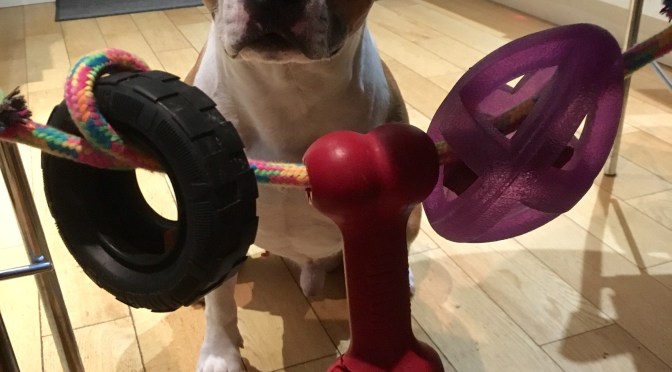
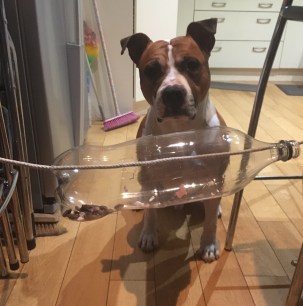
And for Freestyle Friday you will design your own enrichment device with the following ingredients:
face cloths, blankets, towels and similar
We have lots more fun and brain games for you for next week. Start getting ready…
Subscribe to this blog so that each day’s plan is delivered right into your inbox each morning.
Welcome to Day 67 of #100daysofenrichment and thank you for joining us on this journey!
Although our challenges are directed mainly at dogs, we want all species to enjoy and benefit from #100daysofenrichment so, please join in, adjust and adapt to help your pet or companion live a more enriched life.
taking puzzles to a new height, literally, changes the challenge greatly
you really can suspend any puzzle, and today, we are going to build on the puzzling abilities developed on Day 53 in Part 1 – you can start there, if you like, to help your dogs gain the skills
food and cognitive based enrichment
get the family involved in this one – kids love making puzzles for pets and these challenges offer lots of opportunities for children to use their imagination to come up with the best puzzle for their pets.
Remember, supervise children in all enrichment activities and interactions with pets.
Suspended puzzle prep will probably take you about 5-10 minutes – having a collection of puzzle stuff is a good idea…it will resemble a pile of rubbish or recycling!
What do you need?
a range of food rewards
a toy or toys that your dog loves
dog lead, cord, show lace, rope or similar (you could even use a bamboo stick, pole, broom or similar)
balls or toys with holes – the more holes the better!
plastic playing cones, with holes
plastic milk cartons, with handle
cardboard wine bottle carriers
fabric shopping bags (make sure that the bag is fabric only and not coated in or made of plastic)
Enrichment Goals:
to encourage a wide range of foraging and exploratory behaviours
to do more feeding related behaviour than eating
to encourage the development of strategies (behaviours) for getting the food out of the suspended devices
by varying the design of suspended bottles we will facilitate carrying out a range of different behaviours, broadening the dog’s repertoire
While this challenge is certainly food based, they are also experiencing cognitive, sensory and environmental enrichment, with lots of crossover between categories.
Working out how to get to the food and developing dexterous skills in manipulating the suspended puzzles are examples of cognitive challenge.
Sniffing out, tasting and chewing food all offer sensory pay off, but so does finding their way through each food puzzle, determining its value, and engaging in the puzzle of getting to the good stuff.
Suspended puzzles encourage pets to interact with their environment – just the very interaction with the bottle is encouraging the pet to manipulate their surroundings, to get the things they like.
By carefully layering the challenge, so that they don’t give, we want to help the dog expand their range of puzzle-busting behaviours and facilitate your pet applying strategies from other puzzles to new ones; that’s a true cognitive gift and is growing your dog’s brain!
What goals can you add to this list for your pets?
How can we achieve these goals?
give your pet plenty of space for working on suspended puzzles and bear in mind there will be mess, so think about spaces that are easier for clean up
the more difficult you have made the challenge, the higher the value the reward must be so use HIGH value foods to motivate exploration and experimentation and make it VERY easy to get the food (no frustration!)
if your dog just dives in, in full on destruction mode, that might also be an indicator that they need an easier challenge so they get to experiment with a broader range of behaviours
What adjustments will you make for your pets?
Applications of Suspended Puzzles:
Suspended puzzles are a great way to expand your puzzling-arsenal and carefully increasing the challenge will really stretch the dog’s puzzling abilities.
These puzzles offer lots of different possibilities for expanding the dog’s behavioural range, truly engaging them cognitively.
Suspended puzzles are truly adaptable – there really is no limit to how they can be adapted to suit different puzzling levels.
What I tend to see, though, when puzzles are given to dogs, is that well-meaning owners go waaaaay over board, coming up with the most elaborate designs to really challenge their pet.
Suspending puzzles can be quite a change for many dogs so taking it easy and increasing challenge very gradually is more worthwhile.
While it’s great to go for challenge, it’s important that enrichment remain enriching. That means that the challenge must be made appropriate and doable for the individual puzzler.
Our job is to adjust the puzzle difficulty so that our dog uses a range of behaviour and gets to the goal pretty quickly.
This is the true way to improve the dog’s confidence in puzzling (and in life) and help them expand their behavioural repertoire.
Because of the home made nature and variable materials used in suspended puzzles, it’s best to supervise your pet carefully when they have access to this puzzle.
Know your dog! If you have an ingester, these may not work.
If you are concerned about your dog ingesting non-food items during puzzling, have a pocketful of HIGH value treats in your pocket and be ready to toss a couple toward your dog, across their eyeline, if you think they are thinking about eating the bottle.
Making sure the challenge is very doable and they can get to the hidden food rewards quickly is key to modifying their behaviour and expectations during puzzling.
Check all your equipment for this challenge carefully and make sure to remove tape, staples, other fastners, small pieces and plastic pieces. With bottles, remove the lid and plastic ring before giving to your pet. Play safe!
Enrichment Options
Suspending puzzles increases challenge suddenly and drastically. It’s important to work incrementally to help your dog develop skills (behaviours) to solve these puzzles.
Increase or decrease difficulty by lowering and loosening the line, and by working against a wall or surface or have the puzzles freestanding.
Beginners:
puzzle is suspended at or lower than your pet’s chin height
the line is looser
puzzle is suspended against a wall or surface
Intermediate:
puzzle is suspended at or slightly above your pet’s chin height
the line is tighter
puzzle is suspended against a walk or surface
Advanced:
puzzle is suspended at or slightly above your pet’s chin height
the line is tighter
puzzle is freestanding
Option 1 Holey Balls
Balls or toys with holes are great for suspended puzzles as they allow treats to fall out the more the dog manipulates them.
Easier:
Suspend the puzzle against a wall, piece of furniture or other surface. This makes it a little easier for the dog to spin and win!
Make sure to use treats or food rewards that easily fit out the holes in the toy used otherwise your dog will try to bite and tug at the ball or toy.
Work through the beginners, intermediate and advanced levels.
Be on the look out for anything with holes, grids or gaps in, as they can make great props for suspended puzzles. These kids sports cones are a great addition to your puzzle equipment and are available in toy and sports stores.
Easier:
Suspend the puzzle against a wall, piece of furniture or other surface. This makes it a little easier for the dog to spin and win!
Make sure to use treats or food rewards that easily fit out the holes in the cone or item used otherwise your dog will try to bite and tug at it. Frustration isn’t enriching!
Work through the beginners, intermediate and advanced levels.
Plastic milk cartons make really challenging puzzles, especially when suspended by their handle.
The smaller cartons are easier for dogs to solve, especially when full or almost full. A larger carton is more difficult and will require more skill and problem solving.
Easier:
Suspend the puzzle against a wall, piece of furniture or other surface. This makes it a little easier for the dog to spin and win!
Use a smaller carton with more food that fits easily out of the opening to prevent your dog biting and tugging at the carton too much. Frustration isn’t enriching!
Work through the beginners, intermediate and advanced levels.
We have added various challenges to this puzzle here by suspending multiple cartons, of different sizes and suspended in different ways with one hanging from a dog collar.
More challenging:
Suspend your puzzle freestanding or from the back of a chair for a little extra challenge.
Wine bottle carriers make great puzzles and we will be using them again, later over the #100days. Today, we are going to suspend ’em!
This puzzle is best left hanging and freestanding. Here, I’ve hung it using a dog lead from a table.
You can add food, toys or stuffables to the winebox and the different partitions make it trickier to reach the goal. I have added a silicone muffin pan, upside down, with treats on top. Puzzle in a puzzle!
Using a fabric shopping bag can really add to the challenge of suspended puzzles. Because they are floppier, unlike the winebox, they are little more difficult to manipulate and get their head in and out of.
Like our suspended basket puzzle on Day 53, this is a great one for dogs who have a favourite toy that they really like to work for; using a fabric bag is trickier. But you can add a stuffable or another puzzle with food rewards – versatile and challenging!
Now it’s your turn. Show us what you and your pets, of any species, can do with these challenges!
Post to your social media accounts, using the #100daysofenrichment so that we can find you and join our Facebook group to share your experiences, ideas and fun!
You can comment right here too 🙂
We look forward to hearing from you and your pets – have fun & brain games!
Welcome to Day 66 of #100daysofenrichment and thank you for joining us on this journey!
Although our challenges are directed mainly at dogs, we want all species to enjoy and benefit from #100daysofenrichment so, please join in, adjust and adapt to help your pet or companion live a more enriched life.
understand how learning and behaviour work so that you can teach new behaviours responsive to environmental cues
the key to teaching is not in training new behaviours (the dog can already do and is already doing them) but to get behaviour under stimulus control, so that we can ask for behaviour
stimulus control is hard to achieve, even though everyone believes their dog knows sit or down etc.
cognitive based enrichment
while children might be able to participate with some of these exercises, there will be lots of canine excitement and activity with some of these games so they might not be safe for kids
Remember, supervise children in all enrichment activities and interactions with pets.
training exercises can be practiced in individual sessions of 1-2 minutes at a time; have as many sessions as you can!
Today we are going to look at what teaching and training dogs is really all about, while giving them new skills to navigate their world.
Your dog can already do most of the behaviours you want to train – dogs can lie down, they can walk, they can return to you. We want them to do behaviours under certain conditions, mainly when we ask them.
We are teaching dog to carry out specific behaviours at specific times.
While most people behave as if their dog’s behaviour is reliable on verbal cues, this is least likely to be the case. Dogs are much better at learning about environmental, context, body language cues than they are about words so words are likely the last thing they will learn about.
Good thing too as today’s games are all about context and environmental cues!
What do you need?
food rewards – you can use your dog’s regular food, a training mix, commercial treats, home prepared treats such as cut up meats, cheese, vegetables or homemade treats such as liver or tuna cake
depending on which training games you work on, you will need your dog’s lead, his bed or mat, and even your doorbell!
Enrichment Goals:
to teach the dog the meaning of stimuli around him, improving clarity and predictability
to teach alternative, more appropriate behaviours without the need for punishers or aversives
to teach the dog that their human won’t nag or coerce
to build that bond between dog and human
to have a fun and rewarding experience in social situations, between dogs and humans
to learn about learning – this is just another puzzle to your dog…”how do I train the human to make rewards available?!“…it’s all human training, for dogs!
While training exercises certainly fall into the cognitive enrichment category, they can provide so much more.
Improving clarity helps to boost your relationship with your pet, enhances your ability to communicate with one another and builds trust. This is a level of social enrichment that’s tricky to replicate.
When we talk about enrichment being enriching, this is never more clear than when we start to teach behaviours intentionally. It’s the human’s job to set the dog up for success by making sure the behaviour is doable and that rewards are fast-flowing.
There’s no test at the end of this and you and your pet are not under any pressure. Learn to enjoy the time together, whether you achieve the goal behaviour or not. That’s what’s enriching here…the social and cognitive outlets such exercises provide (for both species).
What goals can you add to this list for your pets?
How can we achieve these goals?
although you can use any reward that your dog will work for, using small food rewards that are quick to eat are best for some of these exercises so we can have lots of fast repetitions
keep it simple and split behaviour – reward approximations toward the final behaviour, rather than hoping that your dog will offer the goal behaviour quickly
take your time and work in many short sessions
try for a couple of minutes at a time, 5-10 rewards each session, and then take a break
plan each session – what behaviours are you looking for and rewarding?
watch the clips and try out the exercise
portion out your dog’s daily food and allot some for training exercises
make a training mix by adding in something yummier and leaving it all to ‘cook’ together in the fridge; the smells will mingle, harder foods will soften a little, and everything will become more valuable
remember to adjust your pet’s diet accordingly to accommodate the extra calories from treats added, where relevant
split your food rewards into little bowls with just the right number of rewards in each bowl so that you are ready to go; stick bowls of rewards in places where you may need to teach and reward behaviours so that you have rewards ready to go
What adjustments will you make for your pets?
Applications of Transferring Cues:
You say “sit!”, your dog sits, and you give him a treat…that’s the way this is supposed to work, right? Let’s look at what really happens when behaviour happens.
Traditionally, dog training was approached with a “better do as I say, or else…” and we believed that our function, as trainer, was to bark ‘commands’ at the dog. But, now, thankfully, we have a much better understanding of how behaviour works.
First lesson, behaviour is not in the dog, behaviour happens in the environment.
What we mean by this is, is that the dog is not bold, difficult, untrainable, dominant, aggressive, dangerous…
But, the dog might exhibit x behaviour in certain environmental conditions. Basically, even when you feel that behaviour is inappropriate, the dog is responding in an appropriate manner according to the environmental conditions you have set up for him.
Wait, what?
You, the human, are responsible for the environmental conditions to which your dog is exposed. The buck stops with you. If the dog is carrying out behaviour you don’t like, or not carrying out behaviour you would like, this is down to you.
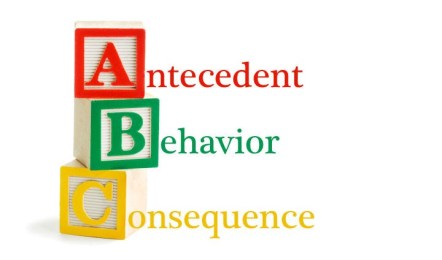
In dog training, we refer to A-B-C or antecedent – behaviour – consequence.
The antecedent or A (might also be referred to as a cue, conditioned stimulus, discriminitive stimulus) happens before behaviour and it tells the animal to do that behaviour because that makes a particular consequence available.
The consequence or C, might be a reinforcer (something that strengthens behaviour) or a punisher (something that weakens behaviour).
You control, for the most part, which As your dog is exposed to and which Cs your dog has access to – As and Cs are in the environment, not in the dog.
To ‘fix’ problem behaviour, you need to know what’s happening before, the A, and what’s happening after, the C and then prevent access and exposure.
When we are teaching a dog to do a behaviour when we ask, we are really just setting up the antecedent, that triggers the behaviour, and transferring the meaning to the antecedent to the one you want to use.
With that in mind, think of how you can rearrange your dog’s environment to prevent unwanted behaviour, making it less efficient and less rewarding.
This also opens you to think in terms of the desired behaviour; instead of thinking about stopping behaviour, instead, think what would you prefer the dog to do?
By preventing unwanted behaviour, you can fill that gap with a new reinforceable and desired behaviour.
Your dog is behaving all the time, and is responding to antecedents (or cues) all around him. For training to be efficient and effective, we want to choose to teach the antecedents the dog is most likely to learn. Words don’t feature high on that list.
Bunny learns to go to her crate when her owners go to the door, instead of barking and jumping up. A person approaching the door has become a cue for her to return to her crate and remain their, awaiting reinforcement.
Instead of punishing this behaviour, we think, what would we prefer the dog to do? She can’t pursue, jump up, and is less likely to bark, from her crate.
Today’s challenges look at teaching the dog new antecedents: when <something> happens in the environment, do this <behaviour>. This greatly speeds up teaching and makes it easier to apply learning.
Enrichment Options
All our games today will help your dog transfer one set of antecedents for another, that makes carrying out the behaviour more efficient and appropriate.
When you think of a new, more desirable behaviour, think of the emotions behind the undesired behaviour and how you can build in more appropriate emotions with the new behaviour.
What does the dog already associate and expect with the new behaviour? Instead of activity and arousal, maybe we can associate calm focus, high value rewards and quieter activities.
Many dogs burst out the door, with arousal and frustration. To combat that, many teach, or attempt to teach, the dog to wait inside the door but this often contributes to building frustration and an even bigger burst out the door when released.
Instead, teach the dog that just outside the open door is a sniffing station and very soon, the opening door is a cue for the dog to whip back around and focus on their human, instead of bursting out.
Dogs get pretty excited about greeting new people; they want to greet face to face, but we make that difficult by standing up and being tall.
To dogs, greeting calmly and with all four paws on the floor are pretty arbitrary rules.
Jumping up tends to be taken very seriously by pet owners. It’s important to remember that from about 3 weeks of age your dog has been practicing jumping up, so it’s well rehearsed long before you bring puppy home.
The simplest approach is to greet the dog; hook the dog’s collar (so you don’t get a bloody nose) and greet the dog. The jumping dog may just need to greet.
Jumping up can be associated with being over-aroused and not quite able to handle the situation; this clip looks at that:
We can prevent the dog jumping up by carefully slotting in a new antecedent arrangement before the old, established one. This prevents the dog being exposed to the established triggers for behaviour.
We are also asking, what would we prefer the human to do?!
In greetings, you might have two problems: the dog jumping up and the human rewarding that behaviour with lots of attention and interaction.
By giving both the greeter and greetee a job to do, more desired behaviour, what we would like them to do, makes it easier to train both dogs and humans.
Transferring the dog’s usual cue for jumping up, the arrival of a person, to a sit behaviour or other four-on-the-floor behaviour sorts one side of the equitation. But let’s train the human too.
We can teach the dog to sit when faced with a person with their arms folded across their chest.
To add a new cue, add it before the old one. In this case, fold your arms and say “sit”, reward when the dog sits. After a few repetitions, your dog will be sitting when you fold your arms.
You can choose any four-on-the-floor behaviour – it doesn’t have to be sit. You can replace jumping up and greeting with any preferred behaviour.
Albi is learning to go to his crate when a person enters the kitchen door, rather than jump up in excitement:
If you need help helping your dog to become more comfortable and handleable when fitting walking gear, see Day 17.
Stop access to rewards:
Truth be told, I am not a big fan of just ignoring unwanted behaviour. It’s likely that, for many dogs who are very excitable when they see their lead, that bringing the lead out, putting it away over and over in response to their behaviour, will likely cause their frustration to increase.
So, for that dog, I want to just get their lead on and go!
What would you prefer the dog to do?
Sit for lead on:
Show the dog the lead, ask for a sit. When the dog sits, toss the reward so that it’s easier to attach the lead, while he’s eating it.
Probably my favourite application of cue transfers is playing doorbell games. Teach your dog that the sound of the door is a cue to do some behaviour, such as go lie on your mat.
To rearrange the environment, you might try disabling or covering your door bell so that the dog doesn’t have reactions to the bell, further rehearsing that behaviour and slowing training.
Your dog, at this stage, probably has a strong emotional response to the sound of the doorbell.
We want to reduce the strength of that association, while helping him form a more positive association with the doorbell sound, and teach him a more appropriate alternative behaviour to do when he hears the doorbell.
This must be built very gradually and carefully, because his current response is so strong and may be distressing for him.
For a full covering of doors and greetings behaviour and planning, see our Christmas Bite on these topics and practice before you really need it!
Doorbell = Snuffle Party
Teach your dog that the doorbell signals a snuffle party! Instead of your dog running to the door, they run to you and their Sniffing Station to snuffle for treats; then you can bring your guests in calmly and quietly.
Establish a Sniffing Station with a snufflemat, a snuffle puzzle, or simply scattering treats on the floor, on a blanket or towel, or in their bed.
Practice in short sessions of just a minute or so at a time.
Begin working close to the door so your dog can quickly check that there’s nobody actually there. But as their comfort increases, you can move your Sniffing Station to the spot you want your dog to go to when the door bell sounds, such as another room, a confinement area, a crate or their bed.
Be exciting as you bound to their Sniffing Station – it’s a snuffle party after all!
Use a recording of your door bell or a similar sounding bell. The one I use can be found here.
You gotta practice door management games before you really need them but they are simple to work into your daily routine and require only 30-60 seconds practice per day.
Start with a recording of a neutral doorbell – one that he won’t have heard before and doesn’t associate with his door or guests coming in. There are a variety of doorbell sounds available on YouTube, for example, this search.
During training, use one of these consistently.
Level 1:
use a neutral doorbell recording
reward with high value rewards
play these training games in lots of different rooms
Stage 1:
play the doorbell recording
immediately feed a high value food reward to the dog
repeat 5-10 times per session
You must get your timing right for this to work. Don’t move toward the treat until after the doorbell sound has played.
When the dog predicts that the doorbell sound makes a treat happen you are ready for Stage 2. You might be able to tell that the dog has developed this association by testing him; play the doorbell sound when he is not looking or is in another room. He should come looking for his treat!
Stage 2:
play the door bell sound
cue the dog to “go to bed!”
reward him when he is in the bed
Practice in short sessions of 5-10 repetitions. When he will go to his bed upon hearing the doorbell recording you are ready for level 2.
This clip shows the basic work required for this training exercise:
Level 2:
work exactly as you did for Level 1, except use a recording of your own door bell
use at a lowered volume if the dog has an aroused response to it
When the dog will go to his bed upon hearing the doorbell recording, move onto Level 3.
work exactly as you did for Level 2, except have a familiar person ring the door bell
practice with the door open and in a spot that allows the dog see what’s going on; have the dog on lead
As your dog improves, you can close the door and have the familiar person outside and once happy with that you might be ready to add an unfamiliar person knocking or ringing!
Sometimes, it’s important that our dogs are safe and confined during certain activities. Maybe you are injured and cant have your dog jumping up or getting under your feet; my favourite application of this is in baby prep. We can teach your dog to go to their bed or crate when you are carrying an infant (which starts out as a doll wrapped in a blanket).
Living with more than one dog can be tricky, especially when all the dogs are adults. Adult dogs are more likely to be competitive with one another, and squabbles among dogs who live together are often to do with access to resources.
We often tell off one dog if they aggress when another dog approaches. But, all we end up teaching that dog is, that unpleasant things happen when the other dog approaches.
Instead we can teach them that good things happen when the other dog is around.
We teach the dog that if their buddy gets a treat, they are about to get a treat too. This helps them feel better about proximity with the other dog and teaches them that they don’t need to compete…yummies are coming!
Contrary to popular belief, dogs don’t need to fight it out and you don’t have to ‘support the hierarchy’ (whatever that means!).
We will teach them that the presence of the other dog makes good things happen and that they will get a treat after their pal. No need to barge in, cause a squabble or lose out!
Now it’s your turn. Show us what you and your pets, of any species, can do with these challenges!
Post to your social media accounts, using the #100daysofenrichment so that we can find you and join our Facebook group to share your experiences, ideas and fun!
You can comment right here too 🙂
We look forward to hearing from you and your pets – have fun & brain games!
Welcome to Day 65 of #100daysofenrichment and thank you for joining us on this journey!
Although our challenges are directed mainly at dogs, we want all species to enjoy and benefit from #100daysofenrichment so, please join in, adjust and adapt to help your pet or companion live a more enriched life.
simple and fun games to boost engagement and choice
your dog chooses to walk close to you without a lead, so that it’s easier when they are on lead
engagement games, like these, teach the dog to choose you, even when you don’t have treats or toys, and even when there are distractions
we start with simple training games and build toward more and more engagement
cognitive based enrichment
while children might be able to participate with some of these exercises, there will be lots of canine excitement and activity with some of these games so they might not be safe for kids
Remember, supervise children in all enrichment activities and interactions with pets.
training exercises can be practiced in individual sessions of 1-2 minutes at a time; have as many sessions as you can!
Because today challenges will be pretty exciting, make some time, after each session, for some lapping and chewing on stuffables.
Think Rollercoaster Games!
We have talk lots and lots about engagement because I believe this is the key to teaching all sorts of behaviours, but more importantly the foundations upon which a wonderful relationship is built, with your pet.
We can formalise some of our engagement games, while still having fun, and teach our dogs to choose to walk with us.
Remember, engagement is about the dog choosing to engage, that they are working to attract your attention, and that you’re (both) developing a meaningful connection.
Engagement, for me and the dogs I work with, including my own, is about the dog choosing to engage, wanting to engage, finding me the most rewarding, over all the other things.
And that’s the key; the dog wants to be involved and to participate.
What do you need?
food rewards – you can use your dog’s regular food, a training mix, commercial treats, home prepared treats such as cut up meats, cheese, vegetables or homemade treats such as liver or tuna cake
if you are working in an unsecured area, use a long line for safety and to prevent your dog practicing not recalling and having lots of fun, in the environment, with out you
Enrichment Goals:
to teach the dog to choose you
to teach a nicer loose leash walking position
to teach the dog that choosing their human makes the magic happen
to teach the dog that their human won’t nag or coerce
to build that bond between dog and human
to have a fun and rewarding experience in social situations, between dogs and humans
to learn about learning – this is just another puzzle to your dog…”how do I train the human to make rewards available?!“…it’s all human training, for dogs!
While training exercises certainly fall into the cognitive enrichment category, they can provide so much more.
Working on choice-led engagement exercises helps to boost your relationship with your pet, enhances your ability to communicate with one another and builds trust. This is a level of social enrichment that’s tricky to replicate.
When we talk about enrichment being enriching, this is never more clear than when we start to teach behaviours intentionally. It’s the human’s job to set the dog up for success by making sure the behaviour is doable and that rewards are fast-flowing.
There’s no test at the end of this and you and your pet are not under any pressure. Learn to enjoy the time together, whether you achieve the goal behaviour or not. That’s what’s enriching here…the social and cognitive outlets such exercises provide (for both species).
What goals can you add to this list for your pets?
How can we achieve these goals?
although you can use any reward that your dog will work for, using small food rewards that are quick to eat are best for some of these exercises so we can have lots of fast repetitions
toys and your engagement, fun and play will work as excellent rewards too
keep it simple and split behaviour – reward approximations toward the final behaviour, rather than hoping that your dog will offer the goal behaviour quickly
take your time and work in many short sessions
try for a couple of minutes at a time, 5-10 rewards each session, and then take a break
plan each session – what behaviours are you looking for and rewarding?
watch the clips and try out the exercise
portion out your dog’s daily food and allot some for training exercises
make a training mix by adding in something yummier and leaving it all to ‘cook’ together in the fridge; the smells will mingle, harder foods will soften a little, and everything will become more valuable
remember to adjust your pet’s diet accordingly to accommodate the extra calories from treats added, where relevant
split your food rewards into little bowls with just the right number of rewards in each bowl so that you are ready to go; stick bowls of rewards in places where you may need to teach and reward behaviours so that you have rewards ready to go
What adjustments will you make for your pets?
Applications of loose leash walking (LLW)engagement games:
You can easily see the value of engagement…it gets you great recall, it gets you nice loose leash walking, it gets you working around distractions.
All while providing the dog with choice. The choice to engage.
Today’s games will focus on engagement for loose leash walking. Your dog will choose to walk with you and you will make that rewarding – simples!
When engagement happens, the dog is fighting to engage regardless of the presence of distractions and triggers and regardless of whether you have treats or toys.
How ever you define it, engagement is chosen by the dog, rather than cued; engagement is not contingent on you having food rewards or toys.
The key to engagement is that you are not trying to get it, you are worthy of engagement and your dog fights to engage!
You can see that engagement is the foundation to teaching all the other behaviours; it’s what we build our relationship, with our dog, on and with.
Engagement is a two-way street
Making engagement happen starts with the human. If we want our dog to choose us, regardless of what else is going on and regardless of whether you have treats or toys, we have to work to prove that engaging with us is the best!
When the dog is engaged, choosing you regardless, he pushes into the learning and interacting process; he is more than meeting you halfway.
Reinforce engagement
Reinforcement strengthens behaviour, so your dog’s disengagement is information telling you that you are not making sufficient reinforcement available for engagement.
We tend to pile on the encouragement, excitement, food and toys trying to get our dogs to engage. When their attention wanes, we attempt to get it back by offering access to reinforcers. Ask yourself, what behaviour are you really reinforcing?
Engagement makes good things happens. Engagement means that the dog accesses behaviour they like to do. Reinforce behaviour with behaviour.
What does your dog like to do? Make that happen contingent on engagement.
Enrichment Options
We’ve introduced engagement games already in relation to sniffing, on Day 34 and lots of formal and informal engagement exercises on Day 59.
Loose leash walking is a task that most pet owners and dog trainers alike find difficult and tedious. You only need to look at the array of equipment that has been developed to give humans better control of dogs when walking. People really want to be able to walk their dogs without being dragged about and that is perfectly understandable.
But, there needs to be some compromise. Dogs need the opportunity to sniff, explore, observe the world, especially when they might have only limited access to this world each day.
Marching around housing estates and urban areas, on a tight leash, may not be providing for their needs and as such, expecting them to be able to trot along side us slow and boring primates, may be a step too far in terms of expectations.
If that’s what we want from dogs, we will need to put the work in along with providing them with outings that are more to their tastes.
Loose leash walking training doesn’t need to be all marching and no fun – I use tons of different games to help trainers help pet owners but today, and largely with my clients, I set the foundation in engagement and watch the loose leash walking happen as a result.
Option 1 Follow Me!
This is my favourite puppy game to introduce engagement, loose leash walking, polite greetings, to prevent biting and foot chasing, and to have fun with your pup! But, this is a great game for pups of all ages 🙂
I like to use Follow Me! indoors or in more enclosed situations so this can be a great rainy-day game, playing Follow Me! around the furniture and up and down the hallway.
This game is simple, you walk and when your dog catches up with you, you reward. You don’t have to do or say anything, just move in the opposite direction to your dog.
For puppies, this exercise can start while they are still on vaccination hold. You can practice off lead and then with the lead dragging so that puppy gets used to the weight of the lead.
Follow-Me! is a great game to teach children to play with puppies, to help reduce puppy jumping and biting. It also helps children develop awareness for where puppy is and how to walk calmly with puppy.
Set up a Follow Me! course in the house with some furniture and keep your dog’s interest by changing direction – you move in the opposite direction to your dog…they go right, you go left and so on. This will keep them moving with you and make it fun and exciting.
You can add simple behaviours like sit or hand targets to Follow Me! exercises. This is especially useful for puppies and dogs who jump up, mouth, bite at feet or trousers by teaching them an alternative behaviour to concentrate on, and to ask for your attention.
When you stop moving, as your dog catches up, you can lure them into a sit or down, use a hand signal for sit or down, ask them to sit or down, or present a hand target down low. Soon they will be offering this behaviour, when you stop moving and without you asking.
Playing Follow Me! exercises, allowing the dog to choose their human over other distractions, can help to build excellent engagement and starts to create nice loose leash walking position.
This game takes the foundations established in Follow Me! games and formalises it a little. Instead of the dog just catching up with you, we raise our training criteria a little – now, we are rewarding when they walk beside you a little, engage with you, stick close to your leg.
Identify the Reward Zone – an area on one specific side, somewhere within leash range of your knee – every time your dog hits that zone, YES! and reward.
Practicing this game in lots of places will help your dog learn to choose you, to walk nicely and still have access to the environment, should they wish. Just reward where you want your dog to be!
Starting with just a few engaged steps at a time, you can build and build to nice loose leash walking that functions in your day to day life with your pet.
Now it’s your turn. Show us what you and your pets, of any species, can do with these challenges!
Post to your social media accounts, using the #100daysofenrichment so that we can find you and join our Facebook group to share your experiences, ideas and fun!
You can comment right here too 🙂
We look forward to hearing from you and your pets – have fun & brain games!
Welcome to Day 64 of #100daysofenrichment and thank you for joining us on this journey!
Although our challenges are directed mainly at dogs, we want all species to enjoy and benefit from #100daysofenrichment so, please join in, adjust and adapt to help your pet or companion live a more enriched life.
build a nail file and teach your dog to file their nails themselves
most suitable for the front nails, which often are the ones that need most care
many, many dogs find having their feet handled or touched very unpleasant
improve your pet’s comfort with having feet handled and with the presence of nail clipping equipment
social and cognitive based enrichment
although children can make great dog trainers with the right guidance, these exercises are best established by the adults in the household
Children might help by preparing treats for practicing this exercise.
these exercises can be practiced in individual sessions of no more than 30 seconds-1 minute at a time; have as many sessions as you can!
What do you need?
food rewards – you can use your dog’s regular food, a training mix, commercial treats, home prepared treats such as cut up meats, cheese, vegetables or homemade treats such as liver or tuna cake
DIY nail file stuff: board, such as a chopping board, duct tape, sand paper (of different types)
a cloth such as a face cloth, tea towel or similar
stairs, steps, a stool or chair that your dog can get their front feet up on
nail clipping tools such as clippers, files, grinders
Many many pet dogs find having their feet handled and their nail clips strongly aversive. This might manifest in the dog moving away, aggressing, licking and struggling when handling is attempted.
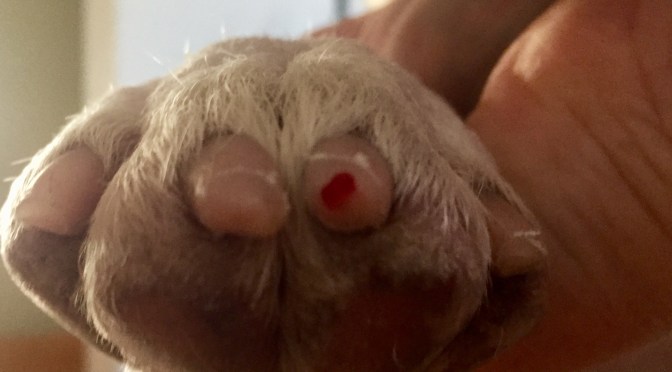
This strong response may have come about because of some bad experience, such as a nail being cut too short, resulting in bleeding and pain. And is very likely to be associated with the awkward and often uncomfortable restraint used when clipping nails or carrying out other foot care. Lots of dogs find the noise of clippers or grinders frightening or startling too.
We have made everything about the whole scenario scary!
Most pet owners will overestimate their pets’ comfort levels in lots of situations and are very likely to presume that their pet is “fine”, even when the dog is showing mere tolerance…most dogs do a wonderful job of merely tolerating human behaviour. Our goal is to achieve more than just tolerance, we want joy!
But, even where fear or discomfort isn’t at the root of the dog’s behaviour, these exercises are helpful in teaching dogs about choice and in teaching appropriate alternative behaviour during handling and nail care.
Just like Day 3 and Day 17 we are going to ask you to really observe your dog’s behaviour and think about consent.
It’s not our pets’ obligation to consent to handling or physical manipulation; our pets are individuals who have likes and dislikes, and good and bad days. They are allowed to say “STOP!” and “WAIT!” if they need to.
And what’s more, teaching them that they can consent, or not, is confidence boosting and bond boosting. You become a beacon of trust, you become predictable and reliable.
I have included these exercises in our project because enrichment is about giving animals skills that help them cope better with their day to day lives (in captivity), along with establishing predictability and controlability.
to improve the dog’s comfort with the handling and procedures involved in nail care
to teach the dog that they can consent to, delay or refuse handling and manipulation
reduce stress associated with loss of predictability and controlability
to encourage a dance of communication, consent, and connection between dog and human
to build that bond between dog and human
to have a fun and rewarding experience in social situations, between dogs and humans
While training exercises certainly fall into the cognitive enrichment category, they can provide so much more.
This process highlights the complex social relationships forged between humans and companion animals. It’s a level of social enrichment that’s tricky to replicate.
By helping the dog learn that they have control over what happens them, in interactions with humans, the world becomes a safer place for them.
When we talk about enrichment being enriching, this is never more clear than when we start to teach behaviours intentionally. It’s the human’s job to set the dog up for success by making sure the behaviour is doable and that rewards are fast-flowing.
There’s no test at the end of this and you and your pet are not under any pressure. Learn to enjoy the time together, whether you achieve the goal behaviour or not. That’s what’s enriching here…the social and cognitive outlets such exercises provide (for both species).
What goals can you add to this list for your pets?
How can we achieve these goals?
work with toys or other rewards that your dog enjoys – associate each handling interaction with a reward and after many pairings, handling becomes just as enjoyable
make it very easy for your dog by gradually adding handling or pressure
watch your dog closely for any signs of reluctance; they might go still, or duck or lean away, they may lick at or mouth your hand or tool, they might pull away
if the animal shows the slightest reluctance, stop immediately
review your approach and don’t go quite so far next time
working like this teaches the dog that, to object, they only need show minor discomfort because you are listening; to gain relief, they don’t need to growl, snarl or snap
keep it simple and split behaviour – reward approximations toward the final behaviour, rather than hoping that your dog will offer the goal behaviour quickly
take your time and work in many short sessions
try for 30 seconds at a time, 5-10 rewards each session, and then take a break
plan each session – what behaviours are you looking for and rewarding?
watch the clips and try out the exercise
portion out your dog’s daily food and allot some for training exercises
make a training mix by adding in something yummier and leaving it all to ‘cook’ together in the fridge; the smells will mingle, harder foods will soften a little, and everything will become more valuable and rewarding
remember to adjust your pet’s diet accordingly to accommodate the extra calories from treats added, where relevant
split your food rewards into little bowls with just the right number of rewards in each bowl so that you are ready to go; stick bowls of rewards in places where you may need to teach and reward behaviours so that you have rewards ready to go
If you are feeding wet or fresh foods, cut up small or mash to a paste and present on a wooden spoon or spatula. Alternatively you can freeze in small ice cube trays or a pyramid baking tray so that you can use small portions and individual treats.
for some of these exercises, I love to use a lappable stuffable (see Day 1) – reward the dog by allowing them to have a few licks and then withdraw the toy
What adjustments will you make for your pets?
Applications of foot-handling comfort:
These exercises continue to build your dog’s comfort in all sorts of situations and interactions with humans. This means that these interactions become safer and more pleasant for everyone.
Pretty much every dog will require some sort of handling and foot care, often regularly, and sometimes in an emergency.
Dogs, when super stressed, either go very still and quiet, or move about, struggle and aggress (or somewhere in between). When they are still and quiet, they are presumed to be ‘well behaved’ and tolerant. When they struggle and aggress, we label them ‘difficult’, ‘vicious’ or ‘dominant’, none of which is accurate.
Either way, this isn’t pleasant for our dogs and as the humans (with the big primate brains), we know that our dogs will need to endure such handling throughout their lives. It’s our job to prepare them for this so it’s a little easier all round.
Helping the dog feel predictability and controlability has wider positive implications, with some research suggesting that these effects generalise to other areas of the animals’ lives. Reducing stress is a good thing!
When we work on handling and husbandry procedures, we establish comfort at different levels that range from management and distraction, to building comfort, to teaching cooperative behaviours.
Throughout our 100 day project, we will introduce exercises from these categories.
Enrichment Options
We are going to start off really easy and get the dog doing all the work…well after you do some crafting…
Making a DIY Nail File & Training the Dog to Use it
Start by making your nail file board by securing a coarse sheet of sand paper to get started with. Finer sand paper can be used to maintain nails length and shape.
This clip outlines how to make the board and introduce the basics to the dog. Work on this over several short sessions to establish these behaviours.
This works really well for the front nails and is now the only nail clipping Decker does. I have always kept his nails pretty short with clippers and files but this is much more comfortable for both him and I!
Here’s Darla, a complete novice, just minutes after the first presentation of the DIY nail board. With clear teaching, a dog will pick this up quickly and with lots of enthusiasm:
Most dogs will drive off their back legs so will often not require too much clipping or filing of the nails on the back feet. But this depends on the conformation of the dog and the shape of their foot. Setting up a back nail file is a little trickier and I haven’t really worked on this with Deck, so I found this clip with a search, giving a nice outline and set up for rear nail filing.
Building comfort with nail husbandry
The covering here on #100days is pretty basic, plus we just have one day to get going on this and, for the most part, creating the most positive, joyous response to foot handling and related procedures requires months of work (usually).
For more on this and tons of support, check out the Nail Maintenance Facebook group for lots of excellent resources, ideas, tips and tricks in a study group format, so will be easier to track your progress.
Or you might like to sign up for a full course that will help you help your dog become more comfortable with nail clipping: Lori Nanan’s Nailed It course.
Creating a CER
Throughout these exercises we are attempting to establish a CER or Conditioned Emotional Response. This means that our dogs learn that one stimulus makes another very reliably happen; reaching toward the dog’s foot, for example, makes yummy treats happen.
A CER helps the dog feel differently about a particular situation. A dog may already have developed a negative CER toward having his foot reached toward due to pain or discomfort during nail clipping. To help form a positive CER, we must undo the negative one (by not exposing the dog to that situation) while building a new, positive association.
This requires lots and lots and lots of practice. In the case of an established negative CER, it might take many tens of thousands of repetitions over many months to turn it around.
We are always following the rules that we have laid out for our dogs:
building progress gradually
allowing the dog decide how comfortable they are, or not
always pairing any move with something yummy, no matter what
listening to the dog
For a CER to be established, we must also get the sequence right:
reach toward the dog and then reach toward the treat
reaching toward the dog makes you produce a treat
if you reach toward the treat at the same time as you reach toward the dog, or if you have the treat out and visible while you reach toward the dog, the dog might not even notice you reaching toward them so no association will be formed
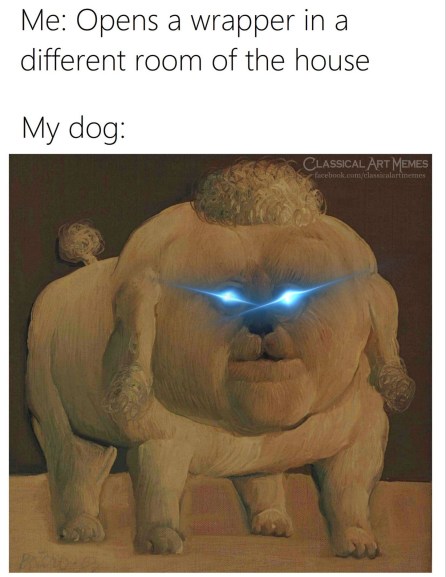
A perfect example of a CER, that I am sure you recognise! Just as the rustling wrapper predicts yummies, we want husbandry and handling contexts to do the same.
Decker recently suffered a very serious injury to his toe that required regular dressing and bandage chances, sometimes daily.
From the beginning, I made bandage change time a big chicken party! Me preparing his bandages and setting up at our bandage station made a lot of chicken tossing happen. That’s right, I established a CER to bandage prep so that even if dressing changing itself was uncomfortable he always looks forward to the process.
Note that when he jumps up he nudges the laid out dressings and not the lunchbox of chicken…bandages make chicken happen!
Even now, months later, if I take out cotton wool, he’s up and super excited, such is the power of a well established CER!
The key to improvement with nail comfort exercises is to practice in lots of short sessions everyday.
If your dog does get excited after these training exercises, help them come down again by working on a stuffable or some snuffling.
Where a negative CER has already been established, it can be a little trickier to get going but you’ve come to the right place to get started!
Right now, when you indicate that the part of the nail care procedure, to which your dog has developed a negative CER, is about to be revealed will kick off an internal emotional and stress response in your dog’s brain and body. This cascades into the behavioural response that you observe. Every time this happens, the scenario is further confirmed as being negative, scary, choice-less and unpleasant to the brain and it will do its best to help the body avoid exposure. In other words, every exposure is probably making it worse.
To turn that around, there are some essentials:
stop the rehearsal of the scary situation
This might mean forgoing nail clipping for the foreseeable future or, where this may affect the dog’s health, having the dog’s nail clipped while sedated by the vet.
Your dog is anticipating when the scary stuff is about to happen so their negative response is starting earlier and earlier on in the process. With more exposure to stress, the brain becomes more sensitive to stress and gets better at anticipating stressful scenarios to allow the body to avoid them.
use new nail clipping stuff
work in a new scenario than before – make it all different
start with the new equipment more gradually so that it never leads to scaring or stressing your dog
use HIGH value food rewards
as above, get your timing right
create a positive CER to each of the stages involved in nail care
For example, this might include:
the sight of nail clipping equipment, such as nail clippers, files or grinders
In that clip, we are clipping matchsticks with the nail clippers – each clip = a treat.
If using a nail grinder, such as a Dremel, you can begin to associate the sound of an electric toothbrush with a treat.
nail clipping equipment approaching and touching the foot
clipping or filing the nail and building the duration
Each of these stages must be worked on individually and carefully paired with high value rewards to create that important CER.
Start at the point at which your dog is comfortable; that might mean the nail clippers on the other side of the room and each time the dog looks, you make a treat happen.
You might have several different exercises happening at the same time, but in separate sessions.
Using distraction
For some dogs, you might be able to give them a yummy lappable to work on while you file their nails, rather than clip them.
Be very clear here, this may only be appropriate for some dogs who are largely comfortable with foot handling and nail manipulation. This just keeps the rewards flowing during the procedure in a more efficient manner because you are using both hands already.
use a spatula, dipped in something irresistible like pate, cable tied to the leg of a chair or table so it’s easy to fit and remove for regular use
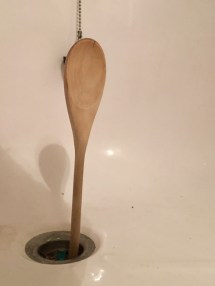
Stick a dipped wooden spoon into the plug hole of the bath or shower for your dog to work on while you groom them there:
line or stuff a Kong toy or other stuffable and wedge in between the sofa cushions; this will be at head height for a lot of medium and large sized dogs
Use a stuffed or line stuffable between your knees to carry out husbandry procedures, such as eye cleaning:
smear the sides of the bath or the walls around a grooming table so that your dog can lap, while you groom and bathe
I found this vegetable cleaner, with a little suction cup, in a home wares store for €1.50 and it’s been really effective for keeping dogs occupied and happy for grooming and bathing. I jam in some pate and freeze it; there are two sides to keep them interested:
You can also buy stuffable toys with suction cups for dogs like the Chase n’ Chomp Sticky Bone or Licky Mats, and there are lots of other types and designs. The suction cup is handy for in the bath and most will connect readily to slick walls or doors.
A Snuffle Mat or similar feeder can be placed on a stool or chair for the dog to work on while you groom them too.
With distraction, the dog may not be as comfortable during the procedure as we would like. I believe it to be safer to file the dog’s nails with a stronger nail file such as those made for filing acrylic nails or similar.
Filing is less likely to cause injury, such as cutting the dog’s quick, so is safer when using a distraction approach to rewarding the dog.
Your challenge
Now it’s your turn. Show us what you and your pets, of any species, can do with these challenges!
Post to your social media accounts, using the #100daysofenrichment so that we can find you and join our Facebook group to share your experiences, ideas and fun!
You can comment right here too 🙂
We look forward to hearing from you and your pets – have fun & brain games!
Welcome to Day 63 of #100daysofenrichment and thank you for joining us on this journey!
Although our challenges are directed mainly at dogs, we want all species to enjoy and benefit from #100daysofenrichment so, please join in, adjust and adapt to help your pet or companion live a more enriched life.
Every Sunday during #100daysofenrichment is Sunday Funday! This means you and your pet repeat your favourite challenge or challenges from the week.
You can do it exactly as you did first time round, you can try a different option, build on your progress already established, reinvent and rejig it…what ever you want to do with the last week of challenges!
Now it’s your turn. Show us what you and your pets, of any species, can do with these challenges!
Post to your social media accounts, using the #100daysofenrichment so that we can find you and join our Facebook group to share your experiences, ideas and fun!
You can comment right here too 🙂
We look forward to hearing from you and your pets – have fun & brain games!
Welcome to Day 62 of #100daysofenrichment and thank you for joining us on this journey!
Although our challenges are directed mainly at dogs, we want all species to enjoy and benefit from #100daysofenrichment so, please join in, adjust and adapt to help your pet or companion live a more enriched life.
You can set up simple or more elaborate searches, hiding just one food item, or hiding one or more food puzzles, like in the video clip above.
These can be set up any place, any time, in the house, or out on walks. Your dog is already really good at finding things with but now we are going to ask him to search for something we know is hidden.
Add to fetch games, or even better, play toy searching rather than repetitive fetch games
Searching for a toy is likely much more beneficial that strenuous, repetitive fetch games. Even slotting a search in to fetch games, every two or three throws is a nice way of varying the game, better maintaining healthier arousal levels and giving your dog a whole-brain (and body) work out!
Use snow or long grass to really challenge your dog’s nose and searching skills!
Safety First
When choosing a search area, check it carefully before bringing the dog in and beginning the search.
Check for cables, sockets, glass, sharp objects or corners, machinery or moving parts, nails or staples, hot surfaces, slippery surfaces, hazardous substances, distractions from scents; even things like doors or steps can cause the dog to bring their head up suddenly, striking it.
Always play safe!
Searches
You can hide your dog’s food, treats, favourite toy or even Stuffables!
Keep it simple, and think of how the air might flow through a space to understand how your dog will detect and narrow in on odour. We talk a lot about this on Day 55 too!
As always, keep the challenge do-able for your pet. Hide one high value food or item in an easy accessible spot to get started with. The more fun and winning your dog has with this game, the better they will be able to persist and work on multiple and harder hides.
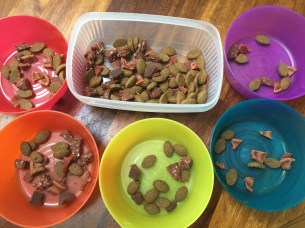
Scavenger hunts are a search with several prizes, so they often suit food more than toys.
You can scavenger hunt indoors, hiding small piles of food rewards or even just one treat, behind different pieces of furniture, doors and so on. Let your dog loose and guide them to any hides they miss.
Outdoor scavenger hunts can create extra challenge and it can take a bit of practice for the dog to learn to keep searching for multiple hides.
Drop a treat in every couple of steps that you take; start with straight lines or gentle arcs but once your dog is methodically searching, you can add turns and bends.
Ideally, we would like our dogs to be sniffing out their regular meals, as much as possible. But, some dogs will need a little help to get them going and we can have our dog sniffing for treats too!
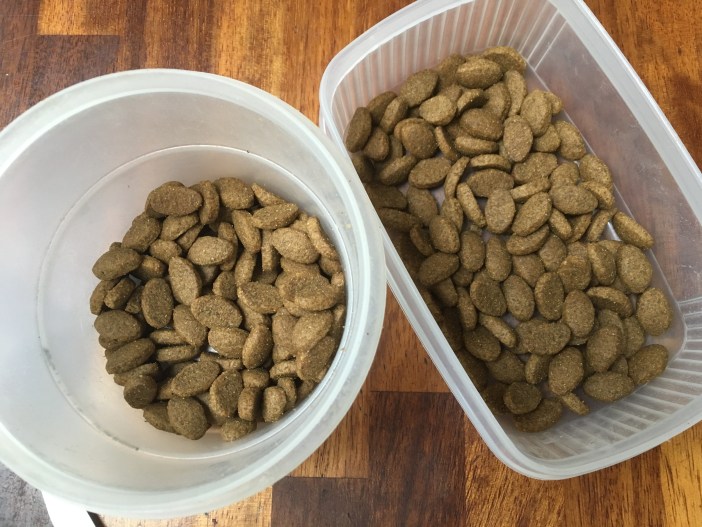
Kibble is a pretty versatile food type for enrichment type feeding, and works well for this exercise.
You can add kibble in with other yummier treats and toss those. Or you can make a Training Mix so that kibble smells and tastes yummier, but without having to add extra calories or other foods, should the dog be sensitive or restricted.
You can improve the smell/taste of kibble by grilling it a little, so that it becomes crunchier and oilier. You might also soak it in stock or other flavouring.
Wet and fresh foods can be a little more challenging:
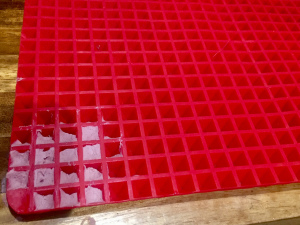
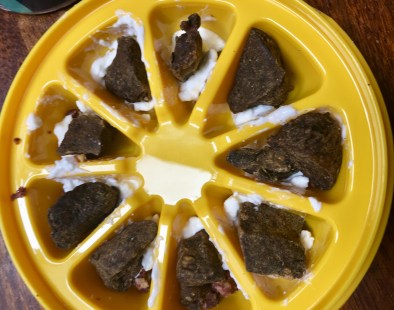
Fresh meats and meat mixes (e.g. raw and home prepared diets) – cut up into small pieces, boiled or baked, frozen in small ice cube trays or pyramid baking mats for small individual treats.
Alternatively, you could use dried or semi-moist meats and cut them into small pieces for tossing. (Note that you feed a smaller volume of dried or dehydrated foods as they are more concentrated.)
Wet feeds (e.g. canned foods) – frozen in small ice cube trays or pyramid baking mats for small, individual treats.
Don’t forget fruit and vegetables too, if you’re dog likes them. Frozen peas are one of Decker’s favourites for sniffing!
Your challenge
Now it’s your turn. Show us what you and your pets, of any species, can do with these challenges!
Post to your social media accounts, using the #100daysofenrichment so that we can find you and join our Facebook group to share your experiences, ideas and fun!
You can comment right here too 🙂
We look forward to hearing from you and your pets – have fun & brain games!

















 AniEd Ireland