Welcome to Day 35 of #100daysofenrichment and thank you for joining us on this journey!
Although our challenges are directed mainly at dogs, we want all species to enjoy and benefit from #100daysofenrichment so, please join in, adjust and adapt to help your pet or companion live a more enriched life.
Every Sunday during #100daysofenrichment is Sunday Funday! This means you and your pet repeat your favourite challenge or challenges from the week.
You can do it exactly as you did first time round, you can try a different option, build on your progress already established, reinvent and rejig it…what ever you want to do with the last week of challenges!
Now it’s your turn. Show us what you and your pets, of any species, can do with these challenges!
Post to your social media accounts, using the #100daysofenrichment so that we can find you and join our Facebook group to share your experiences, ideas and fun!
You can comment right here too 🙂
We look forward to hearing from you and your pets – have fun & brain games!
Welcome to Day 34 of #100daysofenrichment and thank you for joining us on this journey!
Although our challenges are directed mainly at dogs, we want all species to enjoy and benefit from #100daysofenrichment so, please join in, adjust and adapt to help your pet or companion live a more enriched life.
Saturdays during #100daysofenrichment are all about emphasising the dog in all our dogs; all about sniffing and doing dog things.
And today we are going to add something further to that; today we will be adding engagement to sniffing to engagement to sniffing…
Sniffing isn’t a problem behaviour but distractions, like irresistible smells, are often viewed as the enemy to training and attention. It doesn’t have to be that way.
Sniffing doesn’t need to be a distraction; we won’t make it a distraction because we won’t be stopping the dog from doing it.
We can allow dogs sniff, make sure they get their jollies while not having to nag them…and still have them choose us!
What is this black magic?, I hear you ask. It’s engagement!
Engagement…what is it good for?
Like all buzz words that are the talk of training-town, engagement is difficult to define. We know it when we see it, and we certainly know when we don’t have it.
‘To engage’ is defined as participating, to attract someone’s attention, and the one I particularly like, to establish meaningful contact or connection.
The important things to note here is that the dog chooses to engage, that they are working to attract your attention, and that you’re (both) developing a meaningful connection.
Engagement, for me and the dogs I work with, including my own, is about the dog choosing to engage, wanting to engage, finding me the most rewarding, over all the other things.
And that’s the key; the dog wants to be involved and to participate.
You can easily see the value of engagement…it gets you great recall, it gets you nice loose leash walking, it gets you working around distractions.
All while providing the dog with choice. The choice to engage.
When engagement happens, the dog is fighting to engage regardless of the presence of distractions and triggers and regardless of whether you have treats or toys.
Attention and focus and engagement…oh my!
Is engagement the same as attention and focus?
Well, yes and no. Great engagement will get you attention and focus, that’s for sure.
Attention probably means eye contact or something close to that. While focus may not necessarily require that the dog focus on you, perhaps on something specific in the environment.
We might teach these skills as part of working on engagement.
How ever you define it, engagement is chosen by the dog, rather than cued; engagement is not contingent on you having food rewards or toys.
The key to engagement is that you are not trying to get it, you are worthy of engagement and your dog fights to engage!
You can see that engagement is the foundation to teaching all the other behaviours; it’s what we build our relationship, with our dog, on and with.
Engagement is a two-way street
Making engagement happen starts with the human. If we want our dog to choose us, regardless of what else is going on and regardless of whether you have treats or toys, we have to work to prove that engaging with us is the best!
When the dog is engaged, choosing you regardless, he pushes into the learning and interacting process; he is more than meeting you halfway.
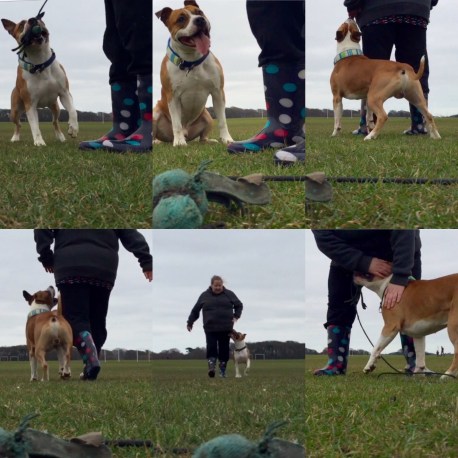
Here’s a clip of Decker and I, in a play-group situation with dogs of mixed age, sex, and neuter status. Decker is an entire male Am Staff (a type of “pit bull”). I have no treats, food or toys – he fights to engage regardless of the distraction level.
Link (Disclaimer: this was not intended to stress out any dog, but more so to demonstrate the ability to develop such owner-focus and engagement without the use of aversives.)
Spot the fighting to engage?!
We certainly want our dogs to be dogs, and we also need them to learn to choose us, for safety and for relationship building. Don’t think of this as an ‘obedience’ exercise or for control. This is about you both developing a connection in the real world, where distractions and worries may be difficult to avoid or control.
Choosing you keeps your dog safe, allows him to ask for guidance, and seek out relief.
Reinforce engagement
Reinforcement strengthens behaviour, so your dog’s disengagement is information telling you that you are not making sufficient reinforcement available for engagement.
We tend to pile on the encouragement, excitement, food and toys trying to get our dogs to engage. When their attention wanes, we attempt to get it back by offering access to reinforcers. Ask yourself, what behaviour are you really reinforcing?
Engagement makes good things happens. Engagement means that the dog accesses behaviour they like to do. Reinforce behaviour with behaviour.
We start by teaching the dog to disengage, and when they engage they get to go away again. Because we never become associated with stopping the fun, the dog will want to choose us over and over.
It’s never too late to start and it’s always worth it. But, it doesn’t happen over night – engagement is a journey, rather than a destination.
Level 1 Go Sniff! & Engagement
On Day 20, we started to work on sniffing on cue: Go Sniff!
Beginners:
If you haven’t worked on Go Sniff! just yet, start with that.
Intermediate:
set up using a SnuffleMat or similar, on grass or even just the floor
take three treats
distribute them so you know where they are, roughly
cue the dog to Go Sniff! and allow them to eat the treats
wait neutrally – don’t talk to the dog, don’t make eye contact, just wait
wait for your dog to engage – they might look toward you, move toward you, make eye contact
as soon as they do you can mark (with a YES! or click, if you do that) or just cue them to Go Sniff! again and distribute three treats as before
Advanced:
bring your dog to a smelly area, somewhere they usually sniff and investigate
allow them to sniff and sniff
remain neutral
if the dog is on lead, follow them to allow them to sniff about and explore
wait for engagement
as soon as they engage, cue them to Go Sniff! again and bring them back to the smelly place to allow them to sniff
you can use food as in the Intermediate exercise if you like, but you don’t have to unless the dog won’t sniff
Practicing this exercise in relatively controlled conditions, and practicing A LOT, helps establish the idea that sniffing is not a treat or a forbidden activity in a training context. Sniffing is the behaviour that gets the fun happening, via engagement.
Level 2 Engagement in the Real World
Work on Level 1 exercises first. A lot. In lots of places around the house and garden, or other controllable situations.
If your dog finds it quick and easy to engage, and you can make that really rewarding, try out Level 2.
Bring your dog out for a Sniffathon. Let your dog sniff and roam and do doggie things.
Wait for them to engage. Just wait.
As soon as your dog engages, come to life. Reward them with five food rewards in a row, one after another. Have some fun with food.
Tell your dog to Go Sniff! and release them to be a dog again. Show them your empty hands and move away. Allow your dog to sniff and explore again. Repeat.
Time how long it takes for them to engage – over time, we should be seeing a reduction in that time, with lots of practice.
Play safe!
If you are working in a non-secure public area, please make sure your dog is safe. Use a long line and follow them, allowing them to explore without pressure.
Ask the dog!
Engagement exercises are the perfect way of asking your dog is they are ready and able to work, interact, play or focus.
Rather than nagging them with cues or trying to drag their attention back to you, let them fully engage with their world, gather information, assess safety. Your dog will learn to tell you when they are ready and able.
Practicing this in all sorts of environments and amidst all sorts of distractions will help to establish this as a way of life for you and your dog.
To make sure this is fun and pleasant for all, take care with distractions and triggers. Work at such a distance that your dog is able to engage with you; if they are super focused on other dogs, people or goings on, then increase distance. Work in more controllable situations.
Playing Fun with Food games helps to boost the value of rewards and makes sure that there is a fun behaviour reinforcing engagement, not just eating.
Here’s my engagement monster and I play/train right beside wild deer (in the Phoenix Park). I make flirt pole and fun happen near distractions so engaging with me is a really easy choice!
And here we are surprised by a deer, who came running out of cover, apparently curious about our activity (a lot of people feed these deer here).
Rather than chasing a deer tens of metres away, he chooses to engage.
The deer follows us for a bit so I have his lead on, just hanging, just in case. Safety first, always.
But, regardless, he chooses engagement.
Ideally, we would like our dogs to be sniffing out their regular meals, as much as possible. But, some dogs will need a little help to get them going and we can have our dog sniffing for treats too!
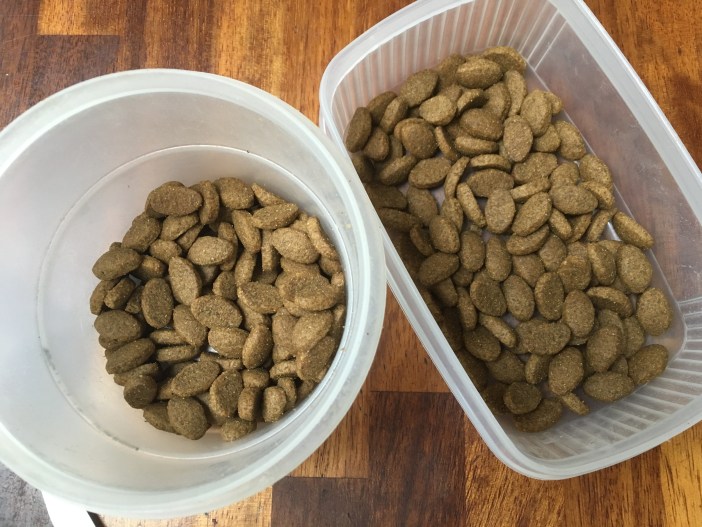
Kibble is a pretty versatile food type for enrichment type feeding, and works well for this exercise.
You can add kibble in with other yummier treats and toss those. Or you can make a Training Mix so that kibble smells and tastes yummier, but without having to add extra calories or other foods, should the dog be sensitive or restricted.
You can improve the smell/taste of kibble by grilling it a little, so that it becomes crunchier and oilier. You might also soak it in stock or other flavouring.
Wet and fresh foods can be a little more challenging:
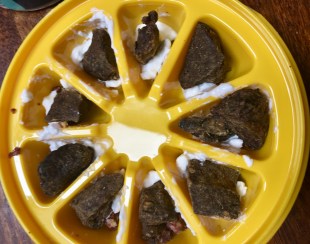
Fresh meats and meat mixes (e.g. raw and home prepared diets) – cut up into small pieces, boiled or baked, frozen in small ice cube trays or pyramid baking mats for small individual treats.
Alternatively, you could use dried or semi-moist meats and cut them into small pieces for tossing. (Note that you feed a smaller volume of dried or dehydrated foods as they are more concentrated.)
Wet feeds (e.g. canned foods) – frozen in small ice cube trays or pyramid baking mats for small, individual treats.
Don’t forget fruit and vegetables too, if you’re dog likes them. Frozen peas are one of Decker’s favourite for sniffing!
Your challenge
Now it’s your turn. Show us what you and your pets, of any species, can do with these challenges!
Post to your social media accounts, using the #100daysofenrichment so that we can find you and join our Facebook group to share your experiences, ideas and fun!
You can comment right here too 🙂
We look forward to hearing from you and your pets – have fun & brain games!
Welcome to Day 33 of #100daysofenrichment and thank you for joining us on this journey!
Although our challenges are directed mainly at dogs, we want all species to enjoy and benefit from #100daysofenrichment so, please join in, adjust and adapt to help your pet or companion live a more enriched life.
Now it’s your turn to get creative! Every Friday is Freestyle Friday. We’ll give you the ingredients for a puzzle or enrichment device and you build it.
Rules:
you must use all the ingredients
you can add anything else you like, or nothing at all
cardboard tubes, toilet roll or kitchen roll tubes, Pringles tubes and similar
You can add food or toys or anything else appropriate, if you like. Or you can use this as it is.
We can’t wait to see what fun and brain games you and your pet get up to with this one!
Your challenge
Now it’s your turn. Show us what you and your pets, of any species, can do with these challenges!
Post to your social media accounts, using the #100daysofenrichment so that we can find you and join our Facebook group to share your experiences, ideas and fun!
You can comment right here too 🙂
We look forward to hearing from you and your pets – have fun & brain games!
Welcome to Day 32 of #100daysofenrichment and thank you for joining us on this journey!
Although our challenges are directed mainly at dogs, we want all species to enjoy and benefit from #100daysofenrichment so, please join in, adjust and adapt to help your pet or companion live a more enriched life.
play is the ultimate in relationship boosting, stress busting fun
games that start with making food fun and then using that to generate the fun in the interaction and engagement
social, cognitive and food based enrichment
play and engagement form the foundation of relationships and successful training
lots of these exercises can get pretty exciting, so it might be better that smaller children not take part but help in preparing training rewards.
Children can be great dog trainers but require lots of guidance and support.
Remember, supervise children in all enrichment activities and interactions with pets.
we are going to be strict with the duration of sessions for these challenges; each session should be no longer than one minute – set your alarm and time it!
Have as many sessions as you can today.
What do you need?
food rewards – you can use your dog’s regular food, a training mix, commercial treats, home prepared treats such as cut up meats, cheese, vegetables or homemade treats such as liver or tuna cake
We will talk about human-dog play throughout this program, and this is our foundation starting point.
Enrichment Goals:
to have fun with food
to make the fun about the engagement and interaction, and not just the food
to build engagement between dog and human
to build that bond between dog and human
to have a fun and rewarding experience in social situations, between dogs and humans
We are not working on training exercises today but I do want to make sure that we understand that all behaviour is reinforced or punished. Reinforcers increase behaviour, punisher decrease it.
So, if behaviour is happening something is reinforcing it, and if it’s not happening, something is punishing it.
Play is no different. Just like cueing behaviour and your dog responding is a dance of communication, play is too. Perhaps, even more so.
You do behaviour, your dog responds, you respond, your dog responds, you respond and so on and on.
This allows for a wonderfully complex level of communication between two species, forging a most health relationship between our two species.
This is a level of social and cognitive enrichment that’s tricky to replicate.
What goals can you add to this list for your pets?
How can we achieve these goals?
keep it really simple today – get a good understanding of inter-species play, and how we humans often get it pretty wrong
take your time and work in many short sessions
try for 30-60 seconds at a time, 5-10 rewards each session, and then take a break
it’s a good idea to film yourself and review the footage (you don’t need to share)
portion out your dog’s daily food and allot some for these exercises – these games are excellent for boosting the value of food so your dog wants to work for every day food, because we’ve made it so much fun
make a training mix by adding in something yummier and leaving it all to ‘cook’ together in the fridge; the smells will mingle, harder foods will soften a little, and everything will become more valuable
remember to adjust your pet’s diet accordingly to accommodate the extra calories from treats added, where relevant
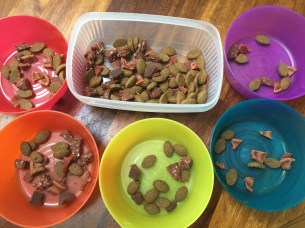
split your food rewards into little bowls with just the right number of rewards in each bowl for each session, so that you are ready to go
If you are feeding wet or fresh foods, cut up small or mash to a paste and present on a wooden spoon or spatula. Alternatively you can freeze in small ice cube trays or a pyramid baking tray so that you can use small portions and individual treats.
What adjustments will you make for your pets?
Applications of Fun with Food games:
Play is a tricky thing that we think we would recognise if we see it, but might not be able to adequately define it. And that’s the case in the literature too.
We think that animals play, but we’re not really sure why. The play research suggests we start by defining play so here’s a simple run down…
play for play’s sake, because you choose to play
play is fun, and that’s enough
play feels good and we want to engage in play (you don’t have to play)
play can sometimes look serious, but there are important differences; the serious parts happen out of order or in the absence of normal triggers relative to the serious stuff
play is creative, spontaneous and improvised
play happens when we feel safe – time should fly, you should feel less self-conscious
And although there might be some agreement on how we might define play, when it comes to deciphering the functions of play, there are lots of differences.
Play probably helps animals prepare for swings in emotion, gets them ready and honed for life and let’s not forget, play is fun! Having fun is a viable function of behaviour.
Dogs and humans play differently and dog-dog play differs from dog-human play (and differs from human-human play). But, like in so many areas, dogs and humans share tons of the basic rules of social interactions.
As is so often typical of us humans, we often approach play in the way we think the dog should play or in the way we think the dog should enjoy playing. And this so often turns the dog off play, changes the nature of games and ultimately causes break downs in communication and relationship.
We even have research that looks at how people play with their dogs and how our play behaviours overwhelm our play partner, yet we continue to push, presumably believing that this is fun and this is how it should be done.
I spend a lot of time working on improving relationships between pets and their people; that’s what this entire project is about too. I also spend a lot of that time helping people play with their dogs (certainly not the worst job in the world!).
I incorporate play in almost every training and behaviour program I design. My most common problem is that people don’t appear to know how to play with their dogs and sometimes don’t value play’s importance, whether that be toy based games, or just silly, playing interactions.
Our trainers will tell you that that is something that causes me great stress and concern – I take play very seriously, playfully serious!
I believe that play is life, and play is a way of dealing with life. Improving your play with your dog does so much more than just fun with food.
Just because you (think you) utilise reward based training, R+, “force-free” or whatever “positive” label, doesn’t mean it’s a happy, playful learning experience. Teaching playful behaviour isn’t the same as playing.
The beauty of establishing these foundations is that the more you play together, the more you will each shape one another’s behaviour. Your behaviour will evolve, adapt and adjust to your player.
The ultimate goal in play is to get really nice play-interactions, without treats or toys. The two players, dog and human, are participating for the pure joy.
Play starts with an invitation and consent, the players make eye contact and ask if they want to keep the game going; play is cooperative so we ask and answer. Play involves mirroring of behaviour and balanced participation.
Today, we start on the road to wonderful, consent-full, choice-led, partnership based play between dog and human. What could be better than that?
Enrichment Options
Option 1: Play with your food
Everything can be fun and playful, even boring food. Start by introducing these games into your repertoire – food and toy play are gateways to wonderful, playful and engaging interactions.
I love these games for dogs who are OTT about food and for those who are little less enthusiastic about food.
Play with the most boring food that your dog will work for – you can always increase value, if needed.
Play with your Food Games:
Which Hand? – great just for fun and to keep your dog occupied if you are waiting around
Catch! and Catch on the Move – fun for talented catchers to keep them focused and responsive to you, even around distractions
Goal Keeping and Kibble Chasing – fantastic rainy day game and to keep your dog occupied and focused
Go Geddit! – another great rainy day game
Find It! games – hide under a blanket (Day 29) and get them snuffling, put it on cue so you can use it any place, any time (Day 20) – wonderful to divert their attention, help them calm and keep them busy
Deck and I play with kibble and these games, that we have been playing together forever, are the reason Decker will joyfully and ENTHUSIASTICALLY work/play for boring, everyday cardboard kibble in any situation.
These games are played in levels; when you get true two-sided, playful engagement at one level and you are ready for the next.
These are the starter levels that will lay a wonderful foundation in play, beyond the #100days. Practice today, tomorrow and beyond and slowly, incrementally build that all important and often elusive engagement. (More engagement and play to come over this project!)
Level 1
Take a look at the Play with your Food games.
5 pieces of kibble (or 5 food rewards), set the timer for 30 seconds (or there abouts)
a different Play with your Food game for each piece
plan your moves ahead of starting with the dog
match your dog’s enthusiasm – if they are quiet, you are quiet, if they are up there, you are up there
It’s a common mistake that pet owners (and trainers) will try to up the ante on enthusiasm to draw the dog’s excitement out and subsequently overwhelming the dog. For play, meet your dog where they’re at.
Take a break after each session but do try to have as many sessions as you can.
Here’s me playing with a novice dog, inexperienced in playing with humans and a little cautious about the world (we had also just met). Her name is Sasha and she had a pretty rotten start but is now in a wonderful, loving home and is blossoming.
It doesn’t have to be quite so nutty as with crazy-boy and I. Deck and I are experienced players and have been playing these games since we first met (over six years ago).
If your dog is in to a little moving around, add that, but your play in-between can be more static and might even just involve a couple of seconds of baby-talk or goofy faces. That’s play too!
Level 3
Now, we’re really going to challenge your ability to keep your dog engaged with you and the game.
Please don’t push this. Play should be fun, not goal oriented and rule-led. Work on Levels 1 & 2 for as long as necessary – there are no prizes for getting to Level 3. It won’t be enjoyable for your dog should you push to this before you are both ready.
5-10 kibbles or food rewards from you
a bowl of the same food rewards on the floor and accessibly
keep the dog with you
the game, with the food, is more rewarding and fun than the food for free
This isn’t a training exercise so no cues, such as leave-it or recalls. If your dog goes for the free food, so be it. Go back and work on Level 2 some more.
In this session, you can see by placing the food I toss too close to the bowl on the floor, we have some close calls. I use our engagement skills and excitement to keep him with me – I am more fun and my food is more fun than the free food (the same food).
make it too exciting when the dog is just starting to show interest
expect too much
rely on food too much
get stuck
play too long
Your challenge
Now it’s your turn. Show us what you and your pets, of any species, can do with these challenges!
Post to your social media accounts, using the #100daysofenrichment so that we can find you and join our Facebook group to share your experiences, ideas and fun!
You can comment right here too 🙂
We look forward to hearing from you and your pets – have fun & brain games!
My favourite playa, whose capacity for joy, fun and play apparently knows no bounds and has me in amazement and awe (and sometimes bewilderment) every day.
Welcome to Day 31 of #100daysofenrichment and thank you for joining us on this journey!
Although our challenges are directed mainly at dogs, we want all species to enjoy and benefit from #100daysofenrichment so, please join in, adjust and adapt to help your pet or companion live a more enriched life.
shallow, open boxes with fun and puzzles inside encouraging snuffling and foraging
food based enrichment
add food to loose items for your dog to snuffle out
get the family involved in this one – kids love making puzzles for pets and these challenges offer lots of opportunities for children to use their imagination to come up with the best Foraging Boxes for their pets.
Remember, supervise children in all enrichment activities and interactions with pets.
Foraging box prep will probably take you about five minutes – having a collection of Foraging Box stuff is a good idea…it will resemble a pile of rubbish or recycling!
What do you need?
shallower, open boxes or tubs
loose materials and items such as paper e.g. packing paper, kitchen roll, newspaper etc., eggboxes, balls, paper cups, Stuffables, and so on
While this challenge is certainly food based, they are also experiencing cognitive, sensory and environmental enrichment, with lots of crossover between categories.
Working out how to get to the food and developing snuffling skills in sniffing out and reaching the food are examples of cognitive challenge.
Sniffing out, tasting and chewing food all offer sensory pay off, but so does finding their way through each food puzzle, determining its value, and engaging in the puzzle of getting to the good stuff.
Foraging boxes encourage pets to interact with their environment – just the very interaction with the box, sticking their head in, is encouraging the pet to manipulate their surroundings, to get the things they like.
By offering a variety of Foraging Box puzzles, at different difficulty levels, we want to help the dog expand their range of puzzle-busting behaviours and facilitate your pet applying strategies from other puzzles to new ones; that’s a true cognitive gift and is growing your dog’s brain!
What goals can you add to this list for your pets?
Dogs can get all sorts of enrichment fun out of a Foraging Box! (Link)
How can we achieve these goals?
give your pet plenty of space for working on Foraging Boxes and bear in mind there will be mess, so think about spaces that are easier for clean up
the more difficult you have made the challenge, the higher the value the reward must be so use HIGH value foods to motivate exploration and experimentation and make it VERY easy to get the food (no frustration!)
if your dog just dives in, in full on destruction mode that might also be an indicator that they need an easier challenge so they get to experiment with a broader range of behaviours
What adjustments will you make for your pets?
Foraging Boxes can be a great way to recycle packing material!Link
Applications of Foraging Boxes:
Foraging Boxes are my go-to – easy to set up, easy to adjust for individuals, and totally involving for dogs…all that sniffing completely sucks them in and they engage fully with the task.
They are such a great way to help encourage dogs to interact with new and weird items, providing opportunities to boost confidence and allow the dog learn that they are safe to snuffle, and it gets them yummies!
It’s important, therefore, that we adjust the Foraging Box difficulty so that the dog can engage, snuffle and win!
Because of the home made nature and variable materials used in Foraging Boxes, it’s best to supervise your pet carefully when they have access to this puzzle.
Know your dog! If you have an ingester, Forgaing Boxes may not work and you might need to supervise them closely.
If you are concerned about your dog ingesting non-food items during puzzling, have a pocketful of HIGH value treats in your pocket and be ready to toss a couple toward your dog, across their eyeline, if you think they are thinking about eating something they shouldn’t.
Making sure the challenge is very doable and they can get to the hidden food rewards quickly is key to modifying their behaviour and expectations during puzzling.
Check all your equipment for this challenge carefully and make sure to remove tape, staples, other fasteners, small pieces and plastic pieces. For loose items, only use things with rounded corners. Play safe!
Enrichment Options
Variety is the spice of enrichment, so try different loose items in each Foraging Box, or mix ’em up for a Mixed Media Foraging Box!
Beginners:
start with just a few items to a box or tub
make sure you can see the base of the box or tub and most of the food rewards
Now it’s your turn. Show us what you and your pets, of any species, can do with these challenges!
Post to your social media accounts, using the #100daysofenrichment so that we can find you and join our Facebook group to share your experiences, ideas and fun!
You can comment right here too 🙂
We look forward to hearing from you and your pets – have fun & brain games!
Welcome to Day 30 of #100daysofenrichment and thank you for joining us on this journey!
Although our challenges are directed mainly at dogs, we want all species to enjoy and benefit from #100daysofenrichment so, please join in, adjust and adapt to help your pet or companion live a more enriched life.
similar to chewing and dissection in annoying pet owners
food based and sensory based enrichment
different dogs have different motivations for digging, with some digging at any opportunity, while some show little interest in digging as a past-time
get the family involved in this one – kids love making puzzles for pets and these challenges offer lots of opportunities for children to use their imagination to come up with the best busy boxes for their pets. There are some training exercises here too, and while children can be great dog trainers, lots of adult support and guidance are required.
Remember, supervise children in all enrichment activities and interactions with pets.
Lots of these digging puzzles will take only minutes to prepare (and some minutes to clean up after too!) and training exercises are best practiced in very short sessions of 30-60 seconds at a time; have as many sessions as you can!
access to different loose substrates such as potting soil, children’s sand, loose soil and foliage (in the real world)
loose items such as paper cups, paper, plastic bottles, balls, toilet roll tubes, Pringles tubes, stuffable toys like Kongs and so on (items with rounded or soft corners)
large, shallow tub or box
Enrichment Goals:
to facilitate digging behaviour
to encourage a wide range of foraging and exploratory behaviours
to do more feeding related behaviour than eating
to encourage the development of strategies (behaviours) for getting the food out of digging boxes
to teach a cute trick
to teach the dog that their human will ask for behaviour and will make sure reinforcement is available – this reduces stress by improving predictability and controlability
to build the bond between dog and human and have fun together
to learn about learning – this is just another puzzle to your dog…”how do I train the human to make rewards available?!“…it’s all human training, for dogs!
While this challenge may be food based, dogs are also experiencing cognitive, sensory and environmental enrichment, with lots of crossover between categories.
Digging behaviour is part of the in-built motor patterns all dogs come with. Many dogs will dig for the sake of digging, as a release for stress and arousal, as a displacement behaviour and apparently, just for the fun of it!
You can certainly introduce food to digging pits, adding a food based component to these challenges too.
Digging encourages pets to interact with their environment – just the very interaction with the digging substrate is encouraging the pet to manipulate their surroundings, to get the things they like.
Training exercises certainly fall into the cognitive enrichment category and can provide so much more.
Providing dogs with cues allows for a complex level of communication between two species; you are merely requesting that the dog perform behaviour (he already knows how to do the behaviour…they can already dig) and that request comes with a contract. Respond appropriately to this signal and rewards are coming your way. That’s the deal…that’s what being a good teacher is about – keeping your word and making it easy for your dog to train you.
This forges the most healthy of relationships between our two species. This is a level of social enrichment that’s tricky to replicate.
When we talk about enrichment being enriching, this is never more clear than when we start to teach behaviours intentionally. It’s the human’s job to set the dog up for success by making sure the behaviour is doable and that rewards are fast-flowing.
There’s no test at the end of this and you and your pet are not under any pressure. Learn to enjoy the time together, whether you achieve the goal behaviour or not. That’s what’s enriching here…the social and cognitive outlets such exercises provide (for both species).
What goals can you add to this list for your pets?
How can we achieve these goals?
give your pet plenty of space for working on these challenges and bear in mind there will be mess, so think about spaces that are easier for clean up
the more difficult you have made the challenge, the higher the value the reward must be so use HIGH value foods to motivate exploration and experimentation and make it VERY easy to get the food (no frustration!)
work with toys or other rewards that your dog enjoys – the reward for doing the behaviour must be worth it and it’s the dog that decides something is worth working for!
keep it simple and split behaviour – reward approximations toward the final behaviour, rather than hoping that your dog will offer the goal behaviour quickly
take your time and work in many short sessions
try for 30 seconds at a time, 5-10 rewards each session, and then take a break
plan each session – what behaviours are you looking for and rewarding?
portion out your dog’s daily food and allot some for training exercises
make a training mix by adding in something yummier and leaving it all to ‘cook’ together in the fridge; the smells will mingle, harder foods will soften a little, and everything will become more valuable
remember to adjust your pet’s diet accordingly to accommodate the extra calories from treats added, where relevant
split your food rewards into little bowls with just the right number of rewards in each bowl so that you are ready to go; stick bowls of rewards in places where you may need to teach and reward behaviours so that you have rewards ready to go
If you are feeding wet or fresh foods, cut up small or mash to a paste and present on a wooden spoon or spatula. Alternatively you can freeze in small ice cube trays or a pyramid baking tray so that you can use small portions and individual treats.
What adjustments will you make for your pets?
Applications of Digging:
Digging is a food related and social sensory related behaviour; dogs may dig to acquire or cache food (burying) and dogs may dig shallow sleeping pits or small dens for puppies to be born.
We have selected for digging conformation and increased digging motivation in lots of types of dogs too, who, for example, have been used to unearth quarry or go to ground after game.
Because this behaviour may be useful to the adult dog, puppies and young dogs, particularly, will practice lots and lots of digging…much to the annoyance of green-fingered owners…
But, digging will fulfill functions in dogs’ lives beyond food. And while providing food based enrichment is important for dogs, appropriate digging might be applicable in lots of ways, helping dogs experience new insights to their sensory world.
Digging is goal oriented behaviour so providing exposure to positive stress or eustress. All of the challenges through #100daysofenrichment are designed to provide dogs with lots of opportunities for eustress. The more the animal has experience with good stress, the more resilient they become.
Digging facilitates the development of dexterous skills, contributing to cognitive challenge.
Sniffing out, tasting food used offer sensory pay off, but so does finding each hidden food item, determining its value, and engaging in the puzzle of satisfying the digging goal.
While young dogs are most likely to dig a lot, dogs of any age may dig, while some dogs show no interest in digging whatsoever.
Digging is likely to be most intense as dogs mature through adolescence, with lots of dogs discovering the joys of digging at about 5-7 months of age; of course, they may have been digging before that but not been able to cause too much damage due to their size, strength, and coordination.
Lots of exploratory behaviour will be seen in adolescent dogs as they continue to experience and learn about their world.
Digging may also function as a stress releaser and a displacement behaviour. And it’s no surprise then, that dogs confined and isolated outdoors for long periods will take up digging.
You might notice that your dog digs intensively before or after defecating, during or part of “zoomies”, when alone or when frustrated at a barrier.
Dogs might use digging to stir up odour, allowing them to gather more olfactory information from a particular spot, and I have even seen dogs use digging motion in behaviour that would seemingly be used in butchering prey animals, separating skin and meat.
Because of the home made nature and variable materials used in some of today’s challenges, it’s best to supervise your pet carefully when they have access to these puzzles.
Know your dog! If you have an ingester, some of these challenges may not work for you or require adjustment.
If you are concerned about your dog ingesting non-food items during puzzling, have a pocketful of HIGH value treats in your pocket and be ready to toss a couple toward your dog, across their eyeline, if you think they are thinking about eating something they shouldn’t.
Making sure the challenge is very doable and they can get to the food rewards quickly is key to modifying their behaviour and expectations during puzzling.
Check all your equipment for this challenge carefully and make sure to remove tape, staples, other fasteners, small pieces, plastic pieces and so on. Play safe!
Enrichment Options
Dogs dig. And some dogs dig a lot. For many owners, this digging behaviour is a problem, possibly ruining their gardening efforts.
If digging is something you want to tackle, don’t think in terms of stopping the digging. Instead, think about offering acceptable outlets for digging.
Try the following program:
confine the dog from digging areas or prevent them digging there by supervising and/or having them on a long line in that area
some suggest to put the dog’s own poop into any existing holes to prevent them going back to continue the excavation
provide a digging pit and encourage digging there by providing a loose substrate, such as potting soil, and burying frozen stuffables or chews or food rewards there.
Make food parcels with paper or cardboard tubes and bury those.
Option 1 Digging in the Wild
If your dog loves to dig, let ’em dig.
Bring them to places that facilitates digging, allow them access to substrates that make digging enjoyable.
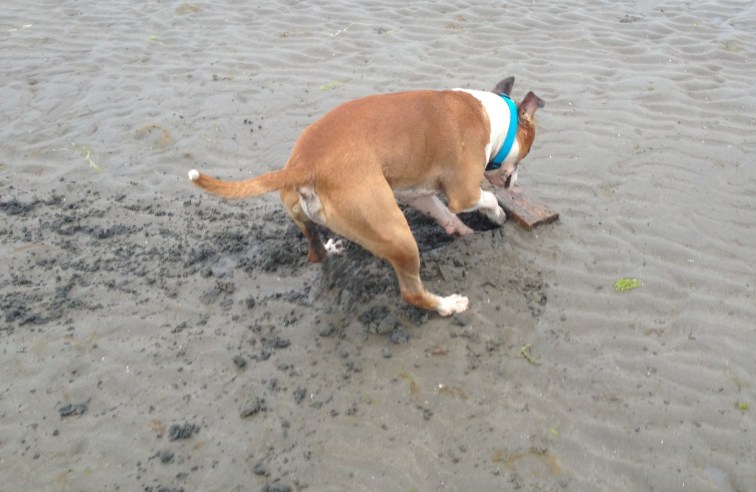
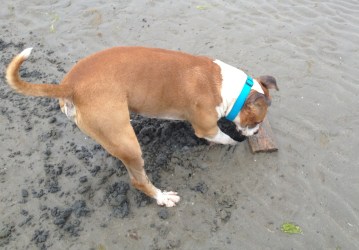
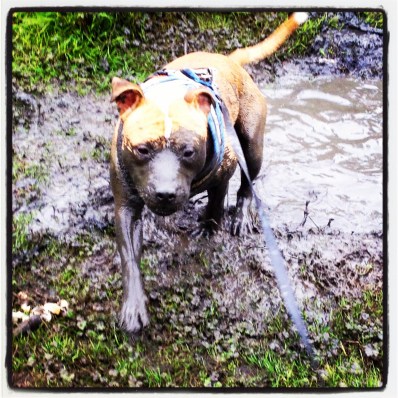
Link (Decker will dig for treasures in the bottoms of flooded ditches or ponds.)
Option 2 Digging Pits
If you have a die-hard digger, providing them with appropriate outlets isn’t always easy. Providing the dog with his own digging pit might allow him to get his digging jollies, without sacrificing too much of your garden.
Use a corner of the garden, and build a little boundary around it so it’s clearly defined.
Alternatively, use a child’s sand pit, paddling pool (not the inflatable type) or large shallow tub, like in this clip.
If your dog is digging in particular spots where you would prefer they wouldn’t, start by positioning the dog’s digging pit there until you get them consistently choosing their new digging pit. Then you can move it to a more convenient location.
Dogs tend to prefer to dig in fine, loose substrate such as potting soil and compost or children’s play sand.
You can prime the area by burying toys, stuffables, chews, kibble, treats or treat parcels.
Sometimes providing outdoor access isn’t always possible but we can help dogs dig indoors too.
Tomorrow, Day 31, we will be talking about Foraging Boxes, and while they are similar, there is a difference. Today’s Digging Boxes aim to encourage digging, while Foraging Boxes encourage snuffling.
To differentiate for the dog, construct a Digging Box:
use a shallow, open box or tub
layer some cloths, towels, blankets on the base over some scattered food
The difference between a Digging Box and a Foraging Box is the layering. The layering at the base may encourage the dog to use their feet because food is only distributed underneath all the stuff, rather than through it and among it, as in a Foraging Box.
But, whatever way the dog finds their enrichment is fine with me…it’s their puzzle after all!
Option 3 “Wipe Your Paws”
Teach your dog to dig on cue and apply it to this cute trick or just digging on cue!
Having behaviour, like digging, on cue means that you can ask your dog to dig when they might need a bit of a release or to have some fun!
By putting a treat just under the edge of a blanket, towel or mat, you can prompt your dog to dig and then capture that behaviour by clicking and/or rewarding it by tossing in more treats.
Decide what you would like your dog to wipe their paws on. If it’s pretty loose, then you can use that and place a treat under it. If it’s firmer, like a door mat, it’s better to use something loose over that and fade it.
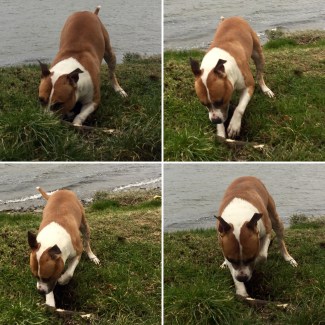
In this clip I demonstrate that process, starting with a blanket, than a face cloth and then just the door mat.
To encourage the digging movement, rather than snuffling, place the treat just under the edge at the side furthest from the dog.
start with the treat under the mat
reward any foot movement toward the edge of the mat
toss food rewards where you want your dog to concentrate, onto the edge of the mat
soon your dog will offer the digging behaviour, without you need to bait under the mat
you can add your cue “wipe your paws” by saying it just before your dog digs
Your challenge
Now it’s your turn. Show us what you and your pets, of any species, can do with these challenges!
Post to your social media accounts, using the #100daysofenrichment so that we can find you and join our Facebook group to share your experiences, ideas and fun!
You can comment right here too 🙂
We look forward to hearing from you and your pets – have fun & brain games!
Welcome to Day 29 of #100daysofenrichment and thank you for joining us on this journey!
Although our challenges are directed mainly at dogs, we want all species to enjoy and benefit from #100daysofenrichment so, please join in, adjust and adapt to help your pet or companion live a more enriched life.
doesn’t need to be a blanket; you can use towels, sheets, duvets, dog beds, clothing
Best to use old blankets as there may be damage as your dog works through these puzzles.
get the family involved in this one – kids love making puzzles for pets and these challenges offer lots of opportunities for children to use their imagination to come up with the best blanket snuffle puzzles for their pets.
Remember, supervise children in all enrichment activities and interactions with pets.
Prepping these puzzles is really quick and then your dog does all the work!
What do you need?
blankets, towels of different sizes and types, face cloths & tea towels, mats, sheets, dog beds, clothing…lots of options…in one of today’s clips you will see me use some of Decker’s bandannas!
to encourage a wide range of foraging and exploratory behaviours
to do more feeding related behaviour than eating; we can use toys in these ones too, but the foraging behaviour is still feeding related behaviour
to encourage the development of strategies (behaviours) for getting the food out of the blankests
by carefully varying the design and adjusting the difficulty, we will facilitate carrying out a range of different behaviours, broadening the dog’s repertoire
While this challenge is certainly food based, they are also experiencing cognitive, sensory and environmental enrichment, with lots of crossover between categories.
Working out how to get to the food and developing dexterous skills in manipulating the blankets are examples of cognitive challenge.
I set up these puzzles in front of the dog, where possible, so they can see me putting the rewards in and under the blanket. Cognition research has demonstrated that dogs are capable of object permanence, meaning that they understand that an item or individual continues to exist, even when it can’t be perceived.
So, hiding a ball out of sight, for your dog is not like playing peek-a-boo with a baby…your dog knows the ball is in there to be found where as the baby may not!
Sniffing out, tasting and chewing food all offer sensory pay off, but so does finding their way through each food puzzle, determining its value, and engaging in the puzzle of getting to the good stuff.
Blanket snuffle puzzles encourage pets to interact with their environment – just the very interaction with the blanket is encouraging the pet to manipulate their surroundings, to get the things they like.
By offering a variety of blanket snuffle puzzles, we can help the dog expand their range of puzzle-busting behaviours and facilitate your pet applying strategies from other puzzles to new ones; that’s a true cognitive gift and is growing your dog’s brain!
What goals can you add to this list for your pets?
How can we achieve these goals?
give your pet plenty of space for working on puzzles and bear in mind there will be mess, so think about spaces that are easier for clean up
the more difficult you have made the challenge, the higher the value the reward must be so use HIGH value foods or toys to motivate exploration and experimentation and make it VERY easy to get the reward (no frustration!)
if your dog just dives in, in full on destruction mode that might also be an indicator that they need an easier challenge so they get to experiment with a broader range of behaviours
What adjustments will you make for your pets?
Applications of Blankets Snuffle Puzzles:
Blanket snuffle puzzles are simple and straight forward, but no matter how much practice your pet gets with these puzzles, they are always challenging because the blanket will always fall in random ways, adding to the challenge for your pet.
These puzzles are truly adaptable – there really is no limit to how they can be adapted to suit different puzzling levels. But, they are also incredibly simple so can be used when very little equipment is available, and when space and time are tight.
I love to use these puzzles when waiting around with a dog, for example at seminars, classes and workshops. Keeps ’em busy and engaged, and prevents boredom and frustration.
Because of the home made nature and variable materials used in these, it’s best to supervise your pet carefully when they have access to this puzzle.
Know your dog!
Making sure the challenge is very doable and they can get to the hidden food rewards quickly is key to modifying their behaviour and expectations during puzzling.
If you are concerned about your dog ingesting non-food items during puzzling, have a pocketful of HIGH value treats in your pocket and be ready to toss a couple toward your dog, across their eyeline, if you think they are thinking about eating the something they shouldn’t.
Check all your equipment for this challenge carefully and make sure there’s nothing that your pet will be able to detach, swallow or get injured on. Play safe!
Enrichment Options
As usual, we are bringing you and your pet through different levels of challenge so that you can introduce them to the puzzle and so that they have time to develop the behaviours required to solve it while avoiding frustration.
Option 1: Things in Blankets
This is your starting point so as to allow your dog to find their feet (paws?) with these challenges; important to help build confidence in the process and reduce frustration and blind-destruction.
Beginners: Things Under a Blanket
place some food rewards on the floor
cover with the blanket, loosely
Let your dog find it and watch for the types of behaviour used to get to the reward.
Now it’s your turn. Show us what you and your pets, of any species, can do with these challenges!
Post to your social media accounts, using the #100daysofenrichment so that we can find you and join our Facebook group to share your experiences, ideas and fun!
You can comment right here too 🙂
We look forward to hearing from you and your pets – have fun & brain games!
Welcome to Day 28 of #100daysofenrichment and thank you for joining us on this journey!
Although our challenges are directed mainly at dogs, we want all species to enjoy and benefit from #100daysofenrichment so, please join in, adjust and adapt to help your pet or companion live a more enriched life.
Every Sunday during #100daysofenrichment is Sunday Funday! This means you and your pet repeat your favourite challenge or challenges from the week.
You can do it exactly as you did first time round, you can try a different option, build on your progress already established, reinvent and rejig it…what ever you want to do with the last week of challenges!
Now it’s your turn. Show us what you and your pets, of any species, can do with these challenges!
Post to your social media accounts, using the #100daysofenrichment so that we can find you and join our Facebook group to share your experiences, ideas and fun!
You can comment right here too 🙂
We look forward to hearing from you and your pets – have fun & brain games!
Welcome to Day 27 of #100daysofenrichment and thank you for joining us on this journey!
Although our challenges are directed mainly at dogs, we want all species to enjoy and benefit from #100daysofenrichment so, please join in, adjust and adapt to help your pet or companion live a more enriched life.
Saturdays during #100daysofenrichment are all about emphasising the dog in all our dogs; all about sniffing and doing dog things.
Adventure Time
We’ve talked lots about being a dog, and the sorts of things dogs must do to be dogs, to be healthy dogs, to be happy dogs.
Our pets live a life that is more human-centric, more and more as modern life encompasses all. You guys, on this project with us, are likely doing a wonderful job of making sure your pet has outlets for their normal, natural, necessary behaviour. All the #100daysofenrichment challenges have been designed to do just that, so, even if you only a do a few, here and there, you are adding lots of opportunities for outlets to your pets’ lives.
Today, we are going to talk about how we can design enrichment adventures for our pets. For most dogs, we can bring them out and about to ensure they experience the world, but that’s not always possible for all pets or people.
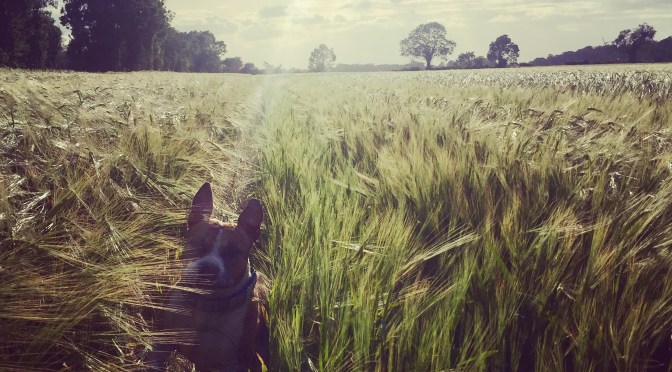
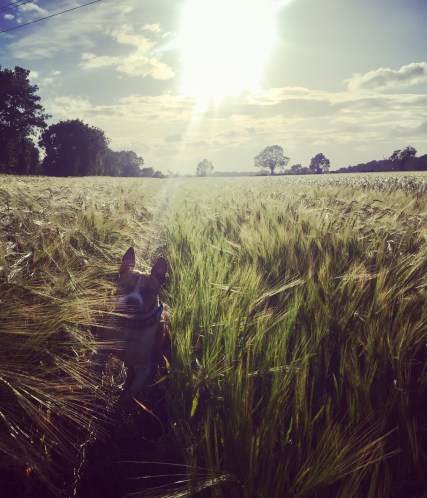
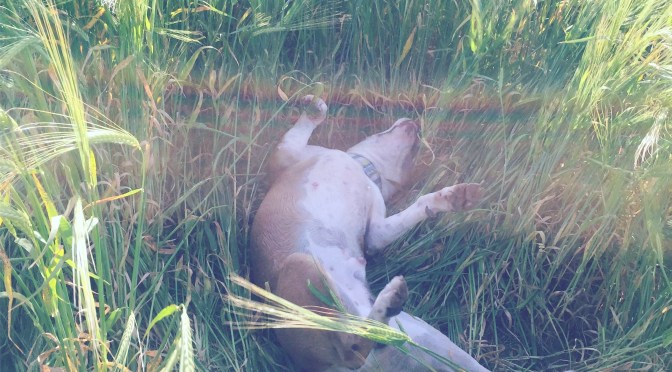
Using our experiences this far, over the last 25 days or so, we have lots of ideas that we can put in place to design a multi-sensory adventure that calls on all categories of enrichment.
Although it’s certainly easier if you can take your pet out to a new or even familiar location, I don’t want you to be limited if this isn’t the case.
We are all learning to apply the knowledge we are developing about enrichment in general, and how it effects our individual pets specifically. Let’s put that to the test today…
If you can’t get out on an adventure:
maybe walks are not possible right now
Instead, go for a drive. Bring your pet in your vehicle to places that allow them to experience some of the sensations of the outside world.
Let them watch the world go by.
Crack a window and allow them to air sniff.
Sit with them far enough from the action that they don’t become frustrated, but close enough that it’s interesting to watch.
With the pet safely restrained, sit in an open vehicle with them.
When you get home, make up for any sensory deficits using any challenges from the 100 days, so far.
If you have an unvaccinated puppy, for example, exposing them to the outside world carefully is an important tool in shaping their behavioural development.
Bring puppy in your arms or in the car. Sit with the door or window open, puppy in your arms, and allow them to air-sniff. Sit with them on a bench or a quiet spot.
When bringing puppy out in your arms, it’s best not to allow others to pet or approach your puppy. When they are restrained, they have little choice in how they interact and that can be overwhelming, especially for young puppies. Make it about air sniffing and observing instead.
maybe outings are not possible right now
Review our 100 days so far and pick three different challenges and present them altogether. Follow the Adventure Time rules to construct your Ultimate Puzzle, ensuring a multi-sensory experience.
Collect vegetation, grasses, sticks and branches and other natural smelly things from a local green area.
Gather small amounts of your collection in fabric shopping bags and hang at sniffing height, rather than on the ground.
This not only makes it easier to clean up but is convenient for the dog and may reduce disease spread, if that’s a concern.
Adventure Time Rules
Consider the categories of enrichment:
social
cognitive
physical world/habitat (environmental)
sensory
food based
The best way to make enrichment truly enriching is to provide it in a natural way (so not too contrived and set up), so that the animal gets to experience it as part of their natural exploration of their world, and to provide enrichment that ticks as many enrichment-category-boxes as possible in one.
An adventure should provide the dog exposure to a multi-sensory, multi-category enrichment experience.
Think about…
Location, location, location!
Where you go will dictate the adventure you have.
Places that offer different substrates, such as grass, gravel, earth, foliage and so on will allow for sensory and physical challenges.
Areas with different sort of coverage and skyline will offer very different visual and auditory qualities – a tree line changes the way sounds travel and the things that can be seen or not, flat grass land allows for visual information to travel fast.
Different terrain, gradient and natural or man-made occurring obstacles can allow for cognitive, sensory and physical challenges.
Of course, make sure your dog gets to sniff to their nose’s content. Sniffathon rules apply – don’t move the dog along, allow them to sniff.
When you go
different seasons, different weather conditions and different times of the day change the olfactory picture for your dog, and therefore present very different sensory and cognitive challenges.
The cooler and drier the air, the slower odour travels, and the more concentrated it becomes. As air warms and moistens, over the day, it moves more and is released more throughout the environment.
Going for an adventure on an early, frosty morning provides a very difference experience than going on a warm afternoon, even if you go to the same place.
How you go
Getting to an adventure can dictate how much the dog enjoys and immerses in the experience.
If it’s stressful to walk your dog to adventure-land, consider driving there.
If the route you take is filled with sequential stressors, consider a different route.
If your dog is worried passing through certain environments on the way, consider walking with a more confident pal, at quieter times with less traffic and fewer passersby.
When dogs are worried, fearful or experiencing distress, they don’t need any further challenge in their lives. As lovely as an adventure sounds, to us, to a less well settled dog, it may be too much challenge for them at this time. Life might be enriching enough without adding further challenge.
Worriers might prefer a smaller world and a regular, familiar and predictable route – developing their confidence and comfort with that is sufficient adventuring for them!
Who you’re with
Social, interactive enrichment is probably the most effective and important to companion animals.
Most pet owners love the idea of their dogs playing with other dogs, and it is the goal of many to provide “socialisation” outlets for their puppies, adolescents and adult dogs.
This 100 day project is not going to prioritise dog-dog social interaction. While I certainly like the idea of a dog, especially adolescent and adult dogs who like that sort of thing, having a buddy or two and meeting regularly for a fun playdate, dog-dog play interactions are not necessarily the central focus of our enrichment endeavours.
Make adventures about the time you, the human, spend with your dog. Make sure you are the most engaging social entity in their life.
What you do…
Choose places that allow the dog to wander safely and as freely as possible (always prioritise safety and security). This allows the dog to choose how they interact with their environment.
Let your dog decide on which direction to take, which path to follow.
Vary the activities you both engage in, with sniffing obviously being a big part of it (it IS Sniffing Saturday after all), and your contribution to that is to let it happen.
Think in Rollercoasters
We will talk about Rollercoaster Games later over this project, but for today, arrange activities that bring your dog up, in terms of excitement, and then bring them down, then up, then down and so on. Like a Rollercoaster.
Bring ’em up:
preparation for going out and getting out into the world, especially initially
perceiving stressors – things that get your dog wound up, happy or not
Get physical! Engage in physically exerting exercise, with your dog, but vary the activity constantly. Try to move away from exertion and repetition, even in play. And play. A LOT together.
Go between sniffing and physical exertion, back to sniffing, practice some training cues, up the exertion, back to sniffing.
Take a break to work on a stuffable. Take a break to be.
Your challenge
Now it’s your turn. Show us what you and your pets, of any species, can do with these challenges!
Post to your social media accounts, using the #100daysofenrichment so that we can find you and join our Facebook group to share your experiences, ideas and fun!
You can comment right here too 🙂
We look forward to hearing from you and your pets – have fun & brain games!















 AniEd Ireland