Day 10 Choice & Choosing – beds and bedding

Welcome to Day 10 of #100daysofenrichment and thank you for joining us on this journey!

Although our challenges are directed mainly at dogs, we want all species to enjoy and benefit from #100daysofenrichment so, please join in, adjust and adapt to help your pet or companion live a more enriched life.

Don’t forget to review all the information leading up to #100daysofenrichment and more here on playing safe. Know your dog!

img_5003

Beds & Bedding

At a glance:

  • providing dogs with a choice of resting places based on their preferences
  • habitat and sensory based enrichment
  • functional spaces are a basic requirement for dogs, contributing to their welfare
  • get the family involved in this one – while a lot of this enrichment challenge is observation based, there are some simple training exercises that children might enjoy participating in
  • sit back, do some observation; move some beds about or engage in some simple training exercises…most of which require you to just sit about!

What do you need?

  • different beds and bedding
  • a range of foods that can be used as food rewards
  • a mat, blanket or towel
20170629_101103863_ios

Enrichment Goals:

  • to provide a choice in resting places and bedding types
  • to encourage dogs to choose and introduce choice into their day to day life
  • to provide dogs with functional spaces – this means that the dog has safe access to different areas that are defined by different activities
  • to teach dogs to move to a specific location when asked and remain there, even in the face of distractions
  • to help dogs calm themselves and settle themselves
  • to teach the dog that their human will ask for behaviour and will make sure reinforcement is available – this reduces stress by improving predictability and controlability
  • to build that bond between dog and human
  • to learn about learning – this is just another puzzle to your dog…”how do I train the human to make rewards available?!“…it’s all human training, for dogs!

While training exercises certainly fall into the cognitive enrichment category, they can provide so much more.

Providing dogs with cues allows for a complex level of communication between two species; you are merely requesting that the dog perform behaviour (he already knows how to lie down on a bed) and that request comes with a contract. Respond appropriately to this signal and rewards are coming your way. That’s the deal…that’s what being a good teacher is about – keeping your word and making it easy for your dog to train you.

This forges the most healthy of relationships between our two species. This is a level of social enrichment that’s tricky to replicate.

When we talk about enrichment being enriching, this is never more clear than when we start to teach behaviours intentionally. It’s the human’s job to set the dog up for success by making sure the behaviour is doable and that rewards are fast-flowing.

There’s no test at the end of this and you and your pet are not under any pressure. Learn to enjoy the time together, whether you achieve the goal behaviour or not. That’s what’s enriching here…the social and cognitive outlets such exercises provide (for both species).
img_5537

Choice & Choosing

Throughout their day, dogs must make choices about which behaviours to demonstrate. For the most part, dogs would choose behaviours that we would probably dislike so we ‘train’ in the hope that the dog will choose behaviours we prefer. This is why #100daysofenrichment is so important for dogs.

No matter what approach or attitude to teaching your dog you take, we are training the dog to choose our preference rather than theirs. We teach dogs to be less dog, so we can live with them. Getting to be more dog is the central tenet of #100daysofenrichment!

Reinforcing behaviours makes them happen more often so the dog is more likely to choose behaviours with a good reinforcement history. Punishing behaviours makes them happen less often so dogs learn to avoid choosing those behaviours.

Our dogs are learning to train their environment, including us humans. How easily trained are you?
Does your dog know how to get you to provide things he likes? Do you make it really easy for him to do that? He chooses behaviours that get you producing reinforcers.

Why we want to maximise reinforcement based approaches is so that our dog isn’t learning to avoid situations that produce punishers because them might include avoiding us.
I want dogs to enjoy choosing behaviours I like…it’s the least I can do, given they might actually prefer to do something else.

Life can’t offer free or even abundant choice; too much choice isn’t beneficial at all! But, where we can, I believe we owe it to dogs, who get so little choice about everything in their lives, to allow them to make some choices, learn that their behaviour makes a difference, and get to be more dog.

We have more Choice & Choosing challenges over the 100 days so this will be a theme we revisit.
Dogs and more so the choices they make is a central tenet of #100daysofenrichment – for enrichment to be enriching, the animal’s choices are prioritised and realised. Examples of how our challenges can be applied in choice provision, her: Forks in the road.

I have battled with and rambled on about choice in dog training before and continue to investigate the best ways to empower pets and other animals with whom we are in contact.
Susan Friedman has been talking about choice in animal teaching forever; choice is a primary reinforcer, she teaches, and that means that animals will naturally seek out situations where choice is available. If it’s evolved as a primary reinforcer (nature selects for this tendency) it’s pretty vitally important to animals, just as food, water, shelter and sex are.

What goals can you add to this list for your pets?
img_4729

How can we achieve these goals?

  • think about the sorts of decisions your dog has to make in living in the human world; what are they basing those decisions on (what’s reinforcing the chosen option, what’s punishing the rejected options?)
  • observe the decisions your pet makes about resting locations – where? when? what heights? what substrate? how do they settle? do they ‘make a “nest”‘?
  • based on those observations, how can we provide them with better choices for bed and rest times?
  • practice the training exercise components of today’s challenges when your dog is already calm and work in conditions that he might choose to settle in
  • use food rewards that don’t get the dog too excited
  • use stuffables to facilitate settling and calming, especially stuffables that encourage lapping

What adjustments will you make for your pets?

Applications of choice in resting:

Being able to rest comfortably and safely is no luxury, it’s vital for health and well-being.

Dogs need a safe and comfortable environment to engage in deep sleep. This means that there must be a lot of ducks in a row.
For the most part, dogs prefer to deep sleep on their sides and stretched out. This is facilitated by being in a safe environment, on comfortable weight-supporting bedding, exposure to the right ambient temperature to allow for stretching out, they are often most comfortable off the floor; all the ingredients for a good sleep.

Today’s challenge goes beyond that. As important as having a safe and comfy resting place is, considering and providing choice for your dog has wide-reaching, positive implications.

Dogs who know their choices count, can use behaviour to ask for relief, then can ask for things they need.
They don’t need to badger and they don’t need to aggress. Choices allow dogs to navigate the human world with confidence because they can control what happens to them.

It might seem like we are starting small but these little moves toward offering more choice can have a big effect.
You will providing comfy, safe resting places, improved recovery from stress, plus a little bit more predictability and controlability. That’s what appropriate choice does – it busts stress and boosts confidence.

img_0654

Enrichment Options

We often presume that our pets experience a good standard of welfare because they live a life similar to ours, in the human world. This is especially the case for pet dogs.

But, what would our dogs choose, if they had the choice?

Are they just resting in a place because we have reinforced that behaviour, because it largely suits us?
Are they choosing to settle in a particular spot because it’s close to us, rather than providing them with their preferences?
Are ‘dog beds’ designed to appeal to dogs or humans?

Although often applied to dogs, they are not den animals. We can look to free living dogs for ideas about what dogs might choose, if they are not completely burdened by human life and direction. Free-living dogs might have young puppies hidden in a den, but the adult dogs don’t really spend much time there.

While looking at species typical tendencies gives us some clues, we must also look at the individual’s preferences for answers. And to do that, we must ask the dog.

I have no doubt, if you are joining in on our project, you are doing a wonderful job at providing the best dog-life for your dog.
We can’t possibly offer our dogs all the choices, or indeed many options they would prefer, despite our best intentions. But we can certainly offer them better choices – two crappy options are no better than no choice at all.

So, today, our mission is to find our dogs better choices by asking them. Giving them the option to choose, and making sure their choices are meaningful. Their behaviour matters. Today, we ask the dog.

Option 1: Beds & bedding

We are going to arrange and rearrange our dog’s environment, their beds/resting places/bedding, to see what options they choose and which ones they prefer.

You might already have formed conclusions about your dog’s resting preferences. Test those interpretations by offering other choices to really ask them what they prefer.

  • where?
    Where does your dog choose to rest?
    Is he only resting there because he’s beside you? What happens if you move?
    Is he only resting there because that’s where you have put his bed? What happens if the bed is moved?
    Is he only resting there because he can keep an eye on the goings on or because he can avoid the chaos?
  • Add other beds, rather than moving the existing beds, to provide other options.

Decker, as always, choosing to rest in the most convenient of places!

  • when?
    When does your dog rest?
    When you are busy or occupied?
    When you’re not available?
    After or before particular activities or occurrences?
  • Keep a log. What just happened? Where does your dog rest in response?
    Can we provide preferred beds in preferred places at particular times?
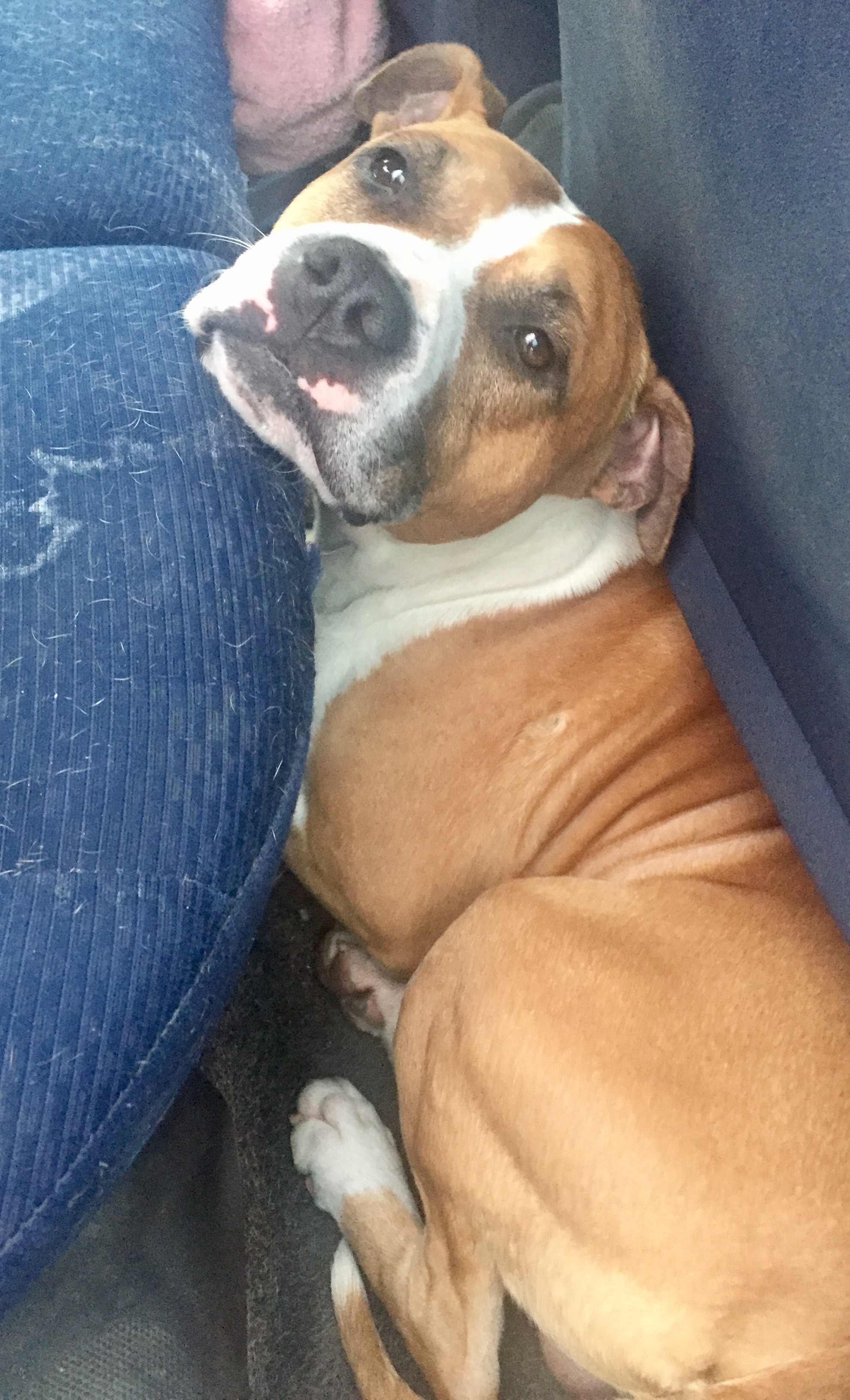
Just because it doesn’t look comfortable to us, doesn’t mean it’s not the dog’s choice!

  • how does your dog rest?
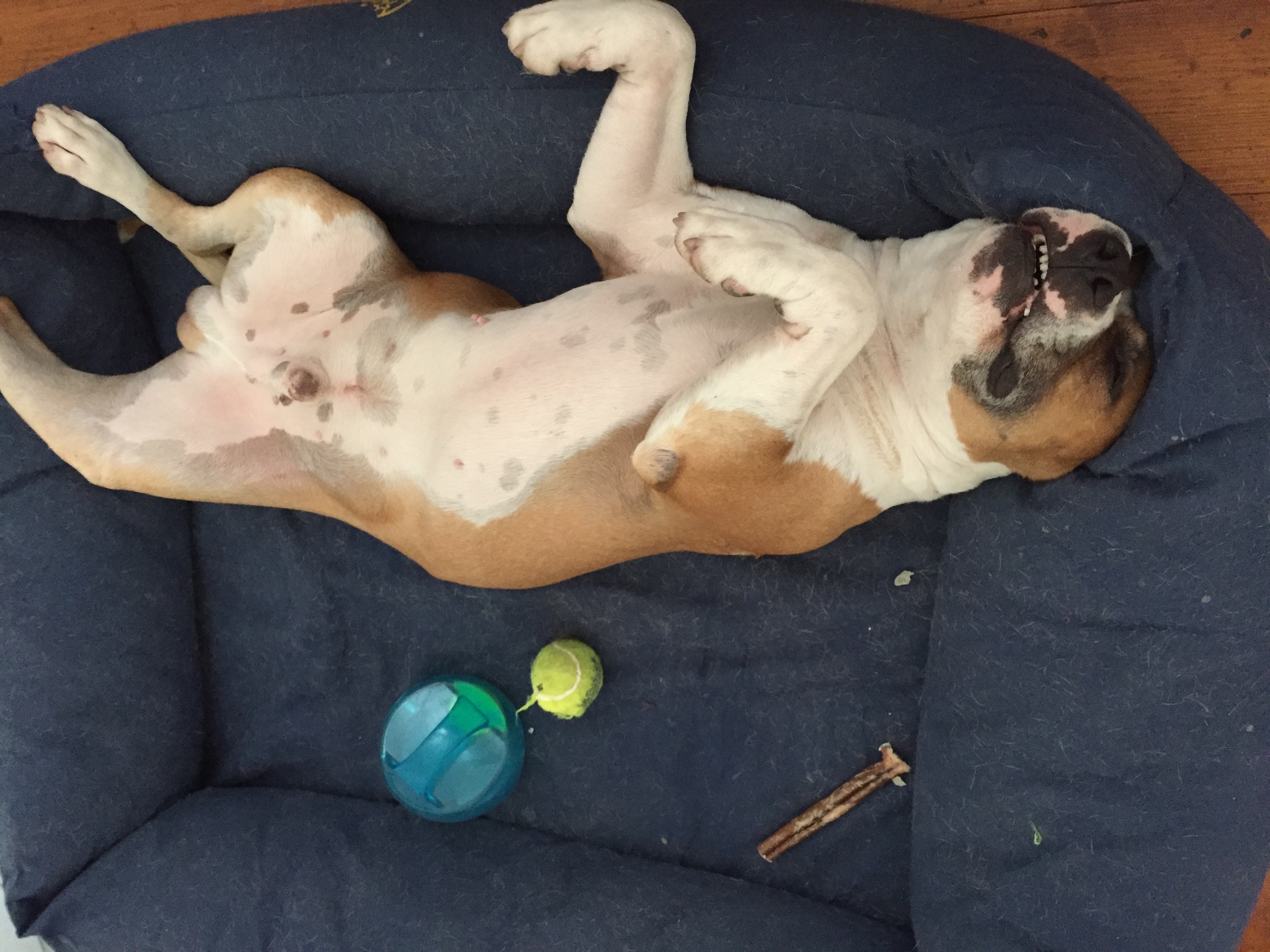
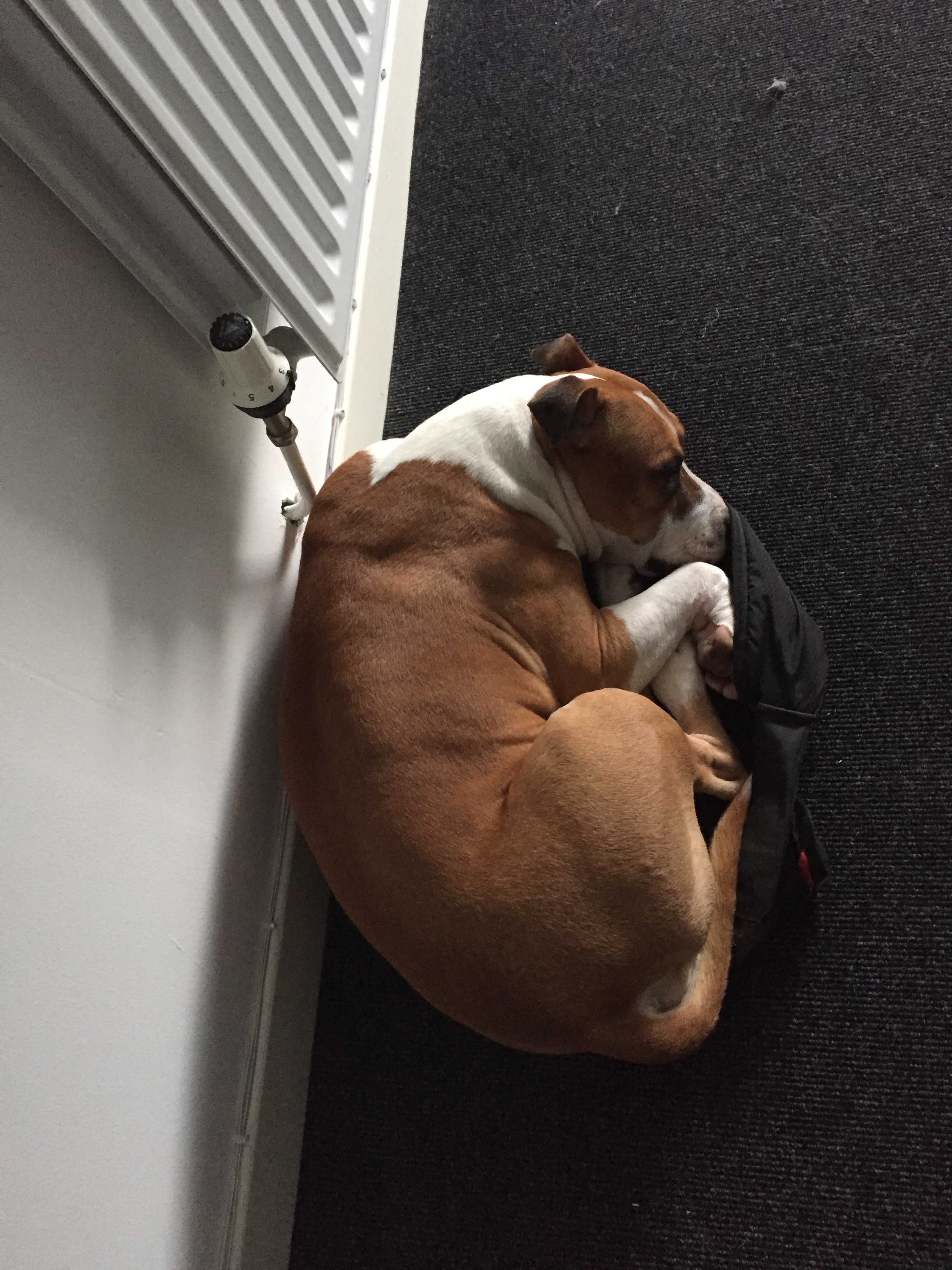
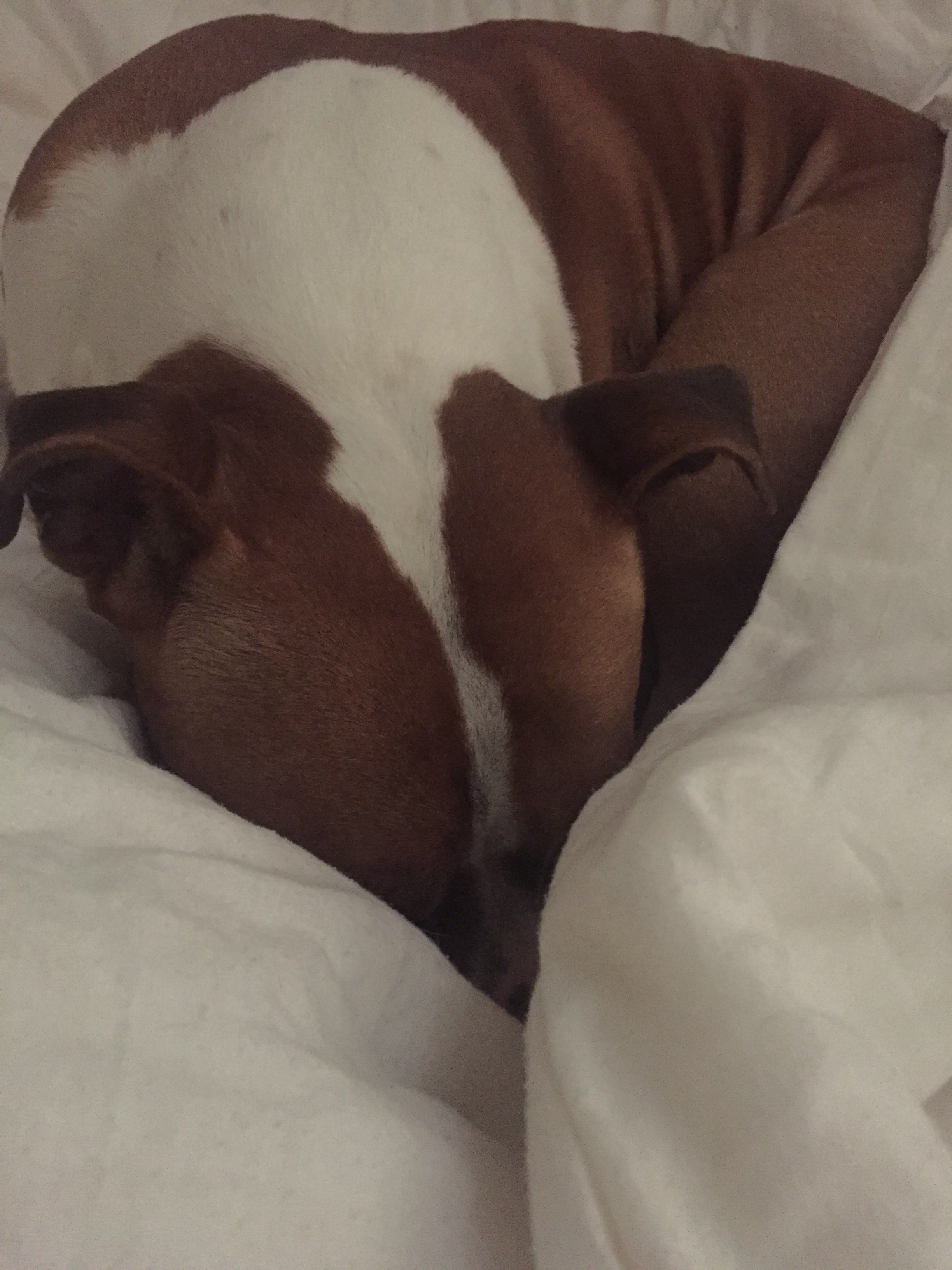
    Check out the positions in which your dog rests – sphinx, on his side, frog legs, curled up, on his back…?
  • Does your dog prepare to settle? He might turn and then lie down, he might dig at his bed before lying down, maybe he just plonks down and falls asleep!
    When and where does he do what he does?
IMG_9108
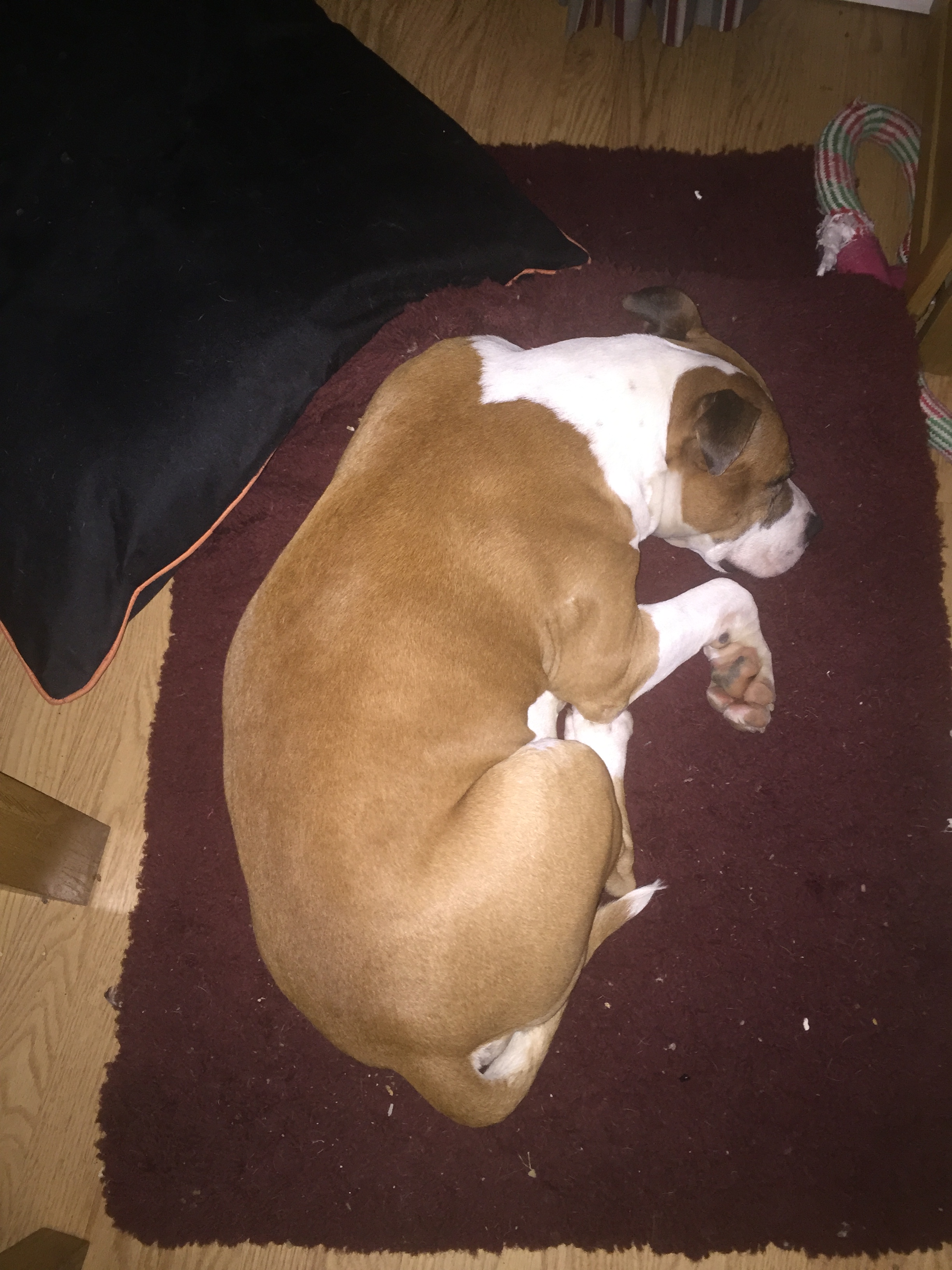
Decker will often kick his comfy cushioned bed aside just to curl up on the rug underneath.
  • Does your dog make a nest? He might turn and dig at his bed, he might rearrange bedding or attempt to.

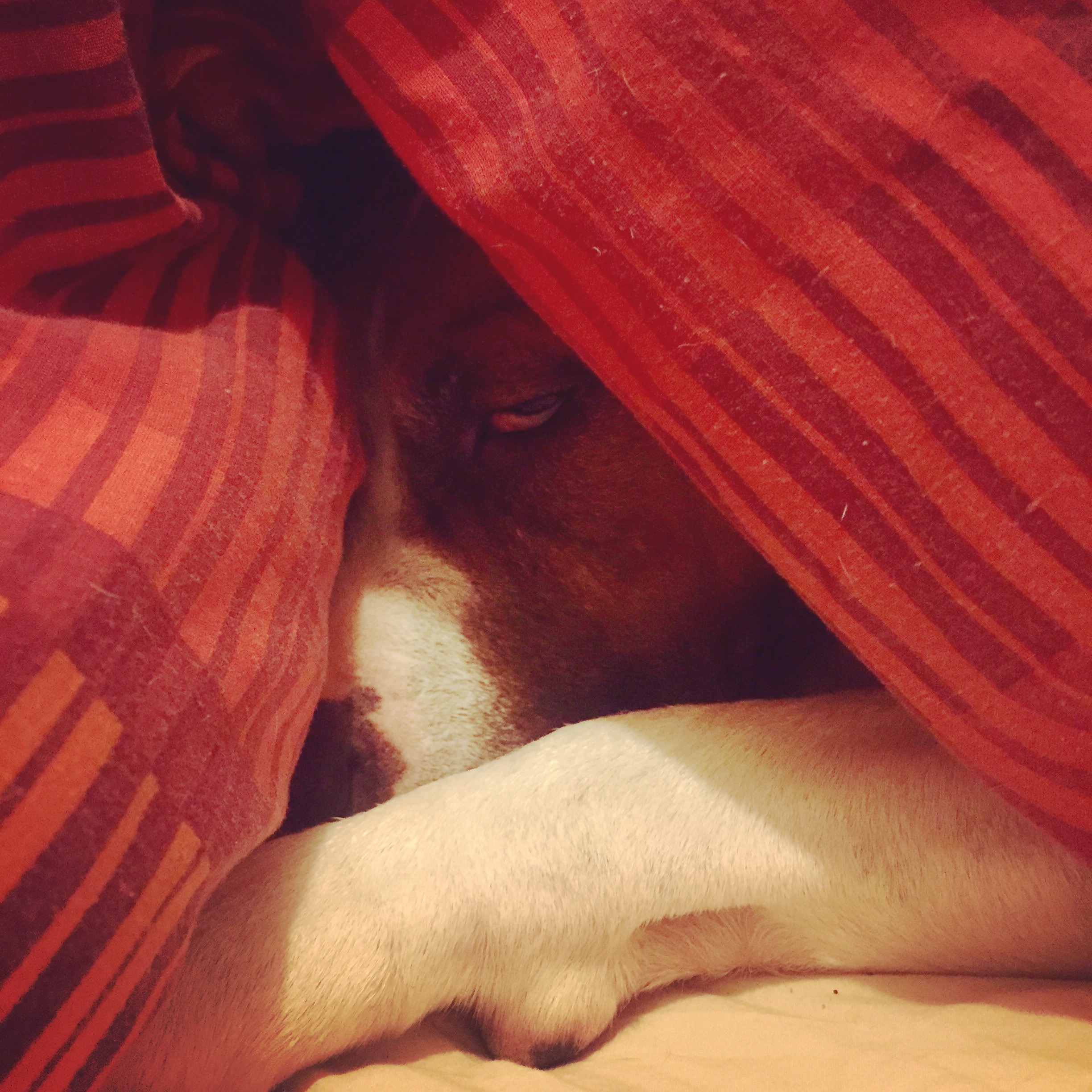
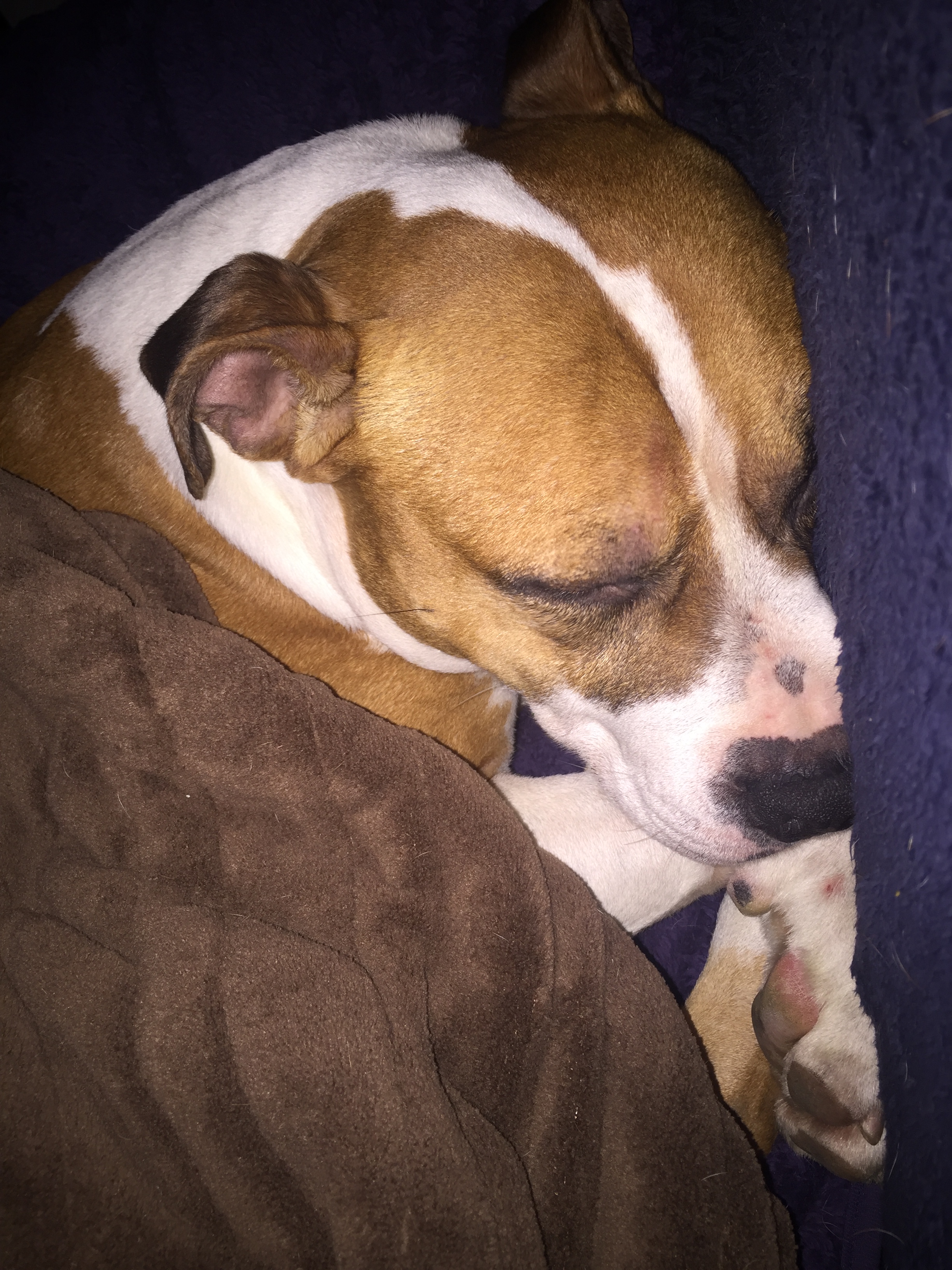
Decker is a nest builder. He will manipulate his bedding to form a pillow and a little hollow, in which he can curl up.

Link

To allow him this option, I make sure he has a variety of beds and bedding to choose from. If he wishes to make a nest, he needs loose bedding. In this clip, he has a rug on the floor for insulation and he will also roll in it, he has a cushion type dog bed and a loose blanket. He will manipulate the blanket to form a pillow and will move about the dog bed and then curl up on it, leaving against part of it, under it or behind it.

This invariably happens when he is settling for a proper sleep, rather than just resting. Decker is a big fan of sleeping! And comfort!
  • ambient conditions
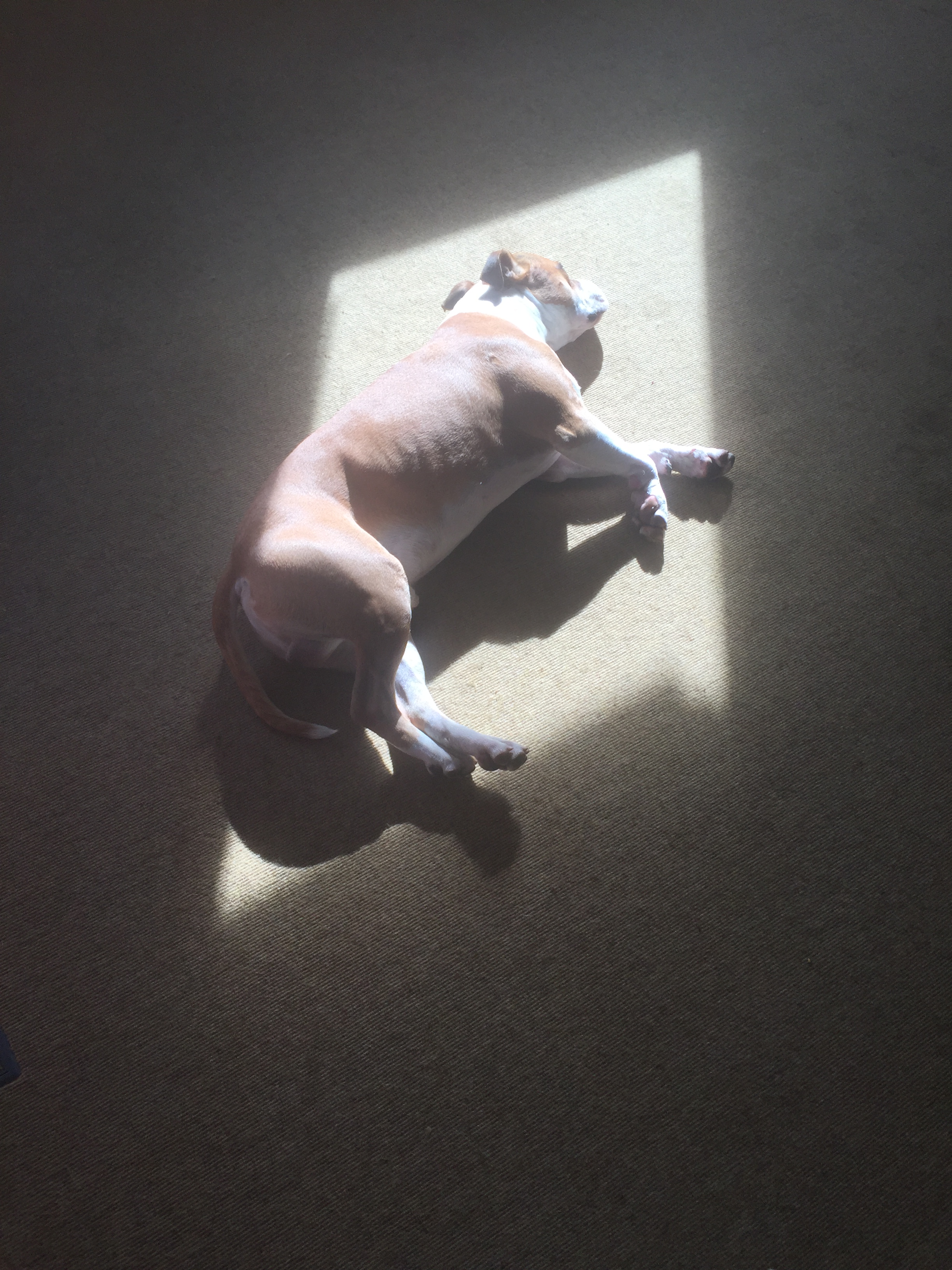
    Try providing bedding options in different ambient conditions. Maybe one part of the room or space is warmer or cooler at different times of the day.
    Can the dog access a suitable resting place when hot and when cold?
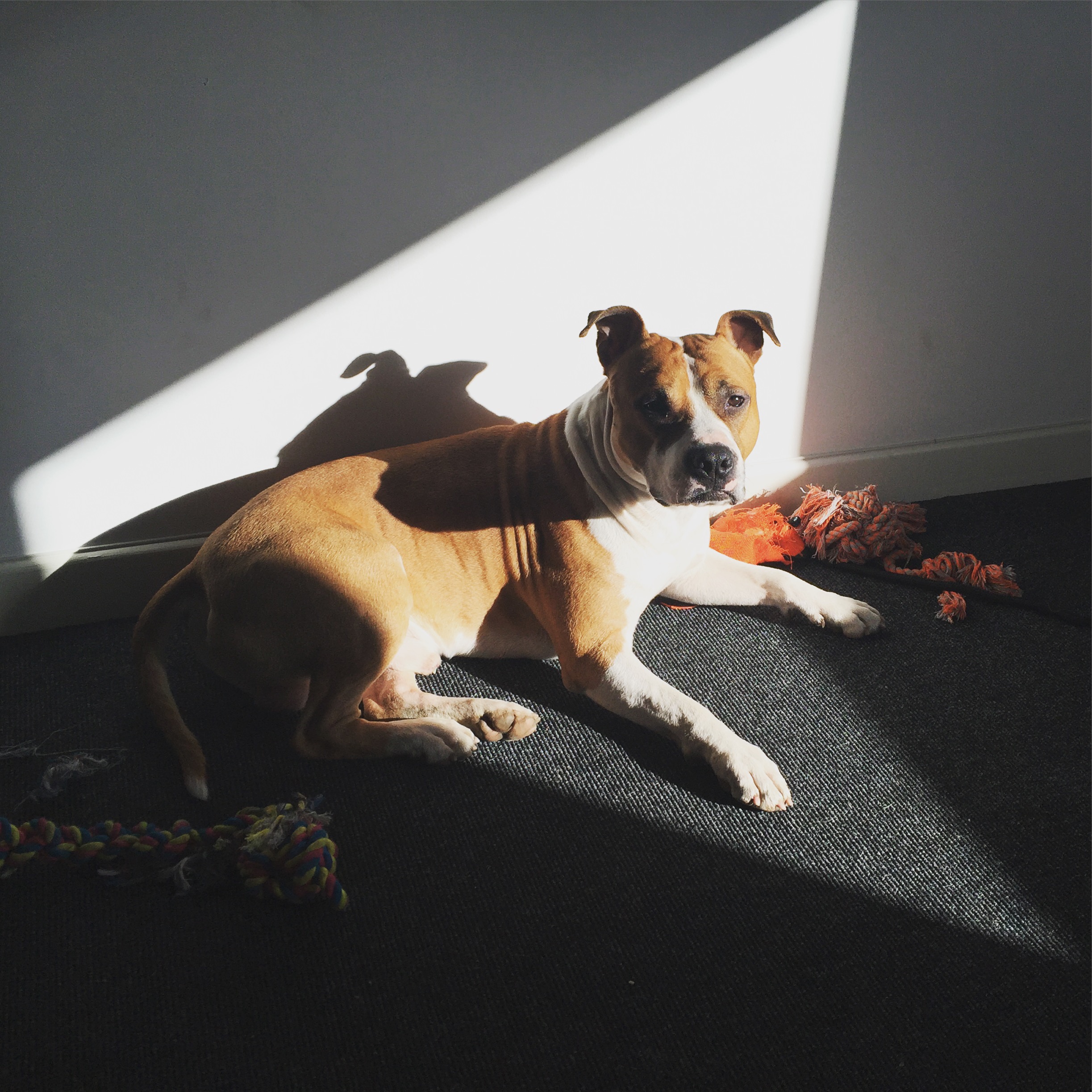
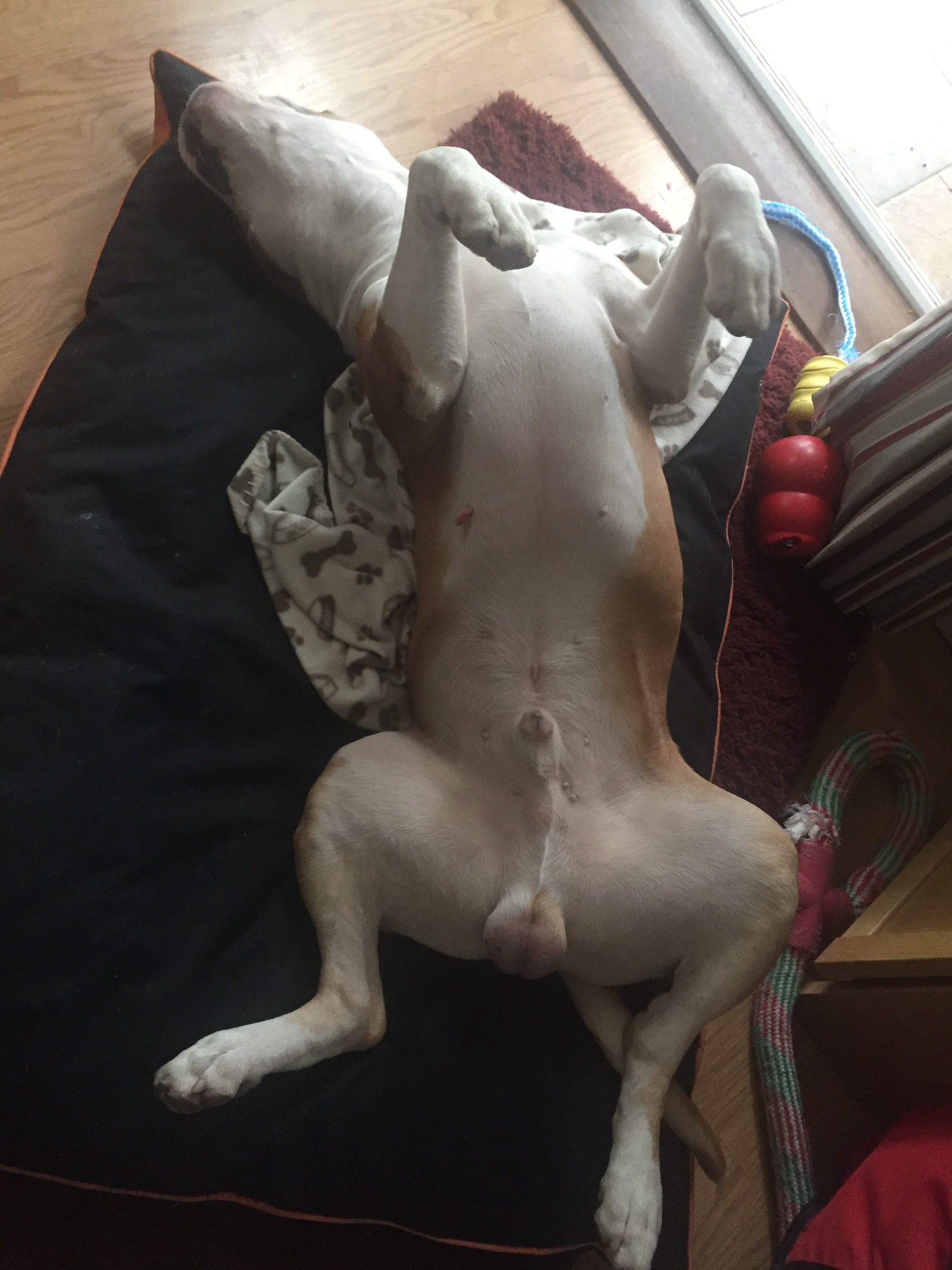
Decker is a heat seeker!

And when hot, sleeps belly-up!
IMG_9119
  • environmental conditions
    Provide bedding to see how much the dog wishes to rest amidst the action and so they can choose to remove themselves for a break.
    Dogs often like to keep an eye on their humans, on entrance and exit points, on cooking and eating and they might like to avoid the hoover or other situations they don’t like.

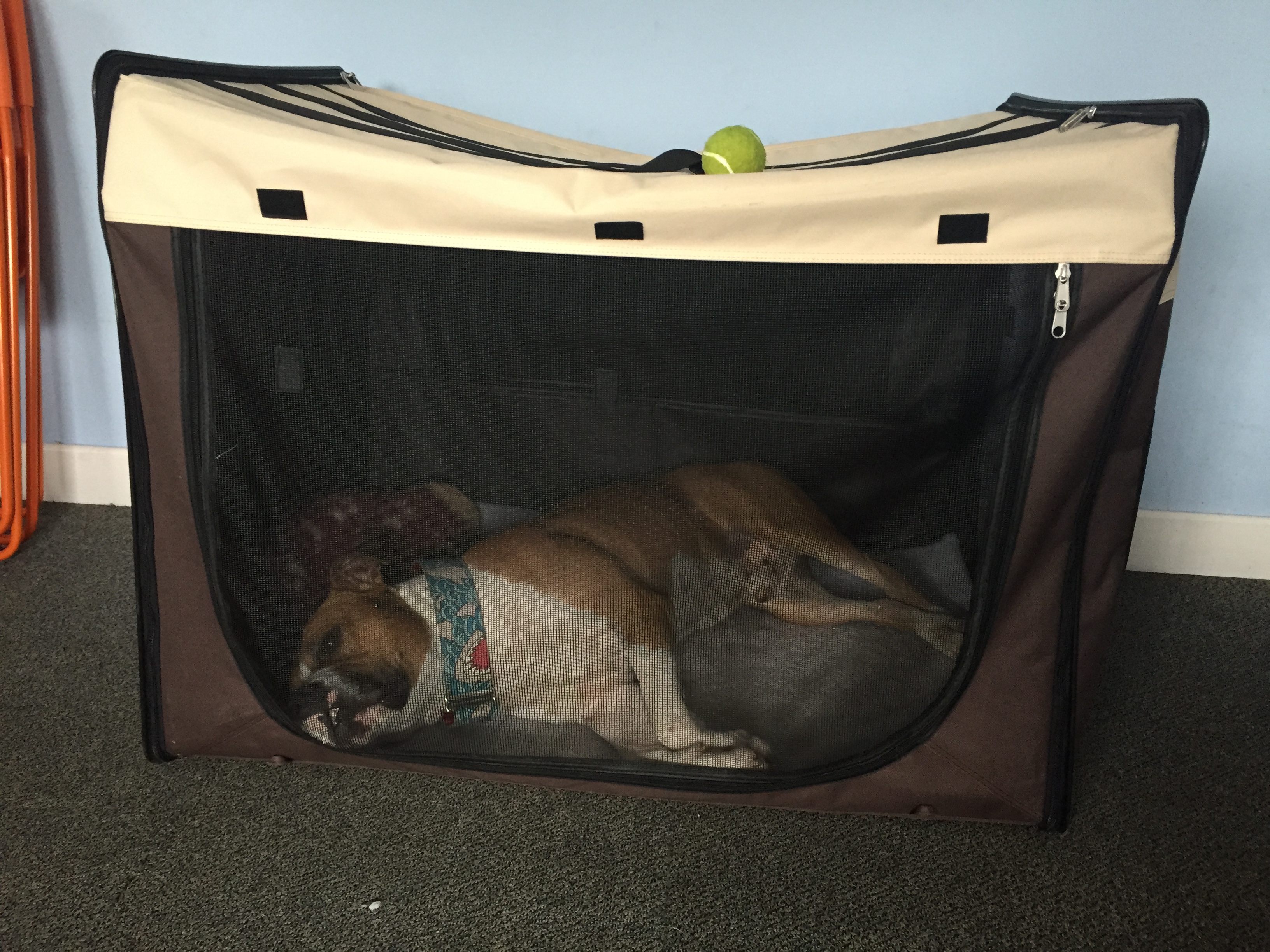
Decker will rest where ever I am!

But maybe, sometimes, they might prefer their own space and time…

IMG_8641
  • social sleeping
    Dogs often prefer to sleep close to their nearest and dearest. This is safer and is important for group bonding. Dogs don’t necessarily need touching or petting, just getting to sleep or rest up next to a bonded individual seems to be their thing. Maybe they just like to be in the same room so that they can rest with company or maybe they want full on body contact.
  • have you tried different types of beds and bedding?
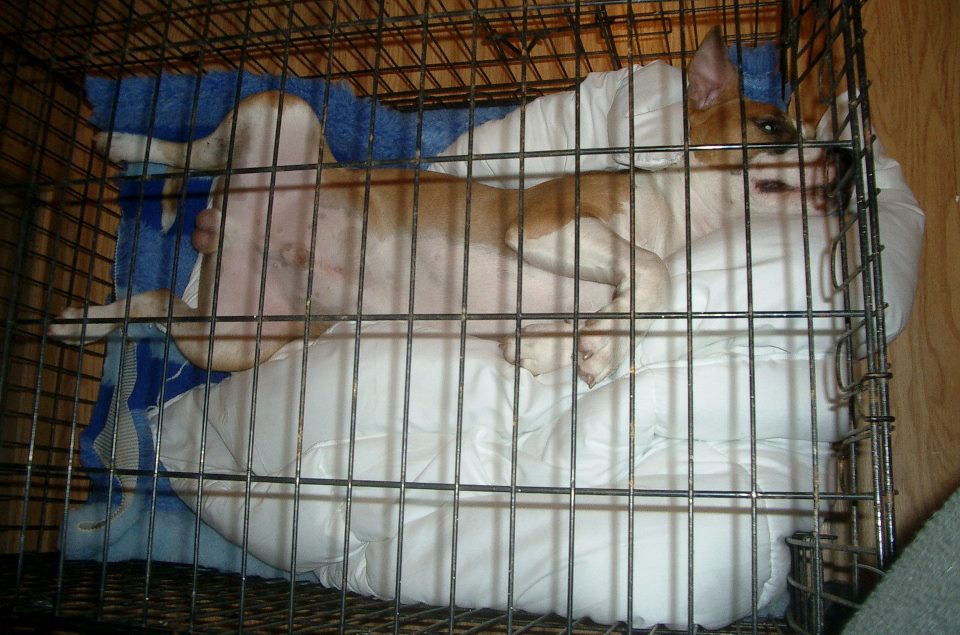
    Maybe your dog would prefer a bed with a lip on it or one without. Maybe they would prefer a flat mat or something more cushioned. Maybe they like to have different bedding types in different places.
    Like Decker, maybe they like a combination of bedding. Perhaps providing that will encourage them to make their own bed or choose the one they prefer.
643993_512832432077428_1439947532_n
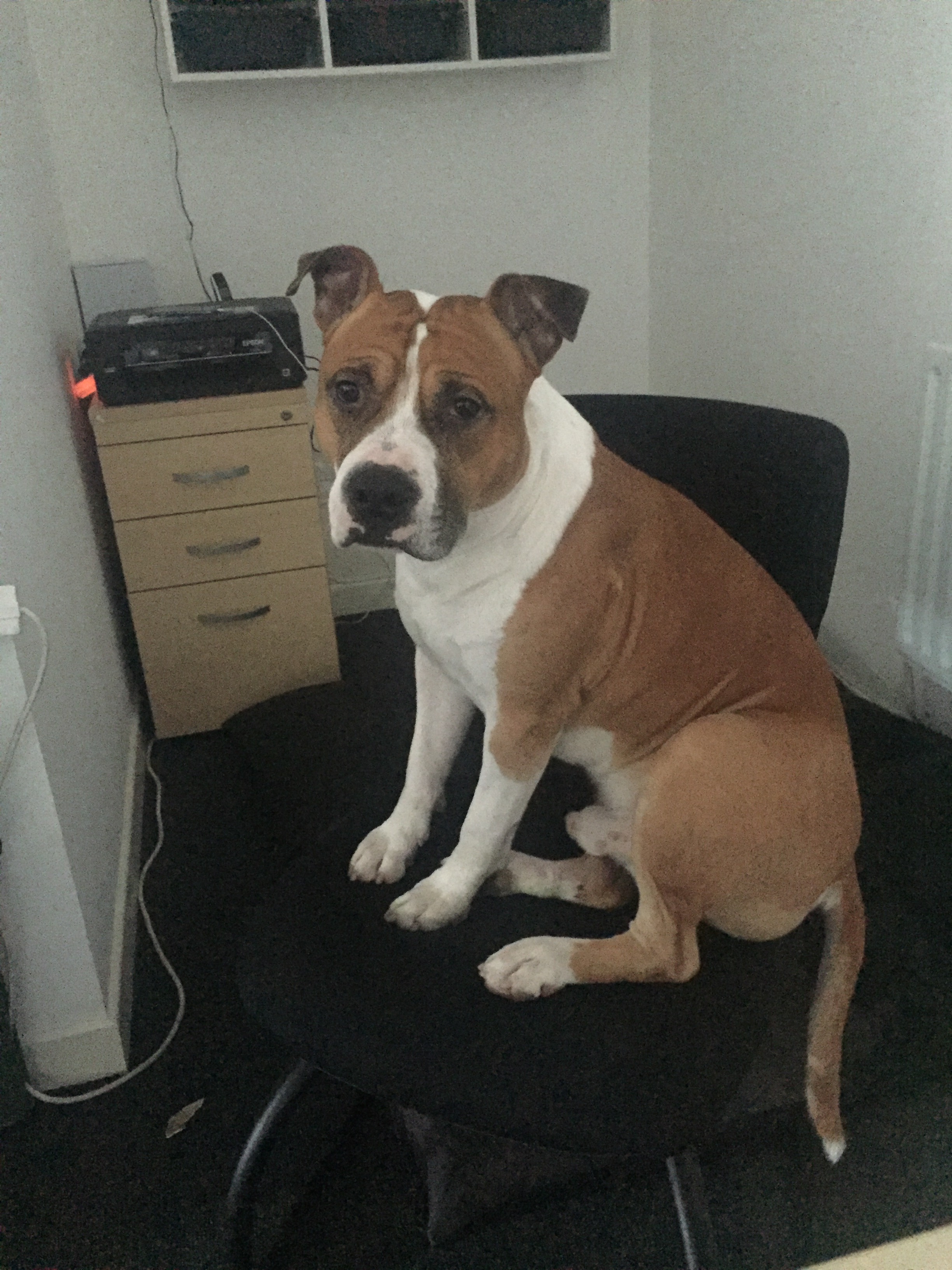
  • have you explored height?
    It is very common for dogs to like resting on a raised surface. Piling up the dog beds might be chosen. Putting their bed onto a chair, a tub or on another upturned dog bed, on a crate or up on a step. Perhaps this provides a better vantage point, perhaps it’s associated with them preferring to be up off the ground.
    There are also a number of commercially available raised beds that many dogs love.
  • human furniture
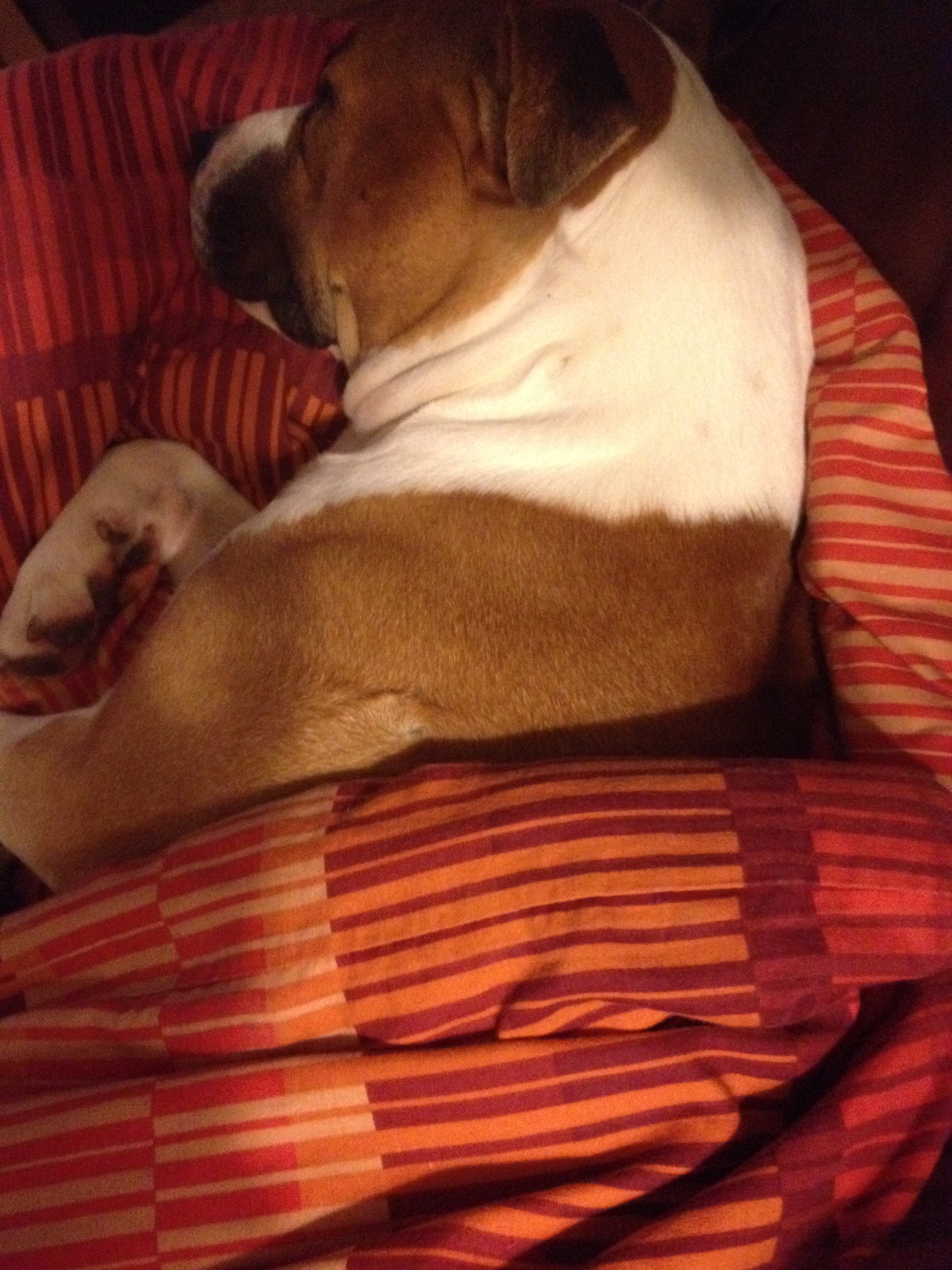
    Whether you like or want your dog on your furniture is up to you. There is no great social significance to your dog being up on your bed or sofa – this will not lead to them attempting a take-over.
IMG_5174

But valued resting places may be guarded, and dogs might prefer not to be approached, touched, manipulated when in these spots, often because there has been a history of moving the dog from these locations. Losing out on access to resources may lead lots of dogs to resource guard. Humans approaching means they are about to lose out, so they might signal that they want humans to go away with freezing, whale-eye, growling, snarling, snapping and even biting. If this is happening, get help.

Teach your dog to get off furniture on cue. Lure them or encourage them off, rather then grabbing them or attempting to intimidate them. Don’t give them a reason to guard.

Dogs probably choose human furniture because it’s comfortable (that’s what it’s supposed to be!) and because you’re there and you spend time there. It might be the height, it might be that it allows them to sleep next to you (something dogs often love, just being), maybe it’s the best option for them.

If up on the furniture is not for you, or your dog, sit with them on the floor. Layout a bed or bedding and sit on it. See does your dog choose to rest with you. Maybe it’s not about being on the sofa, maybe it’s about being with you.

img_0047

Today, make observations and test your interpretations. Today, we ask the dog.

Option 2: Park your Pup

This simple exercise has some really helpful applications and is great for bringing your dog places and helping your dog learn to settle and occupy themselves when the humans are busy or trying to relax too.

img_2145

For practicing this exercise, you need:

  • a mat or bed for your dog
  • their lead and collar
  • a stuffable and some food rewards – make sure the stuffable is filled with something that encourages lapping to aid settling
  • a chair for yourself

Parking involves securing our dog, via their lead, under one foot and a stuffable for them to work on, under the foot. This keeps the dog and the stuffable in one place and their lapping behaviour rewards their settling.

This is a great exercise for puppies or young dogs to help them to learn how to chill when the family are relaxing in the evening time. And it’s the perfect exercise to practice to help prepare your dog for resting quietly beside you at a cafe or some event.

Link

Start with this bit so that you and your get used to the procedure. Reward with some food rewards and then give your dog a stuffable so they can relax, while you sit back and relax. Lazy dog training for the win!

Practice Parking exercises lots and lots, even for just a few minutes at a time, during the day in different rooms and when you are engaged in different activities.

Practice Parking during your walks; about halfway through your walk with your dog, stop and take a break for a stuffable. Park your dog, relax and just be.

When you bring your dog to a place that is helped by Parking, sit with your dog positioned inside of you so they are not being approached all the time, so they have their own space and so that they can just chill, without social pressure. They just want to relax and enjoy their stuffable. Make it possible.

Link

We teach Parking in all our classes, as well as using it as a way of safely managing puppy and dog behaviour in the distracting class environment, and we use it at seminars or workshops, and when our dogs must attend events.

Parking is also a wonderful tool to help your dog calm after excitement; after walks, after training and play, after excitement and arousal.

By helping establish stuffables as a calming aid, and adding Parking, you relaxing and sitting down becomes a cue for your dog to chill. Lots of practice to get there so start Parking your Pup today!

Parking, on the road

We teach settling in public places as part of our puppy curriculum and many other programs too.

Parking is combined with matwork, out and about, to help the dog control arousal, especially in exciting or distracting environments, and to allow everyone to relax and spend time with it being about activity all the time.

Link

This is a great exercise to practice halfway through every outing, weather permitting. This helps to calm your dog and allow them to recover from the physical and mental exertion experienced when out and about.

Link

Option 3: Matwork

Matwork is one of my favourite life skills to work on with pet dogs. It’s one of the first things I work on with new dogs and it’s something that I will continue to work on throughout that dog’s time with me.

Baby Decker’s second day home and his first matwork session!

Matwork teaches your dog to stick to their mat. We build value in being on the mat by making it the most rewarding place to be. Think of all the mischief your dog can’t get up to if lying quietly on their mat…!

Matwork helps at a number of different levels:

  •  your dog has a place to go that’s safe and theirs
  • their mat is a pleasant place to be as that’s where rewards happen
  • allows you to manage dog behaviour; if your dog is exhibiting behaviour you don’t like, instead of thinking how to stop that unwanted behaviour, instead ask: “what would I prefer my dog to do?” Lying quietly on their mat ticks a lot of boxes and solves a lot of problems!
  • teaches your dog to make more polite choices
  • helps with polite greetings behaviour, when the doorbell sounds, when the doors are open, when there’s activity, when you’re eating or working and becomes a mobile signal to settle and relax

Link

This clip shows a real-time session with me introducing down and matwork to a rescue dog, Gracie, just before she goes to her new home. 

Practice matwork in short sessions of a few minutes at a time. If your dog is fidgety or finding it difficult to settle, work for shorter periods and practice more Parking to help them build some duration first.

You can add in fidget breaks to help them let off some steam, intermittently, so that they find it easier to settle.

Link

It’s often better to use less exciting food rewards for matwork so that your dog isn’t too wound up by the anticipation of yummy food.

Beginners: teaching down

Start by teaching your dog to lie down on their mat.

Use the same mat for this work and tidy it away when you’re not training. Initially, we want the mat to be associated with rewards so if it’s just lying there at other times, it starts to use some value.

Link

If you want to progress to teaching your dog to lying down on a verbal cue, this clip will bring your through the stages.

To help your dog relax, teach them to lie down in a more relaxed position. What happens on the outside of the body can help affect what’s happening on the inside; more relaxed behaviour can help the dog feel more relaxed.

Link

Beginners: the mat is the place to be

Once your dog can lie down on the mat, we can begin to establish lying on the mat as the place to be. Note that we don’t need to ask the dog to lie down on their mat; we want the mat to be the signal to lie down there.

Practice some shaping exercises. Shaping is an approach to teaching that breaks the big, goal behaviour down into small achievable steps. We’ve given your dog a headstart as we have already taught them to lie on the mat. Now we are going to let them work it out a little.

Link

Link

Intermediate: mat down, lie down

Now that the dog can find their mat and lie on it, we can begin to further establish that idea by practicing this exercise. Take the mat up between each trial when you toss the treat away for the dog to get. When they return, lay out the may again so they can practice lying on it immediately.

If they can’t quite do that, just go back to practicing easier exercises. Your dog is giving you information that they need more practice and more support.

Link

Intermediate: building duration

Your dog can lie on their mat and they know that lying on their mat is the place to be…now let’s make lying on the mat for longer and longer durations more and more rewarding.

We will use a technique referred to as 300 Peck to build duration. This is a reward-system that helps us build duration in behaviours by always working within the dog’s capabilities.

Start with your dog lying happily on their mat. Start every session with five rewards, one after another, delivered on the mat. Instead of tossing a reward off the mat to reset, start our counting game:

Count 1, reward on the mat
Count 1, 2, reward on the mat
Count 1, 2, 3, reward on the mat
Count 1, 2, 3, 4, reward on the mat

And so on…

If your dog gets up, go back and start at one again. But instead of getting into a cycle of breaking, just practice up to five using 300 Peck. And then work on sessions up to ten, then up to 20 and so on.

Link

Your dog is learning lots, just with these simple exercises: they are learning that the mat is the place good things happen, they are learning that them just lying there makes rewards happen, they are learning to lie on the mat for longer and longer, and we are thinning out the number of rewards so they are learning to lie on their may for longer durations between rewards.

Intermediate: building distance

In class, we tend to approach this exercise a little more formally and apply 300 Peck to the number of steps taken away from the dog.

This clip shows how gradually we begin with this exercise with some young puppies; just standing up straight is the first stage of adding distance!

Link

By using 300 Peck, you build distance in half steps or one step at a time:

Stand up straight, reward
Rock back, reward
Half a step back, return, reward
One step back, return reward
One and a half steps back, return, reward
Two steps back, return, reward

And so on.

But, at home, you can work a little less formally. You can move about the room in a more real-life fashion, always returning to reward and rewarding very regularly, every couple of seconds or so at the beginning.

Link

Practice in short sessions of 5-10 rewards. Place the mat where you are working – step away and back in mock-up real-life situations, such as going to the counter and coming back, sitting at the table, putting something away.

If your dog is breaking more than once, you’ve pushed too much. Make it easier by staying closer and rewarding more often.

Advanced: Doing Nothing

With mat behaviour established, we can begin to help our dogs become better and better at just lying on their mat, calm and relaxed.

We do two exercises to help with this: capturing calmness and thinning ROR (rate of reward).

Start by thinning ROR – this simply means that we reward less.

  • set the timer on your phone for 30 seconds
  • line up ten rewards and deliver these over the 30 seconds
  • each successive round, use one less reward until you just have one to deliver
  • now set the timer for 60 seconds with ten rewards and repeat

Vary the time, vary the rewards. Keep it calm and quiet.

Link

Now you are effectively capturing calmness. Sit back and catch your dog doing nothing. Culturally, we are programmed to catch a learner in the act, getting it wrong, making a mistake. In our program, we catch the dog doing the right thing!

Looking calmer, being quiet, lying on their mat, doing nothing. These behaviours earn calm praise, the quiet delivery of a piece of kibble, quietly sitting beside them, providing a calming massage (if that’s what they’re into).

Doing nothing is an advanced skill that doesn’t come naturally to most dogs. Work your way through, take your time, make it achievable for your dog every step of the way.

Option 4 Set up a Settle Context

Dogs are really good at learning contextually. This means that they learn about the picture, the set-up, that tells them that doing certain behaviours results in specific outcomes.

If we want dogs to be able to settle calmly, we do that by setting up contexts that allow that and then, that signal to the dog that settling is the best thing to do.

What you do and what happens in that context, becomes the cues that signal the dog to settle, just like you might ask a dog to sit by saying the word sit, or by holding a treat (which often cues a sit in many pet dogs).

Set your dog up for success first:

  • practice in a location where your dog often settles
  • use your dog’s bed that they would normally settle on
  • practice when you are calm and won’t need to move about for a bit
  • work when your dog is tired, such as after a walk, play or some sniffing
  • have your dog on lead to reduce them moving about too much
  • set up their bed beside you
  • do the things you would normally do when you want your dog to settle. As soon as I sit down at my desk to work from home, Decker lies on his bed beside me. I don’t say anything, that’s just the context that’s set up.
  • start them off with a lined toy, and keep rewards to a minimum
  • work for very short times to start with  – if you get 30 seconds of settling to start with, that’s great. Build on that by practicing regularly.

This has become my preferred exercise, especially with puppies, rather than starting with more structured matwork. Start with this, and then we can add the “training exercise” version later.

Clip link

Your challenge

Now it’s your turn. Show us what you and your pets, of any species, can do with these challenges!

Post to your social media accounts, using the #100daysofenrichment so that we can find you and join our Facebook group to share your experiences, ideas and fun!
You can comment right here too 🙂

We look forward to hearing from you and your pets – have fun & brain games!

img_9051

Decker warms up his brain on his mat, in the sun!
Day 9 Busy Boxes

Welcome to Day 9 of #100daysofenrichment and thank you for joining us on this journey!

Although our challenges are directed mainly at dogs, we want all species to enjoy and benefit from #100daysofenrichment so, please join in, adjust and adapt to help your pet or companion live a more enriched life.

Don’t forget to review all the information leading up to #100daysofenrichment and more here on playing safe. Know your dog!

img_7807
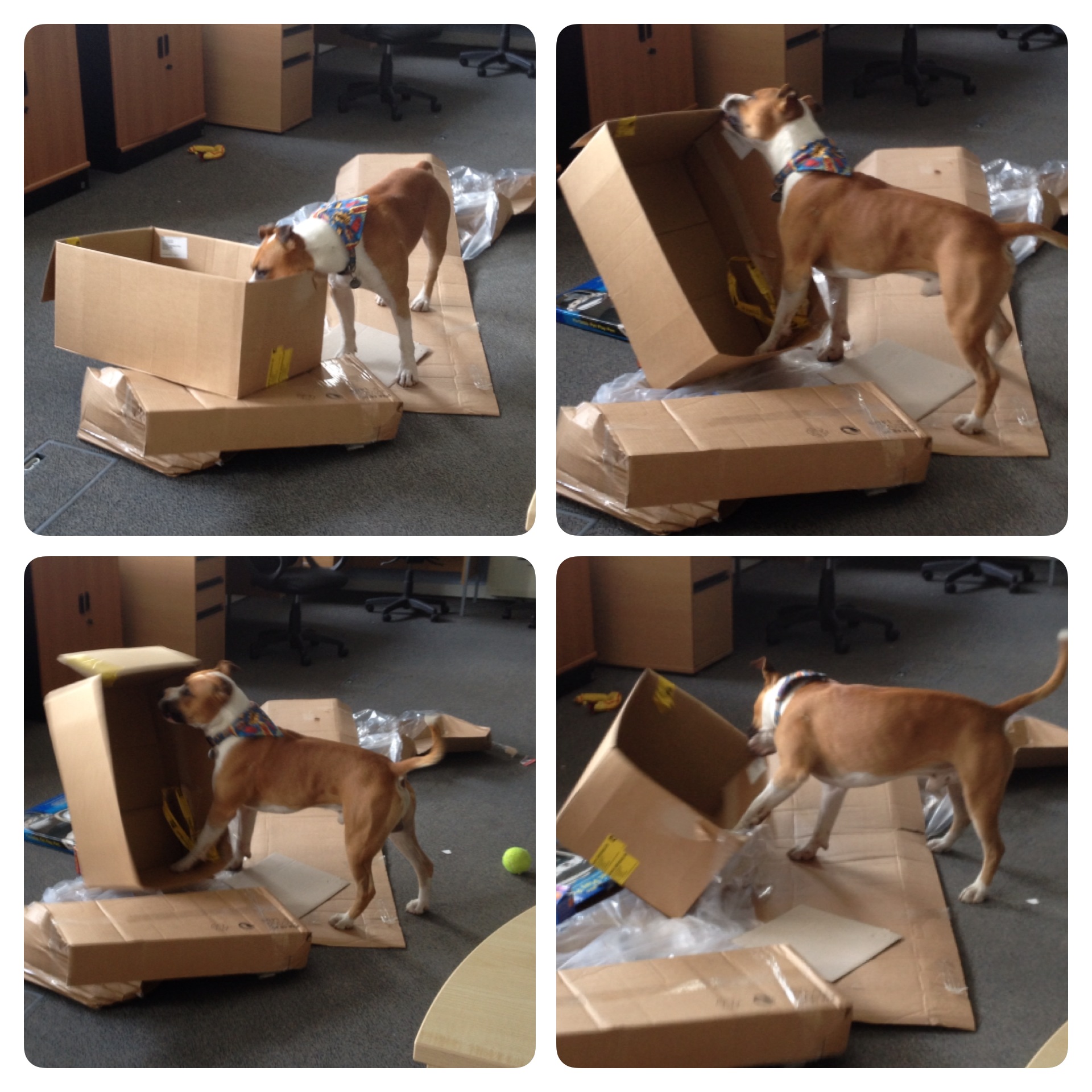
Busy Boxes don’t always need to be food puzzles…empty boxes keep Decker plenty busy!

Busy Boxes

At a glance:

  • smaller boxes with fun and puzzles inside
  • food based enrichment
  • add food, add packing, add a teaser, add a busy box, add a stuffable
  • get the family involved in this one – kids love making puzzles for pets and these challenges offer lots of opportunities for children to use their imagination to come up with the best busy boxes for their pets.
    Remember, supervise children in all enrichment activities and interactions with pets.
  • Busy box prep will probably take you about five minutes – having a collection of Busy Box stuff is a good idea…it will resemble a pile of rubbish or recycling!

What do you need?

  • cardboard boxes, smaller boxes are better for today’s challenges or smaller plastic tubs may also work

  • paper e.g. packing paper, kitchen roll, newspaper etc.
  • eggboxes
  • balls
  • paper cups
  • plastic tray inserts from sweets, biscuits etc.
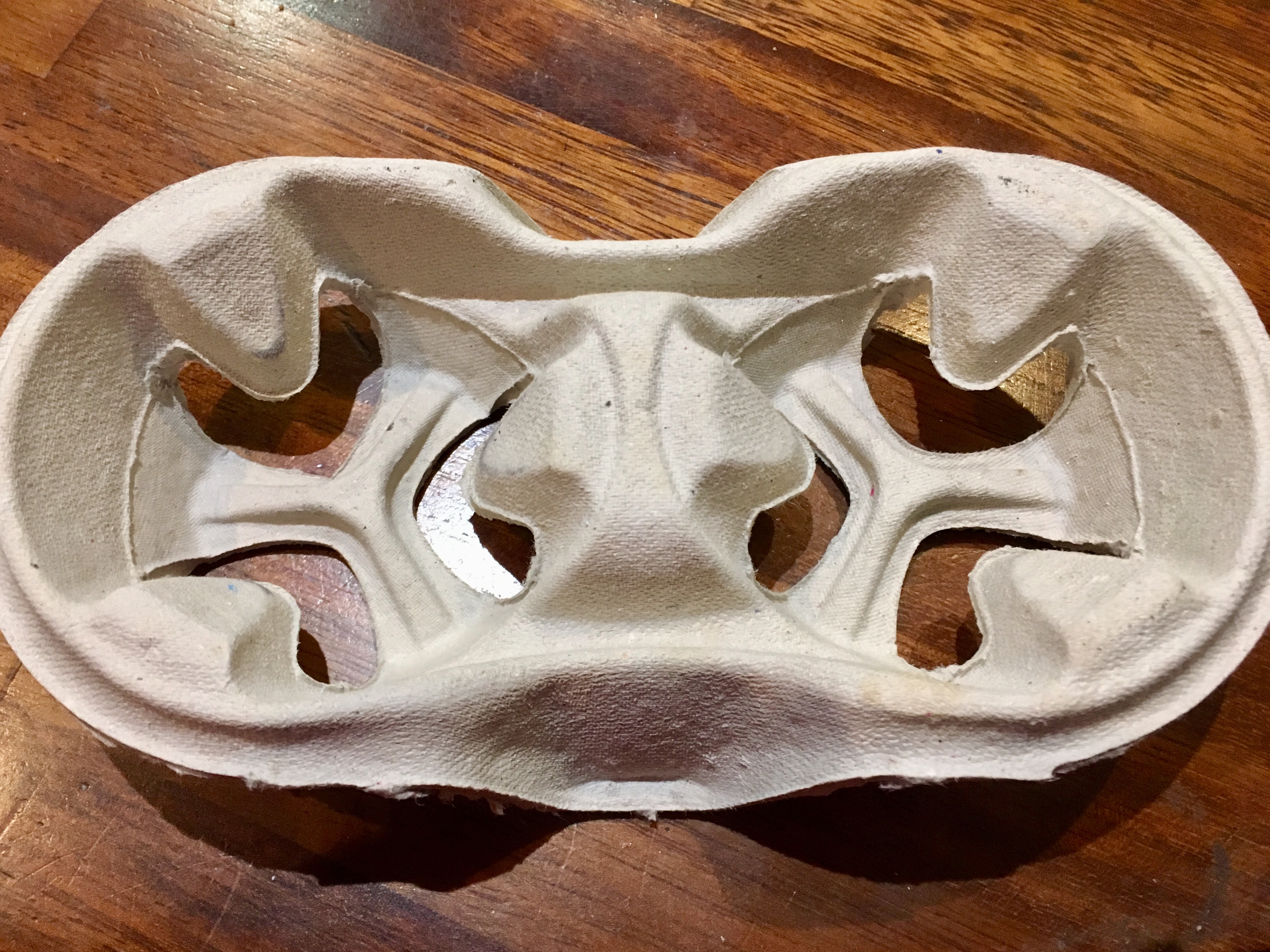
  • cardboard cup holders

cupholder

Enrichment Goals:

  • to encourage a wide range of foraging and exploratory behaviours
  • to do more feeding related behaviour than eating
  • to encourage the development of strategies (behaviours) for getting the food out of  the boxes
  • by varying the design of each Busy Box puzzle we will facilitate carrying out a range of different behaviours, broadening the dog’s repertoire

While this challenge is certainly food based, they are also experiencing cognitive, sensory and environmental enrichment, with lots of crossover between categories.

Working out how to empty get to the food and developing dexterous skills in manipulating the boxes are examples of cognitive challenge.

Sniffing out, tasting and chewing food all offer sensory pay off, but so does finding their way through each food puzzle, determining its value,  and engaging in the puzzle of getting to the good stuff.

Busy boxes encourage pets to interact with their environment – just the very interaction with the box is encouraging the pet to manipulate their surroundings, to get the things they like.

By offering a variety of Busy Box puzzles, we want to help the dog expand their range of puzzle-busting behaviours and facilitate your pet applying strategies from other puzzles to new ones; that’s a true cognitive gift and is growing your dog’s brain!

What goals can you add to this list for your pets?

How can we achieve these goals?

  • give your pet plenty of space for working on Busy Boxes and bear in mind there will be mess, so think about spaces that are easier for clean up
  • the more difficult you have made the challenge, the higher the value the reward must be so use HIGH value foods to motivate exploration and experimentation and make it VERY easy to get the food (no frustration!)
  • if your dog just dives in, in full on destruction mode that might also be an indicator that they need an easier challenge so they get to experiment with a broader range of behaviours

What adjustments will you make for your pets?

Applications of Busy Boxes:

I love using Busy Boxes to keep dogs occupied as they offer different possibilities for expanding the dog’s behavioural range, truly engaging them cognitively.

Truth be told, Decker doesn’t even require any food in the box at all; he’s happy with a box, just to manipulate, wrestle and destroy!

Link

Busy Boxes also are truly adaptable – there really is no limit to how they can be adapted to suit different puzzling levels.

Link

What I tend to see, though, when Busy Boxes are given to dogs, and puzzles in general, is that well-meaning owners go waaaaay over board, coming up with the most elaborate designs to really challenge their pet.

While it’s great to go for challenge, it’s important that enrichment remain enriching. That means that the challenge must be made appropriate and doable for the individual puzzler.

Our job is to adjust the Busy Box difficulty so that our dog uses a range of behaviour and gets to the goal pretty quickly.

This is the true way to improve the dog’s confidence in puzzling (and in life) and help them expand their behavioural repertoire.

Link

Because of the home made nature and variable materials used in Busy Boxes, it’s best to supervise your pet carefully when they have access to this puzzle.
Know your dog! If you have an ingester, Busy Boxes may not work or you might try using a plastic tub and supervise them closely. They will still eat plastic, it will just take them longer.

If you are concerned about your dog ingesting non-food items during puzzling, have a pocketful of HIGH value treats in your pocket and be ready to toss a couple toward your dog, across their eyeline, if you think they are thinking about eating the paper.
Making sure the challenge is very doable and they can get to the hidden food rewards quickly is key to modifying their behaviour and expectations during puzzling.

Check all your equipment for this challenge carefully and make sure to remove tape, staples, other fastners, small pieces and plastic pieces. Play safe!

Activity Box Puppy Hack

Here’s a quick puppy hack to keep puppies busy with appropriate items that they can interact with or that you can redirect them to should they need help choosing appropriate behaviour.

And, not just for puppies – this works for big dogs too!

IMG_1931

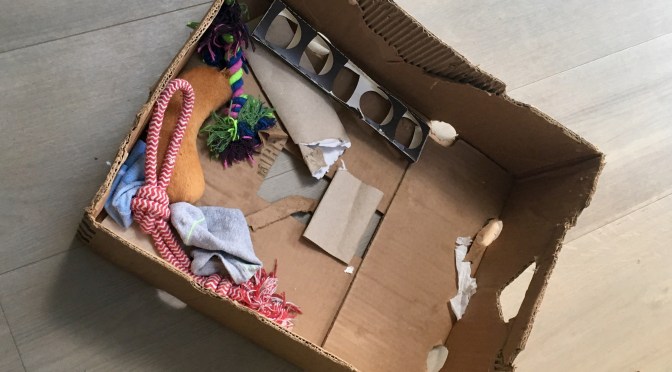
Take a box that your puppy or dog can get into or at least reach into – so that might just be a shallow shoe box for a small puppy.

Add some items of interest such as a couple of toys, a stuffable, some cardboard tubes, maybe some packing paper. Rotate every day or two so there is always something interesting for puppy to check out.

IMG_1705

You don’t need to add food, but you can occasionally so puppy learns to have a sniff and snuffle to keep them entertained.

When puppy needs to keep busy or when you need to redirect them out of trouble, their Activity Box is the place to go!

Enrichment Options

Today’s Busy Box challenge will bring you and your pet through several levels. Even if you are both experienced puzzlers, start with the lower levels to see how wide a range of behaviours your dog offers, to solve the puzzle.

Do they just barrel in, in full-on destruction mode?

Do they try different behaviours for different challenges?

What range of exploratory and foraging behaviours can you observe?

img_7822

Option 1: Have Box. Add food. 

This is your starting point and it’s pretty simple…just get your box and add some food.

This might be important to help build confidence in the process and reduce frustration and blind-destruction.

Beginners:

  • open the box and leave it open
  • you can tear off the lid if needed, especially if it bothers or worries the dog
  • toss the food in there and give it to the dog
  • the shape of the box might alter the challenge, with a wider, lower side, open box being easier to access

Intermediate:

  • add the food and close over lid but not tightly

Advanced:

  • add the food and close the lid

Option 2: Pack it!

Beginners:

  • add paper loosely and scatter food into the box
  • mix it around to encourage lots of foraging
  • packing paper from deliveries or torn up paper bags are great for this, but newspaper or kitchen roll works well too

Link

Boxes with openings, like Easter Egg boxes are great for Busy Boxes stuffed with packing paper!

packing

Some Easter Egg box puzzle ideas here:

Clip

Intermediate: Treat Parcels – paper

  • wrap treats in individual treat parcels and add to the box

  • you can add more loose paper to the box to increase the challenge

Link

Advanced: Treat Parcels – tubes & cups

  • make treat parcels from toilet roll tubes or paper cups – just fold the cardboard over the treat
  • add to the box alone or with loose paper
  • combine with paper treat parcels to make it interesting

Option 3: Have box. Add Stuffable.

Stuffables are a great way of adding challenge to Busy Boxes, and Busy Boxes are a great way to add challenge to stuffables!

Check out Day 1 for Stuffables ideas!

Beginners & Intermediate:

  • add varying challenge by increasing or decreasing the difficulty of the stuffable
  • pop the stuffable in the box
  • add loose packing paper to present a real foraging challenge

stuffable in box

Advanced:

  • make a stuffed tube or tubes and add to the box
  • alternatively you can use paper cups
  • stuff a paper treat parcel into the tube or cup and add to the box
  • you can add several and/or add loose packing paper too

Option 4: Add a Teaser!

Teasers are puzzles where the dog must move one thing to reveal their treat. We most often use balls, paper cups and toilet rolls in muffin pans, plastic trays from chocolates or similar and cardboard cup holders.

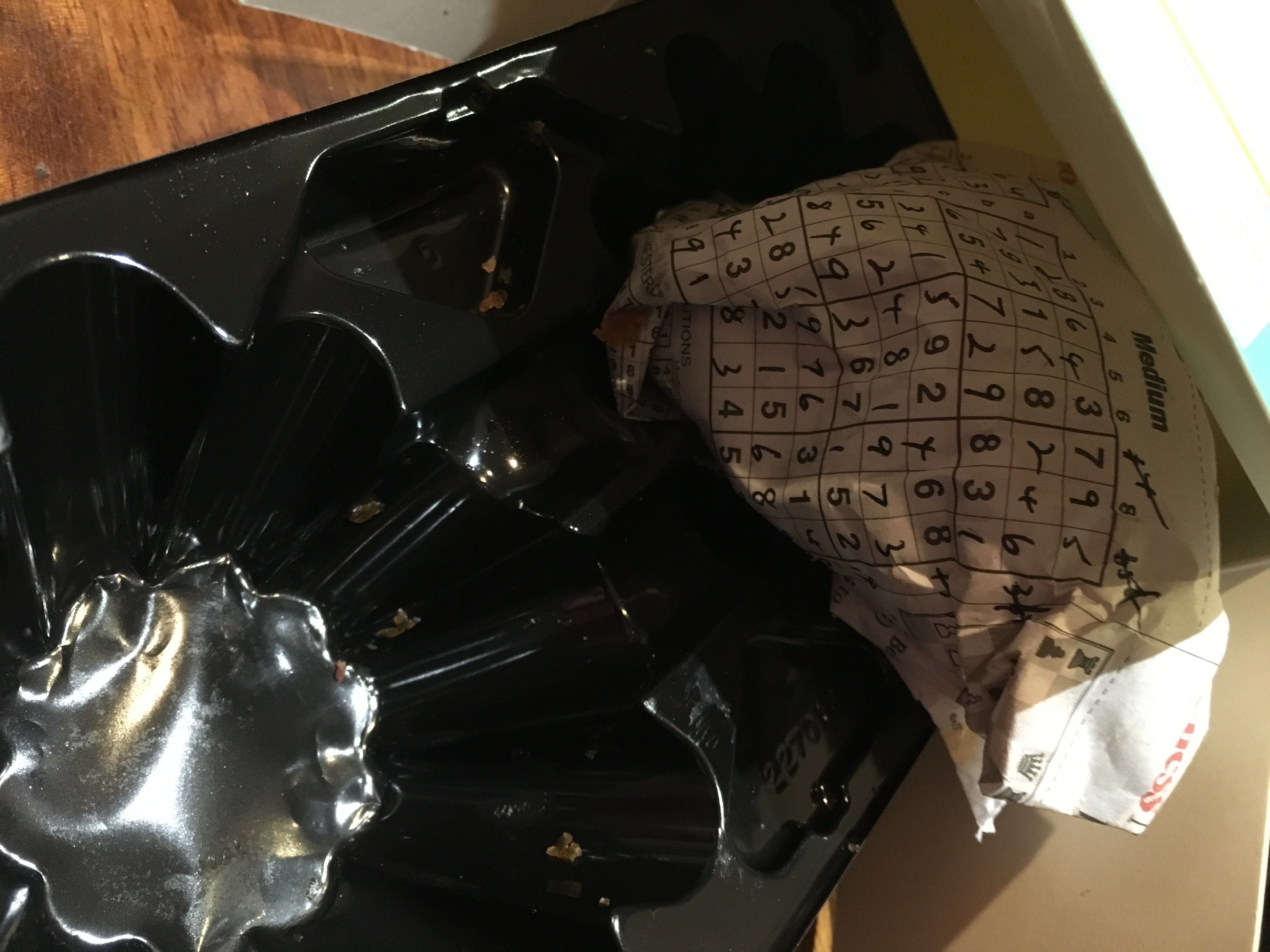
For this challenge, we are going to use those left over plastic insert trays from boxes of sweets, chocolates or biscuits. If you don’t have one, use a cardboard cup holder.

Getting into the box is only the start of the challenge…

Beginners:

  • place food rewards into each space in the insert and add to the box


Intermediate:

  • make a teaser using the tray and food rewards
  • add balls, that are a safe size for your dog. over each treat
  • all into the box

  • add paper treat parcels to each space in the tray and stick that in the box

add packing to tray to box

  • use toilet rolls wedged into suitably sized spaces in the tray, over each treat
  • add to the box

tube teaser

  • pop food rewards into each tray space and wedge paper cups over each treat

Advanced:

  • add food rewards to each space in the tray and then stack the trays
  • you can make this a little easier by adding food, then some packing paper to each space and then stacking another tray on top

  • don’t worry if you don’t have a tray, you can use paper cups instead
  • lay treats in the box and wedge paper cups over them, covering them
  • wedge paper or even toilet roll tubes around the cups to keep them in place if required

Option 5: Busy Box in a Box

The difficulty level lies in how challenging you make the Busy Box in a Box. Start with Beginner’s level challenges and increase the difficulty as your pet improves and their behavioural repertoire broadens.

Take any of the simple or more complex Busy Boxes described here (or invented) and add to another box!

Eggboxes and tissue boxes can be stuffed with food and packing and jammed into a box for a quite Busy Box in a Box.

Simply add a packed Busy Box, with some other loose paper to a box for a simple Busy Box in a Box:

Link

Option 6 Ball in a Box

Busy boxes don’t just need to be about food – you can add your dog’s favourite toy too and make it about playtime!

Beginners

Incorporate boxes, of different sizes, into fetch games by simply tossing the ball in there and letting the dog fetch it.

Using a box that’s slightly taller will add some extra challenge.

Clip link

Intermediate

Turn the box on its side or upside down and allow the dog to manipulate the box to find the ball.

Link

Advanced

Add your dog’s favourite toy to a packed Busy Box so they really need to search and snuffle to find it.

2019-08-28 (3)

Your challenge

Now it’s your turn. Show us what you and your pets, of any species, can do with these challenges!

Post to your social media accounts, using the #100daysofenrichment so that we can find you and join our Facebook group to share your experiences, ideas and fun!
You can comment right here too 🙂

We look forward to hearing from you and your pets – have fun & brain games!

mess
You just need to clean up the mess!

Day 8: Body Awareness – cavaletti

Welcome to Day 8 of #100daysofenrichment and thank you for joining us on this journey!

Although our challenges are directed mainly at dogs, we want all species to enjoy and benefit from #100daysofenrichment so, please join in, adjust and adapt to help your pet or companion live a more enriched life.

Don’t forget to review all the information leading up to #100daysofenrichment and more here on playing safe. Know your dog!

Deck2

Cavaletti

At a glance:

  • borrowed from the horse world, cavaletti or ground poles are small jumps for stepping or trotting over, rather than leaping (for the most part)
  • cognitive and sensory based enrichment
  • often used in training for sports dogs and for rehab after injury, trauma or surgery
  • get the family involved in this one – kids love setting up challenges like this for their pets. It’s probably better that an adult help the dog move over the obstacles though as this requires a level of care and coordination, particularly at the beginning.
    Remember, supervise children in all enrichment activities and interactions with pets.
  • practice in very short sessions of 2-5 minutes at a time – this can be very tiring, both mentally and physically so it’s important that you work for very short sessions

What do you need?

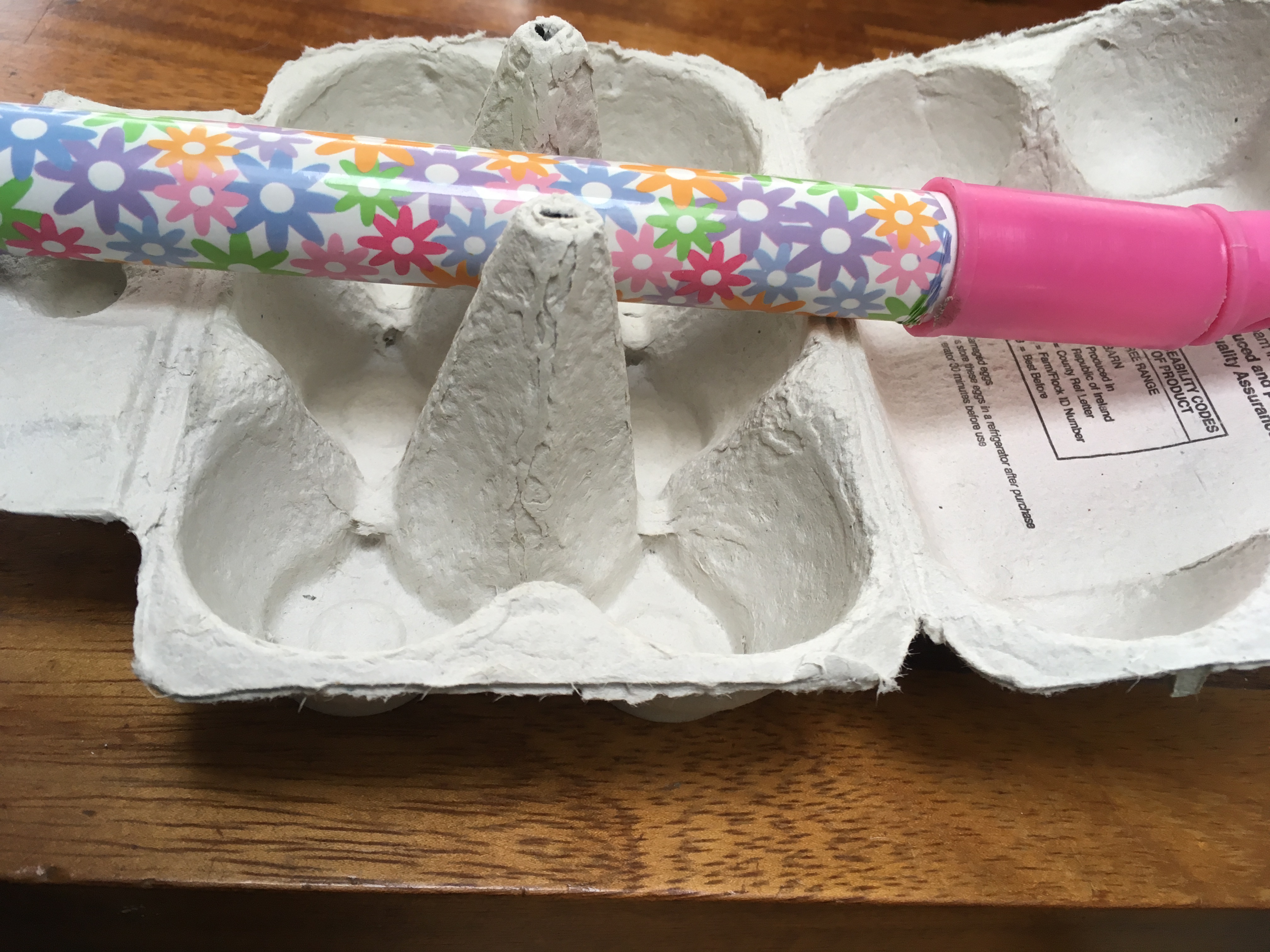
  • eggboxes – you can stack them for more height, but is generally a suitable height for starting out

20190110_115200860_iOS.jpg

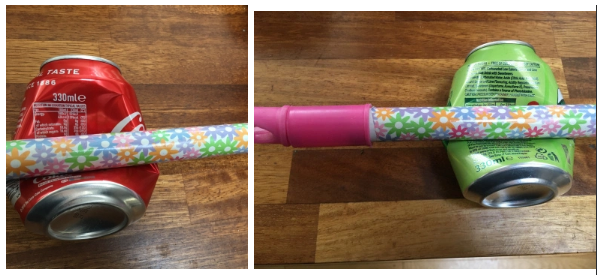
  • drinks cans (empty) – crush them to adjust their height; just squeeze in the middle so that the ends provide stability

2019-08-27

Similarly you can rest poles on folded towels and we have even had participants use shoes or boots to rest poles on!

  • broom or mop handles
  • walk sticks, crutches
  • bamboo or similar light poles
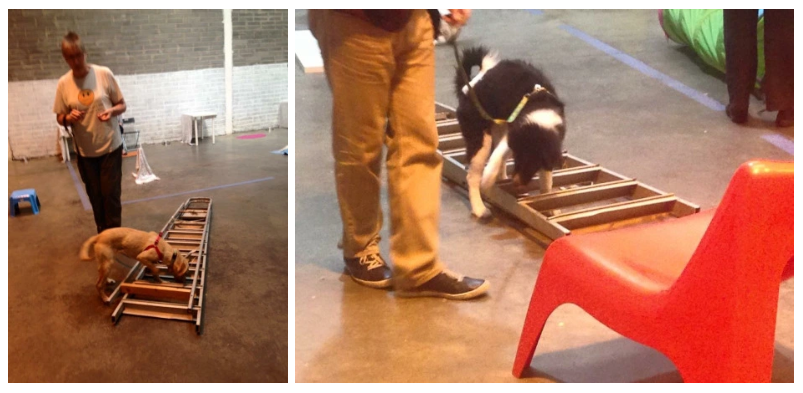
  • flat lying ladder

ladder

  • food rewards – it’s better to use soft food rewards for this one so that they don’t roll on the floor too much, which is important for these challenges

We are talking homemade cavaletti here, but you can go all out on this one, if you have any of the following:

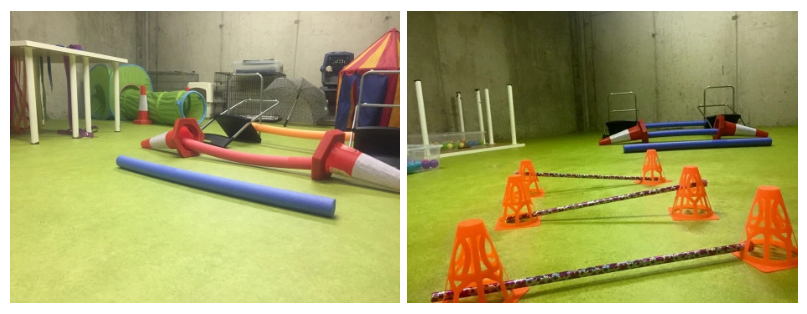
  • PVC pipes, cut to size
  • pool noodles

cavaletti

  • sports cones – the collapsible types are ideal (lower right) for safety and because they have lots of holes in them allowing for adjustments and movement

cones

Some resources will show upturned laundry baskets being used, but we need to take care. We want what ever the poles are suspended into be easily moved should the dog bang off it or tumble over a pole.

You will see that we have used all sorts of things as cavaletti including chairs, cones of different types, plastic tubs and hula hoops. You can keep this as simple as you need to though!
Enrichment Goals:

  • to help dogs develop awareness of how their body moves, where their limbs are and how to adjust and shift their weight to compensate during physical challenge
  • to provide physical and mental challenge to pet dogs
  • to encourage dogs to interact with novel or weird things in their environment
  • to help dogs develop confidence through enhanced body awareness
  • to help dogs slow down and think about how they move and physically interact with their environment
  • to help prevent injury, improve fitness, lengthen stride, increase back and core strength

Cavaletti are used in the dog-world most often to improve an individual’s propioception. This refers to helping the animal develop better awareness of where their body is in space.

This might not sound like a terribly challenging concept, but I can assure you that many dogs have difficulty with this, and if dogs are to train or compete in sports, especially those that require repetitive activities, and dogs recovering from injury or surgery, these exercises can be very beneficial.

While this challenge is certainly cognitive, the dogs are also experiencing sensory challenge and we are adding enrichment to their environment, with lots of crossover between categories.

Cavaletti can be helpful for puppies, whose brains are forming resulting in improving coordination as the relevant brain areas mature, and for older dogs whose cognitive abilities and coordination may be disimproving as they age.

Shy puppies can be particularly helped and given a big confidence boost with cavaletti work. They are learning to interact with their environment, being exposed to novel stimuli and sensory experiences, and engaging their cognitive and sensory systems…literally growing puppy brains!

Link

Link

What goals can you add to this list for your pets?

How can we achieve these goals?

  • take your time with this one and listen carefully to your pet
  • some dogs will be reluctant to pass over the poles on the floor or ground so just leave out the cavaletti arrangement and allow them to check it out in their own time, without you using food to lure them or encouraging them too much. Just let them become comfortable with the additions to their environment.
  • setting up cavaletti on grass or on a non-slip rug or runner, bath mat or yoga mat can help improve the dog’s comfort and increase their willingness and confidence; this is also safer
  • this is not a race – the goal here is to help the dog move slowly over each pole so that they need to think about placing each foot, weight shifting and compensating for different heights and strides
  • work with your dog on lead if required to help them move a little slower but don’t use lead pressure, otherwise they will need to further compensate
  • walk through the cavaletti with your dog and place a treat in each space so that your dog stops and steps over each pole individually and slowly
  • don’t lure your pet, with food in your hand; drop a treat in each space so that your dog has to get it

What adjustments will you make for your pets?

Applications of Cavaletti:

Cavaletti, in the horse, world are used to improve balance, fitness and stride. In dog sports and rehab, it’s applied for pretty similar benefits.

But, this work really can help in other, ‘everyday’ ways too.

My favourite application of cavaletti and other body awareness exercises is with dogs who can have difficulty coping with the ups and downs of the world; dogs who exhibit behaviour associated with cautiousness, shyness or fear, dogs who may show behaviours associated with excitability, frenetic movements, and who have a hard time calming after getting wound up.

Although these dogs’ responses may seem very different, their behaviour may be associated with having difficulty coping with swings in stress, having a hard time recovering and losing control fast.

Getting them thinking about their movement helps them to think rather than react and boosts their confidence on a number of levels.

img_8879

Enrichment Options

Before you even start today’s challenges, set your pet up for success and prevent upset:

Clip link

Option 1: Cavaletti foundations

Start by using similar poles in a course of at least four obstacles.

Roughly measure the distance from the floor to your dog’s elbow; that’s the distance between each pole. The dog should be able to complete one stride or step between two poles.
If you want to encourage lengthening of stride, measure floor to elbow and double.

For short legged/long backed dog like Dachsies, this needs to be a greater distance. These dogs will complete two strides or steps between two poles.

You might have to experiment a little for your dog’s comfort.

Have each pole at a similar height and the same distance apart.
This helps the dog get the game – they build their confidence because all they need to think about is stepping over the poles and they don’t need to worry about adjusting to varying heights or strides, yet.

No pole in the cavaletti arrangement should be higher than the dog’s hock.

Beginners:

  • set up a cavaletti course of four obstacles
  • work on a non-slip surface or on a yoga mat or similar
  • you will step sideways through the course (carefully!) alongside your dog
  • as you step, drop one treat into the space between the pole – try to get just ahead of your dog so there is continuous but slow and steady movement
  • while your dog eats a treat, you step ahead and drop the next one – it might take some practice to get into a rhythm so don’t give up!

Intermediate:

  • set up exactly the same
  • this time, drop one treat between the middle poles and one treat after the last pole
  • only begin to reduce the number of treats between each pole when your dog gets the game
  • if your dog jumps, knocks poles or moves too quickly, go back to the Beginners stage and continue to practice

Advanced:

  • set up as you have done before
  • have treats in a little bowl after the last pole only
  • if your dog jumps, knocks poles or moves too quickly, go back a stage

Link

Link

With your dog progressing, they will begin to move a little faster through the obstacles. Speeding up to a trotting gait is fine, but they shouldn’t move any faster than that. If they do speed up, go back to feeding between poles.
Remember, the point here is to encourage them to think about each body movement, each step. The faster they go, the less they think.

Option 2: Mix it up

It’s important that your dog gets the cavaletti game before starting with this option. There’s no hurry here – progress according to you and your dog’s abilities. Take your time – really invest in building the dog’s confidence with this set-up.

As before, a course of four cavalettis is fine. But this time, we will be mixing it up a little; have poles that are at differing heights and vary the distance between them. This will engage your dog’s sensory and cognitive systems even more.

Beginners:

  • set up a cavaletti course of four obstacles
  • work on a non-slip surface or on a yoga mat or similar
  • you will step sideways through the course (carefully!) alongside your dog
  • as you step, drop one treat into the space between the pole – try to get just ahead of your dog so there is continuous but slow and steady movement
  • while your dog eats a treat, you step ahead and drop the next one – it might take some practice to get into a rhythm so don’t give up!

Intermediate:

  • set up exactly the same
  • this time, drop one treat between the middle poles and one treat after the last pole
  • only begin to reduce the number of treats between each pole when your dog gets the game
  • if your dog jumps, knocks poles or moves too quickly, go back to the Beginners stage and continue to practice

Advanced:

  • set up as you have done before
  • have treats in a little bowl after the last pole only
  • if your dog jumps, knocks poles or moves too quickly, go back a stage

Link

Body awareness work is very tiring for dogs because it is such exerting physical and mental exercise. Just like a good Sniffathon, you might be surprised just how tiring your dog will find these exercises.

Practice in short sessions of just a few minutes at a time. As you notice your dog becoming more clumsy, that’s a good indication that they are tiring, mentally and physically. The dog might knock poles, might attempt to jump or rush poles, or might show reluctance to engage with the obstacles.

Listen to your dog and let them go at their own pace. Slow and steady wins the race!

Your challenge

Now it’s your turn. Show us what you and your pets, of any species, can do with these challenges!

Post to your social media accounts, using the #100daysofenrichment so that we can find you and join our Facebook group to share your experiences, ideas and fun!
You can comment right here too 🙂

We look forward to hearing from you and your pets – have fun & brain games!

img_4677

Day 7 Sunday Funday

Welcome to Day 7 of #100daysofenrichment and thank you for joining us on this journey!

Although our challenges are directed mainly at dogs, we want all species to enjoy and benefit from #100daysofenrichment so, please join in, adjust and adapt to help your pet or companion live a more enriched life.

Don’t forget to review all the information leading up to #100daysofenrichment and more here on playing safe. Know your dog!

img_4487

Every Sunday during #100daysofenrichment is Sunday Funday! This means you and your pet repeat your favourite challenge or challenges from the week.

You can do it exactly as you did first time round, you can try a different option, build on your progress already established, reinvent and rejig it…what ever you want to do with the last week of challenges!

Monday Day 1 Stuffables

Tuesday Day 2 Release the toy, release the joy!

Wednesday Day 3 Handling & Husbandry: Handling Comfort

Thursday Day 4 Hanging Out: Just Be

Friday Day 5 Freestyle Friday

Saturday Day 6 Sniffing Saturday: SNIFFATHON

Your challenge

Now it’s your turn. Show us what you and your pets, of any species, can do with these challenges!

Post to your social media accounts, using the #100daysofenrichment so that we can find you and join our Facebook group to share your experiences, ideas and fun!
You can comment right here too 🙂

We look forward to hearing from you and your pets – have fun & brain games!
IMG_0858

Day 6: Sniffing Saturday

Welcome to Day 6 of #100daysofenrichment and thank you for joining us on this journey!

Although our challenges are directed mainly at dogs, we want all species to enjoy and benefit from #100daysofenrichment so, please join in, adjust and adapt to help your pet or companion live a more enriched life.

Don’t forget to review all the information leading up to #100daysofenrichment and more here on playing safe. Know your dog!

sniff

Sniffathon

Saturdays during #100daysofenrichment are all about emphasising the dog in all our dogs; all about sniffing and doing dog things.

IMG_4770

Implement Sniffathon Rules:

  • allow your dog to sniff sniff sniff
  • no human interference
  • allow your dog to sniff as long as they please – don’t even suggest that they must stop sniffing or move along
  • allow your dog engage in doggie things, even if it seems icky to you, once safe

That’s it, take your dog for sniff, rather than a walk, and let them be a dog!

img_9049

What makes a dog a dog?

When you think of behaviours that are synonymous with dog…what are those behaviours?

Most people who seek my help with their pets are concerned about pretty normal behaviours. Often, when these behaviours are demonstrated in the human world though, they become a problem for the humans. We call them “behaviour problems”, more so because they become a problem for us.

img_5478

Dogs come with sets of behaviour installed. Behaviours that dogs must do.
Selective breeding to produce different types and breeds of dogs has exaggerated or inhibited some behaviour sets so we have differences at that level. Different breeds and types of dogs will exhibit differences in these behaviours.
Continued selection, rearing environment and lifestyle will combine to dictate whether these behaviours become problems for pets and people.

35087350_221929378411866_3632977737490104320_n
Let your dog check their pee-mail!

It’s perfectly normal for dogs to ‘taste’ other dogs’ urine or faeces, to sniff all sorts of faeces and urine (plus other discharges like saliva), to mark and over mark and to kick after toileting:

(Link) I took this clip recently because he was sniffing some dog’s hair so intently and for such a long time. But, I also happened to catch him ‘tasting’, sniffing, overmarking and kicking. Although he spends a lot of time sniffing, presumably detecting social information, he cocks his leg and kicks much less frequently, especially for a mature entire male.
He is a pretty socially confident fella, and I guess he doesn’t need to tell everyone he’s all that, ‘cos he knows he’s da bomb! 

To live with people, dogs must inhibit their very doggieness for much of the day. That’s what #100daysofenrichment is all about; making sure dogs get to be dogs and forget about human rules for a little bit!

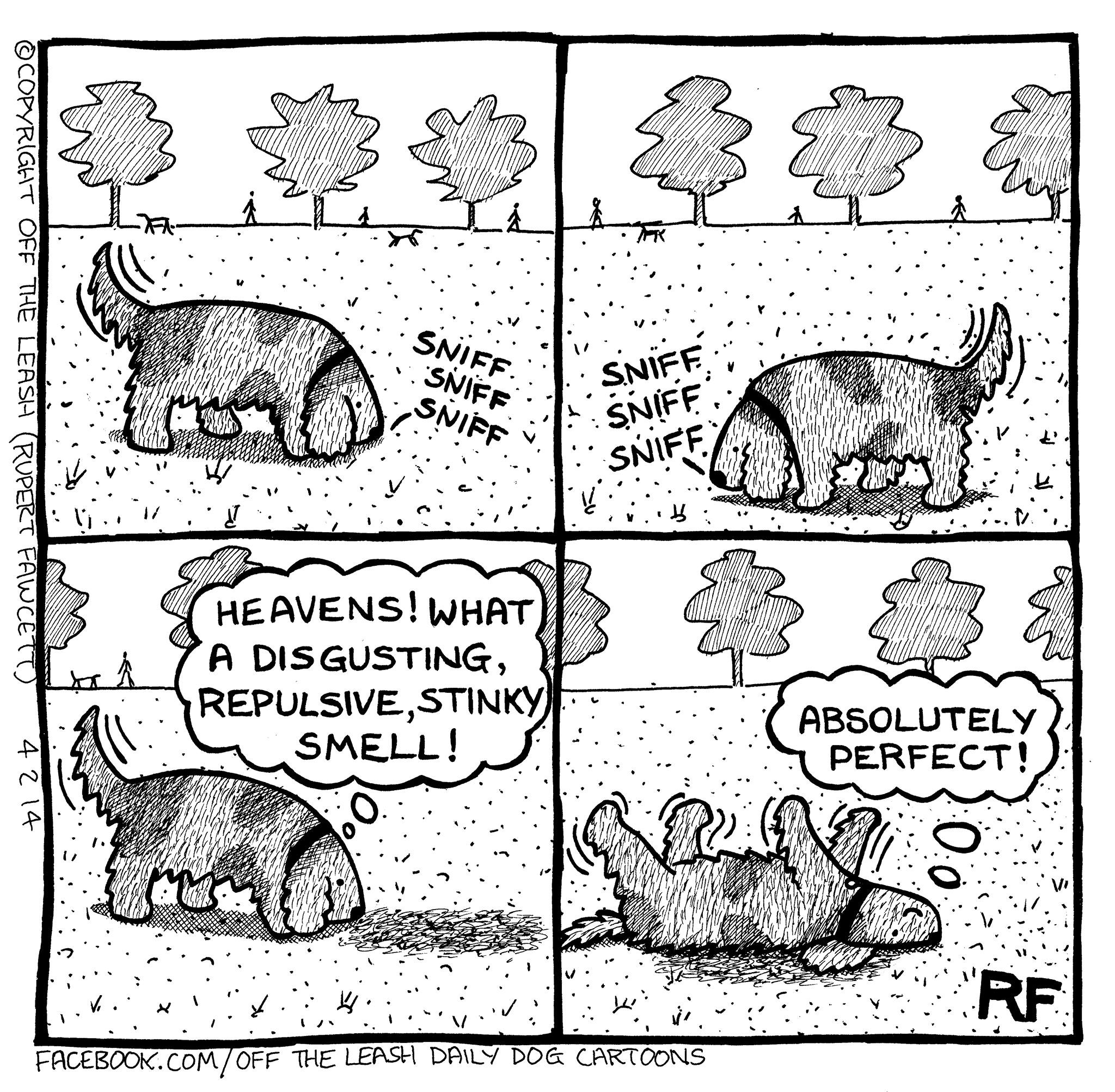
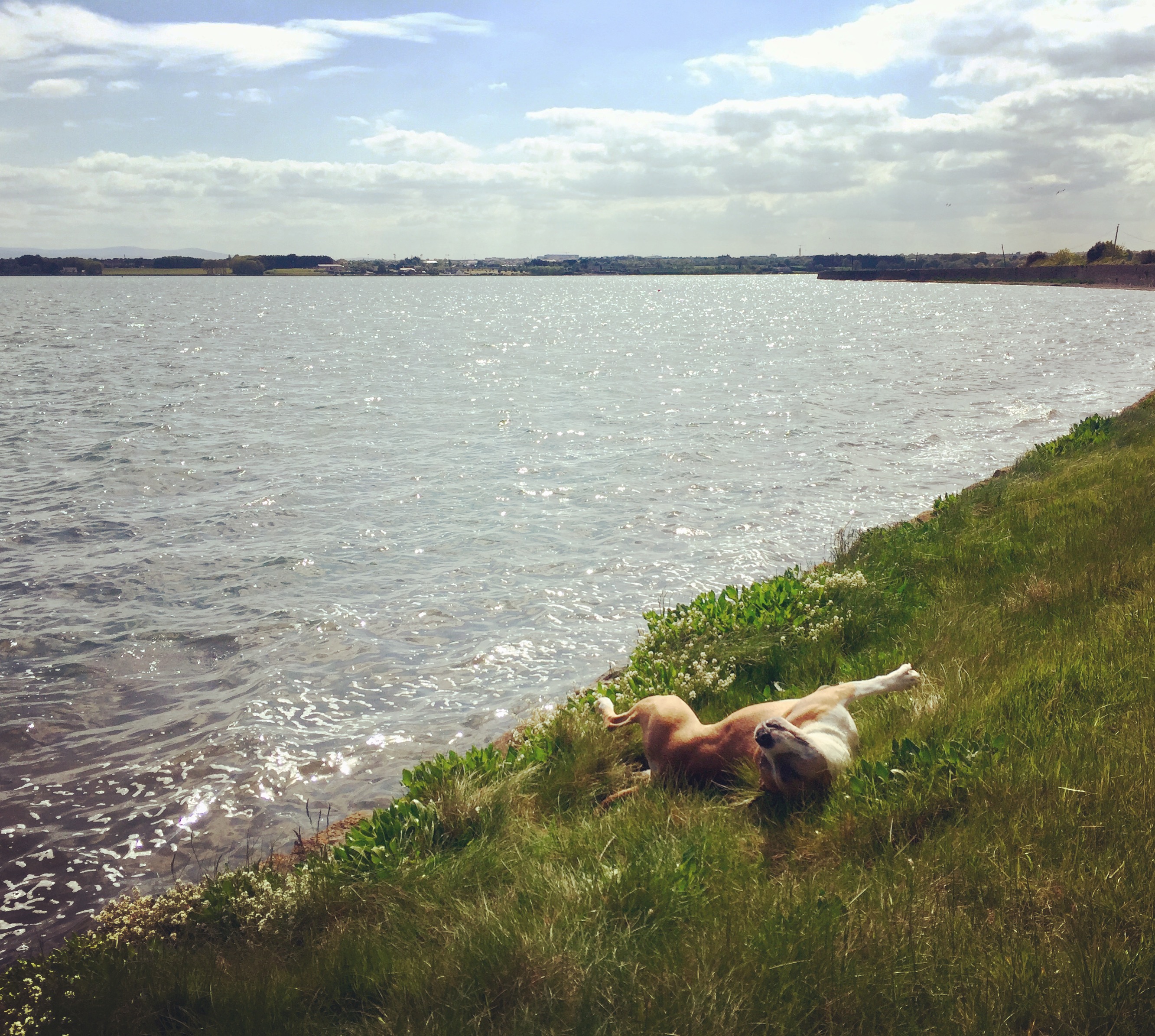
Not many things more joyful than a dog having a good roll in that perfect spot:

Link

Or finding that perfect digging pit…even if it is on the side of the road:

Link

Making dog walks more dog

Although on Sniffing Saturdays we are emphasising sniffing, today on our Sniffathon, we want to facilitate all sorts of dog behaviours, even the ones that we might find abhorrent.

Behaviours like sniffing (obviously!), marking and toileting, eating poop, rolling in smelly things, jumping, digging, splashing, watching the goings-on, barking, chewing, exploring, investigating, sniffing and more sniffing are all on the agenda today.

Link

Link

Go for a sniff, instead of a walk

Today we aim to maximise the amount of sniffing, in as natural a situation as possible, our dogs get up to.

  • take your dog to a place that allows for tons of sniffing
  • pick places that allow your dog to get lost in their noses so without many other distractions; Deck and I have a couple of sniffy places like here and here.
  • have them on lead or a long line for safety, if necessary
  • ideally, bring them to a place where the dog is able to relax a little and sniff systematically, rather than move frantically
  • think about the effects of different times of the day, different ambient temperatures, different weather conditions – all have effects on sniffing and can change the olfactory landscape dramatically, providing different challenges and boosting enrichment

20190315_225044746_iOS

  • your dog might need help slowing down (this clip and this clip show examples of helping dogs do this) so that they can take the time to sniff, rather than be vigilant – the location you choose will help with this
  • try not to use toys or food to encourage them to sniff – let them interact with the environment as they see fit
  • try not to cue the dog or encourage them along – stand behind them, walk slowly, be patient
  • don’t get hung up on how long you are out for or how much distance you have covered…today is about quality rather than quantity
    We are measuring quality in how much sniffing happens!

Link

Sniffathon Challenges

Remember, Sniffathon Rules:

  • allow your dog to sniff sniff sniff
  • no human interference
  • allow your dog to sniff as long as they please – don’t even suggest that they must stop sniffing
  • allow your dog engage in doggie things, even if it seems icky to you, once safe

That’s it, take your dog for sniff, rather than a walk, and let them be a dog!

Link

Enrichment Options

Today, take your dog for a sniff with Sniffathon Rules!

If you can’t get your dog out and about today, that’s ok.

  • bring the sniffathon in if the dog can’t go out

Collect vegetation, grasses, sticks and branches and other natural smelly things from a local green area.

Gather small amounts of your collection in fabric shopping bags and hang at sniffing height, rather than on the ground.

This not only makes it easier to clean up but is convenient for the dog and may reduce disease spread, if that’s a concern.

Here’s a Sniffari set-up for a group of dogs who are indoors for PlayDates; this way we can bring some outside sniffs, inside:

Link

  • bring the dog out for limited exposure

If you have an unvaccinated puppy, for example, exposing them to the outside world carefully is an important tool in shaping their behavioural development.

Bring puppy in your arms or in the car. Sit with the door or window open, puppy in your arms, and allow them to air-sniff. Sit with them on a bench or a quiet spot.

When bringing puppy out in your arms, it’s best not to allow others to pet or approach your puppy. When they are restrained, they have little choice in how they interact and that can be overwhelming, especially for young puppies. Make it about air sniffing and observing instead.

Here I hang out with Cara in the car so she can gather some information about this new place, before she will interact with a new and overwhelming environment.

Link

  • play the Go Find It! game

Some dogs find being outside in the world far too exciting and due to this arousal, are vigilant, rather than engaging in appropriate sniffing behaviour.
They are often moving too fast, scanning for smells, but not really taking anything in. They are stuck in a visual world, checking constantly for signs of danger.

Bringing these dogs out and about and expecting them to calmly sniff at their leisure is too much of a challenge, certainly at this time. Instead, take them somewhere that they can be comfortable – this might just be your back garden, or maybe you can get them out to the front of the house.

Distance traveled is not the point, comfort is. Use some food rewards, that are just valuable enough that they will search for them but will not cause them to become too frantic or wound up. Might be somewhere above kibble but below steak!

Jack and Jessie are exactly this type of dog, having just come from long term kenneling in a shelter, and here they are being introduced to the joys of the Go Find It! game at the front of their house – this is the most engaged in sniffing and playing with their humans outside of the house ever!

Link

Your challenge

Now it’s your turn. Show us what you and your pets, of any species, can do with these challenges!

Post to your social media accounts, using the #100daysofenrichment so that we can find you and join our Facebook group to share your experiences, ideas and fun!
You can comment right here too 🙂

We look forward to hearing from you and your pets – have fun & brain games!

img_7810


Day 5: Freestyle Friday

Welcome to Day 5 of #100daysofenrichment and thank you for joining us on this journey!

Although our challenges are directed mainly at dogs, we want all species to enjoy and benefit from #100daysofenrichment so, please join in, adjust and adapt to help your pet or companion live a more enriched life.

Don’t forget to review all the information leading up to #100daysofenrichment and more here on playing safe. Know your dog!

Freestyle Friday

Now it’s your turn to get creative! Every Friday will be Freestyle Friday. We’ll give you the ingredients for a puzzle or enrichment device and you build it.

Rules:

  • you must use all the ingredients
  • you can add anything else you like, or nothing at all
  • whatever you come up with must be enriching

Day 5 Ingredients

You must use the following:

  • box(es) or tub(s) – any size just make sure they are safe
  • packing, loose paper – any type just make sure it’s safe

You can add food or toys or anything else appropriate, if you like. Or you can use this as it is.

We can’t wait to see what fun and brain games you and your pet get up to with this one!

Your challenge

Now it’s your turn. Show us what you and your pets, of any species, can do with these challenges!

Post to your social media accounts, using the #100daysofenrichment so that we can find you and join our Facebook group to share your experiences, ideas and fun!
You can comment right here too 🙂

We look forward to hearing from you and your pets – have fun & brain games!

IMG_7047

Week 2 Equipment List

Hard to believe that the first week of this ambitious project is coming to an end. It has been a resounding success, down to you guys. The joy you have given us, watching you and your pets have fun and enjoy enrichment together, is much appreciated!

Keep up with all the resources and challenges relating to #100daysofenrichment here
and join our Facebook group too!

All challenges are presented with multiple options so you won’t lose out if you don’t have some of the items.

For Week 2 you will need:

  • eggboxes
  • aluminium drinks cans
  • snufflemat if you have one (don’t worry if you don’t have one)
  • balls (a safe size for your pet)
  • paper cups
  • broom/mop handles
  • bamboo sticks or similar poles, walking sticks, crutches
  • a flat lying foldable ladder (again, don’t worry if you don’t have one)
  • different size cardboard boxes or plastic tubs

20190110_115608010_ios

  • paper, packing paper, wrapping paper, newspaper, kitchen roll
  • plastic trays from sweets, chocolates or biscuits

20190110_115540898_ios

  • cardboard/disposable cup holders
  • Stuffables
  • dog beds and bedding (e.g. blanket, Vet Bed etc.)
  • chew toys, edible chews

And for Freestyle Friday you will design your own enrichment device with the following ingredients:

  • eggboxes
  • balls
  • paper cups
  • paper e.g. packing paper, newspaper, kitchen roll, shredded paper (again, play safe and remove staples, clips and so on)

We have lots more fun and brain games ready for you for next week. Start getting ready…

Subscribe to this blog so that each day’s plan is delivered right into your inbox each morning.

Day 4: Hanging Out – Just be

Welcome to Day 4 of #100daysofenrichment and thank you for joining us on this journey!

Although our challenges are directed mainly at dogs, we want all species to enjoy and benefit from #100daysofenrichment so, please join in, adjust and adapt to help your pet or companion live a more enriched life.

Don’t forget to review all the information leading up to #100daysofenrichment and more here on playing safe. Know your dog!

20190109_232512000_ios

Just be

Today, there’s no big plans or training exercises. Today, we are dialing it way back and hanging out.

Learning to just be is not a skill that comes to most pet dogs easily, and indeed to many people. Just being is a lost art; in the age of smart phones and on-demand entertainment, we don’t have to be very often or for very long.

But, this is such an important skill for companion animals, who, at the whim of their humans, must be able to be in environments that don’t always cater for their natural tendencies.

img_2716

Find your happy place

What do you like to do together?

Where do you like to go together?

Where and when you both can just be. You don’t have to be engaged in any particular activity, just be. Together.

There are no training cues or food rewards, or even toys, required. No smart phones for the humans, no thoughts about what you should be doing.

Be calm and quiet. Sit close or just in one another’s presence.

You don’t have to touch. Humans are tactile, we grip and use our fingers. Dogs are not so much into that. They don’t need petting, touching or grabbing to be.

Dogs often like to lean or touch off one another’s bodies. They might lie back to back, or they might spoon.

img_0274

Hang out

Dogs and other companion animals must learn how to be around people and people-goings-on. Dogs gain these skills by being around people, especially when they are young.

Spending time isolated from opportunities to be around people is detrimental to behavioural and social development. Dogs who are alone for large portions of the day, especially young dogs, may be at risk of suffering negative effects.

To help these dogs, we are tempted to spend the little available time with them go, go going. We think we are making up for lost time by providing the dog with activity, exertion and excitement. While all that stuff may be a good addition, consider just being as just as important a skill and a vital part of helping and supporting them, when you can spend time with them.

Link – read the explanation accompanying this video too

Here I am hanging out with Theo while he was spending time in kennels. Helping him be. So that he can cope with life in kennel accommodation, in virtual isolation. 

Link

Link

Shy girl Faith appreciated lots of time to be, when she first came from the pound.

How to be

This can be tricky for dogs, and people. If this is a dog who is in kennel accommodation, it might be easier to do this from outside the kennel, while the dog has something stuffable to work on initially. Or it might be better to try this away from kennel life, out and about.


Deck & I hang out in the car clip – Note the gaps for consent and asking where he wants contact and if he wants it to continue.

For dogs who find it hard to be, try when they are already calm, initially when they are settling with a stuffable, when the house is quiet. It can take some time to build this ability, for both species.

Put away your phone, concentrate on being, in the moment, with your pet.

IMG_0845

They may or may not want contact or touching. Try not to make this a grooming or scratching session. Massage them calmly and briefly, withdraw and allow them to be. Repeat if they want that. But, it’s not necessary, to be.

img_2469

How you be

There are no rules. Work on being. Work on finding what helps your dog be. Work on finding what helps you be.

Build slowly. Develop being incrementally. Avoid frustration, fidgeting, agitation and excitement. Maybe, you will only be for very short durations, seconds, minutes. That’s ok. It’s a work in progress.

img_4920

Your challenge

Now it’s your turn. Show us what you and your pets, of any species, can do with these challenges!

Post to your social media accounts, using the #100daysofenrichment so that we can find you and join our Facebook group to share your experiences, ideas and fun!
You can comment right here too 🙂

We look forward to hearing from you and your pets – just be!

img_1279

Day 3: Handling & Husbandry – handling comfort

Welcome to Day 3 of #100daysofenrichment and thank you for joining us on this journey!

Although our challenges are directed mainly at dogs, we want all species to enjoy and benefit from #100daysofenrichment so, please join in, adjust and adapt to help your pet or companion live a more enriched life.

Don’t forget to review all the information leading up to #100daysofenrichment and more here on playing safe. Know your dog!

20190107_225444000_ios 1

Handling Comfort

At a glance:

  • improve your pet’s comfort with handling and grooming procedures
  • all dogs must be handled, in often invasive ways, throughout their lives for grooming, health care and first aid
  • social and cognitive based enrichment
  • although children can make great dog trainers with the right guidance, this exercise is best established by the adults in the household
    Children might help by preparing treats for practicing this exercise.
  • these exercises can be practiced in individual sessions of no more than 30 seconds at a time; have as many sessions as you can!

What do you need?

  • food rewards – you can use your dog’s regular food, a training mix, commercial treats, home prepared treats such as cut up meats, cheese, vegetables or homemade treats such as liver or tuna cake
  • a lappable stuffable (see ideas from Day 1)
  • small towel, such as a face cloth, tea towel, or hand towel
  • a brush or comb for your pet

Most pet owners presume that their dog is pretty comfortable with handling and manipulation, and while many are, most dogs are good at tolerating human behaviour. For this exercise, we don’t want to achieve mere tolerance, we want joy!

This is also the first time we are going to ask you to really observe your dog’s behaviour and think about how they might signal that they are voluntarily and happily opting in.
It’s not our pets’ obligation to opt in to handling or physical manipulation; our pets are individuals who have likes and dislikes, and good and bad days. They are allowed to say “STOP!” and “WAIT!” if they need to.
And what’s more, teaching them that they can opt in, or not, is confidence boosting and bond boosting. You become a beacon of trust, you become predictable and reliable.

This is why I have included this in this project. Helping our companions bond over a trust-account, built on communication and choice.
Establishing predictability and controlability are important functions of enrichment.

Link

This clip shows a summary of the stages to building Decker’s comfort with having drops applied to his ear, treatment for painful ear inflammation. 
Not only is this process helping him to feel better about ear manipulation and medication application, but also because he gets to decide when and how this happens to him. 
He is being rewarded with food rewards (and catching) and choice. That makes uncomfortable medication delivery more bearable and possibly even enjoyable. 

You can check out a full playlist of each session helping Decker become comfortable and willing in ear treatment here.

Enrichment Goals:

  • to improve the dog’s comfort with hands approaching, touching, handling and grooming various body areas
  • to teach the dog that they can opt in to, delay or refuse handling and manipulation
  • reduce stress associated with loss of predictability and controlability
  • to encourage a dance of communication, choice, and connection between dog and human
  • to build that bond between dog and human
  • to have a fun and rewarding experience in social situations, between dogs and humans

While training exercises certainly fall into the cognitive enrichment category, they can provide so much more.

This process highlights the complex social relationships forged between humans and companion animals. It’s a level of social enrichment that’s tricky to replicate.

By helping the dog learn that they have control over what happens them, in interactions with humans, the world becomes a safer place for them.

When we talk about enrichment being enriching, this is never more clear than when we start to teach behaviours intentionally. It’s the human’s job to set the dog up for success by making sure the behaviour is doable and that rewards are fast-flowing.

There’s no test at the end of this and you and your pet are not under any pressure. Learn to enjoy the time together, whether you achieve the goal behaviour or not. That’s what’s enriching here…the social and cognitive outlets such exercises provide (for both species).

What goals can you add to this list for your pets?

IMG_2062

How can we achieve these goals?

  • work with toys or other rewards that your dog enjoys – associate each handling interaction with a reward and after many pairings, handling becomes just as enjoyable
  • make it very easy for your dog by gradually adding handling or pressure
  • watch your dog closely for any signs of reluctance; they might go still, or duck or lean away, they may lick at or mouth your hand or the brush, they might pull away
  • if the animal shows the slightest reluctance, stop immediately
  • review your approach and don’t go quite so far next time
  • working like this teaches the dog that, to object, they only need show minor discomfort because you are listening; to gain relief, they don’t need to growl, snarl or snap
  • keep it simple and split behaviour – reward approximations toward the final behaviour, rather than hoping that your dog will offer the goal behaviour quickly
  • take your time and work in many short sessions
  • try for 30 seconds at a time, 5-10 rewards each session, and then take a break
  • plan each session – what behaviours are you looking for and rewarding?
  • watch the clips and try out the exercise
  • portion out your dog’s daily food and allot some for training exercises

20190105_121250580_ios

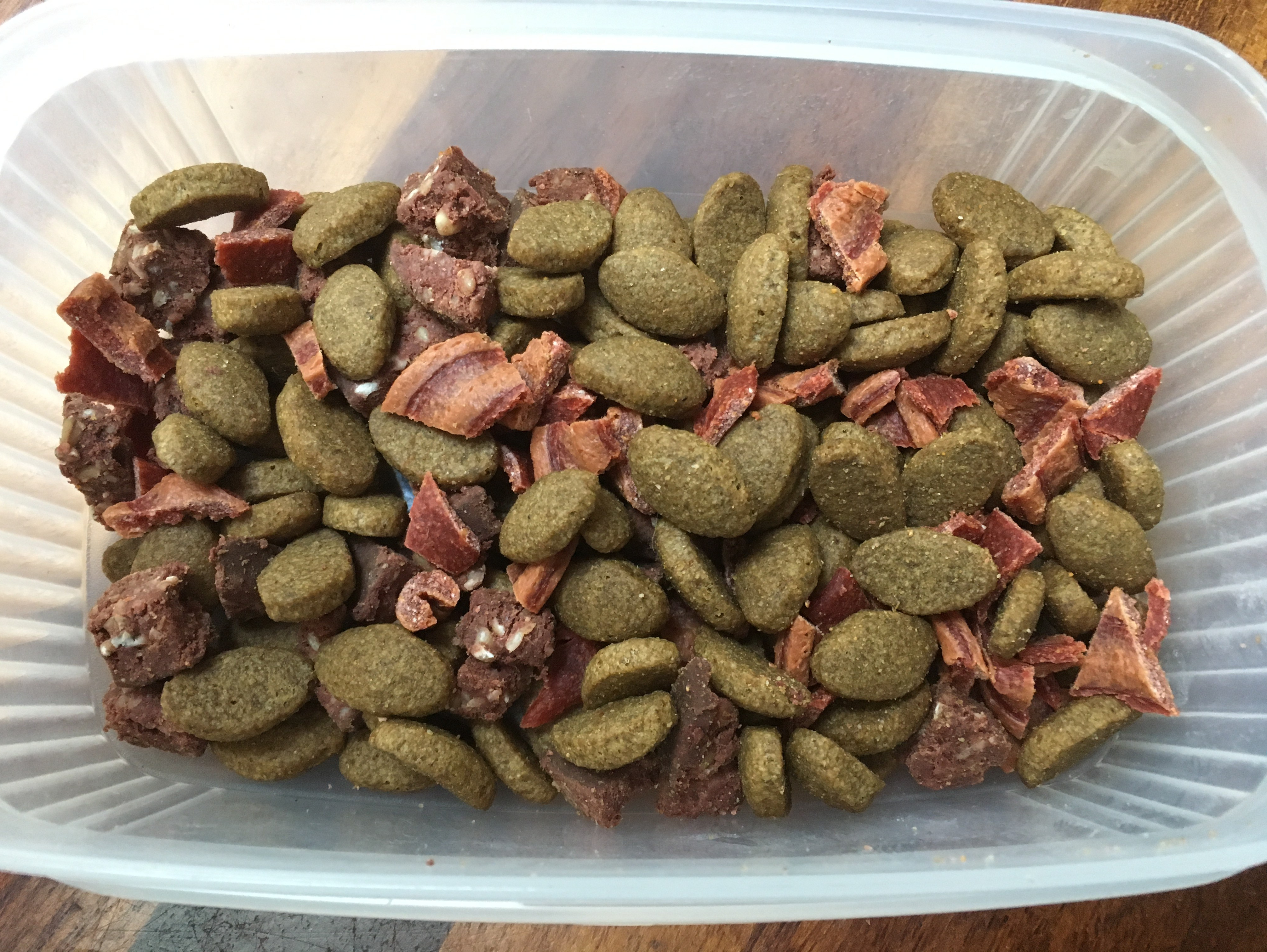
  • make a training mix by adding in something yummier and leaving it all to ‘cook’ together in the fridge; the smells will mingle, harder foods will soften a little, and everything will become more valuable and rewarding

20190105_121536763_ios

  • remember to adjust your pet’s diet accordingly to accommodate the extra calories from treats added, where relevant
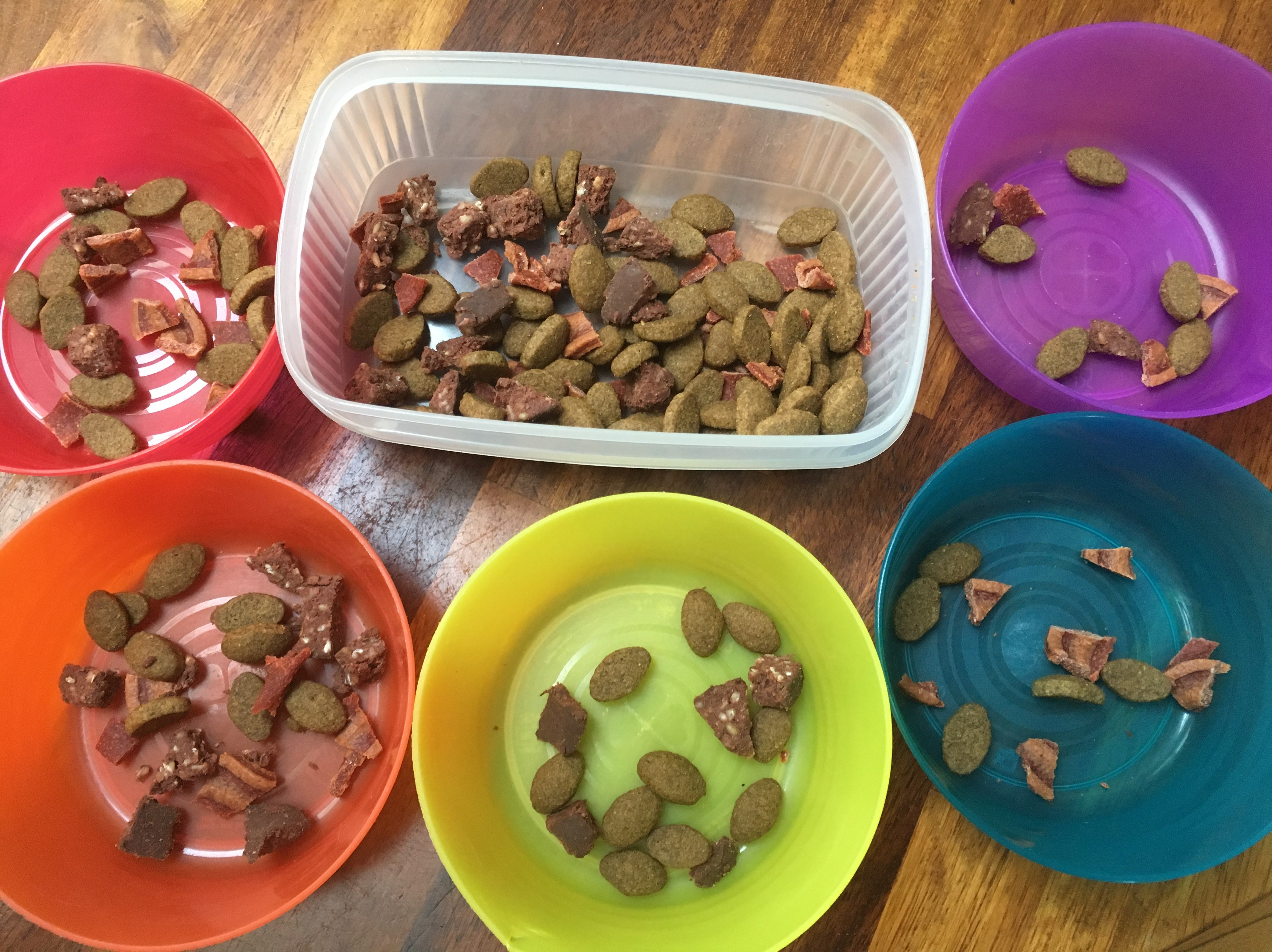
  • split your food rewards into little bowls with just the right number of rewards in each bowl so that you are ready to go; stick bowls of rewards in places where you may need to teach and reward behaviours so that you have rewards ready to go

20190105_121833562_ios

If you are feeding wet or fresh foods, cut up small or mash to a paste and present on a wooden spoon or spatula. Alternatively you can freeze in small ice cube trays or a pyramid baking tray so that you can use small portions and individual treats.

IMG_9387

  • for handling exercises, we love to use a lappable stuffable (see Day 1) – reward the dog by allowing them to have a few licks and then withdraw the toy

What adjustments will you make for your pets?

Applications of handling comfort:

These exercises ensure your dog’s comfort in all sorts of situations and interactions with humans. This means that these interactions become safer and more pleasant for everyone.

Every dog will require veterinary treatment at some point through their lives and most dogs will require some first aid and grooming procedures, sometimes on a daily basis.

Dogs, when super stressed, either go very still and quiet, or move about, struggle and aggress (or somewhere in between). When they are still and quiet, they are presumed to be ‘well behaved’ and tolerant. When they struggle and aggress, we label them ‘difficult’, ‘vicious’ or ‘dominant’, none of which is accurate.

Either way, this isn’t pleasant for our dogs and as the humans (with the big primate brains), we know that our dogs will need to endure such treatment throughout their lives. It’s our job to prepare them for this so it’s a little easier all round.

Helping the dog feel predictability and controlability has wider positive implications, with some research suggesting that these effects generalise to other areas of the animals’ lives. Reducing stress is a good thing!

When we work on handling and husbandry preparations, we establish husbandry comfort at different levels that range from management and distraction, to building comfort, to teaching cooperative behaviours.
Throughout our 100 day project, we will introduce exercises from these categories.

Link

Link

Clip link

Clip link

We help pet owners establish a simple opt-in test with their puppies, early on during puppy education.

Using a yummy stuffable toy, filled with something delicious, we teach the puppy that if they stop lapping at the toy, we stop the procedure immediately.

We want to make this simple and straight forward for puppy owners, who might not have the time or skill to work on cooperative care behaviours, and to help puppies associate something fabulous with handling plus giving them a voice. Win-win-win!

Enrichment Options

Throughout these exercises we are attempting to establish a CER or Conditioned Emotional Response. This means that our dogs learn that one stimulus makes another very reliably happen; reaching toward the dog’s head or collar, for example, makes yummy treats happen.

A CER helps the dog feel differently about a particular situation. A dog may already have developed a negative CER toward having his ears reached toward due to pain from an infection or uncomfortable cleaning or treatment. To help form a positive CER, we must undo the negative one (by not exposing the dog to that situation) while building a new, positive association.

This requires lots and lots and lots of practice. In the case of an established negative CER, it might take many tens of thousands of repetitions over many months to turn it around.

We are always following the rules that we have laid out for our dogs:

  • building progress gradually
  • allowing the dog decide how comfortable they are, or not
  • always pairing any move with something yummy, no matter what
  • listening to the dog

For a CER to be established, we must also get the sequence right:

  • reach toward the dog and then reach toward the treat
  • reaching toward the dog makes you produce a treat
  • if you reach toward the treat at the same time as you reach toward the dog, or if you have the treat out and visible while you reach toward the dog, the dog might not even notice you reaching toward them so no association will be formed

CER
A perfect example of a CER, that I am sure you recognise! Just as the rustling wrapper predicts yummies, we want husbandry and handling contexts to do the same.

Decker recently suffered a very serious injury to his toe that required regular dressing and bandage changes, sometimes daily.

From the beginning, I made bandage change time a big chicken party! Me preparing his bandages and setting up at our bandage station made a lot of chicken tossing happen. That’s right, I established a CER to bandage prep so that even if dressing changing itself was uncomfortable he always looks forward to the process.

Note that when he jumps up he nudges the laid out dressings and not the lunchbox of chicken…bandages make chicken happen!

Link

Even now, months later, if I take out cotton wool, he’s up and super excited, such is the power of a well established CER!

Option 1: Happy Hands

Lots of dogs are, understandably, a little concerned about hands reaching toward them, especially over their head.

The head is a sensitive, delicate area that many animals will show some avoidance or defensive behaviour when reached toward or grabbed. We presume that dogs like to be patted or scratched on the head, and while many learn to enjoy this, most tolerate it or will find it unpleasant in certain contexts.

We are going to start with exercises that teach dogs that a human reaching toward them or over their head makes good things happen, and is never overwhelming.

Beginners:

  • have 10-20 tiny treats ready
  • reach toward your dog, without touching them
  • stop your approach with your hand in mid-air and withdraw that hand
  • immediately reach for a treat with your other hand and feed it to your dog
  • as you bring one hand closer to the dog, you withdraw the other hand
  • repeat 5-10 times per session and take a break

It doesn’t matter what your dog is doing, just make sure that your hand approaching makes a treat happen.

Watch your dog closely for ANY signs of reluctance. Adjust your approach by not reaching so close, next time. We will build more gradually, and that’s ok.

Link

Intermediate

If your dog is comfortable with that sort of reaching, let’s work on building their comfort with having their collar reached for and touched.

We tend to grab our dogs’ collars and restrain them, or even worse, drag or reprimand them via their collars, so it make sense that lots of dogs develop negative associations with having their collar reached for, handled or grabbed.

This is pretty much the same as the above Beginners exercise, except we are reaching toward their collar and touching it gently, providing the dog consents.

Link

Advanced:

With enough practice, your dog will develop so much comfort that they will want you to touch their collar…”here human, touch my collar, ‘cos that makes yummies happen!

When you get to that point, you’re ready to introduce Collar Grab Games.

Link

These essentially teach your dog a recall, without you even needing to call them…they ask you to catch them!

The catching part can be a tricky bit of recall training to teach because it invariably leads to the dog losing out on fun.
When teaching recalls we need to make sure that being caught, by their collar, makes the yummies happen AND results in them being released again.

To help this, we teach an exercise we call Runaway Recalls, which teaches the dog that if they return to their human, they get two rewards: a treat and the opportunity to go away again.

Link

Link

Note that access to water is just about the most reinforcing thing in the whole wide world, to Decker. Coming away from water is difficult for him so it takes A LOT of work to get engagement in anything else when water is available. 

Option 2: Touch 4 Treat

Beginners:

This is our foundation handling comfort exercise that we do with all dogs; because all dogs will require handling at some stage and all dogs deserve to learn that they can consent, or not.

Get a yummy lined stuffable ready and practice this exercise in 30-60 second sessions as many times a day as possible.

We concentrate on building positive associations with handling the face, ears, each foot, tummy and tail.

Link

Listen to your dog if they show the slightest reluctance. You can work harder on that area to boost your dog’s comfort – this might be especially relevant with your dog’s feet, as many dogs will find handling feet uncomfortable.

Link

Be prepared so that you can run through each part of the exercise efficiently. You want to be able to deliver the food reward almost immediately after touching the dog’s body area.

Link

Some dogs are going to need more grooming and handling than others, in different contexts. For example, this Miniature Schnauzer puppy, Scout, is going to have lots of face handling for grooming, clipping, scissoring and physical manipulation. That means we need to work hard on helping build his comfort with this sort of handling.

Link

Intermediate:

After some practice, we can begin to apply Touch4Treat to other handling contexts. The first one we will work on is towel drying.

Along with other potential signs of reluctance or discomfort, with towel drying we are also looking for signs that the dog is trying to bite or mouth at the towel. That tells us that we aren’t rewarding fast enough and we are going too far, too fast.

We start with a face cloth, because it’s less concerning for a dog, especially a small dog or puppy, and is easier to control for the human.

When your dog is comfortable with that, you can use a hand towel and finally a bigger towel that suits their size.

This is essentially a Touch4Treat exercise, you just have your hand through the towel and carrying out the exact same motions. Because you have changed something, go back to where you started with Touch4Treat, rather than diving straight in there with the towel.

Link

Clip link

With your dog more comfortable with this procedure, you might even be able to use your dog’s already established ‘give-the-paw’ behaviour for towel drying:

If your dog is not comfortable with the handling and towel parts of this, you may run the risk of poisoning your ‘paw’ trick, so take care.

Advanced:

If your dog is truly comfortable with Touch4Treat and towel drying, adding a brush or comb will go smoothly.

The same guidelines apply, in that we start off really easy with just the brush approaching or barely touching the dog to their side or back and then immediately rewarding them.

Build very slowly, particularly if the dog has longer hair or is tangled. In the case of matting, it may be better to contact a professional groomer for help.

Link

Handling & Husbandry: management

Husbandry procedures such as grooming and medical treatments can mean high stress for lots of pets.

Thankfully, reducing stress in association with husbandry is becoming more well known and popular, particularly among training and behaviour professionals. Lots of positive moves are being made in veterinary treatment too! Good news for pets 🙂

Cooperative care behaviours are the ultimate in husbandry training; teaching the animal behaviours that allow them to be willing participants in their treatment, such as this amazing example.

Pet owners may not have the time or skill to work on this but there are other things we can do to improve our pets’ comfort and manage their experience. Here are some tips:

  • bring a mat or bed from home
  • bring HIGH value food rewards – lappables are best so bring a stuffable toy filled with something your dog can lap
    Not only is this more convenient to handled, but also lappables are less likely to cause reflux or aspiration should sedation be required.
  • make sure the things you bring the vet’s are washable so that they can be cleaned to avoid transferring bugs
  • you don’t need to wait in the waiting room!
    These are high stress places and usually pretty tight. Go in, without your pet, and let them know that you have arrived. Sit in the car, take your pet to toilet, hang out somewhere quiet.
  • Bring notes with you – what questions do you want to ask the vet?
  • be a good advocate for your pet – discuss how you would like your pet handled and what you can do to help
  • stay calm, breathe deeply and massage your pet with long strokes, if they enjoy that
  • if your dog will require a muzzle, fit that before the examination and bring some yummy baby food in a packet that has a dispenser so it’s easy to deliver through the muzzle
  • allow your pet to investigate the consultation room, before they are examined
  • medium and large dogs may prefer to be examined on the floor
  • use the pet’s mat on the table, or on the floor, for them to stand on during examination, to reduce slipping
  • stay at your pet’s head, delivering the lappable treats
  • organise happy visits to the vet’s or groomer’s – go in, have a game or a stuffable and go home, no treatment and no stress
  • consider the urgency and severity of the pet’s condition – do we really need to do this right now?
  • sometimes, acute stress is better than chronic stress so it may be better to get a procedure over and done with quickly
  • talk to your vet about the use of sedation, chemical restraint, rather than putting the animal through distress

More in-depth help on preparing for vet visits, from us, here: Vet Ready!

Your challenge

Now it’s your turn. Show us what you and your pets, of any species, can do with these challenges!

Post to your social media accounts, using the #100daysofenrichment so that we can find you and join our Facebook group to share your experiences, ideas and fun!
You can comment right here too 🙂

We look forward to hearing from you and your pets – have fun & brain games!

IMG_2078

Day 2: Play: Release the toy, release the joy!

Welcome to Day 2 of #100daysofenrichment and thank you for joining us on this journey!

Although our challenges are directed mainly at dogs, we want all species to enjoy and benefit from #100daysofenrichment so, please join in, adjust and adapt to help your pet or companion live a more enriched life.

Don’t forget to review all the information leading up to #100daysofenrichment and more here on playing safe. Know your dog!

img_0192

Release the toy, release the joy!

At a glance:

  • a release cue is a signal, probably a word, used to ask the dog to let go of a toy or item
  • teaching a toy release, to drop something, apply it to games and tricks
  • cognitive based enrichment
  • toy release, relinquishing stealables, play/play/play, tricks
  • get the family involved in this one – children can be great dog trainers but, for this, it’s best to add smaller children when the pet is responding reliably to the toy release cue to avoid any caught fingers!
    Remember, supervise children in all enrichment activities and interactions with pets.
  • training exercises can be practiced in individual sessions of no more than 30 seconds at a time; have as many sessions as you can!

IMG_2194

What do you need?

  • favourite toys such as tug toys, ropes, tennis balls

toys
Just some of Decker’s toys…I know, I have a problem….but check out the range and differences, all to encourage different types of play and interaction.

  • food rewards – you can use your dog’s regular food, a training mix, commercial treats, home prepared treats such as cut up meats, cheese, vegetables or homemade treats such as liver or tuna cake
  • stealables like socks, tissue
  • maybe even a load of washing and laundry basket…

20190225_110147441_iOS

We will talk about human-dog play throughout this program, and one of the first lessons in learning to play with toys, with humans attached, is to teach the dog to release the toy so that the game can continue!
We want to be able to use a word to ask for an item to be released, whether that’s a toy, a ‘stolen’ item, or a random item for tricks such as loading and emptying the washing machine!

This is an early session of Decker learning to put something into the washing machine; he LOVES emptying the washing machine!

Enrichment Goals:

  • to teach the dog that the release cue, for example, “THANK YOU!”, means something rewarding is about to happen
  • to teach the dog that their human will ask for behaviour and will make sure reinforcement is available – this reduces stress by improving predictability and controlability
  • to encourage more appropriate toy play between dog and human

IMG_E1454
Toy play has been a vital part of helping scaredy-dog Cara develop confidence and appropriate behaviours for coping with her world.

  • to build that bond between dog and human
  • to have a fun and rewarding experience in social situations, between dogs and humans
  • to learn about learning – this is just another puzzle to your dog…”how do I train the human to make rewards available?!“…it’s all human training, for dogs!

20190227_195429732_iOS

While training exercises certainly fall into the cognitive enrichment category, they can provide so much more.

Providing dogs with cues allows for a complex level of communication between two species; you are merely requesting that the dog perform behaviour (he already knows how to do the behaviour…they can already drop things) and that request comes with a contract. Respond appropriately to this signal and rewards are coming your way. That’s the deal…that’s what being a good teacher is about – keeping your word and making it easy for your dog to train you.

This forges the most healthy of relationships between our two species. This is a level of social enrichment that’s tricky to replicate.

When we talk about enrichment being enriching, this is never more clear than when we start to teach behaviours intentionally. It’s the human’s job to set the dog up for success by making sure the behaviour is doable and that rewards are fast-flowing.

There’s no test at the end of this and you and your pet are not under any pressure. Learn to enjoy the time together, whether you achieve the goal behaviour or not. That’s what’s enriching here…the social and cognitive outlets such exercises provide (for both species).

What goals can you add to this list for your pets?

How can we achieve these goals?

  • work with toys or other rewards that your dog enjoys – the reward for giving up the toy or item must be worth it and it’s the dog that decides something is worth working for!
  • keep it simple and split behaviour – reward approximations toward the final behaviour, rather than hoping that your dog will offer the goal behaviour quickly
  • take your time and work in many short sessions
  • try for 30 seconds at a time, 5-10 rewards each session, and then take a break
  • plan each session – what behaviours are you looking for and rewarding?
  • watch the clips and try out the exercise
  • portion out your dog’s daily food and allot some for training exercises

20190105_121250580_ios

  • make a training mix by adding in something yummier and leaving it all to ‘cook’ together in the fridge; the smells will mingle, harder foods will soften a little, and everything will become more valuable

20190105_121536763_ios

  • remember to adjust your pet’s diet accordingly to accommodate the extra calories from treats added, where relevant
  • split your food rewards into little bowls with just the right number of rewards in each bowl so that you are ready to go; stick bowls of rewards in places where you may need to teach and reward behaviours so that you have rewards ready to go

20190105_121833562_ios

If you are feeding wet or fresh foods, cut up small or mash to a paste and present on a wooden spoon or spatula. Alternatively you can freeze in small ice cube trays or a pyramid baking tray so that you can use small portions and individual treats.

IMG_9387

What adjustments will you make for your pets?

Applications of toy release cues:

We use the release cue “thank you!” because it’s a relatively novel cue for most pets, and it’s difficult to say it in anger. When wanting something off a dog, the temptation is to attempt to intimidate the dog, using a stern tone, but that’s not needed.
If a dog isn’t doing some behaviour, it’s because you have to teach it better, not shout louder!

Even when my tug-lover is really into the game and tugging the life out of that toy, I can cue a release gently, without intimidation.

Link

  • release the toy so that the game can continue
  • release the toy so that a break in the game can be taken – this is important so as to keep arousal (and stress) under control
  • release other items
  • reduce the need for resource guarding behaviour
  • to allow the dog to choose to give up toys or items
  • to teach ticks such as putting toys away, picking up things, retrieving things, loading and emptying the washing machine

You can use whatever word or signal you like, once you condition and teach the behaviour correctly.

Enrichment Options

Option 1: Condition “thank you!” cue

Does your dog already have a toy release cue? How effective is that cue?

Unless you have a pretty reliable release behaviour, without intimidation (can you whisper it?), and during the excitement of a game, start here!

Beginners:

  • have 10-20 tiny treats ready
  • hold one or two treats behind your back
  • say “thank you!” in an upbeat voice
  • then move your hand and toss the treats across your dog’s eyeline

It doesn’t matter what your dog is doing, whether they look at you or not, just say “thank you!” and then toss the treats.

Repeat ten “thank yous” per session and then take a break.

Link

By practicing this over several sessions you will teach your dog that the phrase “thank you!” means to check the floor for yummies. By conditioning this cue reliably, your dog will begin to drop things to search the floor for a treat.

Advanced:

With some practice, you can begin to apply your conditioned release cue to play. Just about our favourite toy game to play is tug and contrary to popular belief playing this game won’t lead to behaviour problems.

We love tug because:

  • the human and the dog has the toy most of the time
  • the fun is happening with the human
  • we can easily control and vary the intensity and duration of the game to better manage arousal
  • it’s an excellent confidence booster; check out shy-girl Cara’s confidence increase in this tug game here
  • playing tug training games is a great way to play body and mind games, all in one

This video provides you with a tutorial for teaching tug and release:

Link

Option 2: Practice in play

We want games to be fun but recognise that dogs need to learn some rules about playing with humans, especially because play can get very exciting.

Playing with toys for short periods is a great way to introduce reinforcers other than food rewards, while boosting your relationship with your pet and their joy in engaging with you. Bringing this game on the road is an excellent way to improve recalls and responsiveness while out and about.

Beginners:

Fetch games, although often loved by humans and found addictive by dogs, present some problems.

First of all, the repetitive, intense and exerting nature of fetch games can cause spikes in arousal so constant that they can raise the dog’s overall baseline for stress and being wound up, leading to other problems.
That’s why it becomes ‘addictive’ and dogs can’t seem to get enough, bringing about all sorts of high stress behaviours. Watch your dog’s behaviour the next time you play – note their intensity for the ball, the hard panting, tight mouth, possibly with vocalising and barking…all associated with such levels of arousal that the dog may be losing control.

Second, the dog is being rewarded for moving away from their human. There is such a disconnect between dog and human, especially where those ball launcher devices are used.
We even see automated fetch devices available on the market now – no human needed 😦

More on how to integrate fetch games in a healthy manner:

Fun with Find it! Not just fetch

Find it! and Fetch can live together

To help make sure fetch games are actually fun and playful, while being beneficial for your dog’s behavioural health, we start by solidifying a ball release cue so that you can safely throw the ball again. Once that’s established, we can get the ball, have an obedience break and start the game going again.

Link

Intermediate:

Puppy tug games are our favourite and puppies and adult dogs love it! Check out this clip showing the rules of puppy tug:

Link

This game works great with puppies and young dogs, and also dogs that are really into tug games who can happily switch between a tug toy and food rewards.

Some dogs will find it tricky to move from food rewards back to a toy, so you can teach Tug & Thank You! with two toys instead:

Clip link

Advanced:

In lots of dog sports and training, we use different cues or signals to communicate to the dog what sort of reinforcer to expect, where it will show up and how it will be presented. This helps to refine training and communication, and makes things very clear and predictable for the dog.

For example, for Decker, “tug” means to bite the toy in my hand and I will hang on, “Geddit” means grab the toy on the ground (I should refine this more to indicate what will happen with the toy afterwards, whether to tug or run away with it or to return to me and so on), “thank you” always means relinquish an item, no matter what.

In this clip, we are working on “switch”, which means release one toy and tug the other.

You will see that I continue to prompt his behaviour with more established cues (“thank you” and “tug”) but he starts to learn that the new cue, “switch”, means there’s more fun to be had!

Link

If your dog already has an established release cue, you can introduce a switch cue to add lots of fun to the game!

If your dog’s is a TUG-ADDICT, using your release cue to let the dog know to switch to another available toy, is a great way of teaching that release cue.

Say the release cue, reveal the other toy and make it live (wiggle it, jiggle it, make it irresistible) and when your dog switches, hide the first behind your back. Switch ever 3-5 seconds of tug.

Option 3: Building motivation for toy play

For some dogs, ending the game isn’t the problem…instead, getting the game going is more difficult.

Gaps in human-dog play are often associated with humans coming on too enthusiastically, overwhelming their dog, or humans not splitting play behaviours down into small enough pieces making it difficult for the dog to find their mojo.

Tips for boosting motivation for play:

  • really short sessions – 30 seconds to one minute at a time
  • get their attention first and ask if they might like to engage
  • invite play – show them what you have to offer
  • get consent and continue to ask consent throughout – is this ok? is what I am doing to you or with the toy ok?

Play will feature throughout our 100 day project and we will continue to build the enjoyment and engagement for both ends of the lead!

Beginners:

Use a stuffable toy or a sock, or similar.

Level 1:

  • initially, keep this special toy out of reach
  • play with the toy, away from the dog (but where he can see you) – several 30 second sessions, every day – act as if this is the most fascinating thing ever, lots of ooohs and aaahs, and tossing it in the air and catching it
  • when the dog starts to show interest in this process go to Level 2

Level 2:

  • stuff the toy with treats and play with it by throwing it in the air and catching it.
    If the dog shows interest, drop the toy and when the dog approaches, open and allow the dog to eat the treats. Practice only 2 or 3 times per session.
  • each successive session, be slower to help the dog get the treats so he has to interact more and more with it.
  • when the dog starts to manipulate the toy more, reduce the food in it
  • continue to build manipulation and participation by reducing the food rewards and increasing engagement with the toy and with you

Make sure to allow the newbie-player to control the game; this clip shows how we helped Molly learn to love this game, boosting her confidence and helping her get over her initial reluctance:

Link

Intermediate:

Sometimes, we just want to get a little more interest and engagement in toy play, with our dogs. Again, this comes from us drumming up just enough interest in the toy to get them hooked, and then making it about the interaction between both dog and human, rather than just the toy.

Here I work with Brady, getting him hooked on interacting with me with the toy, rather than just the toy or not at all:

Link

Tips for boosting value in toys:

  • use long toys that can be traced along the ground to encourage interest
  • try using real fur toys (if you are ok with this, fake fur if not) – you can get rabbit skin toys and some dogs love them
  • try lacing a particular toy with hunting scents – work best on fleecy type toys
  • use a sock with food or stuffable toys on a rope

So important is this, that it forms a crucial part of our puppy program curriculum and many of our training and behaviour modification programs. Building engagement and relationship through play, by teaching your dog that the toy is the most fun with a human attached!

Clip link

Option 4: Picking things up

Teaching your dog to pick things up might be key to teaching the dog to release things and to play with you with a toy.

For some dogs, who like to mouth and bite things, just wriggling the toy along the floor will encourage them to try to pick it up, just like Brady in the clip above. But for some dogs we might need to work a little harder to help build value in picking things up.

The entire picking-a-thing-up behaviour can be broken down into smaller, simpler components:

  • looking at the item
  • approaching the item
  • reaching toward the item
  • opening mouth close to the item
  • biting the item
  • picking up the item
  • lifting the item off the floor

We could add further components to the list to include moving with the item and ultimately dropping the item again.

For the more reluctant dog, we can shape and freeshape this behaviour by working on each of the components, a little at a time.
For the trainer, this is an exercise in timing and delivering rewards.

This clip shows the shaping plan put into action with Boomer. This from our learners’ work on a mechanical skills course.

Boomer is a little reluctant and not into playing tug. The learners build from Boomer moving toward the toy, through to beginning to place the toy in a human hand.

Stages of this behaviour include:

  • approaching the toy
  • sniffing the toy/lowering head toward toy
  • mouthing toy
  • picking toy up
  • holding toy while human hand moves toward dog
  • holding toy longer
  • dropping toy into offered hand

Link

You can see our wonderful students work through some of the problems presented, but note that the dog is only offering behaviour that’s been clicked. You get what you click, not what you want!

This exercise can also help to teach a dog a fetch behaviour. Once the dog is picking the item up reliably, and placing it in a human hand, placing the item further away will encourage the dog to bring it back. Soon, you will be able to toss or roll the toy for the dog to retrieve.

Option 5: Tidy up!

Once we have a dog who is picking things up, we can teach the dog to put the item somewhere specific, whether that be a human hand or a tub or box.

This can be applied to teaching tricks such as ‘tidy your toys away’ and we’re going to apply it to something just as helpful…

Start with teaching your dog to pick up an item and place it in your hand. Then you can gradually fade your hand so that your dog is dropping the item into a specific container.

In this clip the stages Decker goes through include:

  • picking up sock and dropping in human hand, over the basin
  • picking up sock and dropping in lowering human hand, over basin
  • picking up sock and dropping in one hand, over basin
  • picking up sock and dropping in to basin, with point prompt

In this clip, I am using a YES! marker. This means, to the dog, that that behaviour is the one to repeat and that your treat is coming. Decker hears “YES!” and drops the sock to get his treat so I just need to line him up so that he is dropping the sock in the basin.

Link

Option 6 Empty and load the washing machine

If you have front loading washing machine, this is a fun and, not to mention, useful trick to teach your dog.

This exercise is just an application of options 4 and 5 so once you have those behaviours established, this one will be a breeze.

One of Decker’s most favourite behaviours that I have every taught him is to empty the washing machine. He comes running when he hears the machine door open and is ready to tug-tug-tug those clothes outta there with his trademark enthusiasm...!

For safety, keep your washer and dryers closed securely at all times, especially when not supervising pets (or children).

Emptying the washing machine

This is one is a little easier and is really the same idea behind picking up an item. If your dog needs help, start by placing their toy or stuffable in the machine and reward them for retrieving it.

Use the same item you used for teaching the dog to pick up and place it just at the opening, at first, so that they don’t have to stick their whole head in until more confident.

Start to work on this as you did when teaching the dog to place an item in a container, so that’s a part of the set up from the beginning.

Link

Loading the washing machine

This takes place-a-toy-in-a-container trick to another level but is essentially taught in the same manner.

Start with your dog just picking up the item and dropping into your hand and, once that’s established beside open machine, start to move your hand a little closer to the door opening each go.
Soon, your pet will be dropping the item into your hand in the machine, so you can start to turn your hand into a pointing motion. To fade that, each go, move your pointing hand a little further out of the machine opening.

Link

Your challenge

Now it’s your turn. Show us what you and your pets, of any species, can do with these challenges!

Post to your social media accounts, using the #100daysofenrichment so that we can find you and join our Facebook group to share your experiences, ideas and fun!
You can comment right here too 🙂

We look forward to hearing from you and your pets – have fun & brain games!

IMG_2446

Animal Education: providing compassionate & evidence-based support, guidance & education