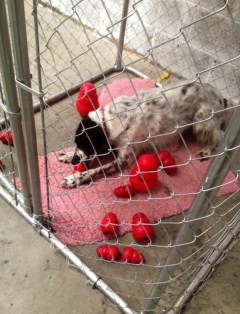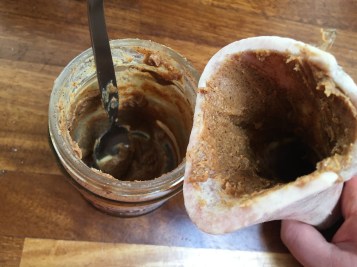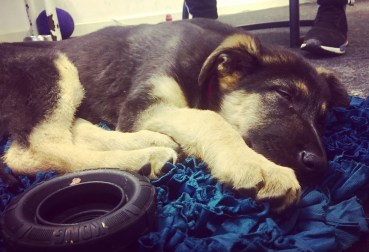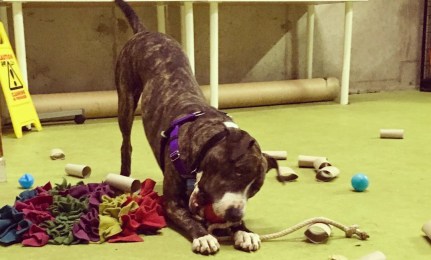
Day 1: Stuffables

Welcome to Day 1 of #100daysofenrichment and thank you for joining us on this journey!

Although our challenges are directed mainly at dogs, we want all species to enjoy and benefit from #100daysofenrichment so, please join in, adjust and adapt to help your pet or companion live a more enriched life.

Don’t forget to review all the information leading up to #100daysofenrichment and more here on playing safe. Know your dog!
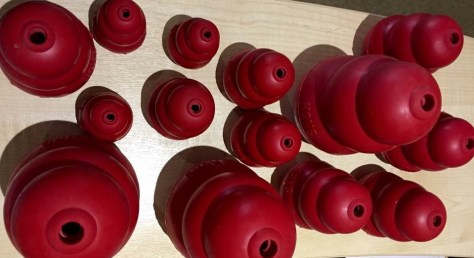
img_9327

Stuffables

At a glance:

  • durable toys or items with a hollow space within for stuffing
  • food based enrichment
  • line them, stuff them, freeze them, hide them, suspend them
  • get the family involved in this one – kids love making puzzles for pets and these challenges offer lots of opportunities for children to use their imagination to come up with the best stuffables for their pets.
    Remember, supervise children in all enrichment activities and interactions with pets.
  • stuffable prep will probably take you 5-10 minutes – do a bulk batch and store in the freezer so you always have stuffables ready to go
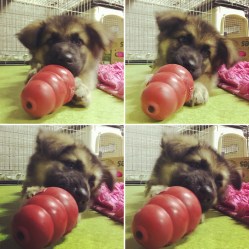
img_7966

What do you need?

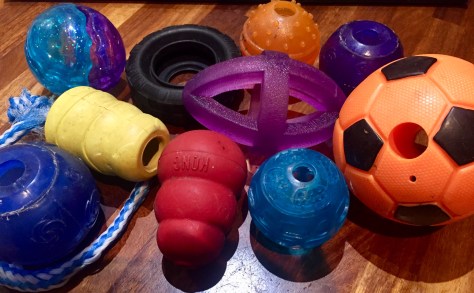
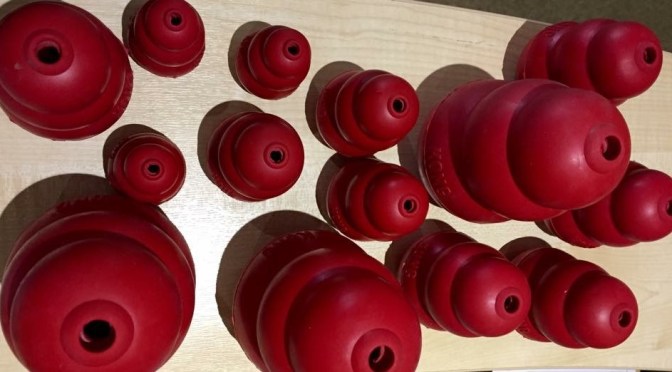
  • stuffable toys, such as Kongs, K9Connectables, Toppl, or any hollow toy suitable for your pet
  • apples, wafer ice cream cones
  • a range of food types
  • a dog lead (a shoe lace or a length of rope will do too)

img_7201

Stuffables form the basis of many of our enrichment programs with pet dogs. Although many of these toys can be used without food for play and chewing, they will feature in today’s challenges with food.

Link

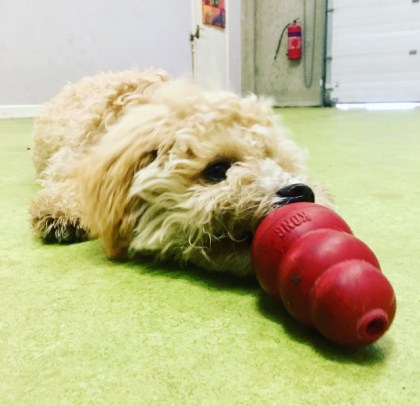
Above: Monty shows the fun a dog can have with an empty Kong toy, encouraging a wide range of behaviours from the canid repertoire! 

Enrichment Goals:

  • to encourage lapping and chewing – these behaviours are relaxing for dogs and can help them recover from stress (including excitement)
  • to slow eating
  • to help dogs settle themselves and soothe themselves
    We teach pet owners how to Park their Pups! This can be a great way of helping puppies, new or active dogs learn to chill when everyone else is relaxed and for bringing your pet places such as outdoor cafes (set up clip here).

img_9307

  • to encourage the development of strategies (behaviours) for getting the food out of stuffables
    For example, Decker will lie down, holding it with one paw and lap at it; he might chew it, squeezing it in his mouth, to loosen the contents so they come out easier; his favourite is to throw it around the place as violently as possible so that food goes flying out of it in every direction!

Using different types of toys with different types of fillings, the dog can get a real work out, developing different strategies for solving the puzzles:

Clip link

Dogs often start with this torpedo approach and sometimes working on it upside down, before learning to hold it under their food for lapping.

While this challenge is certainly food based, they are also experiencing cognitive, sensory and environmental enrichment, with lots of crossover between categories.

Working out how to empty the stuffable and developing dexterous skills in manipulating the stuffable are examples of cognitive challenge.

Sniffing out, tasting and chewing food all offer sensory pay off, but so does finding each stuffable, determining its value,  and engaging in  the puzzle of getting to the good stuff.

Stuffables encourage pets to interact with their environment – just the very interaction with the stuffable is encouraging the pet to manipulate their surroundings, to get the things they like.

What goals can you add to this list for your pets?

How can we achieve these goals?

  • provide a comfy safe space for working on the stuffable – this means that your pet won’t be approached or fussed with when there so that they can work away on their stuffable without too much pressure
  • fill the toy with foods that encourage lapping and chewing
  • if the pet is new to stuffables, use HIGH value foods to motivate exploration and experimentation and make it VERY easy to get the food (no frustration!)
  • if your pet is a novice, give a suitable stuffable when they are calm and chilled and when the house and humans/other pets are calm and quiet – this will help them to associate calm with the stuffable, which in turns helps to calm them further

What adjustments will you make for your pets?

Applications of stuffables:

Once the pet’s use of stuffables is established and they get the game, we can begin to use stuffables in their day to day lives to achieve our enrichment goals.

  • make stuffables available after stress or excitement
    It’s great to have stuffables ready for after walks, games, training sessions, after people come home or after a more stressful event such as getting a fright, after barking and so on.
  • use stuffables to manage and redirect behaviour
    Have stuffables ready when guests come in, to keep your pet busy in another room while guests settle and to give to your pet so that they are busy when guests are present.
  • help to keep them entertained, busy and to settle
    Stuffables can be great to give when you can’t supervise your pet, when you need them to be safe and busy, when you need them to entertain themselves and to settle themselves.
  • sometimes stuffables can be comforting to a confined or alone pet
    But, it’s not a good idea to use stuffables if your pet is already uncomfortable with being confined or alone, or likely to be. They may still become upset and may associate feeling this way with the appearance or addition of a stuffable.

Enrichment Options

Stuffables are versatile and you are only limited by your imagination and your pet’s preferences!

Always carefully check ingredients labels for additions that may be harmful to dogs such as onion powder or sweeteners like xylitol.

Ingredient ideas

Liners:

  • pates, meat or fish pastes
  • cream cheese, soft/spreadable cheese, cottage cheese, yoghurt, butter or spreads
  • peanut butter or other nut butters
  • coconut oil
  • kibble mash (soak kibble in warm water (or flavouring like a gravy) and mash with a fork)
  • cooked and mashed potato, carrot, sweet potato, squashes, apple
  • mashed banana
  • baby food
  • commercial wet food, such as good quality tinned foods
  • Marmite
  • scrambled egg

Stuffers:

  • meats such as chicken, turkey, pork, beef, lamb and so on
  • offal such as small amounts of liver, kidneys, hearts
  • deli meats such as sliced chicken, turkey, salami, roast beef, corned beef and so on
  • processed meats such as hotdog, sausages, cabanossi, black and white pudding
  • tinned fish such as small amounts of tuna, mackeral, pink salmon, sardines (rinse off oils and sauces before use)
  • vegetables (for the most part it’s best that these are properly cooked and then cooled) such as potato, sweet potato, squashes, kelp, spinach, kale, spirulina, carrots, baby sweet corn, peas (I love to use frozen peas as treats!)
  • fruits such as apples, pears, banana, mango, melon, berries like strawberries, raspberries, blue berries
  • breakfast cererals such as Cheerios, Rice Krispies, Corn Flakes
  • pasta, rice, porridge oats and other grains
  • beans, in small amounts, such as kidney beans, chickpeas, butter beans (make sure they have been soaked and cooked correctly before feeding)
  • good quality kibbles or dry foods
  • good quality wet foods like canned foods
  • commercial dog treats such as biscuit dog treats, soft dog treats, freeze dried treats, meat based treats
  • commercial raw foods such as minces and nuggets (stuff the toy with them as frozen and then you don’t need to freeze the entire toy)

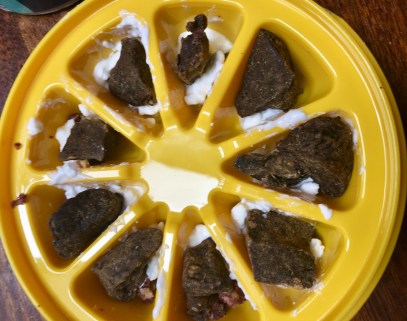
Use ice-cube trays to freeze small portions of wet, raw or other foods for stuffing into stuffable toys or using, like treats or kibble, in other enrichment activities, like sniffing, and devices.
IMG_9387
These triangular ice cube trays are a great shape for stuffing into stuffable toys. Here I freeze dried beef with cottage cheese (I add more to completely fill each gap) for stuffables and scavenger hunts – yum!

Tantalisers

  • meats, offal, deli and processed meats, and harder cheeses like cheddar – stuff in at the bottom of the stuffable and use to jam the opening too
  • long chews such as chicken or turkey feet, pizzles, fish skins and so on – jam through the toy and the mix of foods within

Gravies and flavourings

To entice your pet and to make the stuffable better for freezing, mixing the contents with something yummy is usually a winner!

  • yoghurt, soft and spreadable cheeses
  • water/ice
  • low-sodium stock
  • gelatin (small amounts as it causes flatulence)
  • mash wet foods into pastes, add water to thin if required. to make a ‘gravy’
  • meat or vegetable juices/water (allow it to sit so that the fat can be skimmed and removed)
  • baby foods

Devise recipes for each stuffable by pulling a couple of examples from each category.

Choose a liner and add a tantaliser to the bottom. Mix a gravy with stuffers and fill the toy. Top with a tantaliser. 

Recipe ideas:

Searching the internet will give you lists and lists and lists of stuffables ideas but work on designing ones that work best for you and your pets. Here are some simple ideas, just for fun:

Tuti Fruiti stuffable:

  • mash some banana or cooked (allow it to cool) apple to line the stuffable
  • layer fruit and cream cheese throughout the stuffable

Meat & 2 Veg:

  • layer meat and two mashed vegetables throughout the stuffable
  • pour in a gravy/flavouring and freeze

Breakfast smoothie stuffable

  • jam the bottom of the stuffable with cheese
  • allow a small amount porridge oats soak in water or yoghurt over night
  • add yoghurt and oats mix with berries, melon and mango
  • freeze
img_1112
Dante, professional Kong cleaner

Option 1: Line it

Using a spreadable, line the inside of the stuffable.

IMG_0505
Make sure the challenge is appropriate – start off easy and only increase the challenge if your pet is able for it.

If your pet is new to stuffables, this is the place to start!

Beginners:

  • spread the lining at the widest most accessible point or on the outside of the toy to encourage interaction, without frustration


Intermediate:

  • spread the lining throughout the toy
IMG_1273
Peanut butter bone!

Link

Advanced:

  • spread the lining throughout the toy
  • freeze it

Link

Having lined stuffables ready to go in the freezer is a convenient tool for managing dog behaviour!

Simple lined stuffables with cheese slices mashed into the toy:

20190106_132139804_ios

Option 2: Stuff it

Stuff the toy with your pet’s regular food, with treats or chews, or with meats, vegetables and fruits.

If your pet is just starting out with stuffables, get them working for lined-stuffables first so that they get the game. Then you can begin to loosely stuff the toy and increase the challenge as they develop strategies to empty the toy. Use your pet’s behaviour guide the extent of the challenge.

20190104_021406274_ios

Take care when stuffing toys if blocking one or both of the holes in the toy. There is lots of talk online about dog’s tongues being suctioned into the toy and swelling. This is exceptionally rare and am not sure how much we should worry about it – I have fed thousands of dogs probably a million Kongs and nothing like this has even remotely happened.
But, that doesn’t mean it can’t happen and that we shouldn’t put measures in place to prevent it.

If stuffing a toy, it’s best to add some kibble or other hard food to the bottom around the second hole, just to allow for some air flow, especially if freezing the toy.
Freezing the stuffed toy with a drinking straw down through the toy, out through both holes, may also help to maintain air flow, although once the dog starts to work on it, every thing will move about so care may still be required.

Beginners:

  • line the toy first with a high value spreadable
  • add some of your dog’s favourite treats or high value foods like meat or tinned fish
  • loosely pack the toy so that food comes out readily

Link

Try adding your dog’s favourite long chews to a Kong toy or similar. Jam the chew right through the toy. Once the toy is a safe and appropriate size for the dog, when the dog chews down to the Kong, he will have eaten the safe length of the chew. This also allows you to easily monitor the size of chews as your dog works through them.

Link

For dogs who find Kongs, K9 Connectables frustrating or difficult to empty, you might try a different toy. I particularly like the Toppl from West Paws, which is more open and easier, while still being a satisfying stuffable.

Link

Link

Intermediate:

  • line and stuff the toy
  • add something yummy first to the bottom
  • layer your pet’s regular food with something yummier to fill the toy
  • if using kibble, add it in dry and loose so it’s easier to get out but as your pet improves you can first soak the kibble

Link

Advanced:

  • line and stuff the toy, freeze it for extra challenge
  • jam a long chew through the toy
  • add a yummy tantiliser to the bottom of the toy
  • layer yummies and regular food to fill the toy
  • if using kibble, soak it and soften it first
  • pack the opening of the toy with something delicious
  • freeze the whole stuffed toy

Link

Use flavourings and leftovers to make tantalising frozen stuffables:

Link

Option 3: Pupsicles

No stuffable, just stuffing needed for this one!

This option might be particularly useful for dogs who are likely to ingest stuffable toys, and when they can’t be supervised.
Because we are using ice, essentially, this may only be suitable in warm, comfortable temperatures. Don’t give dogs ice cold things to eat if they are very hot or after exerting exercise – allow them to cool a little first.

  • Line a lunchbox or tub with a freezer bag (or just use the bag) and add water or low-sodium stock. Add some kibble, regular food, treats, meats, vegetables.
  • Close the bag and freeze for a couple of hours.
  • Remove the frozen mix from the tub and peel away the bag (reuse it for the next one!)
  • Give to your pet to work on.

pupsicle

You can also use gravies, yogurt or cream cheese instead of or mixed with the water.

Freeze with in a dog bowl or other container, such as an ice cube tray or cup cake pan for smaller, ready-to-go treats.

Option 4 Edible Stuffables

Like Pupsicles, these provide options when a toy isn’t available or safe to leave with a pet. These also provide different exploration options for pets and they can eat the entire stuffable!

These also might provide more options for dogs in kennel accommodation, for example, as there will be less clean-up and improved safety.

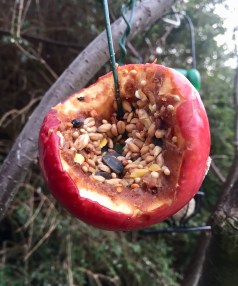
We have found the ones that work best are apples and wafer ice-cream cones.
You could also use fresh lamb or bovine hearts and serve raw, frozen or cooked and dried beef trachea or gullet can also be used, although I am careful about not feeding these too often.

Although ice-cream cones are certainly better for small dogs and puppies, Decker loves the frozen, stuffed ice-cream cones and they are great for scavenger hunts. I like to hide them around the house and garden for him to sniff out and enjoy!

Link

Stuffable cones are lighter than other stuffable toys so can be handy for travelling or bringing stuffables out and about, and a great way of travelling on outings with raw foods or wet foods.

Coring and hollowing out the apples requires a little work and I have found that red apples are a little easier. They are probably preferred as they tend to be less sharp and a little sweeter too.

Link

These also make great wild bird feeders, lined with peanut butter and stuffed with seed, so if your dog doesn’t mind sharing, you can help out the birds visiting your garden too!
20190105_103341561_ios

Option 5 Suspended Stuffables

Suspending any puzzle provides entirely new challenges and sensory experiences for animals. Not only does it look and act differently, they now need to develop new strategies for figuring it out!

In this clip, the stuffable toys used are stuffed with baby food and frozen, but you can use an lining, stuffing and/or tantaliser.

Link

This is a puzzle that’s best introduced for pets who have had some practice with different types of stuffables and levels of difficulty.

Beginners:

  • suspend a couple of lined stuffables
  • suspend at your pet’s head height – tighten the line they are suspended on so that they don’t move too much
  • suspend against a wall or other surface

Intermediate:

  • suspend different types of stuffables
  • leave some slack in the line so that they vary in height and move a little
  • freeze the stuffables for longer lasting fun
  • suspend against a wall or other surface

Advanced

  • suspend different types of frozen stuffables
  • suspend it freestanding and leave some slack in the line so there is lots of movement and challenge

Link

20190104_221328204_ios

Even working on stuffable toys, with the rope or line running through them, not suspended, changes and increases the challenge.

Your challenge

Now it’s your turn. Show us what you and your pets, of any species, can do with these challenges!

Post to your social media accounts, using the #100daysofenrichment so that we can find you and join our Facebook group to share your experiences, ideas and fun!
You can comment right here too 🙂

We look forward to hearing from you and your pets – have fun & brain games!
img_1108

Get ready!

No going back now…we are nearly ready to get started with #100daysofenrichment…

20190104_211157367_ios

Make sure you have checked out all the information surrounding enrichment and our project – it’s all here.

Join our Facebook group and keep an eye on our Facebook and Instagram pages. To get each day’s challenges delivered straight to your inbox, just subscribe or follow this blog!

There’s no stopping now – we can’t wait to get started with you and to hear how you and your pets are enjoying the fun 🙂 Just one more sleep…

Stress: the good & the bad

When talking about stress, most people are referring to the negative effects largely associated with chronic stress. Stress is a normal part of life and nobody can be insulated from it.

Stress responses are experienced at neurobiological, physiological, psychological and behavioural levels. This involves a complex interplay between body and brain systems.

Dogs and other mammals, (and probably birds), all have similar biological ‘equipment’ for experiencing stress – the parts involved in stress responses are very ancient and likely evolved in more simple creatures. That’s because stress keeps us alive.

img_3908

 If stress is needed to keep us alive, how can it be bad?

Stress acts at a number of different levels, depending on the nature of the stressor. Different stressors elicit different types of stress responses.

Any time the body is faced with challenge, it must produce a response that helps it cope with that challenge. If the individual has the neurobiological, physiological, psychological and behavioural tools to rise to the challenge, all is good.

This version of stress is beneficial – it involves goal oriented behaviour, it enhances performance and the more practice an individual gets at ‘good’ stress, the better they become at coping with their world.

But, where the individual doesn’t have the right tools, they may experience the negative effects associated with stress such as neurological damage affecting learning, memory and future sensitivity to stress, feelings of loss of control and anxiety, physical damage to organs and behaviour that may appear fearful, anxious, or aggressive.

Avoidance of the stressor is really the brain’s main aim – the brain would rather be stressed than dead. So, stress causes the individual to be more vigilant, on the look out for stressors to avoid. In dog training, we often called this raised state of awareness arousal.

img_9045

Your dog on stress

When the stress systems engage, everything is escalated: the individual’s sensitivity, vigilance, activity. But the body can’t perform in this heightened state over long periods; increases in breathing, heart rate, blood pressure, circulation of stress related hormones and neurochemicals will have detrimental effects on body and brain over time.

To counter this, an opposing system is activated to help turn off the stress response and bring the body back to a more even keel. That’s certainly how things are supposed to work but this is where it can get tricky…

Just like us, animals develop skills (or behaviours) for coping with stress, helping the body calm. And they need help in developing these skills, especially during adolescence.

Stress responses happen in ancient parts of the brain, in and around the Limbic system, and when this is engaged in monitoring the environment and keeping the body safe, higher thinking parts of the brain, in the cortex, are inhibited.
This makes sense – if the brain is worried about safety, wasting time on thinking may not be terribly helpful.

When stressed, the brain and body are in a more reactionary state and not as well able to think through problems.

img_e8317

Enrichment, challenge and stress

Instead of referring to it as stress, using the term ‘challenge’ may be a better fit in terms of understanding how stress can benefit us, as well as have negative effects.

When the body is challenged it must be able to adapt so that it can cope with and recover from stress.

Good stress will be appropriately challenging, motivating the animal to respond – they will have the tools to cope with the challenge and therefore recover once they have dealt with it.

This might not be the case where the animal doesn’t have the necessary behaviours allowing it to rise to the challenge, where it is exposed to cumulative or sequential stressors so doesn’t have sufficient time to recover in between, or where they are unable to escape exposure.

img_3659

Enrichment must be enriching; that means that appropriate enrichment must provide the animal with outlets and opportunities for good stress. Otherwise, it’s not enrichment.

  • make sure it’s individual – set it up so that it’s enriching for your individual pets
  • have a goal – what should your pet get out of a particular challenge? what behaviours should they demonstrate or would you like to evoke via this particular challenge?
  • be adaptable – be ready to step in, adjust the challenge, rearrange the set-up
  • maintain appropriate challenge – how will you know when your pet is beginning to feel in over their head? how do they show frustration? when do they look to give up?
  • it’s better to prevent them becoming overwhelmed than to wait for frustration before jumping in – that means you start with the easiest challenge and build challenge to coincide with their progress
  • the buck stops with you – always think how you can adjust each challenge to work for your pet so they experience good stress


Week 1 Equipment List

The first week of #100daysofenrichment is just around the corner and as it’s the first week, we are going to keep it pretty simple and straightforward.

Keep up with all the resources and challenges relating to #100daysofenrichment here
and join our Facebook group too!

All challenges are presented with multiple options so you won’t lose out if you don’t have some of the items.

20190103_021441497_iOS
Any of these toys, just like the classic red Kong, can be used as stuffables for appropriate pets!

For Week 1 you will need:

  • a range of foods suitable for stuffing such as your pet’s regular food, spreadable yummies, chews and treats, higher value foods such as meats and fish (for dogs and cats) (more detail here)
  • toys that can be stuffed which basically means any toys that are somewhat durable (appropriate to your pet) and have two holes (two holes are better for safety).
    This might include Kong toys, K9 Connectables, Zogoflex Toppl or Tux, and any durable toy with a hollow section.
    Check out Tough Enough for Charlie‘s range of stuffable toys – an Irish toy supplier and run by an AniEd trainer, so you know it’s going to be good!
  • small towels such as hand towels, face cloths
  • favourite fetch or tug toys (you could even use popular stealables such as socks)
  • brushes, combs or similar grooming equipment
  • thin dog lead, shoe laces, length of rope or blind-cord
  • apples
  • wafer ice cream cones

And for Freestyle Friday you will design your own enrichment device with the following ingredients:

  • cardboard box or boxes of various sizes (remove all staples, tape, fastening and so on)
  • paper e.g. packing paper, newspaper, kitchen roll, shredded paper (again, play safe and remove staples, clips and so on)

More details to follow on Freestyle Friday too.

Week 1 starts on Monday so get ready to get started! Subscribe to this blog so that each day’s plan is delivered right into your inbox each morning.

Food and beyond

Probably the easiest way to provide enrichment for pets is to have them working for their food.
We don’t really like food bowls and believe they contribute to lots of problems so reducing or eliminating their use generally does good things for pets and their people.

During this project, we are not going to get religious about any of this stuff. You do what works for you and your dog – you are here, adding enrichment to your dog’s life and we are delighted to have you…even if you do have several food bowls stashed!

nut

Food Based Enrichment

Animals come with installed motor patterns that relate to feeding behaviour. All dogs have inbuilt predatory behaviours that are found in wild canids including tracking, stalking, chasing, pouncing, biting, dissecting & chewing, caching and consuming.

Food bowl feeding limits a lot of this, so providing enrichment is important; feeding is more than just eating, after all.

IMG_0128

Using food for #100daysofenrichment

No matter what diet or type of food you feed your pet, food can be used as part of our enrichment program.

It is preferable that you use your pet’s daily ration, for the most part. This helps to control calorie intake and makes sure that your pet is eating a balanced diet.

Higher value foods will generally be higher in fat, protein and calories – that’s what makes them yummier. A small amount of higher value foods may be required to build motivation and help pets learn behaviours they need for challenges.

If you are watching your pet’s weight closely or your pet has dietary restrictions, there are things you can do to boost the value of regular food:

  • our favourite are training mixes; this can be adapted to suit the individual’s needs

Link

  • warming food, to just about body temperature, can help increase motivation to eat it
  • getting the pet working for food can increase its value as it becomes harder to get…#100daysofenrichment will help!
  • making sure the challenge is appropriate to prevent frustration and giving up
  • playing with the animal can raise arousal just a little, increasing their motivation to eat

While kibble is often an easy to use, versatile food type for many enrichment applications, all food types can be adapted too.

  • Kibble and dry feeds – used as is, soaked and softened, mashed into a paste, grilled, frozen in water, low-sodium stock or other flavouring
  • Meats and meat mixes (e.g. raw and home prepared diets) – cut up into small pieces, boiled or baked, mashed into pastes, frozen in small ice cube trays or pyramid baking mats for small individual treats
  • Wet feeds (e.g. canned foods) – feed in smaller portions from a spoon, lining enrichment devices, frozen in small ice cube trays or pyramid baking mats for small, individual treats

If we are to add other foods to our pets’ diets, we must make sure they are safe and that the individual can tolerate them.

My dog has a very varied diet, consisting of a limited number of proteins, and in an average day he will have kibble, raw and cooked foods as part of his normal diet. He can tolerate a wide range of foods and this is likely associated with some genetic predispositions as well as careful introduction to a range of food as a youngster.

IMG_4560
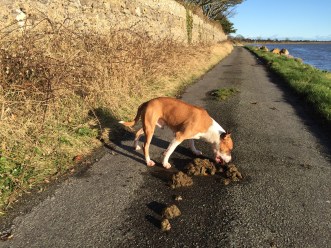
And that sometimes includes poop…

But again, this relies on you knowing your pet.

If you are adding foods, you need to take care, as additions can increase calorie intake and change the nutritional balance of the pet’s diet. This is particularly important with young, growing animals, those with dietary or environmental sensitivities, pets with specific dietary needs and so on.
As such, additions may not be possible and, at the very least, if you are adding stuff, you will need to adjust the pet’s diet to compensate.

Examples of foods that might be useful for #100daysofenrichment:

  • spreadables for lining and freezing like pate, cream cheese, soft cheeses, yoghurt, peanut butter
    Use very small amounts, really as tantalisers, as these will generally be quite high calorie.
    Make sure to use peanut butter that is just peanuts, rather than with lots of sugars and sweeteners, some of which can be dangerous to dogs, e.g. xylitol.
    Pates are usually LOVED by dogs but must be used in small amounts as most will contain onion and garlic powders. There are some brands that do without and in general, fish pates tend not to have these additions.
  • good quality kibbles, commercial wet foods, some prepared raw diets like nuggets
  • various meats – to reduce calorie content choose leaner cuts and boil then skim the fat to prepare
  • tinned fish – probably the best addition as they provide a more well rounded nutritional profile (for the most part), and especially when added to a kibble diet, are usually cheap and can be an effective flavour enhancer in even small amounts
  • edible chews – commercial or “natural” dried chews and treats
  • commercial treats and biscuits
  • fruits and vegetables – take care and make sure they’re safe for dogs.
    Small pieces of carrot, apple (seeds removed), small amounts of mashed banana, cooked broccoli, frozen peas, water melon, blue berriers and raspberries are often favourites, safe and well-tolerated by the majority of dogs
  • cereals such as rice, pasta and so on are unlikely to be a high value or adequately nutritional addition, unless as part of a balanced diet

Beyond food

Throughout #100daysofenrichment we will be adding in lots of enrichment activities that are not primarily food based. You might add in food rewards, for example, but we have lots of activities that involve other categories of enrichment.

IMG_7417
Lots of enrichment ideas that span different categories!

We loosely base our approach on the Shape of Enrichment categories: social, cognitive, habitat, sensory and food. Each week I have tried to cover as many of these as possible and also develop enrichment devices and strategies that incorporate as many as possible, in one, to get more enrichment bang for your buck!

Most people, when thinking of enrichment, think food based and Kong toys, and while these are some of our favourites, there are gaps, especially for lots of pet dogs. Food based enrichment and food dispensing toys alone will not plug those gaps and a more rounded enrichment experience is needed.

Within the enrichment literature, as limited as that is for dogs, active (enrichment interacts with the animal) and socially based enrichment strategies seem to be the most beneficial and welfare friendly. As such, providing dogs with outlets for social contact is important and for pet dogs, or dogs destined to be pets, that must mean social contact and interaction with humans.

IMG_8031

So, what does that mean for dogs who are home alone while their owners work and commute all day? What about dogs in ‘rescue’ and kennel accommodation?
Different categories of enrichment are super important for these dogs too, while also maximising the time humans can hang out with them; we want to make sure it’s quality time, and not just quantity.


Safe & sound!

We gotta talk about health and safety in all our enrichment endeavours. An awareness of what might go wrong will help us keep our pets safe, because, let’s face it, they don’t always look to keep themselves safe!

Dogs will injure themselves in all sorts of ways, especially when it comes to edibles or things they think should be edible…

6-5FZh1ld

What follows are general tips but there may be more specific guidelines appropriate to your pet. There will also be more specific safety tips with particular challenges. But, the bottom line is, you need to know your dog and their tendencies.

  • Always supervise pets with puzzles.
    Again, knowing your pet is important here – there are some things that can be given to some dogs to keep them busy when alone. Choosing appropriate toys or devices will need to be appropriate to the dog’s size and chewing/play style. Toys or devices should look too big for your dog’s mouth and be tough enough that they can’t break off small pieces and ingest them, should that be what they’re into.


  • Know your pet’s puzzling, chewing and play styles. For example, does he have a tendency to ingest non-food items? This might happen accidentally, while chewing and puzzling, but we are more concerned about the dog that intentionally ingests non-food items.
    Some adjustments and close supervision may be required for some individuals.

    It’s a good idea to have a pocketful of HIGH value treats while you pet is puzzling. If they attempt to ingest or chew something inappropriate, quickly toss some of these treats across your pet’s eye line to redirect their attention.


  • Make sure to clean away remnants of puzzles carefully so your pet can’t get them. This might be relevant for the ingesters but also may cause resource guarding in some dogs, who will guard access to even scraps from a puzzle from people or other pets.


  • Many puzzles are designed to give your pet more acceptable outlets for destruction and dissection, which are normal, natural, necessary behaviours for dogs, so make sure that you are preventing them accessing anything you don’t want destroyed or dissected at other times.
    Human training required in putting things away and closing doors!
    With both acceptable destruction and careful management in place, your dog seeking less appropriate outlets will decrease.


  • Never just take or grab something off a dog, especially something higher value like puzzles or treats.
    Not only is it important to allow your dog work it out without too much human interference, some dogs may be uncomfortable with people or other dogs approaching them, reaching for them, touching them or attempting to take something from them.
    This may cause them to demonstrate resource guarding related behaviour such as freezing, growling, snapping or even biting.

    To prevent this, when you want to remove a puzzle, divert their attention so that they move away. You might try throwing some treats in the other direction, go to the fridge, rustle some packing, pretend to get ready to go out.

    Let your dog finish up and move away from the area before you reclaim the puzzle and tidy up. It can be better to allow them to move into another room so you can close the door if necessary or when they are not aware of what you are doing.


  • If you have more than one pet participating, many will prefer just to work on each puzzle alone. This may be especially true in the case of food or toy based challenges; by making it more difficult to get the reward we may increase its value. This means that dogs may be more likely to guard access from one another and people.


  • Children love making puzzles for pets and it can be a great and safe way of involving them in the care of their pet. Make sure to supervise all interactions between dogs and children directly. Teach and guide children to give the dog lots of space to enjoy and work on their puzzles on their own. Humans observe, rather than participate too much or too closely!


  • Lots of puzzles will reuse items such as packing and containers. Carefully check all items and remove loose or unsafe bits such as lids, staples, tape, plastic pieces or loose parts.


And most importantly, have fun & brain games!
Enrichment Planning

Enrichment planning requires just that, planning. And enrichment programs are usually goal oriented.

Let’s explore that a little.

IMG_7404What behaviours might your dog show now that you feel are troublesome, for you or your pet?
What enrichment have you in place already?

What would you like to get out of this program?


There are no right or wrong answers. But there are some rules to our enrichment endeavours.

IMG_9402

  • Enrichment must be individualised.
    Although each day’s challenge will be presented with adjustments providing some options, you can further adapt each one to your pet’s preferences and abilities.
    Take their response to the challenge as information and use that feedback to adjust and upgrade the challenge to best benefit your pet.
    For example, make the puzzle simple and straight forward and use highly valued motivators for beginner-puzzlers to keep them engaged in the process.

The Wobbler wobbling is a little worrying to Billie, so we break it down and introduce it to her first by teaching her the skills she will need, for a big payoff!

Link

This clips shows Benny, a senior dog, working on a snufflemat. Lay out blankets or runners for older dogs or those with injuries, joint discomfort or mobility issues so that they are better able to move about, so that they don’t have to move too much after a sliding enrichment device, and to encourage them to lie down should they need to.

Link

  • Enrichment must be goal oriented.
    This entire program is designed to make sure your dog gets to be more dog, which will lead to improvements in lots of areas of behaviour health.
    You might have specific goals for you and your pet, or goals may reveal themselves as we journey through the 100 days.
    Decide what behaviours you want to see less of and what behaviours you want to see more of. Very often, the underlying contributors to behaviours we don’t like, lie in a lack of appropriate outlets for normal, natural, necessary behaviour. Think of this approach, rather than in terms of obedience or manners behaviours.

IMG_E4657
For me, providing an enriched life for my dog means that I provide him with experiences through which he learns how to choose appropriate behaviour, while also making sure that he gets to be a dog, doing doggie things A LOT.

Link

  • Enrichment must provide choice.
    The animal gets to decide if they participate, what they do, how they participate and how much they engage.
    Your job is to make sure they are safe to choose and that their choices are safe.

In this clip, Decker has a ball stuffed with Husky hair that we use in Sniffaris for olfactory enrichment. Or certainly, we intend that the dog will find it enriching from an olfactory point of view but as you can see, Decker comes up with all sorts of other forms of entertainment!

Link

While Billie was originally working her way through this brain-teaser puzzle, there are food rewards hidden in there and she does engage in sniffing and hunting for them, she also finds chasing the loose balls as just as if not more entertaining, as shown in the following clip.

Link

We need to stand back and allow the dog work it out. Ensure that it’s safe and will not cause them fright or distress and let them do the rest.
What one individual finds distressing is different to others so care must be taken, along with close observation.
Don’t lure or encourage too much – let them be dogs.

Link

Link

  • Enrichment must allow the animal a little control over what happens to them.
    Each challenge will emphasise helping your dog to learn that their behaviour matters, that when they do things stuff happens that they might like, that their world is safe and predictable.

Link

Link

Link

Link

Making sure that the amount of challenge is appropriate, rather than frustration inducing, is an important part of the deal. Enrichment should generate the good kind of stress that is seen with a level of challenge that’s just enough to hold the individual’s interest but not quite so difficult that it causes them frustration or to give up.

Link

Link

  • Enrichment must facilitate the demonstration of species and breed typical behaviours – we should be seeing more of these in appropriate ways as we go through an enrichment program.
    Living with humans means that dogs must inhibit their very doggieness a lot of the time. We want each dog to be more dog!

Puzzling encourages exploration, learning about the world and increased cognitive abilities. Puzzling makes them a better puzzler!

Link

Decker uses a range of strategies, applied to lots of different puzzles, to solve a new one. Enrichment grows brains!

In other words, enrichment must be enriching!

The Nitty Gritty

All the whos, whats and hows of #100daysofenrichment here!

How do I participate?

AniEd WordPress Blog

Follow this blog by subscribing and you will receive each day’s challenge right into your inbox every morning.
All the relevant posts will be archived here too, so you can find them easily.

Social Media

Keep an eye on our Facebook page and ‘like’ it to keep up with progress.

Join our Facebook group AniEd #100daysofenrichment to really participate.

Follow us on Instagram for daily posts and stories showing each challenge.

What happens?

Each week, we will post the list of what you will need for the following week – that way you can be prepared!

Each day, a new challenge will be posted that will include adjustments to suit lots of pets. You just need to participate and let us know how you are getting on.

You can post comments on the blog, Facebook or Instagram pages or in the group. You can post pictures and clips too, which we LOVE to see!

When?

Week 1 starts Monday 7th January 2019. The halfway point, day 50, is Sunday 24th February and day 100 is Monday 15th April.

There will be new challenges covering all sorts of categories of enrichment on Mondays, Tuesdays, Wednesdays and Thursdays.

On Freestyle Fridays, a challenge for the humans will be posted. We will provide you with the raw ingredients to develop a puzzle or enrichment device or set-up for your pet. No limits, no rules other than all the ingredients must be used in some way and it must be enriching.

Sniffing Saturdays…well, that’s self explanatory! Challenges on Saturdays will be all about getting your dog’s nose working even more. The only rule – humans are not allowed to hurry them along…they get to sniff to their heart’s (nose’s) content!

On Sunday Fundays you and your pet get to repeat your favourite challenge of the week and do it again, upgrade it, re-jig it, relive it.


#100daysofenrichment

The 100 Day Project has been running for a number of years, specifically in relation to creativity and the arts, but this year, on social media #100day challenges have been applied to various areas, including dog training.

We are a little late to the party, but hope that you will join us for our 100 days of enrichment challenge (#100daysofenrichment)

IMG_2162

Sticking with a project over long durations can be tough; this will keep us motivated over the first few months of the New Year.
And most importantly, the dogs in our lives might greatly benefit from a structured program enriching their day to day lives.

What is enrichment?

Enrichment includes ways to add to, subtract or adjust our pets’ worlds so that they have more opportunities to engage in species typical behaviours.

IMG_9709

Species typical requirements for dogs include lots of social contact (with people, other dogs or other species – whatever floats their boat), a resting and hideaway space, functional spaces (separate toileting, resting and feeding areas, for example), mental & physical exercise, novel experiences to explore, and lots of opportunities to be a dog, doing dog things.

With dogs being such a variable species, we need to consider breed/type requirements too.

Enrichment is designed to provide animals with more choice – they get to decide how they interact with enrichment, with the things happening around them.

It also helps them to have a little control over what happens to them. Enrichment can help them to learn that their behaviour works to get them things they like and avoid things they don’t like. That’s confidence building and stress busting!

IMG_8344

Animals will find ways to enrich their own lives, if we don’t provide outlets for them. Those behaviours can be ones that their humans find troublesome so enrichment is important in preventing problems by giving your dog an acceptable outlet for dog behaviour. Everybody wins!

Think of enrichment as being a behaviour vaccine!

While Kongs are our favourite dog toy (possibly ever), we will look beyond Kongs and food enrichment, adding challenges from lots of categories of enrichment.

Why #100daysofenrichment for dogs?

  • Don’t let domestication fool ya!
    Dogs might be pet animals but they still come with an extensive range of ‘natural’ dog behaviours including feeding behaviours, social behaviours, scavenging and hunting behaviours. They must do these behaviours – you, the human in control, decides how acceptable or not the demonstration of these behaviours will be.
  • Boredom affects the welfare of captive animals, that includes domestic pets, because captive living allows them a limited repertoire of species typical behaviour.
    We are not just talking at species level either, but also breed/type requirements. We know that lots of people get breeds or types of dogs that require more than a sedentary pet life can provide.  Enrichment allows us to plug some of those gaps.
  • Feeding behaviour is more than just eating and dogs need outlets for feeding behaviour (predatory and scavenging related), as well as social, social, sensory and exploratory behaviour.
  • Dogs are natural puzzlers and are in it for the challenge and not just the end goal.
  • Enrichment increases cognitive and learning abilities, reduces stress and therefore disease, and ensures animals are happier and more content.

The question should be, why wouldn’t you do #100daysofenrichment for dogs?

IMG_6160

Who is #100daysofenrichment for?

Dogs. All dogs.

This might be particularly helpful for dogs in kennel accommodation in shelters (engaging dogs in enrichment improves rehoming) and this might be a great way of publicising dogs looking for new homes.

Each day will have different levels of challenges, options and adjustments so just about every dog can benefit.

These dogs’ humans will benefit too.

Each day’s challenge requires no more than ten minutes of your input or some adjustments to stuff you are already doing. But the effects can be much longer lasting for your dog.

We haven’t forgotten about other pets too and with a little editing and imagination, lots of other species can join in as well.

IMG_0395

The best way to stick to the program is to tell everyone that you are doing it – share your photos and videos, post on social media, and best of all, let us know how you and your dog are doing!

Big plans!

This year has been a very busy year and 2019 is shaping up to be a very exciting year for AniEd.

IMG_8432

The A Dog’s Life and AniEd collaboration is a long standing relationship that has allowed us to provide the best education, support and guidance for pets and their people, at all levels. As we move into the New Year, we will be taking this partnership even further…

Our Vision

A Dog’s Life and AniEd are teaming up even more to develop a unique shelter based Canine Enrichment & Education centre for dogs, pet lovers and professionals. We will continue to play to our strengths, taking pound dogs and giving them the best chance of finding a new and better life, while providing pet owners, students and professionals with an outstanding education in canine training, science, care and behaviour.

Our centre will provide kennel space for a small number of dogs who need new homes and a better life. But, this will be offered in a unique environment where education will play the starring role, preparing these dogs for their new life through structured education, experience and enrichment. Our tutors and students will provide the care and education for these dogs, developing their own skills and monitoring the behaviour health and welfare of our dogs. Win-win!

We want rescue to be the place that people come to get a great dog; to come to get a dog who will adjust well to family life, who will demonstrate appropriate and acceptable behaviour and who will become an asset to the community, representing rescue dogs.

This move will allow us to facilitate the development of knowledge and skill among pet owners, local community members, budding and established professionals and the wider public in a true understanding of canine welfare. Education is key to improving the welfare of people and pets, after all!

Next steps…

To allow us to plan and realise our vision, we are moving from our Glasnevin base and going mobile!

This will allow us to bring training into your homes and continue to move our educational courses more online. This maximises convenience meaning more people and pets will benefit from AniEd’s growing accessibility.

2018-12-23 (5)

You can help!

The AniEd and A Dog’s Life model doesn’t exist – we are the first ones to develop this type of education centre.

But, we need help to do this:

  • help us find the perfect location
    We are looking for a suitable premises in the Greater Dublin, West Meath, East Kildare regions and surrounds. We will need space and buildings suitable for kennel accommodation, office space, classroom space, storage and exercise areas. An old kennels, stable yard, farm or commercial property would be perfect.
  • legal and corporate advisors
    We know dogs but we need help with the scary legal, accounting and incorporation stuff.
  • fundraising teams, ideas and coordinators
    Pioneering all this ain’t going to be easy or cheap, so we will need ongoing fundraising and financial help.

If you think you can help, please get in touch by commenting here, emailing info@anied.ie or enquiries@adogslife.ie

Animal Education: providing compassionate & evidence-based support, guidance & education