The entire #100daysofenrichment program is available for free but it can certainly be challenging to keep the motivation up to complete longer-term projects (which is why 100 days challenges, like this, exist!).
To round out 2019, let’s run our #100days project again from the start. I will be able to update any challenges as we go too.
This will give everyone the opportunity to jump back in and revive good enrichment habits, while also allowing newbies enjoy the challenges and the community participation.
#100daysofenrichment will be starting again on Monday 9th September, just in time for Back-to-School!
Join in by subscribing to this blog so you never miss a new posting, Like & follow our Facebook page where each day’s challenge will be posted and, best of all, come join our fantastic community of enrichers on our Facebook group: AniEd #100daysofenrichment.
Here you can chat with other project participants, share photos and clips of your enrichment adventures, introduce your pets and learn more and more about enriching and entertaining our animals (and ourselves).
So, get ready for Day 1, join in and have fun with your pet!
Enrichment doesn’t need to cost the earth – you can pretty much pay what you can afford while still providing your dog with a variety of experiences to entertain.
Most of #100daysofenrichment challenges are free, but priceless: spending time with your pet, exploring the world together, opening your eyes and seeing what your pet is really asking for.
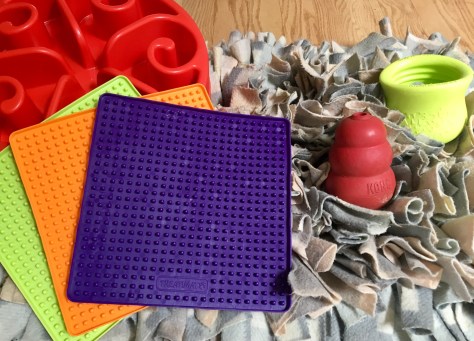
Some of the most popular food-based enrichment toys right now: a snufflemat, a slow-feeder bowl, “Treatimats”, and stuffables, large Kong and a large Toppl.
But, what if I told you that enrichment is not about the toy?!
Enrichment is about the behavioural outcome from which the animal benefits as a result of choosing to participate in the enrichment activity.
Don’t be turned off providing an outlet for your pet’s normal, natural, necessary behaviour just because you don’t have, can’t get, not able to afford a particular toy.
Look carefully at the sorts of behavioural outcomes associated with these toys – that’s what we want to replicate and we can do that without the toy itself.
But, don’t get bogged down with a specific solve – how the dog does it is always right!
This clip, doing the rounds on social media, tries to suggest that the dog has the wrong idea. But that, in itself, is inaccurate. However the dog chooses to engage and ‘solve’ the puzzle is correct – the animal can’t be wrong.
These slow feeders are often a source of frustration for many dogs and as such might not be all that enriching for many. This dog has developed a strategy that allows him/her to solve the puzzle and win the prize. That’s just perfect!
Affordable Alternatives
Making enrichment affordable allows every one to participate and benefits every pet, whether they live with a family, in foster, in kennels.
Make sure you know your dog and consider safety with ALL enrichment devices and activities.
Stuffables
Stuffable toys are generally costly as most are longer lasting and tough. Buying appropriate stuffable toys is a bit of an investment and might even last you through your next pets too.
I love the Toppl from West Paws as a stuffable but it’s not quite as hard wearing as many of the Kong toys so I take care with it with Decker.
Any toy with holes in can be used as a stuffable toy, like the range above.
Stuffables don’t have to be stuffed; you can add the filling to the outside which is especially helpful for novice dogs or dogs that get frustrated with hard-to-reach goodies.
Freeze it to add more challenge and a different sensory experience.
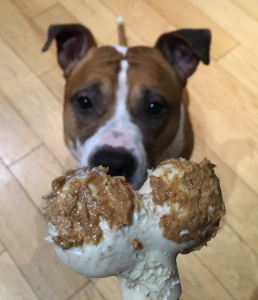
Take a durable chew toy, like a Nylabone or similar, and smear something yummy in the uneven surface created by chewing.
Freeze it to add more challenge and a different sensory experience.
Try edible stuffables, like these cored and stuffed apples.
Freeze just the stuffing and enjoy a stuffable without a stuffable!
While licking and lapping can certainly be relaxing for dogs, make sure to keep frustration low, especially with the more challenging designs. Enrichment must be enriching!
Alternatives to these are so wide and varied and include using plastic inserts from biscuits or chocolates, paper plates, muffin pans, ice cube trays, and upturned dog bowls.
Just smearing the sides of the bath, or the table, for grooming and husbandry procedures is efficient and fast. Securing silicone devices to the sides of the bath or shower makes clean up easier.
Slow feeder
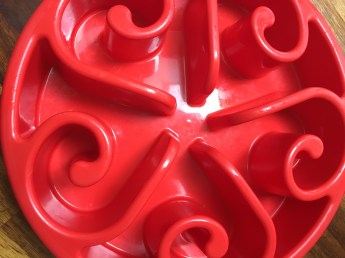
This ALDI slow feeder bowl is quite nice as there’s lots of space, just encouraging the dog to use their tongue, and hopefully not become too frustrated.
You can use the underside of this slow feeding bowl, as a mould or as a slow feeder too:
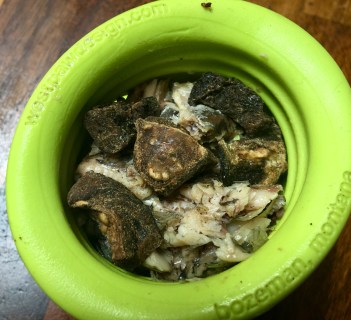
While these can certainly be used with kibble, to slow the enthusiastic eater, they also make excellent feeders to encourage lapping of soft foods. Raw feeders might prefer to feed raw diets in these, rather than in stuffable toys, as there will be less mess.
Adding kibble, with water or something to suspend it in, tinned foods, meats, mixes and so on and then freezing within slow feeders and alternatives can be fed in the container itself or tipped out to create a pupsicle.
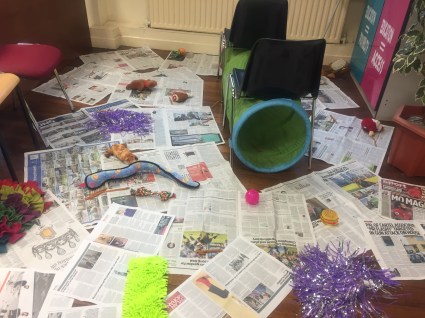
Foraging boxes are a great way to encourage snuffling and exploration, while using what ever safe and appropriate items you have to hand.
Day 31 gives you lots and lots of ideas from ballpit balls to bottles, from toilet roll tubes to toys.
Enrichment is for everyone
No matter the budget or your abilities, there are lots of simple and cheap ways to enrich and entertain.
Charities such as rescues can start a donation campaign for enrichment devices and pet owners can go through your pet’s toys regularly to see what could be donated to a rescue organisation or another needy pet owner.
Add your best budget ideas too so we can all benefit from our community by putting our heads together!
It has long been touted that a dog’s walk, The Walk, was an important event, allowing the dog’s owner to assert their ‘dominance’ and implement all-important control. But, really, there is no social significance to exerting such control on walks and outings.
For most dogs, while walks and outings are certainly significant events, getting out of the house or garden is limited. Most pet dogs have very limited access to the outside world – their humans work long hours, weather is so often unpleasant, their dog’s behaviour might be difficult, and so on.
Earlier this year, a survey from Forthglade dog food revealed that over half of the pet dogs, whose owners had responded, didn’t get a daily outing. While I don’t believe traditional dog walks to be the be-all-and-end-all, and in some cases they are not appropriate for individual dogs, my concern is that it is terribly unlikely, unfortunately, that these dogs have sufficient appropriate enrichment in place to make up for the lack of outings. And in addition to outings, which is also important.
In my experience, and that of many of my colleagues, the bottom line is that most pet dogs don’t get sufficient appropriate enrichment and entertainment. (This impending pet dog welfare crisis is the subject for another post, and a topic I discuss often.)
Choice and choosing features big throughout #100daysofenrichment. In the modern study of captive animal behaviour, it is recognised that opportunities to choose what happens to them allows animals to feel more confident and reduces the stress of captive living.
At the very heart of what makes an activity enriching or not, is how the animal chooses to interact, how they choose to engage, and the behaviours they choose to use. Without choice, enrichment isn’t enriching.
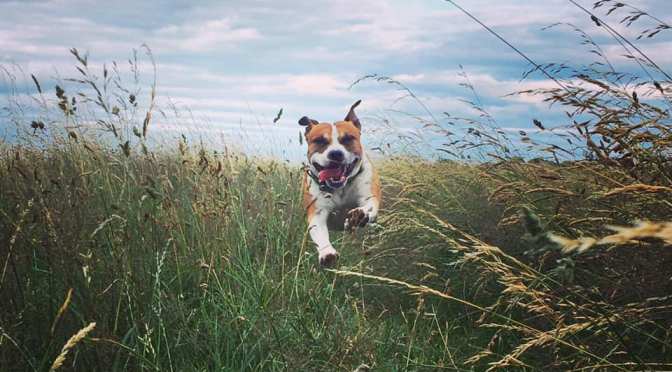
Here’s some clips of recent outings with Decker. There are lots of trails established in the long grass, some mechanically but most just by human and animal activity, as we meander about.
About a month ago, Decker seriously injured his foot and as part of recovery, we’ve been gradually building his exercise back up after almost 3 weeks of next to no activity. This includes walks/trots on lead so that he takes it somewhat easy. We are in the Phoenix Park, which is the most wonderful facility, and there are lots of these crosses eeked out in the long, summer grass.
I have no idea what criteria he uses to choose but you can see him actively consider the best route to take. But it doesn’t matter. How or why he chooses isn’t my business.
Case in point, here he is choosing a specific tennis ball from his collection. 11 identical balls but one is special…
It is not possible to give dogs unlimited choice and often times, if dogs were left to choose in some contexts, they would not make appropriate, safe choices because dogs.
But there are lots of significant ways that we can add choice to their lives, so that they can get a little say in their day, in what happens to them, in their enjoyment.
What can you do to add choice to your dog’s outings?
Can they choose the direction, the location, the activities, the twists and turns, how long they stay..? What else?
After all, there’s no point following my nose…that would not be a fun dog-outing at all! The dog’s nose knows so let them choose what to do with it, every day.
Where will your dog’s nose bring you today?
Make dog walks more dog
Dog walks don’t have to be elaborate or even lengthy. We just need to make sure they are more dog!
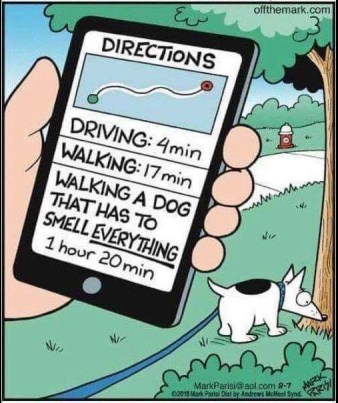
#100daysofenrichment emphasises making sure that sniffing and other doggie pursuits are central so that outings are more about quality than quantity…time spent sniffing is never a waste so go for a SNIFF instead of a walk:
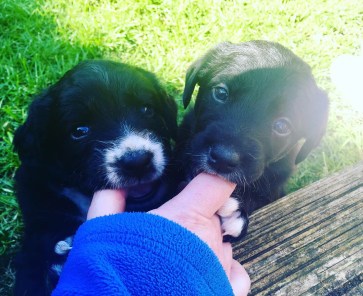
Almost consistently, puppy owners will want help with puppy biting & nipping behaviour (including foot chasing) and toilet training. Although they will understandably have lots of concerns and questions, those top the polls.
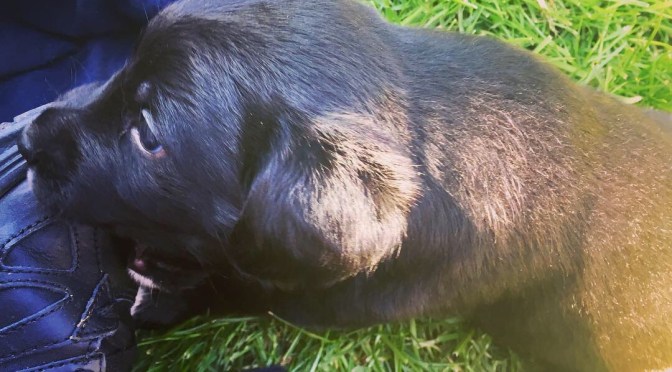
Most puppies, by the time I see them, will show well established foot biting/chasing behaviour. But, this behaviour didn’t start in their new home; swinging out of conspecifics is a normal part of puppy-puppy and puppy-dog interactions. When they go home, that comes to an end so human feet become a clear favourite.
While this behaviour isn’t terribly concerning in terms of the dog becoming ‘aggressive’ as an adult, it’s irritating and possibly dangerous (in tripping someone up), plus might indicate puppy needs help with managing internal conflict and arousal.
Your Toolbox
No one tool alone is going to resolve this, or any other unwanted behaviour, but, rather, a variety of tools that are best applied in different contexts.
STOP making it fun!
When you move, squeal and pull your foot back, this is likely to add to the fun puppy is having…you are basically acting like a dog toy…
Puppy is getting lots of jollies out of this – getting to bite, chew and rag your feet, shoes, slippers or trousers gives puppy an outlet for their excitement, providing relief from stress (feeling wound up) and soon this game becomes the source of fun in and of itself.
When puppy approaches, stop moving. Be boring.
While this might be most effective for puppies whose behaviour isn’t really well established, it also stops a seasoned-foot-biter getting any further pay off.
Redirect their focus.
You’ve stopped moving. The little monkey is swinging out of your trouser leg or dressing gown strap. Now what?
Puppies are pretty easy to distract so make a fuss about something else.
Pretend to be embroiled in a very interesting imaginary task, complete with lots of ooohs and aaaahs, rustling of packaging, moving of items, tapping of surfaces.
Very often puppy will be enticed and wonder what you are up to.
Now you will be able to redirect puppy to a different activity by, for example, tossing some kibble onto the floor for searching, toss a treat or chew into another room, throw or wiggle their toy. Once they have moved away and forgotten about foot chasing, you can engage them in another activity that will keep them busy a little longer while also helping them calm such as a stuffed toy, a sniffing game or chewing.
Provide them with an alternative outlet. All behaviour serves a purpose, meaning the dog is doing behaviour to get something they need. A puppy biting, chewing and ragging on something, especially in a greeting or exciting situation, is seeking an outlet for their excitement.
They might not be quite sure how to cope with a greeting or the associated excitement so may be experience some internal conflict, not sure how to proceed.
Have a long toy, ready to wriggly on the floor, as soon as you come in the door so that puppy has something to rag on and tug. (Clip below)
Spend lots of time playing with puppies in short two minute sessions, practicing tug & thank you. A typical tug session should look like this (clip link):
This not only encourages play between human and puppy, but you are also teaching puppy to respond even when excited and helping puppy learn to regulate their own excitement, before things become too crazy and bitey.
Change puppy’s expectations
Instead of expecting a big greeting and lots of foot chasing, help puppy’s expectations change to some other activity.
Practice coming in and out of confinement, in through a door or baby gate for example, presenting a different activity straight away. Puppy doesn’t even get to think about foot chasing. Toss food to move puppy away as soon as you enter and keep them sniffing and moving away as you move about. (Clip below)
Play FOLLOW ME! games, a lot
Follow Me! teaches puppy to walk close to you for food rewards. It’s a simple game that must be practiced often, even outside foot-chasing contexts. Puppy learns that there are other ways to get and keep your attention.
It’s simple. Stroll about and each time puppy catches up with you or walks beside you, stop and feed a small food reward. Puppy can earn an entire meal during practice for this one.
Puppy learns that you moving about doesn’t need to involve chasing or biting your feet and by rewarding very regularly initially, puppy is prevented from even thinking about it. (Clip below)
This simple and fun exercise quickly establishes a really nice walking position for awesome loose leash walking and builds an excellent level of engagement. Lots of benefits to this one!
In this clip we practice Follow-Me! with Klaus. He happens to offer a sit behaviour that is rewarded and from then on, he offers an auto-sit each time the human stops moving. While this isn’t required, it’s a nice side-effect of puppy learning to human train. From Klaus’ point of view, he’s learning to get the human to produce food rewards – he just sits (and looks cute) – irresistible! (Clip below)
teach LEAVE-IT! for feet or moving things
Help puppy learn that “leave it” means to reorient to their person, away from the moving thing, for a big pay-off.
Start by practicing in non-chasing scenarios and don’t make the moving thing too enticing to begin with. As soon as puppy looks toward it, say “leave it” and immediately offer a great reward. (Clip below)
You can work on mop chasing in the same way too, and apply ‘leave it’ with a toy to foot chasing. (Clip below)
Foot chasing and biting isn’t confined just to puppies; lots of adolescent dogs will do it too, often when greeting or going out for a walk. The excitement is more than their teenage brains are able for and biting is a neat way for them to channel that.
This usually is an initial response to getting out into the world, and soon dies down as the dog finds other forms of entertainment.
Use sniffing stations to get out the door – drop a few food rewards every couple of steps until you can get to an area where you can encourage your dog to sniff or engage in other activities.
Similarly, you could use a tug toy or other toy that the dog can carry or bite on. This can also help to redirect them from leash biting, which might be seen at the beginning of walks too.
Play the Go Find It! game on walks or in areas where the dog might redirect their excitement to biting or mouthing. This simple game can help to improve loose leash walking and engagement, while changing their motivations and helping to provide them with an outlet for their excitement.
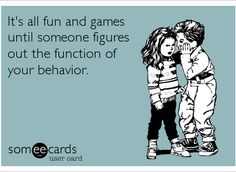
Behaviour functions for the behaver. This means that the animal is doing the behaviour to get things that they like or to avoid things they don’t like – dogs do behaviour that works for them!
Culturally, we are pretty obsessed with stopping behaviour we view as bad but to modify behaviour, stopping unwanted behaviour might be short sighted but often appeals to the quick-fix addicts.
Attempting to stop behaviour after the fact by, for example, administering punishers is so often too little too late. The dog has already got his jollies.
Instead we prevent the dog practicing behaviour we don’t like (practice makes perfect, after all!) so that we can clean the slate and establish new, alternative, more desired and ideally, incompatible behaviour.
To modify unwanted behaviour, we need to know the whens, whats and whys.
How does behaviour happen?
Dog training is generally thought to be about telling the dog to do something, using commands and making sure they’re followed through on.
While that satisfies a traditional attitude to our dogs, that’s not really what’s happening at all.
Dogs do behaviours that work. These behaviours work because things around the dog, in the environment, tell them to do a behaviour to access something or avoid something.
The things in the environment that tell the dog it’s the right time to do that behaviour are called antecedents (A) and the things they access as a result of doing the behaviour are called consequences (C).
When the A’s happen, the dog is getting prepared to do the behaviour and expecting a specific outcome. The A’s tell the dog to anticipate the availability of something the dog likes or to anticipate a way to avoid something they don’t like.
A little mention of management here, before we go on
The conditions in which behaviour happens, the A and the C, have nothing to do with the dog – they are in the environment. That’s why we say that behaviour is in the environment and not in the dog!
To stop behaviour, we must prevent the dog’s exposure to A’s and their access to C’s. That’s what management is – we stop the dog rehearsing behaviour by rearranging their environment.
Management clears the way for teaching and learning new and more desirable behaviour, providing a foundation upon which to build.
Consider the function of behaviour when teaching new behaviour
This is Ollie and one of his awesome humans. He’s a puppy and has been taught that tugging the mop is the BEST game ever. This commonly happens with puppy behaviours – they are cute and funny, providing endless entertainment for both species.
But the reality is that, in just a couple of short months, Ollie will be able to quickly destroy the mop as soon as it’s produced and that doesn’t make it so fun after all.
Over time, his mop-tugging behaviour has become very intense, more so than with toys.
Have a think about the A’s and C’s for this behaviour.
The C’s are pretty clear – there is a big pay off in getting to tug the mop; it moves and it’s soft and squishy, which are textures dogs often like to bite; this behaviour causes a surge in arousal with all the component neurochemicals causing him to feel good about it all.
Don’t forget the A’s! In dog training there is an inordinate amount of time devoted to discussion of C’s and not nearly enough about A’s and related factors.
As soon as Ollie’s human walks toward the mop, he is following and watching. You can see his excitement building with jumping up, trying to grab it, even vocalising.
He responds this way when in another room and can only hear the mop too! Ollie might just be a proper mop-addict!
He anticipates a whole lot of excitement when the mop comes out (you’re on your own there, Ollie!). This arousal means it’s really tricky to redirect his attention on to something else and to get him to let go of the mop.
As soon as the mop comes out, Ollie is geared up for some tugging – that behaviour functions for him, providing an outlet for his excitement. If we just take that away, in that context (ABC), where does that excitement go?
Our goal in modifying behaviour is to teach a suitable alternative behaviour – what would we prefer the dog to do?
But that behaviour needs to also plug the gap of the unwanted behaviour so that the dog still gets his jollies, just in a more appropriate manner. The new behaviour functions for the old, unwanted one.
Often times, in reward based training (or what ever label you care to use), we get hooked on throwing food rewards at new behaviour without considering that there was a real need there, on the part of our learner, and a real function being satisfied.
When we remove that outlet for that animal, we may be effectively suppressing behaviour but because we are reinforcing a more desired behaviour, often with food, we think that’s ok. And it might be.
But, our training plans must include consideration for the function of unwanted behaviour, ensuring that those functions are satisfied.
(Want to learn more about this? Check out this introduction to the A-B-Cs of Behaviour webinar for the tools to design training plans. )
For Ollie, we will tick lots of these boxes, with the help of his awesome family:
no mopping when Ollie is around – management
short one to two minute training sessions of ‘leave the mop’ exercise in the clip above – he learns that he gets his tugging jollies when he hears “leave it” and that the mop coming out makes his toy available for tugging…we are switching up those A’s and C’s
continued practice on play and tugging in other contexts too to really get some control and responsiveness built in
plenty of outlets for normal puppy behaviour in lots of different ways throughout the day (#100daysofenrichment is great for puppies too!)
As we move forward, we can start to build other alternative behaviours into this context; for example, the mop coming out means crate time or garden time with a yummy stuffable or sniffing game.
And we might use some strategies that have been successful with less intense mop chasers too.
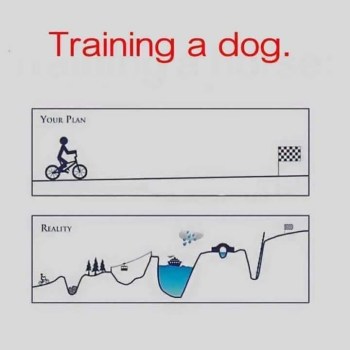
Ultimately, the presentation of the mop will mean chill out over there but first we gotta make sure he’s getting what he needs out of this mop business. Training is a journey, not a destination, and we’re in it for the long haul!
#100daysofenrichment was never meant to be a standalone thing. The exercises were designed to allow you incorporate them into your daily activities with your dog.
Our Facebook group, which you can still join btw, is great for showing how participants have assimilated lots of the days’ challenges into their every day lives.
After all, #100daysofenrichment isn’t just for #100daysofenrichment 😉
Decker on Injury Rest
Last week, Decker really ripped open a toe-pad on his front left. Pad skin is keratinised so is tricky to suture and takes a loooooong time to heal and harden again. The wound is probably too severe for suturing, so I am dressing it every second day, keeping it padded and booted and making sure he rests it.
Weeks of injury rest is hard for any dog, and their humans. Luckily Decker is a lazy dog in a crazy dog’s body and we have practiced for rest periods like this, being bored, so he’s pretty straight forward when it comes to just hanging out.
Happily, the wound looks good, he’s on lots of pain relief and is, as always, in great form and happy about life. We appreciate your healing thoughts on this one so we can get back to swimming and adventure time, before the summer is over for another year.
As you can tell, he’s super stressed by all this rest-business…this is definitely harder for me than him!
#100daysofenrichment is perfect for injury rest! Decker has lots of these challenges in his daily life anyway, so with a little adjustment, I can keep him busy and entertained even though he can’t do a whole lot of physical exercise.
Here’s a clip of one of our day’s activities, split across lots of short sessions over the day so he can rest his foot too.
Dog’s Trust Ireland’s Dogs Do #100daysofenrichment
Dogs might have limited access to enriching activities and environments by virtue of living in a shelter or kennel facility.
The Dogs Trust Ireland dogs are lucky to have wonderful carers who participated in #100daysofenrichment and who continue to do the best for these dogs by brightening their days with challenging fun and brain games.
A big and special thanks to canine carer extraordinaire, Cheryl Monaghan, who tirelessly brings #100days challenges to these dogs awaiting their homes, and shares their joy in our Facebook group and in this fantastic video:
It might be strange for a dog trainer to say this, but I’m just not that impressed by obedience, by trainers barking out “commands”, with compliance and with expectations that their dog should obey.
Don’t get me wrong, I love watching a trainer with slick mechanics work (and I especially LOVE the joy in their learner) or watching some really cool antecedent arrangement (management or setting the learner up for success); that definitely floats my boat.
Relationship and engagement produced through that is awesome, but superficial obedience and blind compliance; nope, not for me.
But, it’s easy to see why many will be enamoured by it.
I get it, pet owners want an easy life; we want dogs to slot into our busy lives and we certainly don’t want our dogs’ behaviour to embarrass us…after all, there are no such things as “bad” dogs, just “bad” owners, right?!
Maybe it’s the shame or dread of shaming.
Maybe we are still stuck in our cultural attitude toward our relationship with dogs; us in control and them being subservient.
Maybe we get our jollies by being in control, or certainly perceiving that we are in control.
Whatever’s behind it, understanding the time and place for obedience is important. Obedience isn’t the be all and end all, and sometimes it’s not what we have and it’s not what is needed.
Is it really obedience? Or is it just suppression?
In general, pet owners want to be able to stop their dog doing unwanted behaviour. When we think of obedience, this is often what we are thinking of…how do I stop my dog jumping, lunging, pulling barking… or whatever.
If that’s how you’re approaching this, you might already be off on the wrong foot. Behaviour doesn’t really go away; learning means that neural pathways are established in the brain and that’s not really undone. Instead, we develop new neural pathways that produce alternative behaviours and we strengthen those, with repetition, so that new, alternative, and hopefully more desirable behaviour, is established.
Punishers suppress behaviours but teaching alternative behaviour is the real key to success. That means that stopping the dog practicing unwanted behaviour (to prevent further establishment) while reinforcing desired behaviour is the solution to training problems.
Despite that, a whole range of products, equipment and ‘miracle cures’ are available designed to suppress behaviour. Indeed, that’s what most training tools do. Suppress rather than teach.
Those tools or techniques that cause the learner stress through fear, discomfort, pain, act to not just stop behaviour but to suppress it, convincing the dog that the world isn’t safe and that they better not step out of line. This looks like an animal who is quiet and tolerant, even calm. They stop offering behaviour. They effectively shut-down the weight of the stress being so great.
This clip, from Eileen And Dogs, shows some examples of dogs who appear biddable, well-behaved and even calm. But, look closely.
These dogs are still and frozen, moving or behaving very little. That’s what’s not right here – these dogs are not behaving as they would normally. Their normal responses are inhibited by the stress they are experiencing.
I can see why this might appeal. Look how little these dogs are doing. Look how quick we got compliance.
But this isn’t real life. This is TV-training. And dogs are not robots. They are responsive, sentient, learning beings for whom it’s normal to react and interact. And when that’s not happening, something not’s right.
Is it really obedience? How do we really get obedience?
What most people think of as training, or at least, as trained behaviours is probably not what they have at all. That’s because achieving a truly trained behaviour is not an easy thing. Simple, yes. Easy, no.
In dog training, we use the term ‘under stimulus control’ to describe a behaviour that is well established in response to a cue in a range of contexts (might be a word, body position or movement and so on).
A behaviour is under stimulus control when the learner responds to the cue quickly and efficiently, every time, the learner doesn’t offer that behaviour when not cued, the behaviour isn’t offering that behaviour when a different cue is presented, and other behaviours are not offered in response to that cue.
It’s also commonly presumed that the dog is responding to the verbal cue you use (“sit” or “down”), and even that’s in doubt with dogs being more likely to learn about contexts and your body movements than the words we use. (D’Aniello et al, 2016) (D’Aniello et al, 2017)
You might like to check out Dr Dunbar’s SIT TEST which asks, “does your dog really know sit?”.
Of course, we probably don’t want or need rigid stimulus control in a lot of pet-dog contexts; we want to be able to say certain words in certain contexts and not have to contest with a responsive dog throwing behaviours at us.
Truth is, it’s vastly underestimated just how much repetition and consistent practice is required for dogs (and humans) to establish behaviour reliably. And then you add distractions into that and we need MORE work. The magic number of 10,000 reps is often used to help illustrate this challenge and while that can vary, to help your dog perform behaviour on cue in a range of circumstances is a big ask.
Sometimes, obedience is just not the answer
Obedience can actually get in the way of what we want to achieve with our dogs, in some situations. And this is especially true if obedience is being held above all else.
Feelings first
Your dog is using his behaviour in an attempt to cope with the goings on and it’s a very honest account. It’s telling you how well your dog is coping, or not. Your dog’s behaviour is information.
If your dog is feeling distressed or worried in a particular context, his behaviour will let you know. When stressed, the brain is generally looking for a way out – how to get the body out of that stressful situation.
That means that behaviour will be related to getting away, escaping or delaying social interaction or to scare something away.
Attempts to distract, redirect or correct the dog’s behaviour will often rely on obedience – the dog is told to sit, the dog is verbally intimidated or is restrained in place.
For the most part, if the dog is trying to get distance, give it to him. Not being able to get away from something scary or overwhelming makes it more scary.
We are concerned with feelings right now – if the dog is stressed, not allowing him escape will increase that stress.
Better feelings bring better behaviour.
But the opposite can happen too – better behaviour will bring about better feelings. In this context, we might get the dog that distance they crave when they are showing only mildly concerned behaviour. Calmer, quieter, more polite social behaviour gets you distance – crazy dog behaviour not required.
The problem with sit
It’s good to review, to critique and we are doing that quite a bit in dog training right now. One question we might ask is, why do we teach dogs to sit?
Sitting isn’t really a favoured position by dogs, in natural situations. They tend to sit mostly when they aren’t sure about something (we often call this information gathering) and they might tuck their bums in a sitting motion should they be uncomfortable with something around their back end, such as another dog sniffing them.
Associating sit with amazing rewards and being careful when we ask for sits will go a long way to keeping it positive and happy. But, when we don’t establish this, sitting, when asked, may not be a pleasant situation for your dog at all.
Obedience classes in the face of fear
A training class will be full of people and other dogs, in a confined space, around lots of high value resources, with everyone on lead and a little tense.
Such is the understanding of the application of obedience, on a pretty regular basis, I will discuss this with a client who wants to bring their dog to an obedience class to help with behaviour related to fear, shyness, aggression, “reactivity”.
Putting those dogs in such an environment means that they will have difficulty moving away, achieving distance and gaining relief. And while their behaviour may be suppressed in this situation, so they appear tolerant, it’s probably not helping them feel better about being in close proximity with triggers.
What’s that dog really learning about triggers? How does that experience make that dog feel?
Obedience is not a priority for puppies
This by far one of my biggest bug bears – we have tons of time to teach puppies to come when called and walk nicely on lead, but such limited time to help them develop comfort and confidence.
Before puppy learns the rules of obedience, they need to learn the workings of their world. Obedience and even food rewards can mask puppy’s experience of their world around them at the most important time for them to experience that world.
Puppies must develop life skills, rather than obedience behaviours. Life skills build on behavioural tendencies partly inherited and affected by their first weeks of life, and by the time they go to their new homes we are rushing to make sure we make much progress as adolescence looms.
I wish puppy owners would spend time bringing their puppies every where, going for car trips, people and dog watching, helping puppy develop comfort with handling, grooming and husbandry, learning to play and engage with their humans, and being able to settle in confinement. If that was the priority, I would see far fewer dogs later on for behaviour work, that’s for sure.
Getting puppies out into the world and guiding their pet owners is the central focus of AniEd puppy programs.
Puppies learn to choose their humans, when they’re ready and they have finished taking in all the information they need to be comfortable; SNIFF, EXPLORE, OBSERVE.
Engaging with their people becomes a cue or signal from puppy that they are comfortable and confident with the situation.
The beauty of this comfort-first-obedience-later approach is that you get really cool engagement and even obedience as a side effect, without much extra effort.
Think comfort first – if the dog is comfortable, their behaviour will follow and we can build obedience behaviours into that, if you like.
Make dog walks more dog
A simple way to reduce the pressure and add a little more dog to your dog’s life is to re-think your dog’s walks.
When it’s safe, let your dog be a dog. Let him sniff (and sniff and sniff and sniff and sniff…), let him wander and roam (safely), let them roll and dig.
Take the pressure off, loosen the lead, prioritise quality over quantity, don’t get hung up on walking in front. Obedience doesn’t need to be front and centre when you take your dog out.
You’re dog’s not broken. You don’t need to fix him.
All behaviour functions for the animal. Generally, dogs are doing behaviour that gets them things they like and allows them to avoid things they don’t like.
Your dog’s behaviour isn’t and can’t be “bad”. It’s just behaviour.
Most of the unwanted behaviours that dogs do, are normal dog behaviours. Behaviours that dogs need to do. That are inbuilt and part of the package.
We have made arbitrary rules about the sorts of dog behaviours we like and don’t like. Dogs don’t know about that until we try to reshape their experience with human-imposed-obedience.
Dogs must get to be dogs. Meeting their needs will provide a better more solid foundation for appropriate behaviour than obedience alone.
Dogs are not robots. Sometimes they can’t obey.
Obedience is a human made construct based on our arbitrary rules for how dogs should behave in the human world. The dog is often the last to find out about it.
When a dog can’t or doesn’t comply, the first thing I look at is the environment. Remember, behaviour is in the environment, not in the dog.
The environment is causing the dog discomfort and for obedience, there first must be comfort.
Maybe the goings on are causing the dog to feel over excited, worried, cold or too hot, maybe they are conflicted or distracted.
Maybe our training isn’t so hot, maybe we just are not close to sufficient stimulus control so your dog doesn’t know how to respond in these new or overwhelming conditions.
Sometimes stress looks a lot like disobedience.
None of it is deliberate or willful. Behaviour is information. Listen.
If you want to really train, look at your dog’s environment and change it up so that the behaviour you like is going to happen.
What do we do instead?
I’m not suggesting that there is no place for obedience training, teaching behaviours and improving your dog’s manners. Training is happening all the time, regardless of what you call it or how much you consciously participate. Your dog is learning how to get the good things and avoid the bad things all day, every day.
Training just aims to make sure that the behaviours produced are ones we like.
While it might seem like semantics, I suggest a mind shift might be considered. Instead of aiming for compliance and obedience, think about willing engagement, think about providing your dog with guidance in experiencing their world, think about letting your dog be a dog.
Sure, training is still happening but instead of it being obedience led, we can let it be a little more dog-led.
This doesn’t get you off the hook. I do think that most pet dogs need better guidance from their human partners. They need better and more outlets for their behaviour. They need more help learning to just be with their humans.
Your job is still to set your dog up for success, to arrange their environment so that they are safe, and to make sure they have outlets for their behaviour, constructing that foundation.
We can provide all that, while getting joyful and willing engagement from our dogs, without ever mentioning the O-word.
Moving to this mindset is what’s behind #100daysofenrichment – an entire ‘training’ manual without mentioning or prioritising obedience once.
We often talk about it, setting the learner up for success…but what does it mean?
Traditionally, we think of ‘training’ as being about barking out “commands” and showing ’em who’s boss but now that we have a better understanding of animal behaviour and learning, that approach is redundant.
Behaviour is in the environment
That’s another one we say a lot: behaviour is in the environment, not in the dog. Behaviour doesn’t happen in isolation; your dog does behaviour in certain conditions. These are the Whens and Whys of behaviour.
When does your dog do a behaviour (any behaviour)?
Who’s present? What’s just happened? Where are you? What have you just done? Any and all of those things might cause or trigger behaviour.
Why does your dog do a behaviour (any behaviour)?
What does your dog get after a behaviour? What does your dog get away from after a behaviour? Any and all of those things might be the reason he does it.
Behaviour happens in certain conditions for certain outcomes. Dogs do behaviours that work!
Teaching our dogs involves us setting up the whens and whys so they are less likely to do unwanted behaviour and to make it easier for them to behaviours we like. That’s setting them up for success!
Your dog’s behaviour is information
Unwanted behaviour, for the most part, is normal dog behaviour. We’ve generally put our dog in a situation that makes inappropriate behaviour happen.
We haven’t set them up for success.
That means our dog’s behaviour, whether appropriate or not, is information about how well they are able for that situation. Training gives your dogs the coping skills (behaviours) needed to deal with the environmental situations we put them in.
Your dog’s behaviour in a situation, gives you information about how well you have prepared them, or not.
Puppy Party
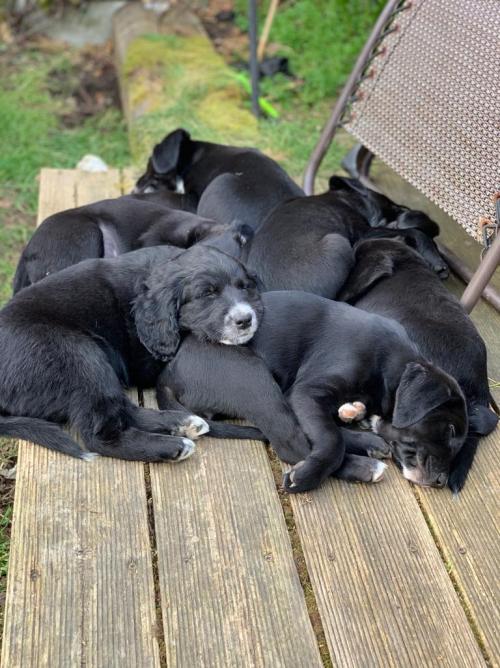
Follow the progress of Bonnie’s babies on our Facebook page. We have been working with these six puppies who were born while their mum was in the care of A Dog’s Life. Bonnie’s babies, and Bonnie their mum, have been in a wonderful foster home, learning about life in the human world and getting ready for going to their new families.
At about 6.5 weeks of age, they came for a puppy party with a community petcare course I was delivering. This was their first big outing, away from their home and away from their mum. A BIG challenge for such young puppies that meant a longer car journey, crate confinement, a new place, lots of new people and all new sensory overload.
No such thing as “bad” behaviour
Living with humans, for dogs, is tough. We have made arbitrary rules about what behaviour is acceptable or not. Dogs are born with a ton of in-built behaviours that humans, for the most part, don’t like. We humans have come up with all sorts of inventive and aversive means to suppress this unwanted dog behaviour under the guise of asserting that we are in charge and attempting to mould them to conform to our preferences.
You would expect that bringing six young puppies to a school environment would cause all sorts of chaos and put them in situations that allow for lots of mischief that people find inappropriate, and we might not want them to practice.
This is where setting them up for success comes in…
Adjust the picture
Knowing all this means it’s my responsibility to help them cope. At just over six weeks, we can’t really expect these puppies to have many skills, but we have been preparing them by bringing them on short car trips, spending some time in crate confinement, meeting lots of new people and spending time away from their mum.
Training and appropriate exposure helps to set the scene and set them up for success by adjusting the picture so each puppy is better able to choose appropriate behaviour.
Behaviours of concern: distress related behaviour while confined in their crate during the journey there such as vocalisation, attempts to escape, squabbling with siblings
Whens: in the car, longer duration of confinement, intermittent stopping and starting in rush-hour traffic
Whys: frustration at being confined, wanting to move about, wanting to move away from siblings, wanting comfort or contact with human, needing to toilet, hunger
Setting them up for success:
puppies were brought to an area where they toilet before travelling
puppies were brought to an area where they play before travelling so they were just getting ready to sleep as we left
puppies were given their breakfast shortly before the opportunity to toilet
I set the crate up in the car before bringing them out – the crate was lined with puppy pads so it wasn’t too slippy and was absorbent
one of may favourite puppy hacks is to smear the walls of the inside of the crate with something really yummy and irresistible
then I turn on the heat in the car, play classical music and we all bask in the calm!
Behaviours of concern: toileting every where, hiding or escaping, chewing stuff, getting in the way, being distressed in a new place and without mum
Whens: in a new place, without their mum, access to lots of space, after a period of confinement
Whys: exploration, having fun, reunite with mum, to toilet
Setting them up for success:
get set up before they come in
cordon off an area of the room securely and safely, away from the door, so people can come in and out easily without disturbing the puppies
set up a blanket and toys from home that will smell like mum and familiarity
have newspaper and puppy pads on the floor
lots of places to hide
plenty of novel objects too
high value chews and loaded snuffle mat to engage with as soon as they arrive, that will keep them busy while they take it all in and will help with calming
having more chews, food and toys available than there are puppies – this reduces competition
Behaviours of concern: behaviour associated with feeling overwhelmed at the new place and new people
Whens: once they arrive and are brought in
Whys: it’s all new and lots of new experiences lumped one on top of another can be pretty stressful
Setting them up for success:
getting everything ready before bringing the puppies in
allowing them plenty of time to settle and find their feet before all the new people arrive
giving them time to choose how and when they interact with the environment and the people
By the time puppies had explored and chewed, toileted and played, they were ready for another nap so were pretty sleepy when everyone began to arrive, and soon nodded off.
Behaviours of concern: vocalising, biting, chewing, jumping up, making strange and hiding
Whens: all the people are present, new place and new people, just woken up
Whys: experiencing distress or startle, to escape social interaction, hungry and wanting food, to toilet or to sleep
Setting them up for success:
allowing them to wake naturally
having food and space to toilet available immediately upon waking
more stuffed Kongs than puppies
having attendees sit back and allow puppies to choose to interact
no picking up the puppies
giving clear instruction
teaching attendees how to interact (rather than emphasising how not to) and providing them with new skills and awareness
allowing puppies to choose how and when they engage and interact
The puppies had a great time with minimal stress for everyone. We had peaceful car journeys, they coped amazingly well with being in a new and weird environment, they were friendly and outgoing with everyone and then slept all the way home!
Bonnie’s babies are ten weeks next Thursday and will be getting their second vaccination. By the weekend they will be ready to go to their homes. If you would like to add a fantastic companion to your family, get in touch with A Dog’s Life.
How can you set your dog up for success? What the behaviours you might be concerned about? What are the relevant whens and whys? How can you prepare your dog with behaviours for coping and how can you adjust the picture so it’s easy for them to choose appropriate behaviour?
#100daysofenrichment may be officially over, but that doesn’t mean the enrichment needs to stop.
Easter Egg boxes make GREAT puzzle boxes for different Busy Boxes…you’ll have to eat all the Easter Eggs so…
Make sure to keep the chocolate away from pets and if you have had a real Easter Egg hunt, make sure that you have cleared away all the eggs before allowing your dog access.
Instead, set up an Easter Puzzle Hunt for them!
Just because it’s Day 101, doesn’t mean the enrichment has to stop!
You make #100days what it is
I never anticipated that this little project, from our little company, would reach so far and generate so much interest. But it did. And that’s down to you and your participation and support.
I can’t thank you enough for getting involved, sharing, and for providing feedback. The messages and comments of gratitude, letting me know how you and your pet have benefited has been the most amazing reinforcement. Throughout, it’s kept me going, striving to produce the best resources with the most information.
I have enjoyed every moment of the community aspect of this project; seeing how you have applied the challenges, how you have made adjustments to suit you and your companion, and most of all, watching pets engage in enrichment activities in a truly enriching manner.
That’s all you. Thank you.
Start on Day 101
The hope of any #100day project is that participation helps to establish long lasting habits, beyond the one hundred days. You can continue to incorporate any or many of the challenges into your daily lives with your companion animals.
you might pick challenges or days that are particularly valuable and enjoyable to you and your pet
think of challenges that are about just being and living with your pet – lots of those involving just being and providing choice might be good considerations
go back and start at Day 1 all over again
each day’s challenges provide multiple options so you might go back and do an alternative challenge from each day
Whatever way you plan to do it, please do keep doing it.
Keep going
The blogs, as is, will remain in place so you can dip in and out or even start again. New people might like to join in or lurkers might like to get stuck in and really have a go at it.