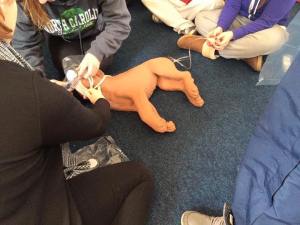
Baby on the way? Or even potentially on the way? Get preparing and to start you off here is an excellent piece from Family Paws: Carry a doll? Should we practice?
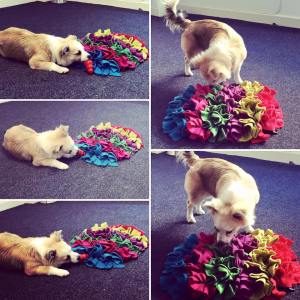
Such a simple but great way of providing enrichment for cats, and I am certain that some dogs would enjoy this too, maybe with bigger and even stiffer bristles:
Playing with your dog is incredibly important in terms of developing and maintaining your relationship and there has been a little bit of work looking at dog-human play; here’s a covering of recent work in this area highlighting some of the best ways to play!
This week we had lots of applicants in for interview, well more of a chat really, for our new Canine Behaviour & Training Technician program that’s starting next month. CBTT7 will be starting soon and we can’t wait!
Awesome Pets & their People
Molly was back for more Daytraining this week and we were able to achieve more polite leash walking in new areas with much improved responsiveness and reduced vigilance from Molly!
Help your dog pass major triggers, when there’s no other way, like a large dog in a window (only a couple of metres from the pathway) barking at us, as is the case here:
Once we can surprise Ralph with his new recall cue when he’s mildly distracted, we can begin to build an approach and collar grab into our recall routine:
Not only does our new recall cue mean that the dog will always be rewarded, but also means that to access distractions they must recall first.
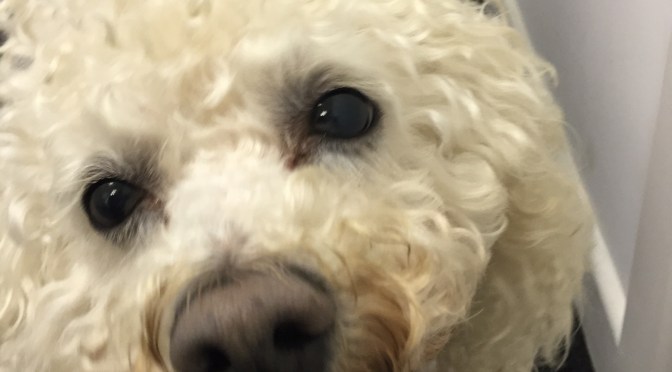
Lola came for some behaviour work – she is even more adorable in real life! She has spent much of her early life confined to a crate but is now in a great new home and we will be working through some behaviours to help her settle and better cope.
Teaching default sits is a great exercise – think of all the things that your dog can’t do if she’s sitting…!
More Canine First Responder course delivery this week for the Animal Care students of Ormonde College of Further Education, Kilkenny with everyone earning their certs and a greater understanding of what to do in an emergency.
This weekend, our CTI3 learners are back for their second weekend of tuition, working on Canine Health & Disease and Animal Learning & Applications.
They are working hard on learning about canine health, responsible ownership, disease and disease prevention, emergency care, environmental enrichment, learning theories, canine signaling, the effects of aversives and training techniques luring, capturing, targeting and freeshaping. They will certainly deserve their rest after all that!
Specific ingredients are often present in dog attacks to humans, the impact of many being preventable. This excellent piece looks at the building of a dangerous dog, in a pretty direct manner.
What would it look like if we treated other people we don’t know, like we do strange dogs? Would our expectations of dog behaviour change…?
We couldn’t blame these people for objecting to this harassment, yet may subject dogs to this and expect them not only to tolerate it, but to enjoy it. Not fair!
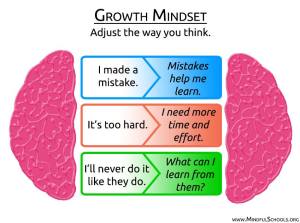
Reframing is key to many of life’s challenges, including some dog training challenges too: Training mindfully
Dogs have such an entwined relationship with humans that they have apparently evolved a heightened awareness for our emotional states:
Nail clipping is often dreaded by both people and pets, but just how important is cutting your dog’s nails, really?
Teach your dog to be more comfortable with nail clipping, rather than just managing their behaviour with help from this lovely clip:
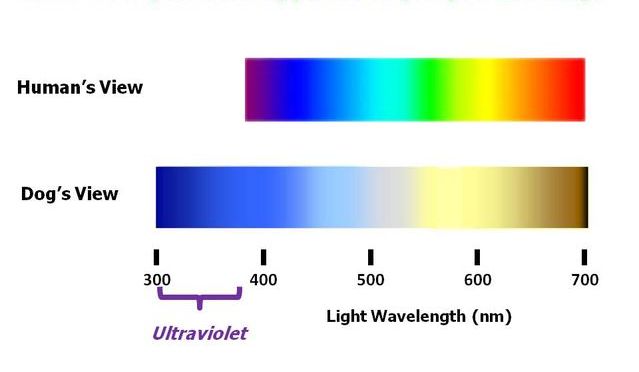
Just like humans, visual acuity in dogs declines with age but dogs are more likely to become nearsighted, according to a recently published report. This may account for changes in responsiveness and other behavioural responses. Summary of this work here.
And to keep that vet visit and treatment as stress-reduced as possible this post offers a wealth of resources on doing just that: Less stress at the vets for dogs and cats
A nice straight forward piece here, Are Muzzles Cruel?…let me give you a hint…NO!
Congratulations to Lucca, an explosives detection dog, receives the Dickin Award, after serving with the US Marine Corps in Iraq and Afghanistan and losing a leg – go Lucca!
Molly did some really fantastic work during Daytraining this week and we made lots of progress when we went for short walks – go Molly!
Molly – treat stalking level: expert
Here she practices Crate Games, 1, learning to settle in her crate, that polite behaviour gets her nice things and that rewards happen away from the door:
This stunner, Balto, came for some behaviour work and we put lots of new exercises in place to help him and his family.
Practice collar grab exercises with your dog everyday, even if you only do five reps at a time – it all adds up, helping your dog feel more comfortable with collar handling, a vital skill.
Make sure to go at your dog’s pace, listening to them to maintain comfort and safety.
Elvis, and his buddy Millie, came for a training session too and we worked on confinement comfort…but really needed to spend more time working on posing…or at least both looking at the camera at the same time…
Bella and Ruby came for a visit too. Bella has just been adopted and we want to make sure that these two girls learn to get along and develop a great friendship.
We looked at lots of the best ways to manage their behaviour with separation and careful integration so that we can avoid the rehearsal of any unwanted or inappropriate behaviour.
On walks we are going to practice lots of parallel walking so that the girls can become more comfortable with one another, in wide open space, without direct approach or contact, and while everything is moving.
Here’s a top tip: do you own an adolescent dog, a new dog, a puppy or a worried dog?
Bring treats with you on every walk. Any time you or your dog spot something concerning that causes your dog to alert, stop and watch your dog closely.
Each time your dog looks at the distraction, feed them a treat, one after another.
Soon your dog will begin to get the game and look at the distraction and then back at you (hey! where’s my treat?!). Your dog is learning that distractions mean to focus on their person – without you saying a thing!
If your dog reacts, vocalises, can’t take food or is unable to look away from the distraction, the situation may be too much for them. Get them out of there and try again, when further away.
Rua and Loki are quite a pair – full of life and mischief! They came for some behaviour work to help them cope better with stress, learn to settle when apart and make life easier for everyone!
Blurry tails!
Loki is learning to happily wear a muzzle right now; an important skill for all dogs.
We recommend this training program for helping dogs learn greater comfort with muzzling and taking your time so that they are comfortable with the feel of the muzzle on their face.
If your muzzle training reaches a bit of a lull or you want to give your dog some extra help, try adding this exercise:
Prince, such a cheeky chappie, came for some behaviour work too and is going to be learning all about crate training and handling comfort from now on!
An unexpected visitor
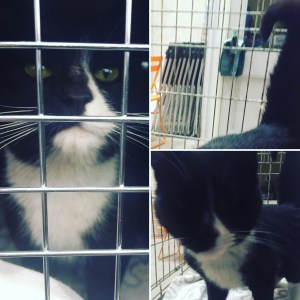
A very sweet and friendly cat, yes, a feline, found us and we soon made friends. He has no collar or chip, and is injured and quite skinny.
He is very comfortable with our handling and contact and had a yummy lunch, before we brought him to the vet for treatment.
We have a lovely rescue space all lined up for him, should no owner come forward, so hopefully he is on the road to recovery soon.
We have named him Ollie!
Although we didn’t introduce him to the dogs, to prevent any distress, Daisy and Dilis had a great time sniffing one of the blankets he slept on, giving it a very thorough going over!
Olfactory enrichment!
People Training
Today our CN4 group came for their last day of tuition on their Canine Nutrition course.
We covered lots and lots, with some great discussions on homemade and commercial diets, food and behaviour, dietary adverse reactions, obesity and dietary support and management for a range of conditions.
A busy day with Decker lending a hand because who better to tell us about canine nutrition than the dog himself!
AniEd Dogs
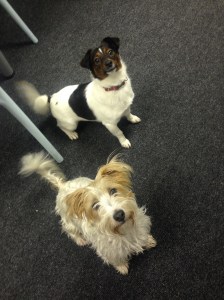
These four troublemakers had lots of fun being office dogs:
More woofing to make up for the lack of Woofs last week!
The fantastic Jessie is still looking for her forever home!
Detail of an amazing piece of work, run by Morris Animal Foundation since last year, involving 3000 Golden Retrievers and their owners hoping to shed more and more light on genetic disease, particularly related to cancers in these dogs, all dogs and people too: San Jose dogs, owners join DNA studies to help find cures
Bloat or GDV, is a scary and often fatal condition particularly affecting large dogs (especially Great Danes) and one long surrounded in mystery. Works commissioned in the last few years is progressing to provide more information on the possible genetic basis of this and related conditions; a summary of this fascinating and not yet published work here.
Never heard of bloat or not sure what it looks like? Check out this piece on identifying the signs of bloat.
Dogs who are trained for the highly stressful and difficult job of being an assistance dog are very carefully selected, produced, reared and trained – this is not a job that any or every dog can do; read the ups and downs of such a journey here.
When we keep dogs as pets they are living in a foreign land; take some time to learn a little about their communication behaviour (I am sure that you have noticed that they can read humans pretty well!):
But training/learning is for all species, in pretty much the same basic way, so here are some lions with an awesome recall and stationing behaviour: Recall
Older dogs require a little extra TLC to make sure they have the best quality of life for as long as possible: 6 Tips for Caring for Older Dogs
Just as it’s important to take care toward the end of your dog’s life, it’s also vital that great care be taken at the start of your dog’s like: Puppy 101
We have talked about the importance of looking beyond daily-walkies as a way of entertaining your dog here; this piece looks at this too, with some nice ideas included: What’s in a walk?
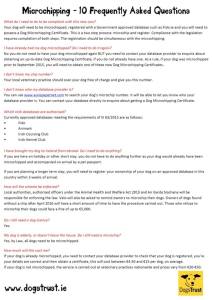
There seems to be continued confusion about microchipping which is now a legal requirement for all dogs.
We have updated our information post about microchipping several times as new information seems to slowly trickle down here and Dogs Trust Ireland have shared a Top 10 FAQs:
We also sent you a piece on a more balanced attitude to being a dog trainer, working at what should be your dream job…Somewhere in between
Awesome Pets & their People
Molly was back for more daytraining – she had lots of yummy Kongs and a lovely nap…
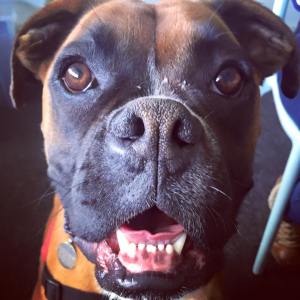
Gorgeous Boxer girl Bailey was back for a follow-up session:
She, and her people, have been doing so well that we signed off on Bailey’s case and they will continue to work to maintain our program. We will always be here to support them so hope to see them again.
Jessie from A Dog’s Life, now in a new foster, came for a session to make sure everyone is settling in well.
This stunning dog is looking for a new home; find out more about her here.
Mason, also from A Dog’s Life, has worked his magic on his foster family and they have now become his forever family – YAY!
He and his new sister, Lucy the Basset, are getting on great, with careful management by his people. Good news!
Elsie, who has just been adopted from A Dog’s Life, came for a session with her new family to help everyone settle in and get to know one another.
Moe cam back for his first follow-up, after initial consultation, and he and his people have made amazing progress. We were ready to do some stooge-dog work to help teach Moe alternative and more acceptable behaviours when he sees other dogs.
And then we had some fun with ball play!
Riley, the Tibetan Terrier puppy, came for his first session and had a great time learning how to train humans…
People Training
We have a new Canine Behaviour & Training Technician group starting soon and already have a list of applicants for interview. CBTT7 will be underway next month and we can’t wait to get the ball rolling. More here.
Don’t forget that we have Helen Zulch back for another weekend seminar/workshop in June! There is only one working space left for the Saturday and couple of spectator places on both days so you better sign up quick so that you don’t miss out!
More information here and on our Facebook event here.
AniEd Dogs
Zak cuddled up to the heat:
And the rest of them went to work:
Hopefully we have some more lovely Spring weather in the coming week…enjoy!
Dog training is a pretty dynamic and certainly dogmatic field, even more so with the popularity of social media and the speed with which information spreads.
With such strong views it is no surprise that attitudes to everything from education to ethics, and from techniques to terminology are often extreme and polarised. Balance truly is a dirty word in dog training…
…or wrong, for that matter!
A vocation and a career
Dog trainers often enter this area, first in hobby form or perhaps via working with their own pet and slowly will (hopefully) build on knowledge and skill to help develop a career.
But this area is not quite a profession just yet – our field is unregulated, with no minimum standards of education, experience, skill or knowledge.
The transition from passion to every-day-job can be difficult for others (and ourselves) to appreciate, leading to lots of less comfortable attitudes toward our work.
You say black, I say white
Just recently, this piece was published on a blog known for its pretty direct tone: Why being a dog trainer f***ing sucks and in response to that, several pieces on why being a dog trainer doesn’t suck…
And around and around we go.
(Please be warned, that the above linked piece contains some pretty strong language.)
The truth will set you free
Like any job, dog training will have ups and downs and those swings will come in cycles. It’s not always brilliant and it’s not always awful.
But we’re not in dog training for the big bucks and instead reap a range of other rewards.
Now, this isn’t a rant or a moan – we don’t work down coal mines or in third world conditions, but because AniEd spends a lot of its time, not only training dogs, also supporting new and developing dog trainers our concerns lie in building a professional industry, recognised and respected.
It is misleading to tell, especially new, dog trainers that all is rosy, and that you should always love your job, the dogs, the people. This is unrealistic for any area.
But it’s not always helpful to vent and rant either so middle-ground must be achieved.
Why is it so tough?
Well, truth be told, it’s not much tougher than lots of other jobs out there, especially those where you deal with lots of human clients.
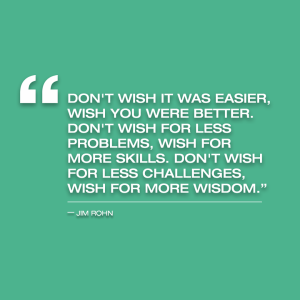
But, when you come into this field, your expectations can be a little high – it’s supposed to be a vocation, right? So that might set you up for a little bit of a crash & burn.
Challenges that dog trainers might face:
You might think you’re in the wrong place…
I don’t think there’s anyone out there who says to themselves that they would like to work with people, “so I’m going to become a dog trainer”.
But dog trainer is a misnomer – a whole lot of our work involves people-training.
It’s really “people” trainer…
Might help to:
– seek education in becoming a great people-trainer, emphasise this as part of your developing skill set
You spend a lot of time working alone, and much of your daily social contact is with dogs and clients.
It’s probably what you thought you wanted, but after a while it can become really lonely. And it can be particularly difficult if you have some emotional turmoil or you’re feeling a bit delicate – being alone with your thoughts can push you a little over the edge.
…or so you thought…
Might help to:
– engage in non-work related social activities regularly
– maybe even develop a new, non-job-like hobby
– generate a good support structure, someone you can call and have a chat with when you feel the loneliness creeping in
– develop an excellent support network among colleagues too
Your friends and family probably don’t get your job.
Because dog training is seen as a vocation and as something that “anyone can do“, it can be difficult for others close to you to truly understand that there may be complexities and difficulties.
But because of this attitude to our field, we have often put quite a bit of effort into talking-up dog training as a career so it can be uncomfortable to admit that sometimes it’s not what you had hoped for.
Might help to:
– be top of your game by reading, practicing, learning and developing
– realistically describe your job and its demands to non-doggie people
– promote our profession, by behaving in a professional manner
It’s a passion AND a job
Your hobby, passion and love becoming your career certainly sounds great but…
This makes it hard to break away – your day job is dogs but so is your spare time.
We often work largely from home and in other peoples’ homes so don’t have that threshold to cross and leave it all behind.
Really…?
Might help to:
– learn to compartmentalise
– hang out with your own dogs – you will really appreciate them!
– assign working hours, and don’t respond to job-stuff outside those hours
– develop very clear policies about client interactions, and establish those boundaries from the start
You got into this because you love dogs.
Dogs are pretty awesome. But sometimes they can, like anything, try your patience – it’s OK to concede that. You are human and a dog trainer.
What’s more, when many pet owners come to us it’s because their dog is causing them a big problem. It’s hard to empathise with them when you know that their behaviour is a major part of the problem, and they continue to vilify their dog.
That can inform your attitude to the human end of the leash.
Might help to:
– concentrate on behaviour – don’t take it personally, it’s just behaviour…even the human behaviour
– learn to empathise – a misguided pet owner is you x number of years ago
– at the same time though, learn to draw that line
Whether you like it or not, you are a people trainer.
It’s not just that humans pay the bills, it’s so much more than that. The welfare of the dog depends on your ability to communicate, instruct, counsel and teach that human.
One of the biggest frustrations is that people have seriously inflated expectations of dogs. This is reinforced by media coverage and by other dog-people.
Sharing stories about miraculous acts of canine kindness, promoting dogs as loving you more than they do themselves and attributing super-natural powers to dogs in terms of their abilities to save and support contributes to this. Dogs are awesome with out all that.
Unrealistic expectations lead to disappointment, which leads to poor motivation, leading to temptation to reach for quick fixes. That can feel pretty thankless sometimes.
Might help to:
– promote realistic, grounded education on all things dog
– help them to reframe their attitude
– facilitate dogs being dogs, and help pet owners appreciate that
– continue to develop excellent counselling skills
Dog training is simple, but it’s not easy (~ Bob Bailey)
Dog training involves mechanical skill that takes lots and lots and lots of practice, instructing and feedback to learn.
Pet owners are typically unskilled and we have the challenge of teaching them to teach their dogs. We might have been working on developing our skill level over years and years and even thousands of dogs.
Not only are we teaching the dog new behaviours, but the human too.
Might help to:
– be a really good do-er, before you become a teacher
– seek education in the mechanics – prioritise this because only from an in-depth understanding can you teach this to non-skilled pet owners
– apply dog training mechanics to teaching pet owners: provide feedback, split criteria and create a collaborative learning environment, that is conducive to learning
Good dog trainers are educated and invested.
The dog trainers who are going to truly advance our industry toward becoming a respected, regulated, standard-filled profession are educated, with both academic and experiential credentials. We learn about the appliance of science, how animals learn, how natural behaviour is shaped, how genetics interact with health and behaviour, how to construct meaningful training plans and how to teach both ends of the leash – and that’s just for starters.
We are living in the most exciting time that dog training has seen – in the last decade-ish, science has begun to really dig canine science and we get to reap the rewards of all this investigation.
The financial, time, emotional and physical commitments to our continued education will be pretty huge.
This is not a fly-by-the-seat-of-your-pants operation, or at least it shouldn’t be.
It is understandable, then, that when people belittle our efforts by not respecting our work, it’s going to hurt.
Might help to:
– promote professional conduct
– continue to invest in your education
– make sure your training does the talking
We only have ourselves to blame.
It can sometimes seem easy to blame pet owners. But this is the same blame that they might put on their dogs, frustrating us.
We have to be able to take on the responsibility for the human learning, just as the learning-human is taking on responsibility for their dog learning.
At the same time, and this is the tricky bit, we also have to know when we have done all we can do, step away and move on.
This is the hardest part.
Might help to:
– have support from colleagues with whom you can discuss cases, outcomes, ideas
– help people and their pets to the best of your ability
– work within your skill, competence level and remit
– know when to quit, when you have done all you can do (you’re not a magician)
– have an outlet for venting BUT please be careful with ranting and moaning – this can very quickly overwhelm you and inform your feelings and behaviour
I hate to say it, but other trainers can make life miserable.
Without consistent standards and a lack of professionalism, business and personal conduct can sometimes leave a lot to be desired.
This might manifest in bitching (pun intended), snarky comments made publicly, social media interactions, bad-mouthing, stealing clients, copying or misrepresenting ideas, logos, policies etc.Social media, as wonderful a tool as it can be, can also be a curse. It has encouraged almost religious following and the rise of gurus, with egos to match.
The boasting and bragging on social media can become tiresome and further raise expectations of this job – there is often a gap between reality-reality and social-media-reality.
Might help to:
– get off the computer!
– let your training do the talking
– don’t engage in trainer-bashing
– have supports and outlets outside of social media
– critically evaluate EVERYTHING
– choose your mentor wisely and avoid the hollow gurus
– allow for balance and don’t dismiss another trainer too easily – you can probably learn something from most trainers
Behavioural health is just as important as physical health.
This industry is young, and as of yet not well understood by many, even those in other related industries.
Spotting a dog who is in physical pain may be easier for others to spot and appreciate; somewhat invisible behavioural suffering is a harder sell.
Most of our starter dog trainers, don’t earn from their new career right away. Instead they supplement their earnings from within or outside of the animal care industry. Many will develop the dog walking, pet sitting, boarding sides of their businesses first, adding training as it grows.
Even though nobody would deny the importance of early and continued education for children, it’s not a given for puppies and dogs.
Might help to:
– forge great relationships with veterinary staff, groomers, pet shops and other stakeholders
– promote proper socialisation practices for puppies
– engage with breeders and rescue organisations, and other sources for dogs
Training is about relationships
Developing positive attitudes and relationships is our most important function.
We do that via the dog-pet owner relationship, via the pet owner-trainer relationship, via the dog-trainer relationship, via the dog-society relationship, via trainer-trainer relationships and via trainers-society relationships. No pressure then!
We must take care with the ease with which we can facilitate more confrontational relationships with people (pet owners and professionals alike).
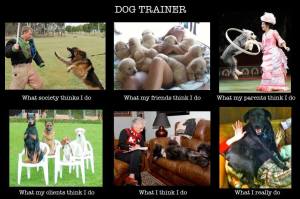
Outlets such as this and this, are understandably borne out of frustration and funny, but how helpful are they, really?
I love my job
When I say that I am not exaggerating, I truly love my job.
But some days I am exhausted, frustrated, feel helpless and it’s OK to acknowledge that.
Identifying that helps me to reframe and work out where I need to make changes.
I really do!
When you lack that clarity, you can’t see the wood for the trees, you need help. Compassion fatigue and burnout have been highlighted in animal care of late, and dog training and behaviour work bare all the hallmarks, making us susceptible too.
If your mental health is suffering, you are helping nobody. Ask for help. Always ask for help.
More on compassion fatigue and mental health here and here.













![XUDN6892[1]](https://aniedireland.com/wp-content/uploads/2016/04/xudn68921.jpg?w=300&h=300)























 AniEd Ireland